




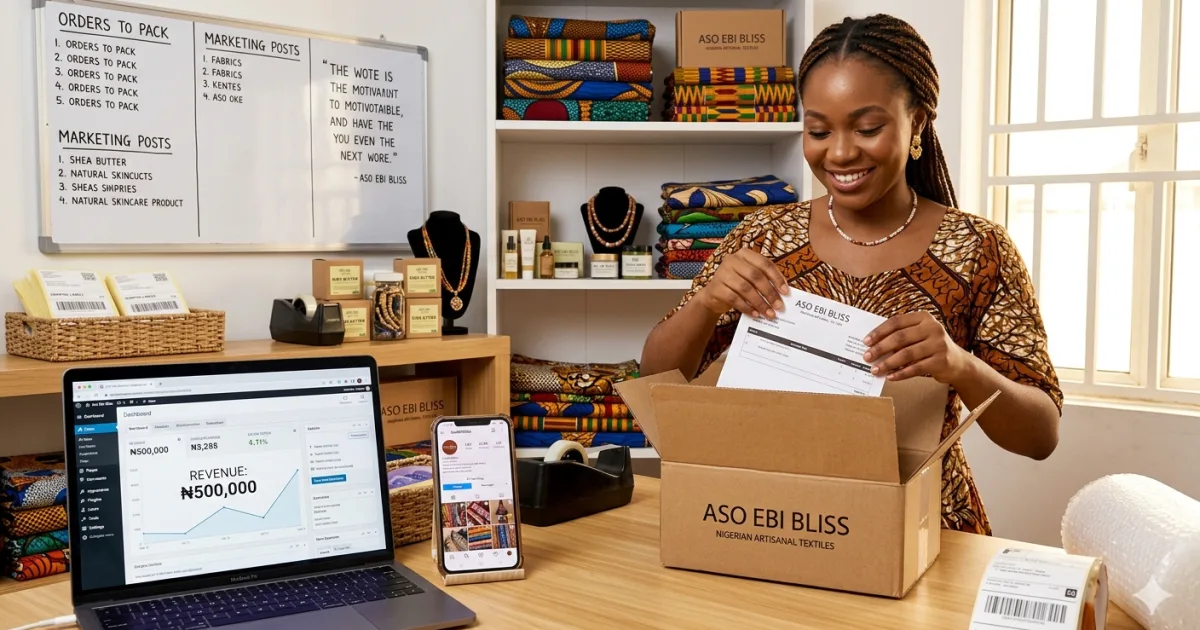
Nigeria’s e-commerce market crossed $7 billion in 2025 and is growing strongly into 2026 — fuelled by expanding internet access, mobile payment adoption, growing consumer trust in online transactions, and a young, digitally active population that increasingly prefers buying online. Jumia and Konga remain dominant marketplace platforms, but they do not tell the whole story. The most financially rewarding story is being written by thousands of individual Nigerian entrepreneurs who have built six- and seven-figure monthly revenue businesses selling through Instagram, WhatsApp, their own websites, and marketplace platforms — often starting with less than ₦100,000 in capital.
The baker in Abuja who used Instagram to grow her dessert brand from her kitchen to a strong national client base. The fashion entrepreneur in Lagos who built a ₦5M/month Ankara accessories business through WhatsApp catalogue drops. The electronics reseller who scaled from a single Jumia listing to a verified PowerSeller account generating ₦3M/month in orders. These are increasingly common outcomes for Nigerian entrepreneurs who understand that building an e-commerce business in Nigeria in 2026 does not require expensive technology or significant startup capital. It requires the right strategy, the right product, the right platforms, and the discipline to execute consistently. This guide is your complete roadmap.
📊 Nigerian E-Commerce 2026 — Key Facts
- Nigeria e-commerce market: $7.4 billion+ (2025); strong 2026 growth trajectory
- Best payment gateways: Paystack (most widely used) + Flutterwave (multi-currency best)
- Best platform for beginners: Flutterwave Store (free) | Jumia Seller Centre (immediate traffic)
- Best platform for scaling: WooCommerce (most flexible) | Shopify (fastest setup)
- Nigerian consumer insight: 50%+ of sales use Pay on Delivery (POD) — trust remains critical
- Top logistics partners: GIG Logistics, Sendbox, Kwik Delivery, DHL — nationwide coverage
- Best product categories 2026: Fashion, beauty, baby products, gadgets, packaged food
- Social commerce dominance: Instagram + WhatsApp are primary channels for most Nigerian SME e-commerce brands
- Capital to start: ₦0 (WhatsApp + Flutterwave link) to ₦500,000 (full WooCommerce + inventory + ads)
- Time to first sale: 24–72 hours on Jumia marketplace | 1–2 weeks with own site + paid ads
- Six-figure monthly revenue timeline: 3–6 months with right product and consistent marketing
Step 1: Choose Your E-Commerce Business Model
| Model | How It Works | Capital | Best For |
|---|---|---|---|
| Inventory Model | Buy products upfront; store; sell from stock | ₦50k–₦500k+ | High margins; quality control; faster fulfilment |
| Dropshipping | Customer orders → supplier ships direct | ₦0–₦50k | No inventory; low startup; test many products |
| Made-to-Order | Receive order; produce/source; ship | ₦0–₦100k | Fashion, food, crafts, custom items; no overstock |
| Digital Products | Sell eBooks, courses, templates, music — no physical goods | ₦0–₦50k | Zero delivery cost; infinite inventory; passive income |
| Marketplace Reselling | List on Jumia/Konga; platform handles payment and some logistics | ₦30k–₦200k | Built-in traffic; quick start; test products fast |
Step 2: Choose the Right Products to Sell
Product selection determines your competition level, margin potential, logistics complexity, and marketing cost. The product categories with the most accessible path to six-figure monthly revenue for Nigerian entrepreneurs in 2026 are fashion and clothing, beauty and personal care, baby products, and packaged food — all high-demand, logistically simple, and offering sufficient margin after marketing and logistics costs.
| Category | Nigerian Demand | Competition | Margin Potential | Recommended? |
|---|---|---|---|---|
| Fashion and clothing | ⭐⭐⭐⭐⭐ | HIGH | 200–400% with right positioning | ✅ Yes — niche down |
| Beauty and personal care | ⭐⭐⭐⭐⭐ | HIGH | HIGH | ✅ Yes |
| Baby products | ⭐⭐⭐⭐ | MEDIUM | HIGH | ✅ Yes — underserved niche |
| Packaged food / snacks | ⭐⭐⭐⭐ | LOW-MEDIUM | HIGH if branded | ✅ Yes — NAFDAC required |
| Phone accessories | ⭐⭐⭐⭐ | VERY HIGH | MEDIUM | ⚠️ Only with import advantage |
| Handmade crafts / Ankara | ⭐⭐⭐ (locally); very high internationally | LOW | VERY HIGH | ✅ Yes — best for international |
| Electronics (phones, laptops) | ⭐⭐⭐⭐ | VERY HIGH | LOW (thin margins) | ❌ Not for beginners — fraud risk |
Where to source your products: Local manufacturers and artisans (best for authentic Nigerian goods); importation from China via Alibaba/1688/Temu (for mass-market accessories, gadgets, fashion basics at 200–400% markup); local wholesale markets (Balogun Lagos, Ariaria Aba, Onitsha Main Market); and local dropshipping suppliers who ship under your brand name.
Step 3: Validate Your Product Before Investing
The most expensive e-commerce mistake is investing ₦200,000 in inventory for a product nobody wants at your price. Validation costs almost nothing and prevents this. Quick validation methods in Nigeria: post your product on WhatsApp status and count enquiries within 24 hours; create a simple Instagram post describing the product with price and DM for orders; list on Jumia or Jiji to test market response before building your own store; run a small ₦5,000 Facebook/Instagram ad to 500 targeted Nigerians and measure clicks and enquiries. If you get 20+ genuine enquiries from 500 people, you have a viable product. If you get 2, reconsider before investing heavily.
Step 4: Legal and Financial Setup
Running a serious e-commerce business in Nigeria requires proper legal and financial infrastructure. You can start selling informally, but for long-term growth and payment gateway approval it is recommended to register with CAC and obtain a TIN and business bank account. Payment gateways like Paystack and Flutterwave require CAC documents, TIN, and a business bank account for merchant account approval. Without merchant account approval, you are limited to informal payment collection that limits your ability to scale.
- CAC registration: Business Name (₦11,000 minimum) — required for payment gateway merchant accounts and marketplace seller accounts
- TIN: Now auto-generated with CAC registration
- Business bank account: Open at any commercial bank with your CAC certificate and TIN
- Payment gateway account: Paystack or Flutterwave merchant account — requires CAC docs + bank account + BVN
- NAFDAC registration: Required if selling food, drinks, cosmetics, or pharmaceutical products online
Step 5: Choose Your Sales Platform
| Platform | Best For | Cost | Traffic | Nigerian Fit |
|---|---|---|---|---|
| WhatsApp Business + catalogue | Beginners; personal sellers; high-trust sales | FREE | Your existing network | ⭐⭐⭐⭐⭐ Most trusted channel |
| Instagram Shop | Fashion, beauty, food — visual products | FREE | Organic + paid growth | ⭐⭐⭐⭐⭐ Dominant Nigerian social commerce |
| Flutterwave Store | Immediate free store setup; beginners | FREE (2% transaction fee) | Bring your own traffic | ⭐⭐⭐⭐ Nigerian-built; instant setup |
| Jumia Seller Centre | Physical products; immediate access to millions of buyers | FREE setup + 5–15% commission | Jumia’s existing traffic | ⭐⭐⭐⭐⭐ Best for immediate first sales |
| WooCommerce (WordPress) | Full control; custom branding; scaling; all product types | ₦30,000–₦100,000/year hosting + domain | Bring your own traffic | ⭐⭐⭐⭐ Most flexible; requires some technical setup |
| Shopify | Speed of setup; professional stores; international selling | $25–$65/month (~₦37,500–₦97,500) | Bring your own traffic | ⭐⭐⭐⭐ Fast and professional; monthly cost |
| Konga Marketplace | Physical products; alternative to Jumia | Commission-based | Konga’s existing traffic | ⭐⭐⭐ Smaller than Jumia but growing |
| Selar.co | Digital products exclusively | FREE (transaction fee) | Bring your own traffic | ⭐⭐⭐⭐⭐ Best for digital products in Nigeria |
The recommended multi-platform approach for most Nigerian e-commerce beginners: start on Jumia or Instagram (immediate traffic); build a WhatsApp catalogue as your highest-conversion sales channel; then invest in a WooCommerce website after validating your products and accumulating customer knowledge. Selling across multiple platforms simultaneously reduces platform risk and maximises customer reach.
Step 6: Build Your Online Store
For those building their own website, WordPress + WooCommerce is the most flexible and affordable option for Nigerian entrepreneurs — giving full control over your store, branding, pricing, and customer data without monthly platform fees beyond hosting. A typical WooCommerce store setup: domain name (₦3,000–₦7,000/year); web hosting in Nigeria (₦20,000–₦60,000/year on Qservers, HostNowNow, or Whogohost); WooCommerce plugin (free); Paystack/Flutterwave payment plugin (free). Total annual cost: ₦23,000–₦67,000 — significantly less than Shopify’s monthly fees at scale.
Critical website requirements for Nigerian e-commerce success: mobile optimisation is non-negotiable — Nigerian customers primarily shop on phones; fast loading speed (under 3 seconds) on Nigerian mobile connections; Nigerian naira pricing displayed by default; multiple payment options (card, bank transfer, USSD, and where possible Pay on Delivery); clear delivery timeframe and cost information on every product page; visible WhatsApp contact button for customers who want to ask questions before buying; and SSL certificate (HTTPS) which signals security and is required by all Nigerian payment gateways.
Step 7: Integrate Nigerian Payment Gateways
Seamless, trusted payment options increase conversion rates. Integrating local payment methods like Paystack or Flutterwave can cater specifically to Nigerian customers, while also offering global options like PayPal or Stripe for international buyers.
| Gateway | Setup | Transaction Fee | Best For | International? |
|---|---|---|---|---|
| Paystack | Free merchant account; Paystack + CAC + TIN + BVN | 1.5% + ₦100 (local) | 3.9% (international) | Most widely used in Nigeria; easiest integration with WooCommerce/Shopify | ✅ USD, GBP, EUR |
| Flutterwave | Free merchant account; same documents as Paystack | 1.4% (local) | 3.8% (international) | Multi-currency; best for international customers; many African markets | ✅ 30+ currencies |
| Interswitch/Webpay | More complex setup; enterprise-grade | Varies | Large enterprise; bank-grade security | ✅ Limited |
| Bank transfer (manual) | No setup; just provide account details | None (bank fees apply) | High-trust purchases; supplement to gateway | ❌ Local only |
| USSD (*737#, *770#, etc.) | Offered by Paystack/Flutterwave automatically | Included in gateway fee | Customers without smartphones or card | ❌ Local only |
The Pay on Delivery (POD) option is critical for Nigerian e-commerce trust-building. Over half of local e-commerce sales rely on Pay on Delivery, reflecting widespread caution about online fraud. If your logistics partner supports POD (GIG Logistics and some others do), enabling it dramatically increases conversion rates — particularly for first purchases from customers who have not bought from you before. The trade-off is cash flow complexity and the risk of delivery refusals; manage this by only offering POD in major cities initially and requiring a deposit for high-value orders.
Step 8: Set Up Delivery and Logistics
Reliable logistics is the operational foundation of any physical product e-commerce business in Nigeria. Delivery speed, packaging quality, and the handling of damaged or missing deliveries determine whether a customer buys from you again. You can handle deliveries using third-party logistics companies like GIG Logistics, Sendbox, Kwik, or DHL. These companies offer nationwide delivery and cash-on-delivery services in some cases.
| Logistics Company | Coverage | Delivery Time | POD Available? | Cost Range |
|---|---|---|---|---|
| GIG Logistics | Nationwide + international | Same-day (Lagos); 1–3 days (other cities) | ✅ Yes | ₦800–₦3,000 depending on weight/distance |
| Sendbox | Lagos + expanding nationwide | Same-day and next-day in Lagos | ✅ Yes | ₦700–₦2,500 |
| Kwik Delivery | Lagos, Abuja, Port Harcourt | Same-day; 1–2 days | ✅ Yes | ₦500–₦2,000 |
| DHL Nigeria | Nationwide + international | 1–5 days (domestic); 3–7 days (international) | ❌ No (domestic) | ₦2,000–₦10,000+ (domestic) |
| Jumia Logistics / J-Force | Nationwide (via Jumia’s network) | 1–5 days depending on state | ✅ Yes (Jumia orders) | Included in Jumia commission for Jumia orders |
| In-house delivery (Lagos only) | Your delivery radius | Same-day | ✅ Yes | Cost of fuel + rider |
Step 9: Build Customer Trust — Nigeria’s Most Critical E-Commerce Factor
Trust is the central challenge and central opportunity of Nigerian e-commerce. Nigerian consumers have legitimate reasons for caution — scams, counterfeit products, non-delivery, and poor customer service are real experiences that have made many Nigerians cautious about online shopping. The e-commerce brands that win in Nigeria in 2026 are those that systematically address this trust gap.
The trust-building strategies that work for Nigerian e-commerce brands:
- Show real customer photos and testimonials on every product page and social media account. Screenshots of WhatsApp conversations from satisfied buyers, photos of customers using your products, and verified reviews are worth more for Nigerian conversion than any professional marketing copy.
- Be visible and responsive on WhatsApp. Nigerian buyers frequently want to ask questions, negotiate prices, or confirm product details before completing a purchase. A WhatsApp business number that responds within 30 minutes converts significantly better than a store that relies purely on static product pages with no personal interaction.
- Offer Pay on Delivery where possible. The willingness to accept POD signals that you are confident in your product — reducing the buyer’s perceived risk enough to convert the hesitant buyer.
- Show your face and story. Nigerian consumers trust people more than logos — particularly for smaller brands. A founder-visible brand where the business owner appears in product demos, behind-the-scenes content, and customer interactions builds the personal trust that anonymous storefronts cannot achieve.
- Guarantee clear returns and refund policies. State your return policy clearly and honour it without argument. A buyer who gets a painless refund becomes a repeat customer; a buyer who fights for a refund never returns and actively warns others.
- Use a professional Nigerian business bank account name. When payment is made to “Lagos Fashion House” rather than a personal name, it signals legitimacy that reduces buyer anxiety about being scammed.
Step 10: Drive Traffic and Sales — Nigerian Digital Marketing Strategy
A beautiful store with no traffic generates zero sales. Traffic generation is the ongoing work of any e-commerce business. The most effective traffic channels for Nigerian e-commerce brands in 2026:
Meta Ads (Facebook/Instagram): Use targeted social media campaigns on Facebook, Instagram, and TikTok — focus on major cities like Lagos, Abuja, and Port Harcourt for the best return. Meta Ads targeting in Nigeria is precise enough to reach Lagos women aged 25–40 who are interested in beauty and fashion — and the cost per click is significantly lower than in Western markets, making Nigerian social advertising exceptional ROI when products and creative are right. Allocate 70% of your ad spend to retargeting (people who have visited your website or engaged with your content) rather than cold audiences — Nigerian retargeting converts at 3–5× the rate of cold traffic.
Influencer marketing: Nigerian micro-influencers (5,000–50,000 followers) in specific niches frequently offer paid promotions at ₦10,000–₦50,000 per post or reel — dramatically more affordable than established macro-influencers while often producing better conversion rates within their highly engaged niche communities. A beauty micro-influencer with 25,000 genuinely engaged followers recommending your skincare product produces more sales than a celebrity post reaching millions of passive viewers.
WhatsApp broadcast marketing: Build a WhatsApp broadcast list of customers who have bought from you or expressed interest. Regular product updates, exclusive offers, and new arrival announcements sent to a warm WhatsApp list consistently outperform cold social media advertising for repeat purchase rate. Treat your WhatsApp list as your highest-value marketing asset — grow it deliberately and protect it carefully.
SEO and content marketing: Creating helpful blog posts, product guides, and educational content that Nigerian buyers search for drives organic (free) traffic to your store over time. “Best moisturiser for Nigerian skin types,” “How to care for Ankara fabric,” and “Affordable baby products Lagos” are examples of content that brings in buyers who are already in purchase mode. SEO is slow (3–6 months to see results) but produces the most valuable traffic — buyers who found you through a Google search have higher purchase intent than those reached by a social media ad.
Instagram Commerce — The Most Powerful Nigerian E-Commerce Channel
Instagram is the dominant channel for Nigerian e-commerce brands in 2026 — particularly for fashion, beauty, food, and lifestyle products. The Instagram e-commerce model that works in Nigeria:
- Consistent visual identity: Every post should be immediately recognisable as yours — consistent background colours, lighting, and composition. Nigerian Instagram buyers follow and engage with brands that look professional and deliberate, not random.
- Mix of product content and lifestyle content: 60% of your posts should show products in use, styled, and contextualised for the Nigerian buyer’s life. 40% should be educational, behind-the-scenes, or personal — building the relationship that converts followers into buyers.
- Reels over static posts: Instagram’s algorithm strongly favours Reels in 2026. Short product demos, packaging videos, “What I ordered vs what I received” trust content, and quick styling tips all perform better as Reels than as static images. Post Reels 3–4 times per week for maximum algorithmic reach.
- Clear pricing in every post: Nigerian buyers are price-conscious and will not DM to ask for a price — they will scroll past if price is not visible. Show price prominently in post captions or as text overlay on the image.
- Strong call to action: “DM ‘WANT’ to order” or “Click the link in bio to shop now” in every post. Do not assume followers know what action to take.
WhatsApp Commerce — Nigeria’s Secret E-Commerce Weapon
WhatsApp is Nigeria’s most-used communication platform, and it is also — though rarely discussed in global e-commerce literature — one of the most powerful sales channels available to Nigerian e-commerce brands. The combination of intimacy, immediacy, and the existing trust that WhatsApp carries from its role as a personal communication tool makes it uniquely effective for product sales in the Nigerian context.
The WhatsApp commerce system that drives consistent Nigerian e-commerce revenue: create a WhatsApp Business account with a complete product catalogue, business hours, and an automated greeting message for new contacts; post product updates and promotions to your WhatsApp status daily (100+ viewers = significant sales opportunity); build a broadcast list of previous buyers and interested contacts for new product announcements; use payment links from Paystack or Flutterwave to send in-chat payment requests that buyers complete without leaving WhatsApp; and follow up every completed order with a delivery update message and a satisfaction check that naturally invites a testimonial.
Selling on Jumia — Nigerian Marketplace Strategy
Jumia provides access to a large customer base through its marketplace — a major advantage for sellers who need immediate traffic without building their own audience. For fast-moving consumer goods, fashion, electronics accessories, and home products, Jumia’s existing customer base provides immediate first-sale potential that your own website (with no existing traffic) cannot match in the early stages.
Jumia seller best practices: high-quality product photography with white backgrounds (Jumia’s standard) significantly increases click-through rate; competitive pricing within your category (use Jumia’s search to understand what your competition charges); a product title that includes the exact keywords Jumia buyers search for; quick dispatch (ship within 24 hours of order for high seller rating); and consistent excellent ratings (maintain above 4.5 stars by packaging carefully, describing products accurately, and resolving complaints promptly). Sellers who achieve “Jumia Official Store” or “Jumia Verified” status receive dramatically more visibility in search results — prioritise meeting these criteria as an early performance target.
Step 11: Scale to Six Figures — Revenue Growth Framework
Reaching ₦100,000/month (the “six-figure” threshold) from a Nigerian e-commerce business is achievable within 3–6 months for operators who: have validated a product with genuine demand; are consistently active on Instagram and WhatsApp; and invest modestly in paid advertising. Here is the realistic revenue progression framework:
| Phase | Monthly Revenue Target | Key Activities | Marketing Investment |
|---|---|---|---|
| Phase 1 (Months 1–2) | ₦30,000–₦80,000 | WhatsApp + Instagram organic; first Jumia listings; friend and network referrals; first paid Instagram ads (₦5,000–₦10,000 test) | ₦5,000–₦15,000 |
| Phase 2 (Months 3–4) | ₦80,000–₦200,000 | Scale what works from Phase 1; retargeting ads; micro-influencer deals; build WhatsApp broadcast list to 200+ contacts; expand product range | ₦15,000–₦40,000 |
| Phase 3 (Months 5–6) | ₦200,000–₦500,000 | Launch own website (WooCommerce); dedicated Meta Ads campaign; grow Jumia seller rating; begin email list building; hire part-time packer/dispatcher | ₦40,000–₦100,000 |
| Phase 4 (Months 7–12) | ₦500,000–₦2,000,000+ | Full multi-platform operation; consistent paid ads with positive ROAS; B2B wholesale deals; branded packaging; staff; possibly own stock warehouse | ₦100,000–₦500,000 |
The most important scaling principle for Nigerian e-commerce: reinvest profits back into the business during the first 12 months. Every ₦100,000 in profit that goes back into advertising and inventory generates ₦200,000–₦400,000 in the next cycle for brands with proven products. The businesses that reach ₦1M+/month consistently are those where the founder delayed personal wealth accumulation in favour of business reinvestment during the critical growth period.
8 Mistakes That Kill Nigerian E-Commerce Businesses
- Investing heavily in inventory before validating demand. Buy 5–10 units and sell them before buying 100. The validation step is not optional — it is the difference between a profitable business and a garage full of unsold stock.
- Building a beautiful website before building an audience. A ₦200,000 custom website with zero traffic sells nothing. Build your Instagram following and WhatsApp list first, then invest in a website when you have customers to send to it.
- Ignoring mobile optimisation. If your store does not load properly on a smartphone in under 3 seconds on a 4G Nigerian connection, you are losing the majority of your potential buyers. Test your store on an Android phone on a normal Nigerian data connection before launching.
- Not building a customer list. Your Instagram followers belong to Instagram. Your WhatsApp contacts belong to WhatsApp. The only customer relationship you fully own is your email list and your direct WhatsApp contacts. Build both from your first order onwards — they are your most valuable long-term business asset.
- Competing on price alone. Nigerian consumers do not always buy the cheapest option — they buy the most trusted option at a price they consider fair. Competing purely on price in a race with Jumia sellers and China-direct importers is a race you cannot win sustainably. Compete on trust, service, and brand rather than price.
- Poor packaging and presentation. The unboxing moment — when a Nigerian customer receives your product — is your most powerful branding opportunity. A product delivered in a branded bag with a thank-you note and careful packaging creates the “wow” reaction that generates the testimonial photograph that goes on WhatsApp status and drives your next 10 orders. A product delivered in a black nylon bag with no note or care is functional but forgettable.
- Not following up after purchase. The customer who bought once is your best source of the next purchase. A WhatsApp message 24 hours after delivery asking “Has your order arrived? How do you like it?” — followed by a request for a review if they are satisfied — produces repeat purchases and testimonials at a fraction of the cost of acquiring new customers.
- Running paid ads without tracking. Spending ₦50,000 on Meta Ads without tracking which ads produced orders and which did not is money spent without learning. Install the Meta Pixel on your website, set up conversion tracking, and review your ad performance weekly. Every naira of advertising should teach you something about your customer.
Frequently Asked Questions
Q: Can I start an e-commerce business in Nigeria with no capital?
Yes — using WhatsApp Business as your storefront and Flutterwave payment links for transactions, you can take orders and receive payment before buying the product, then source the product and deliver. This made-to-order zero-capital model works for fashion, food, and handmade products. You cannot operate this way indefinitely — as order volume grows, you need inventory — but it is a legitimate path to first revenue without upfront investment.
Q: Which is better for a Nigerian beginner — Shopify or WooCommerce?
For speed of setup and technical simplicity, Shopify. For cost efficiency at scale and full flexibility, WooCommerce. Shopify costs approximately $25–$65/month (₦37,500–₦97,500) and handles hosting, security, and updates for you. WooCommerce on WordPress costs ₦20,000–₦60,000/year for hosting and is more flexible but requires more technical management. If you have no web development background and want to launch quickly, Shopify. If you want the lowest long-term operating cost and maximum flexibility, WooCommerce.
Q: How do I sell Nigerian products internationally?
For physical goods, Etsy (best for crafts and handmade items), Amazon (for mass-market goods), and eBay are the primary international platforms. For crafts and fashion with African/Nigerian identity, Etsy’s global audience — particularly diaspora buyers and international customers interested in African products — is the most accessible market. Every product that is unique, handmade, and reflects Nigerian cultural identity sells better on Etsy than equivalent mass-produced alternatives. Combine with Instagram international hashtags (diaspora-focused) and targeted Meta Ads to specific countries with large Nigerian diaspora populations (UK, US, Canada) for direct-to-consumer international sales.
🛒 Six-Figure E-Commerce Store Nigeria 2026 — Quick Reference
- Market size: $7.4 billion Nigeria e-commerce (2025); growing strongly in 2026
- Start free: WhatsApp Business (catalogue) + Flutterwave link = store with zero setup cost
- Best beginner platforms: Flutterwave Store (free) | Jumia Seller Centre (immediate traffic)
- Best scaling platform: WooCommerce (most flexible; lowest cost) | Shopify (fastest; monthly fee)
- Payment gateways: Paystack (most used, 1.5% + ₦100) | Flutterwave (best for international, 3.8%)
- Best logistics: GIG Logistics (nationwide + POD) | Sendbox | Kwik | DHL
- Trust builders: Customer photos + WhatsApp responsiveness + POD option + visible return policy
- Marketing priority: Instagram Reels (3–4/week) + WhatsApp broadcast + micro-influencers + Meta Ads retargeting
- 6-figure timeline: 3–6 months with right product + consistent execution + modest ad spend (₦15k–₦40k/month)
- Scaling rule: Reinvest profits back into inventory + ads for first 12 months; delay personal withdrawals
- International selling: Etsy (crafts/handmade) + Amazon (mass-market) + diaspora-targeted Meta Ads
- Most important tool you’re not using: WhatsApp broadcast list — your highest-converting, zero-cost marketing channel
naijasabi.com.ng/ covers e-commerce, business, tech, and everything Nigerian entrepreneurs need to build successful businesses in the digital economy. Bookmark our Business section for regular updates on e-commerce platforms, marketing strategies, and entrepreneurship resources for Nigeria.




0 Comments
No comments yet. Be the first to share your thoughts!