


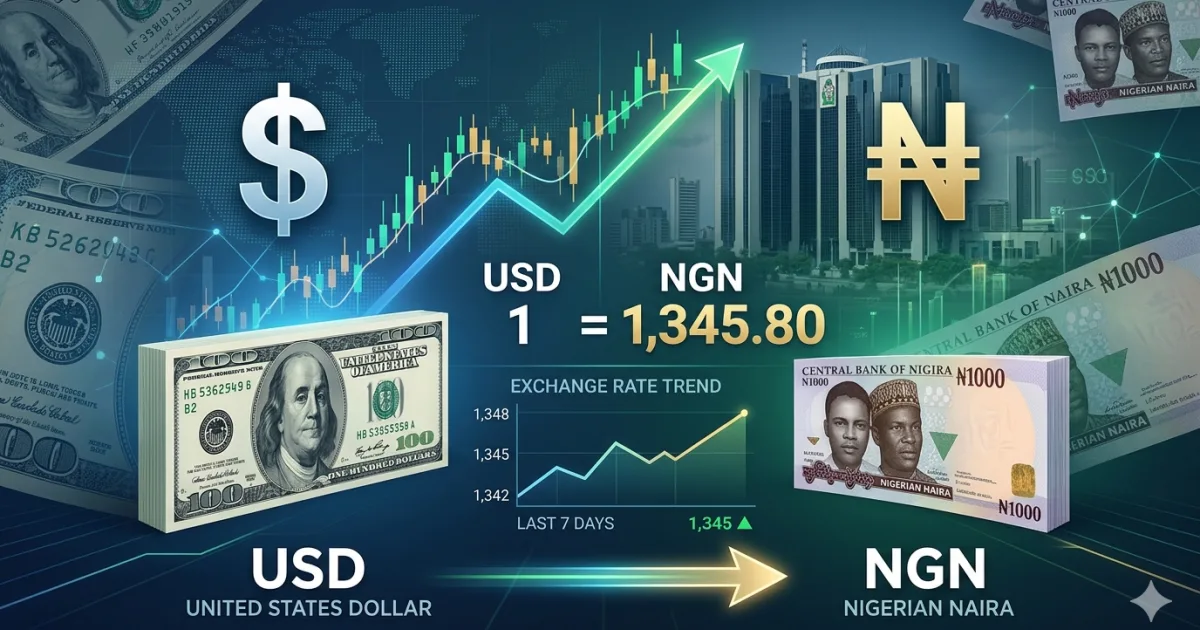
If there is one number that Nigerians check more than any other — more than fuel prices, more than food costs — it is the dollar to naira exchange rate. Whether you are sending money abroad for school fees, receiving a salary in dollars, buying imported goods, or simply trying to understand why your ₦50,000 feels lighter every month, the USD/NGN rate touches nearly every financial decision in Nigeria. This page is updated regularly to give you the most current rates available across all markets.
Dollar to Naira Rate Today — 5 April 2026
⚡ Today’s Live Rates — Updated: April 5, 2026
Rates sourced from Aboki Forex, NairaToday, and CBN NFEM data. Refresh for the latest figures.
| Currency | Black Market (Buy) | Black Market (Sell) | CBN Official Rate |
|---|---|---|---|
| 🇺🇸 US Dollar (USD) | ₦1,400 | ₦1,420 | ₦1,380.79 |
| 🇬🇧 British Pound (GBP) | ₦1,870 | ₦1,910 | ₦1,824.86 |
| 🇪🇺 Euro (EUR) | ₦1,590 | ₦1,620 | ₦1,591.92 |
| 🇨🇦 Canadian Dollar (CAD) | ₦1,007 | ₦1,022 | ₦990 |
Current parallel market spread (USD): Approximately ₦39 between CBN official and black market sell rate — one of the lowest spreads in recent memory.
Data sources: Aboki Forex | NairaToday | CBN Official
What this means in plain naira: As of today, if you want to exchange $100 at the black market, you would receive approximately ₦142,000 (at the ₦1,420 sell rate). Through your bank at the official CBN/NFEM rate, the same $100 gives you approximately ₦138,079. The difference — about ₦3,921 per $100 — reflects the current parallel market premium, which is significantly lower than it was during Nigeria’s exchange rate crisis in 2023 and 2024.
Quick Currency Converter: Dollar to Naira
Use the table below to quickly convert common dollar amounts to naira at today’s black market sell rate (₦1,420/$) and the CBN official rate (₦1,380.79/$):
| USD Amount | Black Market (₦1,420) | CBN Official (₦1,381) | Difference |
|---|---|---|---|
| $50 | ₦71,000 | ₦69,050 | ₦1,950 |
| $100 | ₦142,000 | ₦138,100 | ₦3,900 |
| $200 | ₦284,000 | ₦276,200 | ₦7,800 |
| $500 | ₦710,000 | ₦690,500 | ₦19,500 |
| $1,000 | ₦1,420,000 | ₦1,381,000 | ₦39,000 |
| $5,000 | ₦7,100,000 | ₦6,905,000 | ₦195,000 |
| $10,000 | ₦14,200,000 | ₦13,810,000 | ₦390,000 |
Note: Black market rates change multiple times daily. Always confirm with your BDC operator or parallel market trader before any transaction. NaijaSabi does not facilitate currency exchange.
CBN Official Rate vs Black Market Rate: What Is the Difference?
A question that confuses many Nigerians — especially those new to forex transactions — is why there are two different rates for the same dollar. Here is the clearest explanation:
🏦 The CBN Official Rate (NFEM Rate)
This is the rate at which the Central Bank of Nigeria (CBN) facilitates dollar transactions through the Nigerian Foreign Exchange Market (NFEM). It is the rate used by commercial banks (GTB, Access, Zenith, UBA, First Bank etc.) when you buy or sell dollars through official banking channels. As of April 2026, since the CBN unified exchange rates in 2023, the NFEM rate has become much closer to the parallel market rate than it historically was. The official rate for April 5, 2026 is approximately ₦1,380.79 per dollar.
Best for: Paying school fees abroad, importing goods with a Form M, official business transactions, IPPIS salary earners.
🏪 The Black Market / Parallel Market Rate
The parallel market — commonly called the black market or “aboki rate” — is where Bureau De Change (BDC) operators, independent currency traders, and informal money changers operate. It is driven purely by supply and demand. When demand for dollars exceeds what official banks can supply — because of import needs, school fee payments, medical tourism, and dollar speculation — the black market rate rises above the official rate. As of April 5, 2026, the parallel market sell rate is approximately ₦1,420 per dollar.
Best for: Quick cash transactions, small diaspora transfers received informally, dollar cash exchange for travel.
The Naira’s Journey: From Crisis to Fragile Stability (2023–2026)
To understand where today’s rate sits in context, you need to understand the extraordinary turbulence the naira has been through over the past three years — and how far it has recovered.
| Period | Approx. Rate (USD/NGN) | Key Event |
|---|---|---|
| May 2023 (pre-reform) | ₦460/$ | Old official rate before Tinubu’s FX unification |
| June 2023 | ₦770/$ | CBN floats naira; immediate devaluation |
| December 2023 | ₦1,000/$ | First time naira crossed ₦1,000 at official market |
| January 2024 | ₦1,455/$ | Naira lost 37.6% in January alone — Bloomberg’s worst-performing currency |
| Late 2024 (peak) | ~₦1,740/$ | Naira’s all-time low; parallel market premium over 60% |
| End of 2024 | ₦1,535/$ | CBN reforms begin taking effect; gradual recovery |
| End of 2025 | ₦1,435/$ | First full-year appreciation since 2012 (6.5% gain) |
| February 2026 | ₦1,354/$ | Naira’s strongest point in 2026; reserves hit $50B |
| April 5, 2026 | ₦1,381 (official) / ₦1,420 (parallel) | Current rate — fragile stability with narrow spread |
“Those holding unnecessary foreign exchange reserves are losing money every day.”
— CBN Governor Olayemi Cardoso, addressing the National Economic Council, February 2026
The quote from Governor Cardoso captures the scale of the turnaround. For much of 2023 and 2024, Nigerians who held dollars were protected — the naira was collapsing, and dollar savings were multiplying in naira terms. By early 2026, with the naira stabilising and the parallel premium narrowing to single digits, the calculus had reversed. Speculative dollar hoarding — which had been one of the key drivers of naira weakness — was becoming unprofitable.
Why Has the Naira Stabilised? Four Key Drivers
1. CBN Monetary Policy Tightening Under Governor Cardoso
When Olayemi Cardoso took over as CBN Governor in late 2023, the naira was in freefall. His response was aggressive. The Monetary Policy Rate (MPR) was raised cumulatively by 875 basis points — from 18.75% in January 2024 to 27.5% by November 2024. Those high interest rates attracted foreign portfolio investment into Nigerian government securities, bringing fresh dollars into the country. In September 2025, confident that inflation was declining, the CBN made its first rate cut in five years — reducing the MPR from 27.5% to 27.0%. A further cut to 26.5% followed in February 2026. The result: Nigeria’s headline inflation fell from 27.61% in January 2025 to 15.1% in January 2026 — eleven consecutive months of decline.
2. Surging Diaspora Remittances
Perhaps the most dramatic structural shift has been in diaspora remittances. When Nigerians abroad sent money home, they previously preferred informal channels — the black market gave them more naira than the official rate. The CBN’s reforms changed this equation by narrowing the official-parallel spread, making formal remittance channels competitive. According to CBN Governor Cardoso, monthly inflows through formal channels tripled from approximately $200 million to $600 million following the reforms. For all of 2025, workers’ remittances reached $15.466 billion in the first nine months alone, according to CBN data. The CBN’s 2026 projection is $26.13 billion in total diaspora remittances for the year — a structural shift that provides the naira with a much more stable dollar supply base than oil prices alone.
3. External Reserves Recovery
Nigeria’s gross external reserves have undergone a remarkable recovery. From a fragile $3.99 billion in net foreign reserves at the end of 2023, the CBN rebuilt its war chest to $50.12 billion by February 2026 — the highest level in approximately 13 years. The Daily Trust reported in March 2026 that Nigeria’s reserves were projected to reach $51.04 billion by year-end, supported by oil earnings, diaspora remittances, sovereign bond issuance, and FX market reforms. Larger reserves mean the CBN can intervene more decisively when the naira comes under pressure, giving the market confidence that extreme volatility is less likely.
4. The Electronic Foreign Exchange Matching System (EFEMS)
Launched in December 2024, the EFEMS is a trading platform that allows authorised dealers to trade foreign exchange in real-time with full price transparency. Before EFEMS, the official market operated with limited visibility, creating space for manipulation and widening the official-parallel spread. Research firm Afrinvest West Africa reported that since EFEMS launched, the gap between official and parallel market rates narrowed to under ₦20 — compared to over ₦100 a year earlier. While the spread has since widened slightly to approximately ₦39 (as of April 5, 2026), it remains dramatically below the crisis-era levels of 60%+.
Major Change Coming: CBN’s New Diaspora Remittance Policy (May 1, 2026)
⚠️ Important Notice for Nigerians Receiving Money from Abroad
Effective May 1, 2026, the Central Bank of Nigeria has directed all International Money Transfer Operators (IMTOs) — including Western Union, MoneyGram, Ria, and PayPal partners — to settle all inbound remittances in Nigerian naira only. This means that if your family member or employer sends you money from the UK, USA, or Canada, you will no longer receive it in dollars or pounds — you will receive it directly in naira at the prevailing official exchange rate. The circular was signed by Musa Nakorji, Director of the CBN Trade and Exchange Department. The goal, according to the CBN, is to bring approximately $22 billion in annual diaspora remittances into the official foreign exchange market, improving transparency and boosting the naira’s dollar supply base.
What this means for you: If you currently receive remittances in dollars through an IMTO and convert them yourself at a better rate, this option will no longer be available from May 1. Plan accordingly — and if you need to maintain a dollar balance, consider opening a domiciliary account with your bank before the deadline.
Naira Rate at the “Big 5” Nigerian Banks Today
If you are buying or selling dollars through a commercial bank, the rate you receive will be close to the CBN NFEM rate but may include a small bank margin. Here is what to expect at major Nigerian banks as of April 2026:
| Bank | USD Buy Rate (approx.) | USD Sell Rate (approx.) | How to Access |
|---|---|---|---|
| GTBank (GTCo) | ~₦1,370 | ~₦1,390 | GT Mobile, branch counter, internet banking |
| Access Bank | ~₦1,368 | ~₦1,388 | AccessMore App, branch, USSD |
| Zenith Bank | ~₦1,372 | ~₦1,392 | ZenithDirect App, Eazymoney, branch |
| First Bank | ~₦1,365 | ~₦1,385 | FirstMobile App, branch, First Online |
| UBA | ~₦1,370 | ~₦1,390 | UBA Mobile App, branch |
Bank rates are approximate and change daily. Call your bank’s customer service or check their mobile app for exact current rates before transacting.
Expert Outlook: Where Is the Naira Headed in 2026?
The question every Nigerian is asking: will the naira continue to strengthen, stay flat, or weaken again? Here is what analysts and policymakers are projecting:
“The exchange rate could approach N1,000 per dollar in the near term if the CBN stopped market interventions aimed at ensuring currency stability.”
— President Bola Tinubu, public address, early 2026 (expressing bullish optimism on the naira’s trajectory)
“The naira could strengthen to around N1,100 this year if reforms are sustained.”
— Aliko Dangote, Africa’s richest man and founder of Dangote Group, commenting on naira outlook, 2026
While those are optimistic projections from high-profile figures, independent analysts offer a more measured view. Most analysts and research firms project the naira trading within the ₦1,350 to ₦1,520 per dollar range through 2026, based on the following assumptions:
- Upside risks (naira could strengthen further): Sustained diaspora remittance growth; oil production increasing toward 1.5–1.8 million barrels/day; Dangote Refinery reducing Nigeria’s import bill; continued foreign portfolio investment attracted by high interest rates; Nigeria’s exit from the FATF grey list in late 2025 boosting institutional confidence.
- Downside risks (naira could weaken): Global oil price decline; election-cycle spending pressure (elections expected in some states); speculative dollar demand; global USD strength; slower-than-expected reforms.
The Punch newspaper, citing Agusto & Co. analysis, described the naira’s current position as “fragile stability” — a recovery that is real but not yet structurally guaranteed. The recovery from nearly ₦1,740/$ in late 2024 to approximately ₦1,380/$ today (official rate) is the product of coordinated policy effort, not automatic market forces. If that policy discipline is sustained, the gains can hold. If it slips — particularly around election cycles — history suggests the naira is vulnerable.
How to Get the Best Exchange Rate in Nigeria: Practical Tips
Whether you are converting dollars to naira or naira to dollars, the difference between a good rate and a bad one can mean tens of thousands of naira on a single transaction. Here is how to navigate the market smartly:
For Converting Dollars to Naira (Selling Dollars)
- Compare rates first. Check Aboki Forex (abokiforex.app), NairaToday (nairatoday.com), and Monierate (monierate.com) before approaching any BDC operator. These platforms aggregate rates from multiple sources and update daily. The difference between operators can be ₦10–₦30 per dollar — which adds up significantly on large amounts.
- Prefer larger, newer denomination bills. In Nigeria’s parallel market, crisp, large-denomination dollar bills (especially $100 notes printed in 2017 or later) command better rates than small denominations or older, worn notes. This can make a difference of ₦10–₦20 per dollar.
- Transact in the morning. Rates are generally more stable early in the trading day. By afternoon, if demand spikes or news breaks (oil price drops, CBN policy announcement), rates can shift quickly and not always in your favour.
- Use licensed BDC operators. Licensed Bureau De Change operators registered with the CBN offer more accountability than street changers. A list of licensed BDCs is available on the CBN website. Avoid unlicensed “area boys” who may short-change you or pass counterfeit naira.
- Never exchange extremely large amounts in one go. For significant amounts (over $5,000), split the transaction and do due diligence on rates. Large transactions in the parallel market can sometimes cause the local rate to move against you.
For Receiving Dollars from Abroad (Diaspora Transfers)
- Use formal remittance channels. With the spread between official and parallel rates now under 3%, the days of dramatically better black market returns on remittances are largely over. Services like Sendwave, Lemfi, Remitly, Grey Finance, and WorldRemit often offer rates close to the official rate with lower fees than Western Union or MoneyGram.
- Open a domiciliary account. If you regularly receive dollar income (remote work, freelance, diaspora transfers), a domiciliary account at any major Nigerian bank lets you hold the dollars and exchange them when the rate is favourable. This is especially important before the May 1, 2026 CBN policy change takes effect.
- Compare transfer fees, not just rates. A service offering ₦1,395/$ but charging ₦5,000 in transfer fees may be worse than a service at ₦1,385/$ with zero fees, depending on the amount you are sending.
Frequently Asked Questions
How much is $1 dollar in naira today?
As of April 5, 2026: $1 = ₦1,420 at the black market (parallel market) sell rate. At the official CBN/NFEM rate, $1 = approximately ₦1,380.79. Rates change daily — refresh this page for the most current figures, or check Aboki Forex and NairaToday for real-time updates.
What is the CBN official exchange rate today?
The CBN official rate (NFEM — Nigerian Foreign Exchange Market rate) for April 5, 2026 is approximately ₦1,380.79 per US dollar. This is the rate used by commercial banks for official forex transactions. For the most precise and up-to-the-minute CBN rate, visit the CBN’s official website at cbn.gov.ng under the “Exchange Rates” section.
What is the black market (aboki) rate today?
The black market (parallel market) dollar to naira rate on April 5, 2026 is approximately ₦1,400 (buy) and ₦1,420 (sell). These rates represent an average across Lagos (Island, Mainland) and Abuja (Wuse Zone 4) BDC operators. Local rates may vary slightly by location, operator, and denomination of notes being exchanged.
Is the black market dollar rate illegal in Nigeria?
The operation of unlicensed Bureau De Change (BDC) outlets is technically outside CBN regulations. However, the CBN has licensed thousands of BDC operators across Nigeria who are authorised to trade foreign exchange at market rates. The distinction matters: a licensed BDC offering rates slightly above the official NFEM rate is legal; an unregistered street changer is not. For significant transactions, always use a CBN-licensed operator for legal protection and to avoid counterfeit currency risk.
How much is £1 pound to naira today?
As of April 5, 2026: £1 (British Pound) = ₦1,910 at the black market sell rate. The CBN official rate is approximately ₦1,824.86 per pound. For Nigerians in the UK sending money home, check services like Sendwave, Wise, and Lemfi for the most competitive GBP-to-NGN transfer rates.
Why is the dollar to naira rate different in Lagos and Abuja?
Because the parallel market is unregulated and driven by local supply and demand, rates can vary by ₦5–₦20 between cities. Lagos typically has the highest volume of dollar transactions (driven by importers, businesses, and the largest BDC concentration), while Abuja’s Wuse Zone 4 is the second most active market. Smaller cities like Kano, Port Harcourt, and Ibadan may have slightly different rates depending on their local dollar supply situation. The rates published on this page represent a national average.
Where can I check the live dollar to naira rate online?
The most reliable platforms for tracking the dollar to naira rate in real time are:
- Aboki Forex (abokiforex.app) — Black market and BDC rates updated hourly
- NairaToday (nairatoday.com) — Parallel market rates for USD, GBP, EUR, CAD, and more
- Monierate (monierate.com) — Compares rates from 40+ exchange providers including Binance, Luno, Yellow Card
- CBN Official Website (cbn.gov.ng) — Official NFEM rate, updated each business day
- Nairametrics — Financial news and daily exchange rate commentary from Nigerian analysts
Monthly Exchange Rate History: Dollar to Naira (2025–2026)
| Month | CBN Official (avg.) | Parallel Market (avg.) | Spread |
|---|---|---|---|
| January 2025 | ~₦1,535 | ~₦1,600 | ~₦65 |
| March 2025 | ~₦1,500 | ~₦1,565 | ~₦65 |
| June 2025 | ~₦1,480 | ~₦1,530 | ~₦50 |
| September 2025 | ~₦1,460 | ~₦1,500 | ~₦40 |
| December 2025 | ~₦1,435 | ~₦1,465 | ~₦30 |
| January 2026 | ~₦1,430 | ~₦1,455 | ~₦25 |
| February 2026 | ~₦1,355 | ~₦1,420 | ~₦65 |
| March 2026 | ~₦1,379 | ~₦1,415 | ~₦36 |
| April 2026 (to date) | ~₦1,381 | ~₦1,420 | ~₦39 |
The trend is clear: the spread between official and parallel market rates has compressed dramatically from its 2023–2024 crisis peak of over 60%. While February 2026 saw a temporary widening (driven by increased import demand and dollar speculator activity), the general direction through 2025 and into 2026 has been toward a narrower, more unified exchange rate — the CBN’s stated goal.
Summary: What You Need to Know About the Dollar to Naira Rate Today
- Today’s black market rate: $1 = ₦1,420 (sell) | ₦1,400 (buy)
- Today’s CBN official rate: $1 = ₦1,380.79
- Current spread: approximately ₦39 — near historically low levels
- £1 pound = ₦1,910 (black market) | ₦1,824.86 (CBN)
- €1 euro = ₦1,620 (black market) | ₦1,591.92 (CBN)
- Naira gained 6.5% in 2025 — its first annual appreciation since 2012
- Nigeria’s external reserves: ~$49.29 billion (end March 2026) — near 13-year high
- Diaspora remittances: $600M/month through formal channels (CBN target: $1B/month by end 2026)
- Major policy change: From May 1, 2026, all IMTO remittances must be paid in naira
- Analyst consensus: naira likely to trade ₦1,350–₦1,520 range through 2026
This page is updated regularly with the latest exchange rate data. Bookmark it and check back daily for current rates. For real-time tracking between updates, use Aboki Forex or NairaToday. For the official CBN rate, visit cbn.gov.ng.
Have questions about the exchange rate or how to get the best deal on your forex transaction? Drop them in the comments below and our team will respond. You can also read our related guides: How to Open a Dollar Account in Nigeria and How to Send Money from UK and USA to Nigeria.

0 Comments
No comments yet. Be the first to share your thoughts!