




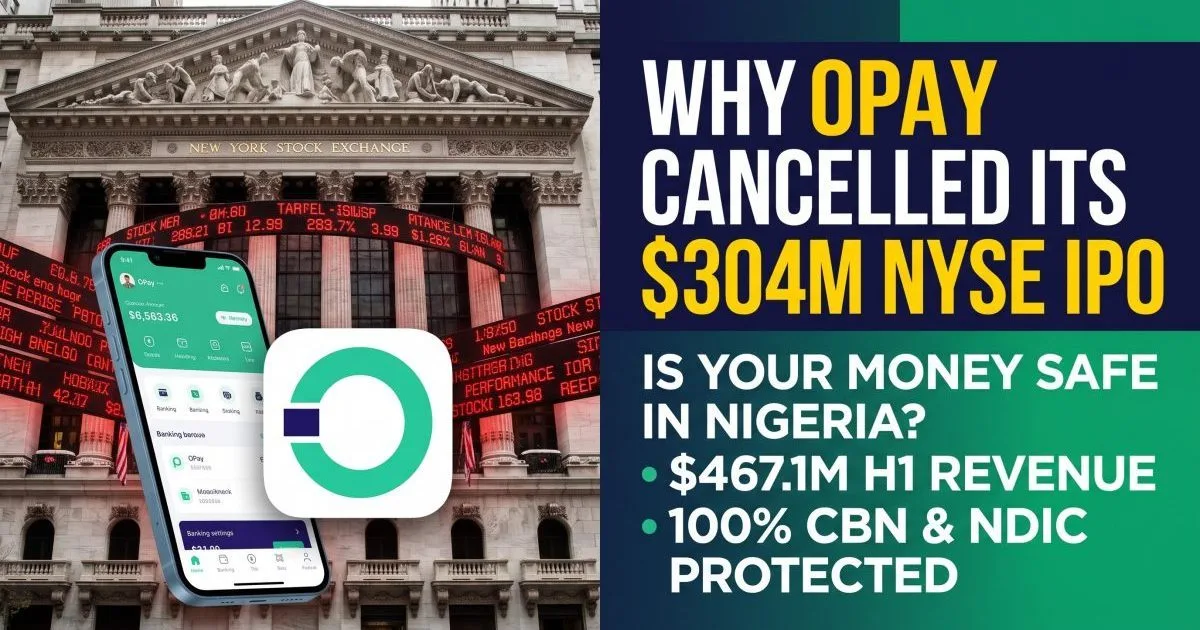
Key Takeaways: OPay’s Cancelled NYSE IPO & Safety of Funds at a Glance
- The Dramatic Float: SoftBank-backed fintech giant OPay priced 16 million American Depositary Shares at $19 each (valuing the firm at roughly $4 billion) and its executives proudly rang the New York Stock Exchange (NYSE) opening bell.
- Sudden Ht / Cancellation: Hours later at 3:30 PM, trading was halted before a single share could exchange hands, and OPay officially announced that the offering would not be completed.
- The Regulatory Reason: OPay cited a “recent regulatory inquiry relating to a jurisdiction immaterial to the Company’s business operations”. Reports later pointed to inquiries from a Chinese regulator linked to founder Zhou Yahui.
- Nigerian Business Remains Untouched: Nigeria is OPay’s core profit engine, accounting for 89.5% of its revenue in the first half of 2026, with over 50.1 million monthly active users.
- Are Your Funds Safe? 100% Yes: The failed US public listing is a corporate equity event; it has zero operational or financial impact on customer wallets, merchant balances, or CBN deposit protections in Nigeria.
For millions of daily users across Nigeria who rely on OPay for instant transfers, airtime top-ups, POS merchant settlements, and savings, headlines announcing that the fintech giant had suddenly cancelled its multi-million dollar global stock market debut sent shockwaves through social media. Within hours, viral WhatsApp broadcasts and panic-driven tweets began questioning whether the platform was in financial trouble.
The reality behind the headlines, however, is a fascinating cross-border corporate drama rather than a local liquidity crisis. OPay had successfully priced its $304 million Initial Public Offering (IPO) on the New York Stock Exchange (NYSE), valued the company at roughly $4 billion, and its leadership team had already performed the historic ceremony of ringing the opening bell. Yet, before a single share could trade on the public floor, the offering was abruptly pulled due to an unexpected regulatory inquiry originating thousands of miles away from its operating markets.
This comprehensive, data-driven pillar guide examines exactly what happened at the New York Stock Exchange, why a foreign regulatory shadow derailed the listing, OPay’s true financial health in 2026, and why customer funds in Nigeria remain completely safe and protected.
Table of Contents
- Executive Summary Table: OPay’s Cancelled NYSE IPO Metrics
- The Timeline: From Ringing the NYSE Opening Bell to Sudden Cancellation
- The Regulatory Mystery: Why Did a Foreign Inquiry Derail the Float?
- A Financial Powerhouse: OPay’s H1 2026 Revenue ($467M) & Profit ($90.9M)
- Nigeria as the Crown Jewel: 89.5% of Revenue & 50.1M Active Users
- Is Your Money Safe in Nigeria? CBN Protection & Operational Reality
- What This Means for OPay POS Agents, Merchants, and Everyday Users
- The SoftBank Factor & Partner Standstills (Standard Bank’s $200M Stake)
- Will OPay Try Again? Future Public Market Prospects
- Official SEC Filings & Management Communiqués
- Frequently Asked Questions (FAQs)
1. Executive Summary Table: OPay’s Cancelled NYSE IPO Metrics
Review the verified financial and corporate parameters surrounding OPay’s aborted New York Stock Exchange public float:
| Corporate Metric | Official Verified Details (October / November 2026) |
|---|---|
| Target Stock Exchange | New York Stock Exchange (NYSE) under ticker symbol OPAY |
| Planned Capital Raise | $304 Million USD (offering 16 million American Depositary Shares at $19) |
| Valuation at Pricing | Approximately $4 Billion USD |
| Date of Aborted Listing | Friday, October 30, 2026 (halted at 3:30 PM before shares traded) |
| Primary Stated Reason | Regulatory inquiry relating to a jurisdiction immaterial to operations |
| H1 2026 Revenue | $467.1 Million USD |
| H1 2026 Net Income | $90.9 Million USD |
| Nigerian Revenue Contribution | 89.5% of total company revenue |
| Active User Base | Over 50.1 Million Monthly Active Users |
2. The Timeline: From Ringing the NYSE Opening Bell to Sudden Cancellation
The events of Friday, October 30, 2026, will go down in financial history as one of the most unusual moments in cross-border fintech listings. Weeks of roadshows, SEC filings, and underwriter syndication had culminated in OPay pricing its 16 million American Depositary Shares (ADS) at $19 each—the bottom of its projected $19–$21 range—giving the Africa-focused fintech a market capitalization of roughly **$4 billion**.
On the morning of October 30, OPay’s executive team stood proudly on the podium at the New York Stock Exchange in lower Manhattan and rang the opening bell under the ticker symbol **OPAY**. Investors and analysts anticipated a landmark moment for African technology firms accessing global public equity.
However, the celebratory mood evaporated by mid-afternoon. At approximately **3:30 PM**, trading was suddenly halted by exchange authorities before a single share had exchanged hands. Later that evening, OPay filed an urgent notice with US regulators disclosing that the public offering **“will not be completed”** due to a late-breaking regulatory inquiry.
3. The Regulatory Mystery: Why Did a Foreign Inquiry Derail the Float?
In its official communication to US securities regulators, OPay stated that the cancellation was prompted by “a recent regulatory inquiry relating to a jurisdiction immaterial to the Company’s business operations”. While the company’s prospectus did not explicitly name the country, financial investigators and media reports by Bloomberg pointed directly to **Chinese regulators**.
Why would a Chinese regulatory body have any jurisdiction over a company whose core operations are in Nigeria, Pakistan, Egypt, and Indonesia? The connection lies in corporate ownership and founding structure:
- Founder & Chairman Links: OPay’s non-executive chairman and largest shareholder (holding a 21.3% stake) is **Zhou Yahui** (referenced in SEC filings as James Zhou). Zhou is a prominent Chinese tech entrepreneur who previously founded Beijing Kunlun Tech and serves as chairman of the web browser firm Opera.
- China’s Overseas Listing Regulations: Since March 2023, Beijing authorities have enforced strict filing requirements for offshore companies and holding structures (such as Cayman Islands entities) if the underlying founders or significant operational roots trace back to mainland China, regardless of where the revenue is earned.
- An Inquiry Does Not Equal Misconduct: Financial analysts emphasize that a regulatory inquiry is an investigative or compliance review, not an accusation of financial wrongdoing. Nonetheless, under US underwriting rules, an active unclosed regulatory query anywhere in a parent structure makes proceeding with a multi-million-dollar IPO legally untenable until resolved.
4. A Financial Powerhouse: OPay’s H1 2026 Revenue ($467M) & Profit ($90.9M)
One of the most striking aspects of the aborted IPO is that unlike many Silicon Valley tech startups that burn billions of dollars while posting perpetual losses, **OPay is exceptionally profitable**. Financial disclosures in the company’s SEC prospectus revealed robust fundamentals for the first half of 2026:
| Financial Indicator (H1 2026) | Verified USD Amount | Operational Growth Context |
|---|---|---|
| Total H1 2026 Revenue | $467.1 Million | Massive surge compared to $197 million in the same period of the previous year. |
| Net Income (Profit) | $90.9 Million | Demonstrates strong operating cash flow and robust unit economics. |
| Monthly Active Users (MAU) | 50.1 Million Users | Counted across its primary emerging markets as of July 2026. |
5. Nigeria as the Crown Jewel: 89.5% of Revenue & 50.1M Active Users
Despite being legally domiciled in the Cayman Islands with headquarters in Singapore, OPay’s commercial lifeline beats strongest in Nigeria. According to the company’s official filing documents, Nigeria contributed a staggering 89.5% of total company revenue in the first half of 2026 (translating to roughly $417.6 million).
With tens of millions of retail customers, hundreds of thousands of active POS agents, and deep integration into everyday commercial transactions across Lagos, Kano, Ibadan, Port Harcourt, and Abuja, OPay functions essentially as systemic financial infrastructure in Nigeria. Its secondary markets—Pakistan, Egypt, and Indonesia—contribute the remaining portion of its user base.
6. Is Your Money Safe in Nigeria? CBN Protection & Operational Reality
Direct Answer for Every Nigerian User: Yes. Your money in OPay is 100% safe. The halted New York Stock Exchange IPO is an international corporate equity event involving share sales between institutional investors; it has zero connection to customer deposits, savings wallets, or merchant cash balances held inside Nigeria.
To understand why local funds remain completely insulated, look at how OPay operates under Nigerian law:
- Regulated by the Central Bank of Nigeria (CBN): OPay operates in Nigeria under a valid Mobile Money Operator (MMO) license issued by the CBN and is insured by the Nigeria Deposit Insurance Corporation (NDIC).
- Customer Funds Are Segregated: By regulatory law, customer deposits cannot be touched or used by parent holding companies for offshore stock market maneuvers; they are held in dedicated trustee accounts in partner commercial banks within Nigeria.
- Business As Usual: POS terminals, app transfers, savings accounts, and bill payments continue to function normally without disruption across the country.
7. What This Means for OPay POS Agents, Merchants, and Everyday Users
For agents operating green OPay terminals in markets and neighborhood shops, or everyday users transferring funds between banks, the aborted IPO changes nothing about daily operations:
- Commissions, withdrawal settlements, and transfer speeds remain fully operational.
- Merchant liquidity and working capital lines provided through partner Nigerian commercial banks are unaffected.
- No account re-verification or panic withdrawal is required.
8. The SoftBank Factor & Partner Standstills (Standard Bank’s $200M Stake)
While everyday Nigerian users face zero risk, institutional backers experienced a temporary roadblock. Major stakeholders such as SoftBank (which holds a 6.6% stake through its Vision Fund) had to put their equity exit strategy on hold. Additionally, a massive parallel agreement—in which a unit of South Africa’s **Standard Bank** had agreed to purchase up to **$200 million in shares**—was explicitly structured to depend on the successful completion of the IPO, placing that capital injection on standby.
9. Will OPay Try Again? Future Public Market Prospects
Market analysts note that because OPay pulled the offering *after* pricing but *before* trading began, the episode is less a failed business launch than a temporary regulatory speed bump. OPay management has expressed confidence that the inquiry will be resolved satisfactorily. Once compliance clearances are finalized, the company could choose to refile for a US public listing or explore alternative exchanges in the future.
10. Official SEC Filings & Management Communiqués
For verified transparency, reference OPay’s official regulatory disclosures:
- US SEC Form F-1 / Prospectus (October 2026): Outlining the 16 million ADS offering at $19, financial disclosures showing $467.1M H1 revenue, and corporate governance structure.
- Post-Halt Regulatory Notice (October 30, 2026): Formally notifying the New York Stock Exchange and Securities and Exchange Commission that the public offering would not be completed due to foreign regulatory inquiries.
11. Frequently Asked Questions (FAQs) About OPay’s Cancelled NYSE IPO
1. Why did OPay cancel its New York Stock Exchange IPO?
OPay withdrew its planned $304 million IPO on October 30, 2026, after disclosing a late-breaking regulatory inquiry from a foreign jurisdiction (reported by financial media to be Chinese regulators examining founding ownership links).
2. Is my money safe in my OPay account in Nigeria?
Yes, 100% safe. The cancelled IPO is an international corporate stock market event that has zero impact on user wallets, merchant balances, or funds held in Nigeria under CBN licensing and NDIC insurance protection.
3. How much revenue did OPay generate in 2026?
According to its prospectus, OPay recorded **$467.1 million in revenue** and **$90.9 million in net income** for the first half of 2026, with Nigeria accounting for 89.5% of total earnings.
4. Does this affect OPay POS agents and merchants in Nigeria?
No. POS terminals, merchant settlements, transfers, and daily banking operations continue to function normally across all states.


0 Comments
No comments yet. Be the first to share your thoughts!