




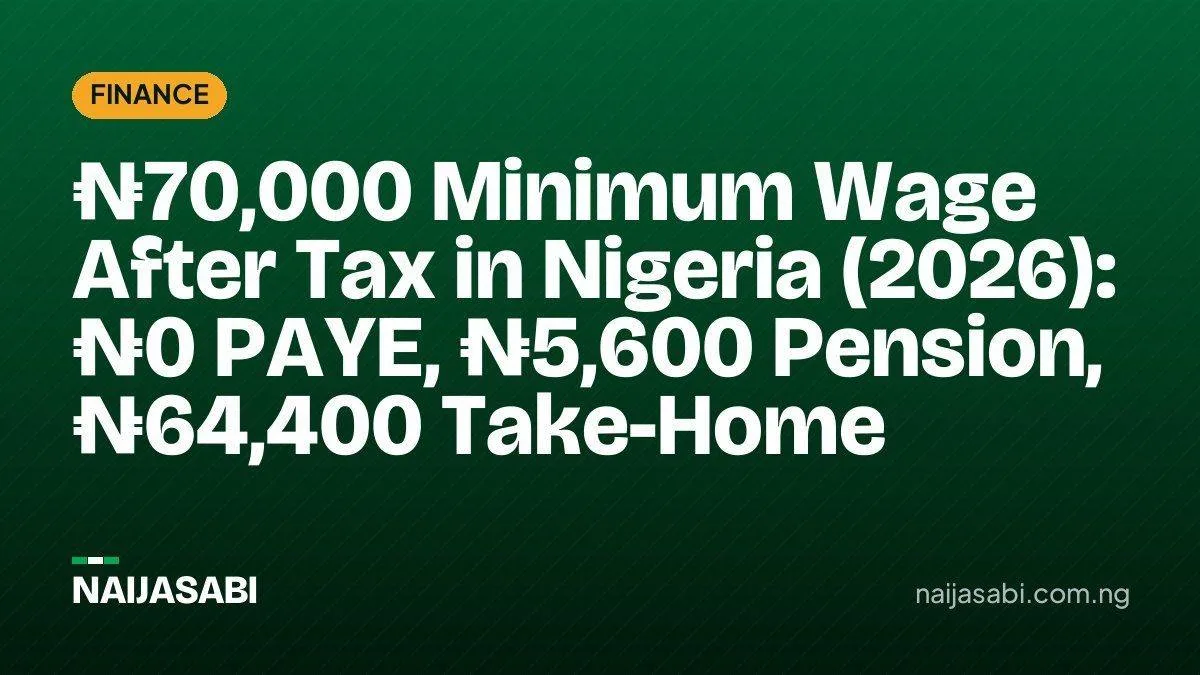
📌 Quick answer: On the ₦70,000 national minimum wage, you pay ₦0 PAYE tax in 2026. Income at or below the national minimum wage is exempt under the Nigeria Tax Act 2025. Your only usual deduction is 8% pension (₦5,600), so your take-home pay is ₦64,400 a month (₦772,800 a year). If your employer does not run a pension scheme, you keep the full ₦70,000. Earn a little more, say ₦80,000, and tax starts at about ₦1,040 a month, far less than the ₦3,503 the old rules would have taken.
₦70,000 a month has been Nigeria’s national minimum wage since the National Minimum Wage (Amendment) Act 2024 took effect in July 2024. It is what many cleaners, security guards, drivers, junior shop staff, domestic workers on formal contracts and entry-level public servants are paid.
Since 1 January 2026, salaries in Nigeria have been taxed under the Nigeria Tax Act 2025. The question most minimum-wage earners ask is simple: does any tax come out of my ₦70,000? The answer is no. This guide shows the full breakdown, what changes if you earn slightly more, and what to check on your payslip.
₦70,000 Salary After Tax: The Full Breakdown
| Item | Monthly | Yearly |
|---|---|---|
| Gross salary | ₦70,000 | ₦840,000 |
| Pension (8% employee contribution) | −₦5,600 | −₦67,200 |
| PAYE tax | ₦0 | ₦0 |
| Take-home pay | ₦64,400 | ₦772,800 |
| Employer’s pension contribution (10%, paid on top) | ₦7,000 | ₦84,000 |
Why There Is No Tax on ₦70,000
Two parts of the new tax law protect a minimum-wage salary.
- The minimum-wage exemption. The list of reliefs and exemptions published by the Presidential Fiscal Policy and Tax Reforms Committee for the 2026 rules puts it first: “Individuals earning the national minimum wage or less (exempt).” If your pay is ₦70,000 or less, no PAYE should be deducted at all.
- The 0% band. Under the Fourth Schedule of the Act, the first ₦800,000 of chargeable income each year is taxed at 0%. After 8% pension, a ₦70,000 earner’s chargeable income is ₦772,800 a year, which is below ₦800,000 anyway.
The exemption matters for workers whose employer does not deduct pension. Without pension, chargeable income would be ₦840,000, which is above the ₦800,000 band. The exemption still means no tax is due on ₦70,000.
What If You Earn a Bit More Than ₦70,000?
The exemption covers only pay at or below the national minimum wage. Above it, your salary is taxed normally, but the 0% band still protects most of it. With 8% pension on the full salary, you pay no tax until about ₦72,464 a month, the point where chargeable income reaches ₦800,000 a year. After that, only the part above ₦800,000 is taxed, at 15%.
| Gross a month | 2026 PAYE | 2026 take-home | 2025 PAYE (old rules) | You save |
|---|---|---|---|---|
| ₦70,000 | ₦0 | ₦64,400 | ₦0 | — |
| ₦75,000 | ₦350 | ₦68,650 | ₦3,107 | ₦2,757 |
| ₦80,000 | ₦1,040 | ₦72,560 | ₦3,503 | ₦2,463 |
| ₦85,000 | ₦1,730 | ₦76,470 | ₦3,899 | ₦2,169 |
| ₦90,000 | ₦2,420 | ₦80,380 | ₦4,295 | ₦1,875 |
| ₦100,000 | ₦3,800 | ₦88,200 | ₦5,300 | ₦1,500 |
| ₦120,000 | ₦6,560 | ₦103,840 | ₦7,460 | ₦900 |
This is where the new law helps low earners most. Under the old rules, a worker paid ₦75,000 lost about ₦3,107 a month to tax. Under the new law, it is ₦350. Several states and many private employers pay more than the national minimum, so if your salary is ₦75,000 to ₦100,000, check that your payslip reflects the new figures.
How the ₦80,000 example is worked out
- Yearly gross: ₦80,000 × 12 = ₦960,000.
- Take off pension: 8% is ₦76,800, leaving chargeable income of ₦883,200.
- 0% band: the first ₦800,000 is tax-free.
- 15% band: the remaining ₦83,200 × 15% = ₦12,480 a year.
- Monthly PAYE: ₦12,480 ÷ 12 = ₦1,040.
Old Rules vs New Rules at ₦70,000
Minimum-wage earners were already exempt from personal income tax under the old Personal Income Tax Act, as amended by the Finance Act 2020. So for someone on exactly ₦70,000, both systems give ₦0. The change shows up for people just above the line: under the old law, crossing ₦70,000 by even one naira meant paying about ₦2,711 a month in tax. Under the new law, tax rises gradually from ₦0, so a small raise no longer comes with a big tax bill.
What Can Still Come Out of Your Pay
| Deduction | On ₦70,000 | Notes |
|---|---|---|
| Pension (8%) | ₦5,600 | Compulsory if your employer has three or more staff. It is your money, saved in your Retirement Savings Account. |
| National Housing Fund (2.5% of basic) | Up to ₦1,750 | Only if your employer deducts NHF. On a ₦70,000 basic it is ₦1,750. |
| PAYE tax | ₦0 | Exempt at the national minimum wage. |
| Union dues, cooperative, loans | Varies | Only with your agreement or under your union’s rules. |
If your employer deducts both pension and NHF on a ₦70,000 basic, your take-home is ₦62,650. If it deducts neither, you keep ₦70,000.
What Your Employer Pays on Top
A ₦70,000 worker costs an employer more than ₦70,000. Under the Pension Reform Act 2014 the employer must add at least 10% (₦7,000) to your pension, and most employers also pay 1% of payroll to the Nigeria Social Insurance Trust Fund (NSITF) for employee compensation, which is ₦700. That puts the monthly cost of a minimum-wage worker at about ₦77,700, before any other benefits.
Each month, ₦12,600 goes into your Retirement Savings Account (your ₦5,600 plus your employer’s ₦7,000). That is ₦151,200 a year, before any investment returns.
Is ₦70,000 Still the Minimum Wage?
Yes. The National Minimum Wage (Amendment) Act 2024 set the national minimum wage at ₦70,000 a month and shortened the review cycle from five years to three, which puts the next review in 2027. Labour unions have pushed for an earlier increase. Until a new figure is signed into law, ₦70,000 remains the national minimum, and the tax exemption applies to pay at or below it.
Work Out Your Own Take-Home Pay
Enter your salary below. The calculator uses the 2026 rules and shows the old-rules figure for comparison.
Take-home pay calculator 2026
Nigeria Tax Act 2025 rates, in force since 1 January 2026.
| Monthly | Yearly |
|---|
How your tax was worked out
What it costs your employer
Take-home on common salaries
| Gross a month | Tax a month | Take-home a month |
|---|---|---|
| ₦70,000 | ₦0 | ₦64,400 |
| ₦100,000 | ₦3,800 | ₦88,200 |
| ₦150,000 | ₦10,700 | ₦127,300 |
| ₦250,000 | ₦24,500 | ₦205,500 |
| ₦500,000 | ₦65,300 | ₦394,700 |
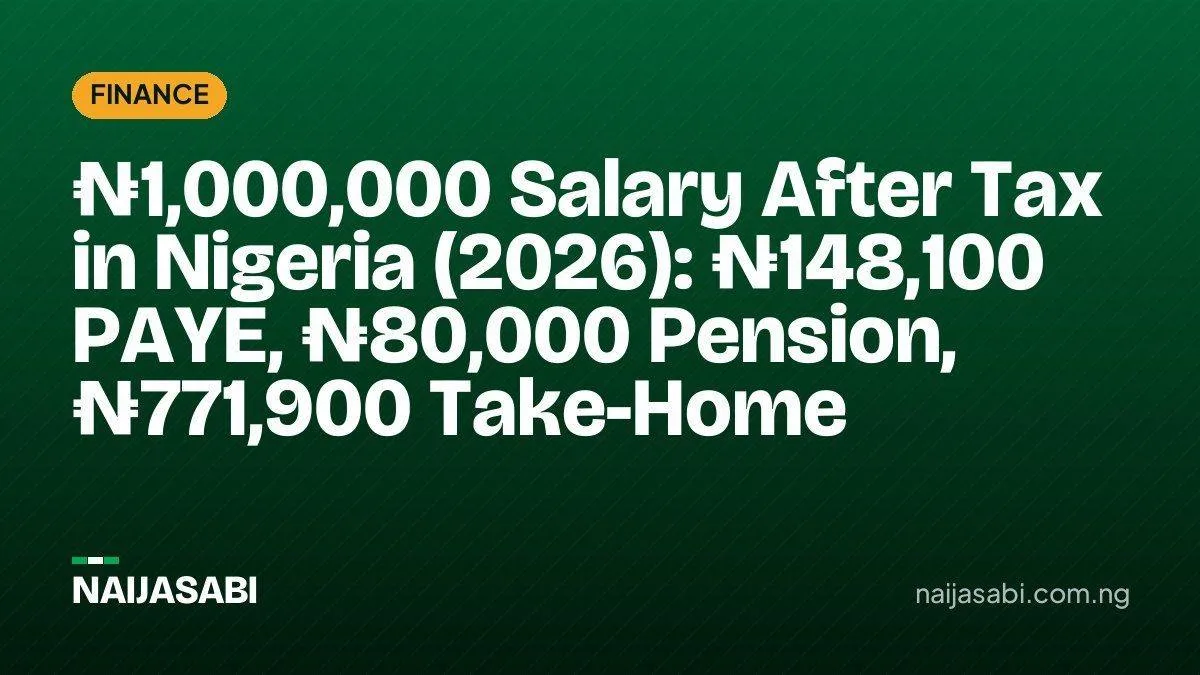
| ₦1,000,000 | ₦148,100 | ₦771,900 |
With 8% pension on the full gross pay, no NHF and no rent relief.
An estimate. Your employer's payroll may treat allowances differently. For a formal answer ask your HR team or a tax adviser.
Source: Nigeria Tax Act 2025 (sections 30 and 58, Fourth Schedule); Pension Reform Act 2014; National Housing Fund Act; National Minimum Wage (Amendment) Act 2024. Employer costs: Pension Reform Act 2014 (at least 10%), Employee's Compensation Act 2010 (NSITF, 1%), Industrial Training Fund Act (ITF, 1%).
Check Your Payslip
- Tax deducted from ₦70,000? It should be ₦0. Ask HR to remove it and refund what was taken this year.
- Earning ₦75,000 to ₦100,000 and still paying old-rule tax? Compare your payslip with the table above. If you pay much more, payroll may still be on the old rules.
- Pension deducted but not showing in your RSA? Check your statement from your Pension Fund Administrator. Your employer must remit both its share and yours.
- Paid less than ₦70,000 for full-time work? Employers covered by the Act must pay at least the national minimum wage.
See our full breakdowns for ₦100,000, ₦150,000 and ₦200,000 salaries.
Frequently Asked Questions
Do minimum wage earners pay tax in Nigeria in 2026?
No. Individuals earning the national minimum wage of ₦70,000 or less are exempt from personal income tax under the 2026 rules.
What is ₦70,000 after tax in Nigeria?
₦64,400 a month after 8% pension, because no tax is due. Without a pension deduction, you keep ₦70,000.
How much tax is paid on ₦80,000 salary?
About ₦1,040 a month under the Nigeria Tax Act 2025, with 8% pension on the full salary. Under the old rules it was about ₦3,503.
At what salary do you start paying tax in Nigeria?
With 8% pension deducted on your full pay, at about ₦72,464 a month. Below that, your chargeable income is under the ₦800,000 tax-free band.
Is pension compulsory on the minimum wage?
Yes, if your employer has three or more employees. You contribute 8% and your employer at least 10%.
What is the effective tax rate on ₦70,000?
0%. No PAYE is due.
Sources
- Nigeria Tax Act 2025 – income tax bands (Fourth Schedule) and exemptions, in force from 1 January 2026
- Presidential Fiscal Policy and Tax Reforms Committee – list of tax reliefs and exemptions under the 2026 tax laws, November 2025
- National Minimum Wage (Amendment) Act 2024 – ₦70,000 national minimum wage and three-year review cycle
- Personal Income Tax Act (as amended by the Finance Act 2020) – Consolidated Relief Allowance, tax bands and minimum-wage exemption applying until 31 December 2025
- Pension Reform Act 2014 – 8% employee and 10% employer contributions
Last updated: 8 November 2026 · NaijaSabi Finance Desk. Figures are worked examples for a single job; your payslip can differ if you have other income or allowances. This is general information, not tax advice.


0 Comments
No comments yet. Be the first to share your thoughts!