




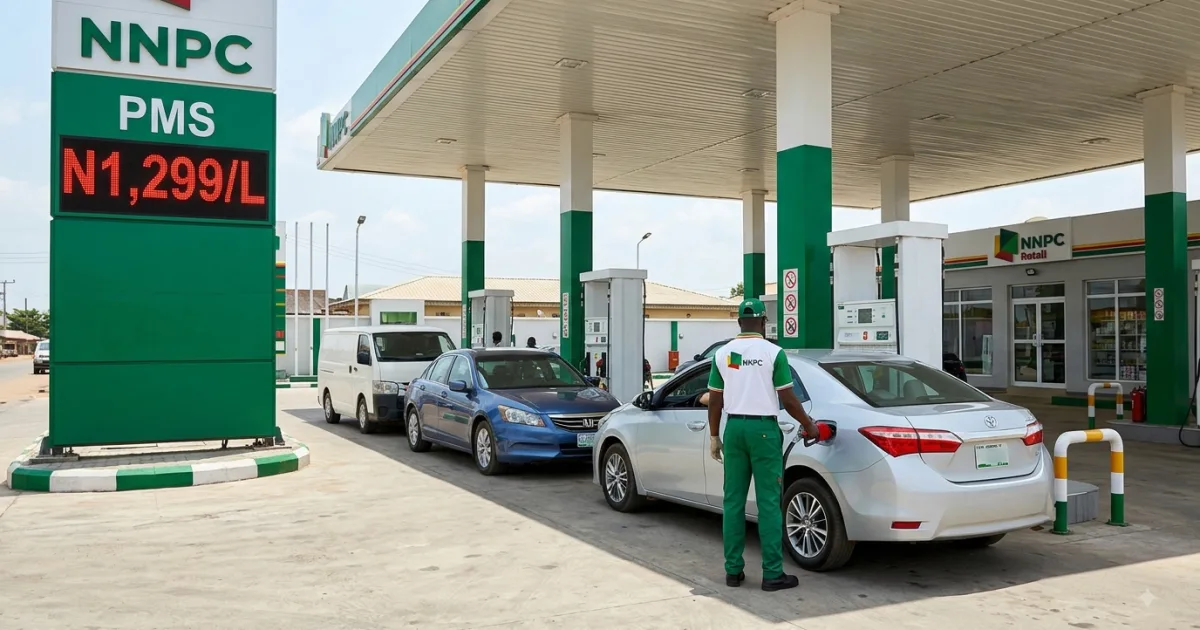
📌 Quick Summary: NNPC cut petrol price to ₦1,299 per litre in Abuja from 4 August 2026. This guide breaks down the new price by state, what caused the reduction, whether transport fares will fall, and what to expect next for Nigerian fuel prices.
Nigerians who have been paying ₦1,335 per litre at the pump just got a small but meaningful respite. The Nigerian National Petroleum Company (NNPC) Limited reduced the pump price of Premium Motor Spirit (PMS — petrol) by ₦36 per litre — bringing the official Abuja price to ₦1,299 per litre from 4 August 2026. It is the first downward adjustment in petrol prices since the devastating subsidy removal of June 2023, which tripled fuel costs overnight. Here is everything you need to know — by state, by vehicle, and by impact on your daily life.
The New Petrol Price: Key Facts
| New Official Price | ₦1,299 per litre (Abuja/FCT) |
| Previous Price | ₦1,335 per litre |
| Reduction | ₦36 per litre (2.7%) |
| Effective Date | 4 August 2026 |
| Announced By | NNPC Limited |
Petrol Price by State: August 2026
Nigeria does not have a uniform nationwide petrol price — transport costs, state levies, and local market conditions mean prices vary significantly by location. The ₦1,299 is the NNPC station price in Abuja. Here is the estimated price range across Nigeria’s regions:
| Region | States | Estimated Price/Litre |
| Federal Capital Territory | Abuja | ₦1,299 (official) |
| Southwest | Lagos, Ogun, Oyo, Osun, Ekiti, Ondo | ₦1,300–₦1,360 |
| South-South | Rivers, Delta, Bayelsa, Edo, Cross River, Akwa Ibom | ₦1,300–₦1,370 |
| Southeast | Anambra, Enugu, Imo, Abia, Ebonyi | ₦1,320–₦1,400 |
| North-Central | Kogi, Benue, Plateau, Nassarawa, Niger, Kwara | ₦1,330–₦1,420 |
| Northwest | Kano, Kaduna, Sokoto, Zamfara, Kebbi, Katsina, Jigawa | ₦1,340–₦1,450 |
| Northeast | Borno, Yobe, Adamawa, Gombe, Bauchi, Taraba | ₦1,380–₦1,600+ |
What Does ₦36 Mean for How Much You Spend on Fuel?
| Vehicle Type | Tank Capacity | Saving per Full Tank |
| Small sedan (Toyota Corolla, Honda Civic) | 50 litres | ₦1,800 |
| SUV (Toyota Highlander, Lexus RX) | 70 litres | ₦2,520 |
| Commercial bus (Hiace) | 70 litres | ₦2,520 per fill |
| Truck (3-tonne) | 150 litres | ₦5,400 |
For individual car owners, the savings per fill are modest but real — the ₦1,800 saved on a sedan fill-up is meaningful against a Nigerian household budget. For commercial drivers and transport companies filling up multiple times per week, the cumulative savings over a month are more significant and create some basis for an eventual transport fare adjustment.
Why Did NNPC Cut the Price?
Three factors converged to make the August 2026 price reduction possible. First, the naira’s strengthening against the dollar — from a low of approximately ₦1,900/$ in early 2024 to ₦1,359/$ in August 2026 — has reduced the naira cost of any imported petroleum components in the domestic supply chain. Second, the Dangote Petroleum Refinery’s increasing domestic output has reduced Nigeria’s dependence on imported refined petrol, removing a dollar-cost component from the supply chain. Third, Dangote’s concurrent decision to suspend dollar-denominated petrol sales — selling in naira instead — has removed another layer of dollar cost from the chain between the refinery and the pump.
Will Transport Fares Fall?
This is the most practical question for the majority of Nigerians who do not own cars. The honest answer: probably not immediately, and not proportionally. Nigerian transport operators — bus drivers, danfo operators, keke napep riders, Uber and Bolt drivers — raise fares quickly when costs rise and reduce them slowly or not at all when costs fall. The ₦36 reduction is approximately 2.7% of the current petrol price — insufficient on its own to trigger visible fare reductions. However, if the current trend continues and further reductions follow in the coming months, cumulative reductions of 10–15% from peak prices could create conditions where transport unions and individual operators reduce fares — particularly if the NCC (National Council on Commerce) or state consumer protection agencies apply regulatory pressure.
What to Expect Next
The trajectory of Nigerian petrol prices over the next six months depends primarily on three variables: the naira-dollar exchange rate (a stronger naira reduces import costs), Dangote refinery output scaling (more domestic supply reduces import dependence), and global crude oil prices (higher crude prices increase production costs even from domestic refineries). On the optimistic scenario — naira stable or slightly stronger, Dangote at 60–70% capacity, crude stable — further reductions toward ₦1,100–₦1,200 per litre by early 2027 are possible. On the pessimistic scenario — naira weakens, crude rises, refinery has technical issues — prices could return toward ₦1,400–₦1,500. Watch the indicators monthly.
Frequently Asked Questions
What is the current petrol price in Nigeria August 2026?
₦1,299 per litre at NNPC stations in Abuja as of 4 August 2026. Prices vary by state — see the regional breakdown above.
Why did NNPC reduce petrol price?
The naira’s strengthening, Dangote refinery’s domestic output increasing, and Dangote suspending dollar-denominated sales combined to create conditions for a price reduction.
Will petrol prices fall further in Nigeria?
Further reductions are possible as Dangote scales production and the naira remains stable. The pace depends on exchange rate and refinery output trajectory.
How much is kerosene in Nigeria August 2026?
Household kerosene prices vary by region — approximately ₦1,200–₦1,800 per litre depending on location and distribution channel.
Sources
- NNPC Limited official announcement — August 4, 2026
- Nairametrics — nairametrics.com
- NaijaSabi Finance Desk research — August 2026
Last updated: 18 August 2026 · NaijaSabi Finance Desk.
Stay Updated with NaijaSabi
Nigeria’s most important stories — across education, finance, entertainment, civic affairs, sport, and lifestyle — are covered daily by NaijaSabi’s editorial team. We research deeply, verify carefully, and write specifically for Nigerian audiences who deserve accurate, useful, actionable information. Bookmark naijasabi.com.ng/ and subscribe to our Morning Brief newsletter, which delivers the most important Nigerian stories to over 52,000 inboxes every morning. Whether you are a student navigating the admission process, a professional tracking economic policy, a parent managing family finances, or a fan following Nigerian music and sport — NaijaSabi has the content you need, written with the depth you deserve. Share this article with anyone who needs this information. Drop your questions and thoughts in the comments section below — our editorial team reads every comment and updates articles based on reader questions. Return to this page for the most current information as the situation develops. NaijaSabi: Nigeria’s most trusted independent digital publication, serving millions of readers monthly across Nigeria and the Nigerian diaspora worldwide. From Lagos to London, Abuja to Atlanta, Kano to Toronto — wherever Nigerians are, NaijaSabi keeps them informed, engaged, and ahead of the story.




0 Comments
No comments yet. Be the first to share your thoughts!