


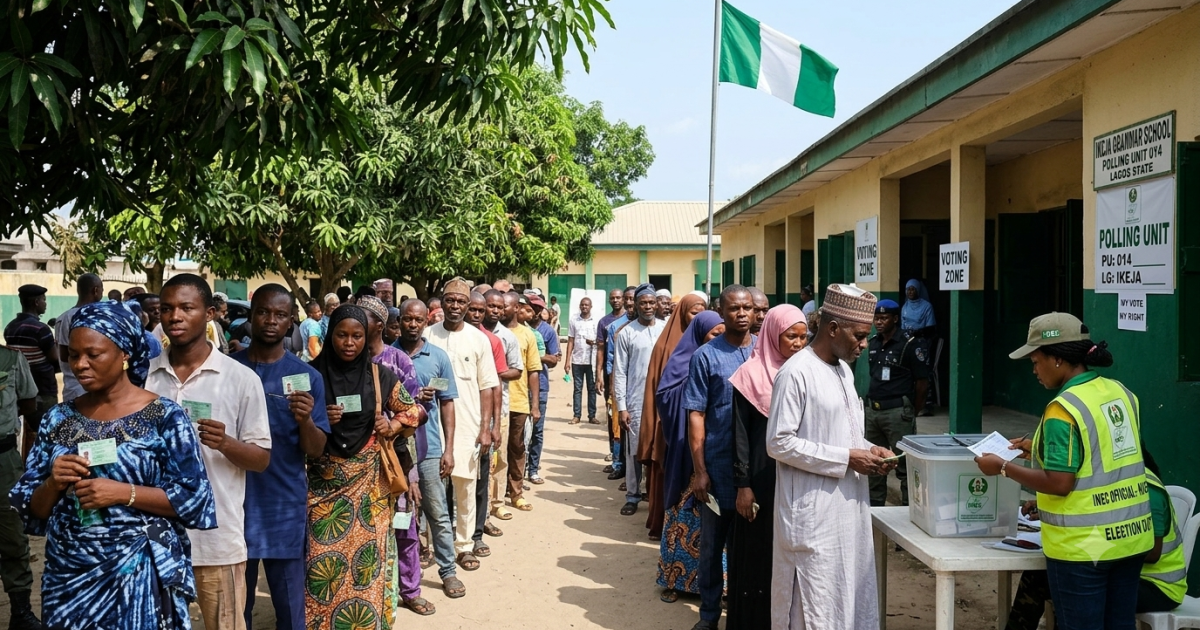
📌 Quick Summary: Nigeria’s 2027 general elections are confirmed for Saturday 16 January 2027 (Presidential and National Assembly) and Saturday 6 February 2027 (Governorship and State Assembly). These dates are set by INEC under the Electoral Act 2026 signed by President Tinubu in February 2026. You need a valid PVC to vote. This is the complete plain-language guide — the dates, who is on the ballot, what has changed under the new Electoral Act, who can vote, what you need on election day, and the full 2027 election timeline.
Nigeria is 20 weeks away from the most consequential election since 2023. The 2027 general elections — now confirmed for January and February under a completely new Electoral Act — will determine who governs Africa’s most populous country for the next four years, who sits in the Senate and House of Representatives, and who governs Nigeria’s 36 states. For the first time since Nigeria’s return to democracy in 1999, the presidential election will hold in January rather than February. Everything has moved earlier. The campaign season has already started. And if you have not checked your PVC status yet, the window to act is narrowing. Here is everything you need to know.
The 2027 Nigeria Election Dates: Complete Official Schedule
| Election | Date | Day | What Is Being Decided |
| Presidential Election | 16 January 2027 | Saturday | President and Vice President of Nigeria |
| National Assembly Elections | 16 January 2027 | Saturday | 109 Senate seats + 360 House of Representatives seats |
| Governorship Elections | 6 February 2027 | Saturday | Governors for all 36 states (where terms expire) |
| State Assembly Elections | 6 February 2027 | Saturday | State House of Assembly members across 36 states |
These dates are confirmed by INEC’s official revised timetable published on 26 February 2026, following the signing of the Electoral Act 2026 by President Bola Tinubu on 18 February 2026. The dates replaced the earlier schedule which had placed the presidential election on 20 February 2027 — moved forward primarily to avoid coinciding with the Ramadan fasting period.
Why January? The Electoral Act 2026 Explained in Plain Language
The Electoral Act 2026 — which replaced the Electoral Act 2022 — is the legal foundation for the 2027 elections. It was signed into law on 18 February 2026 and introduced several significant changes that directly affect voters, candidates, and political parties. Here is what changed and what it means for ordinary Nigerians.
Change 1: Elections Now Hold Earlier
The new law’s adjusted statutory timelines mean elections must be held earlier in the electoral cycle — producing the January 2027 presidential date rather than the February date Nigerians have been used to since 1999. This is the first time since Nigeria’s return to democracy that Nigerians will vote for a president in January.
Change 2: You Can Now Download and Print Your Voter Card
One of the most practically significant changes in the Electoral Act 2026: voters can now download their voter card directly from INEC’s website rather than depending entirely on physical PVC collection. This is intended to reduce the distribution bottlenecks that left millions of Nigerians unable to collect their PVCs before past elections. The downloadable voter card serves the same function as the physical PVC for accreditation purposes at polling units. Physical PVCs remain valid and can still be collected at INEC LGA offices.
Change 3: Voter Registration ID Requirements Narrowed
The new law limits the documents acceptable for voter registration to three: a Birth Certificate, a Nigerian Passport, or a National Identification Number (NIN). National ID cards and Driver’s Licences have been removed from the list of acceptable registration documents. Note: this affects new registrations — if you already registered using a Driver’s Licence in 2023 or earlier, your existing registration remains valid.
Change 4: No More Delegate Primaries — Only Direct Primaries or Consensus
Section 84(2) of the Electoral Act 2026 abolishes indirect primaries — the delegate-based system that allowed small groups of party members to select candidates on behalf of the wider party. All parties must now nominate candidates through direct primaries (where all registered party members vote) or consensus. This is the most significant change for Nigerian politics: it was the delegate system that enabled godfathers and money to dominate candidate selection. Whether direct primaries will be properly implemented in 2027 is a different question — but the legal requirement now exists.
Change 5: Vote-Buying Now Carries a 10-Year Election Ban
Section 22 of the Electoral Act 2026 introduces a mandatory 10-year ban from contesting any election in Nigeria for anyone convicted of vote-buying or the illegal trading of Permanent Voter Cards. The minimum fine for this offence is ₦5 million, up to two years imprisonment, or both — in addition to the 10-year electoral ban. This is significantly more punitive than the 2022 Act’s provisions and is intended to deter the widespread vote-buying that characterised the 2023 elections.
Change 6: Election Funds Must Be Released 6 Months Before Election Day
The Electoral Act 2026 requires that election funds due to INEC be released at least six months before any general election — meaning by July 2026 for the January 2027 presidential election. Under the 2022 Act, the requirement was 12 months — a provision that was consistently violated. The six-month window is shorter but is intended to be more practically enforceable.
Who Is on the Ballot in 2027?
| Position | Confirmed or Likely Candidates | Party |
| President | Bola Tinubu (incumbent, seeking re-election) | APC |
| President | Atiku Abubakar | ADC (formerly PDP) |
| President | Peter Obi | NDC (formerly Labour Party) |
| President | Rabiu Kwankwaso (running with Atiku under ADC) | ADC |
| Senate | 109 seats — all 36 states and FCT elect 3 senators each | Multiple parties |
| House of Representatives | 360 seats across all federal constituencies | Multiple parties |
| Governorship | All 36 state governors up for election | Multiple parties |
Campaign for presidential and National Assembly elections officially began on 19 August 2026 under INEC’s timetable. Governorship and State Assembly campaigns begin on 9 September 2026. All campaigns must end 24 hours before election day — meaning presidential campaigns must stop by 15 January 2027.
Who Can Vote in the 2027 Nigeria Election?
To vote in the 2027 general elections, you must meet all four of the following conditions:
| Condition | Details |
| Nigerian citizenship | You must be a Nigerian citizen |
| Age 18 or above | You must be at least 18 years old on election day (16 January 2027) |
| Registered voter | Your name must appear on INEC’s register of voters. The CVR exercise closed on 30 August 2026 — no new registrations are possible before the 2027 elections |
| Valid voter card | You must present your PVC (physical) or your downloadable voter card on election day for BVAS accreditation |
What to Bring on Election Day
| Item | Required? | Notes |
| Permanent Voter Card (PVC) — physical | Yes (or downloadable alternative) | The primary accreditation document. Collect from your INEC LGA office if you have not done so |
| Downloadable Voter Card | Alternative to physical PVC | Available from INEC portal under the Electoral Act 2026. Check inecnigeria.org for instructions |
| Nothing else is required | — | Your PVC or downloadable card is sufficient. You do not need to bring any other ID to the polling unit |
The Complete 2027 Election Timeline: Key Dates You Need to Know
| Date | Activity |
| 18 February 2026 | Electoral Act 2026 signed into law by President Tinubu |
| 26 February 2026 | INEC releases revised 2027 election timetable |
| 23 April – 30 May 2026 | Party primaries (including dispute resolution) |
| 27 June – 11 July 2026 | Presidential and NASS nomination form submission |
| 30 August 2026 | Continuous Voter Registration (CVR) exercise ends |
| 19 August – 14 January 2027 | Official campaign period for Presidential and NASS elections |
| 9 September – 4 February 2027 | Official campaign period for Governorship and State Assembly elections |
| 18 October 2026 (approx.) | 90-day voter registration cutoff before presidential election |
| 15 January 2027 | Presidential and NASS campaigns must end (24 hours before election) |
| 16 January 2027 | Presidential and National Assembly Elections |
| 4 February 2027 | Governorship and State Assembly campaigns must end |
| 6 February 2027 | Governorship and State Assembly Elections |
| 29 May 2027 | Inauguration Day — new President takes office |
What Is Different About This Election Compared to 2023?
Three things make 2027 structurally different from 2023. First: the January date is unprecedented — Nigerians will be voting for a president during the harmattan season for the first time since 1999. Voter turnout in January, with shorter daylight hours and the post-Christmas economic reset, may behave differently from February patterns that campaigns have historically been built around. Second: the opposition landscape has reorganised significantly. Atiku Abubakar is now running under the ADC alongside Rabiu Kwankwaso, consolidating the northern opposition vote that was split in 2023. Peter Obi has moved to the NDC. The three-way race of 2023 — APC, PDP, Labour Party — is being replaced by a different three-way configuration with different regional dynamics. Third: the downloadable voter card option is new and untested at scale. If INEC’s implementation is smooth, it could significantly increase the number of Nigerians able to vote — particularly the younger registered voters who never collected their physical PVCs.
Frequently Asked Questions
When is the 2027 presidential election in Nigeria?
Saturday, 16 January 2027. This is the official date confirmed by INEC under the Electoral Act 2026. The Presidential and National Assembly elections hold simultaneously on this date.
When is the 2027 governorship election in Nigeria?
Saturday, 6 February 2027. Governorship and State House of Assembly elections across all 36 states hold on this date — three weeks after the presidential election.
Can I still register to vote for the 2027 election?
No. The Continuous Voter Registration (CVR) exercise closed on 30 August 2026. New registrations are no longer possible before the 2027 elections. If you did not register during the CVR window, your next opportunity will be ahead of the 2031 general elections.
Do I need a PVC to vote in 2027?
Yes — but the Electoral Act 2026 now allows voters to download and print their voter card from INEC’s portal as an alternative to the physical PVC. Both the physical PVC and the downloadable voter card are valid for accreditation at polling units using INEC’s BVAS machines.
What changed about Nigerian elections under the Electoral Act 2026?
Six main changes: elections moved to January (from February), voters can now download voter cards, registration ID requirements were narrowed to Birth Certificate/Passport/NIN only, party primaries must now be direct (no more delegates), vote-buying carries a new 10-year election ban, and election funds must be released to INEC 6 months before election day.
Who is running for president in 2027?
Confirmed candidates as at August 2026: President Bola Tinubu (APC, incumbent seeking re-election), Atiku Abubakar (ADC, running with Kwankwaso), and Peter Obi (NDC). Additional candidates may emerge as INEC’s final candidate list will be published 60 days before election day — by approximately 17 November 2026.
What is the INEC contact number for election queries?
INEC Contact Centre: 0700 000 4632. You can also check your voter status and polling unit at cvr.inecnigeria.org/vvs.
Sources
- INEC Official Revised 2027 Election Timetable — inecnigeria.org — 26 February 2026
- Electoral Act 2026 — signed 18 February 2026 — full text at inecnigeria.org
- INEC Statement by National Commissioner Mohammed Kudu Haruna — February 2026
Last updated: 31 August 2026 · NaijaSabi Civic Desk. Candidate information reflects confirmed declarations as at August 2026 and will be updated as the final INEC candidate list is published.
How to Prepare: Your 2027 Election Checklist
With 20 weeks to election day, here is a practical checklist every Nigerian voter should work through before January 2027. First: check your PVC status today at cvr.inecnigeria.org/vvs — if it shows Verified, go and collect your physical card this week or download it from the INEC portal. If it shows Pending, set a reminder to check again in 30 days and follow up with your INEC LGA office if still unresolved by October. Second: confirm your polling unit — your polling unit is shown on your voter card and on the INEC portal. If you transferred your registration during the CVR exercise, confirm your new polling unit before election day. Turning up at the wrong polling unit on 16 January 2027 means you cannot vote, regardless of having your PVC. Third: note the campaign blackout — all presidential campaigns must stop by midnight on 15 January 2027. Any political activity on election morning is illegal and should be reported to INEC or the Nigerian Police Force. Fourth: plan your journey to your polling unit — polling units open at 8am and close when the last person in the queue has voted, but no later than a reasonable closing time set by the presiding officer. In past elections, queues at busy urban polling units have stretched to four or five hours. Arriving early, knowing your route, and planning around potential transport disruptions on election morning will determine whether your vote is cast or not.
0 Comments
No comments yet. Be the first to share your thoughts!