




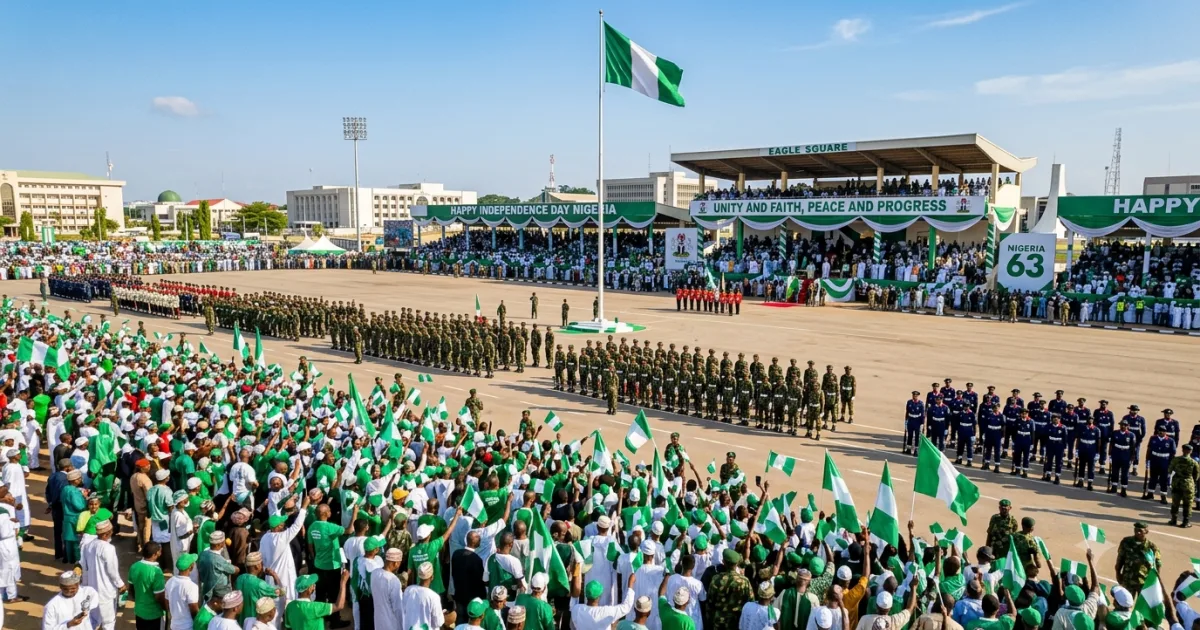
📌 Quick Summary: Nigeria’s 66th Independence Day falls on Thursday 1 October 2026 — a federal public holiday. October 1 marks the day Nigeria gained independence from British rule in 1960. President Tinubu will deliver a nationwide broadcast at 7am on NTA and all major channels. With Independence Day falling on a Thursday in 2026, many Nigerians will enjoy a four-day weekend if they take Friday October 2 off. This complete guide covers the history of October 1, what the day means in 2026, the official programme of events, what is open and closed, travel considerations, and where to celebrate across Nigeria.
On 1 October 1960, Nigeria’s first Prime Minister, Sir Abubakar Tafawa Balewa, received the instruments of independence from the British colonial government at midnight in Lagos — and the green-white-green flag of the new Federal Republic rose for the first time over the largest black nation on earth. Sixty-six years later, October 1, 2026 arrives as a Thursday public holiday in a Nigeria that looks very different from 1960 but is still wrestling with versions of the same fundamental questions: How do we build a nation that works for all its people? How do we convert extraordinary natural and human resources into shared prosperity? What does it mean to be Nigerian? The 66th anniversary is not just a public holiday. It is a national reckoning point — an annual moment when those questions are asked loudest, the answers are debated most openly, and the promise of 1960 is measured against the reality of the present.
Nigeria Independence Day 2026: Key Facts
| Date | Thursday 1 October 2026 |
| Anniversary | 66th Independence Anniversary |
| Day Nigeria gained independence | 1 October 1960 (from the United Kingdom) |
| Holiday type | Federal public holiday — applies nationwide across all 36 states and FCT |
| Tinubu nationwide broadcast | 7:00am WAT — NTA, Channels TV, TVC, AIT, and all major broadcast channels |
| Official parade | Presidential Villa, Abuja — 10:00am (subject to confirmation from OSGF) |
| Long weekend potential | Thursday + Friday Oct 2 (if taken off) = 4-day weekend (Thu–Sun) |
| Offices closed | Federal and state government offices, banks, most businesses |
| Schools | Closed — October 1 falls during the third term break period |
The History of October 1: What Nigerians Are Celebrating
Nigeria’s independence from British colonial rule did not come suddenly. It was the result of decades of activism, nationalist organising, and political negotiation by figures who understood that self-government was not a gift the colonial power would volunteer — it had to be demanded, organised, and won. The journey began formally in 1944 when Herbert Macaulay and Dr Nnamdi Azikiwe co-founded the National Council of Nigeria and the Cameroons (NCNC) — the first major pan-Nigerian political organisation. It accelerated through the 1950s with constitutional conferences in London, the Richard’s Constitution of 1946, the Macpherson Constitution of 1951, and finally the independence negotiations of 1957 to 1960 that produced the framework for self-government.
At midnight on 30 September into 1 October 1960, in front of 2,000 guests at Lagos’s Tafawa Balewa Square — then called Race Course — the Union Jack was lowered and Nigeria’s green-white-green flag rose. Princess Alexandra of the United Kingdom represented Queen Elizabeth II at the ceremony. The first Prime Minister, Alhaji Sir Abubakar Tafawa Balewa, gave the independence address. Nigeria became the most populous independent African nation — a role it has never relinquished.
Nigeria at 66: What Has Changed, What Has Not
What Has Changed
In 1960, Nigeria’s population was approximately 45 million. In 2026, it is approximately 237 million — the seventh-largest national population on earth and the largest in Africa. Nigeria’s GDP, which was negligible at independence, is now Africa’s largest — over $500 billion at official exchange rates in 2025. Nigeria has produced Nobel laureates (Wole Soyinka, 1986), global business leaders, world-class athletes, and a diaspora of over 17 million people contributing to economies worldwide. Nollywood — born in 1992 — is now the world’s second-largest film industry by volume. Afrobeats is a global genre. Nigerian food, fashion, and culture are studied and celebrated internationally. The country that was born in 1960 has produced remarkable things in 66 years.
What Has Not Changed
The structural questions that Nigerian nationalists debated in 1960 — how to share power and resources fairly among a diverse federation, how to build institutions that outlast individual leaders, how to translate oil wealth into broad-based prosperity — remain unresolved in 2026. Nigeria’s electricity generation per capita is lower today than it was in 1980. Its roads, outside of a handful of recently built expressways, remain inadequate for a country of 237 million. Its healthcare infrastructure — as the 2026 Lassa fever outbreak demonstrates — struggles to manage endemic diseases that are well within the capacity of better-resourced health systems to control. October 1 is the day Nigerians are permitted — encouraged — to hold both truths simultaneously: pride in what the country has produced, and honest reckoning with what it has not yet become.
The Official 2026 Independence Day Programme
Based on the established pattern of Nigeria’s Independence Day celebrations under the Tinubu administration, the 2026 programme is expected to follow this structure. The Office of the Secretary to the Government of the Federation (OSGF) will publish the official detailed programme approximately two weeks before October 1 — check osgf.gov.ng for the confirmed schedule.
| Time | Activity | Where |
| Friday 25 September | Special Jumu’ah prayer at National Mosque | Abuja National Mosque, 1pm |
| Sunday 27 September | Inter-denominational church service | National Christian Centre, Abuja, 10am |
| Thursday 1 October, 7am | President Tinubu nationwide broadcast | NTA, Channels TV, TVC, AIT — all major channels |
| Thursday 1 October, 10am | Official anniversary parade (subject to OSGF confirmation) | Presidential Villa, Abuja |
| 1–3 October | State-level celebrations, cultural displays, parades | All 36 state capitals |
Note on the parade: The Tinubu government cancelled the Independence Day parade in both 2025 and 2023, citing various reasons. Whether the full military parade returns for the 66th anniversary in 2026 has not been confirmed as at the date of this publication. Check OSGF’s official communications closer to October 1 for confirmation.
What Is Open and Closed on October 1, 2026
| Category | October 1 Status | Notes |
| Federal government offices | Closed | All federal ministries, departments, and agencies closed |
| State government offices | Closed | All state government offices closed nationwide |
| Commercial banks | Closed | All Nigerian commercial bank branches closed. ATMs remain operational. Mobile and internet banking available. |
| Schools (public) | Closed | October 1 falls during the third term holiday break period in 2026 |
| Markets | Partially open | Major markets in most Nigerian cities operate at reduced capacity or close on public holidays — check your local market |
| Supermarkets and malls | Open | Most major supermarkets and shopping malls remain open on public holidays — check specific locations |
| Petrol stations | Open | Most filling stations remain open on public holidays — NNPC-operated stations typically maintained |
| Hospitals and pharmacies | Emergency services open | Government hospitals operate emergency/casualty departments. Pharmacies vary — check your nearest |
| Airports | Open | Nigerian airports operate on public holidays — check your airline for specific flight status |
| Restaurants and hotels | Open | Most restaurants, hotels, and hospitality businesses remain open — Independence Day is a commercial opportunity for them |
The Four-Day Weekend: Travel and Events Planning
October 1 falls on a Thursday in 2026. For Nigerians who take Friday October 2 off — either through annual leave, flexible work arrangements, or working in sectors that observe the post-holiday Friday — this creates a four-day weekend running from Thursday October 1 through Sunday October 4. This coincides with the expected BBNaija Season 11 finale on Sunday October 4, making the first weekend of October 2026 one of the most event-packed in recent Nigerian cultural history.
Travel: What to Expect
Interstate transport fare increases are standard around Nigerian public holidays — prices on the Lagos-Abuja, Lagos-Port Harcourt, and Lagos-Onitsha routes typically rise 30 to 60 percent in the 48 hours before and after a long weekend. Book your travel early if you are planning to move between cities over the October 1 weekend. Flight prices on domestic routes — particularly Lagos to Abuja, Lagos to Enugu, and Lagos to Port Harcourt — are likely to spike. Book before September 20 to secure the best fares.
Events in Lagos
Lagos typically hosts several Independence Day events — concerts, cultural exhibitions, food festivals, and private parties. Lagos State Government typically organises a public event at Tafawa Balewa Square or another major Lagos venue. Watch Lagos State Government’s official social media channels (@followlasg) for confirmed 2026 event listings. Private event organisers typically announce independence weekend concerts and parties in September — check Eventbrite Nigeria and Tickets.ng for confirmed events.
Events in Abuja
The official federal government programme takes place in Abuja — the presidential broadcast, the official parade (if held), and ministerial events. The FCT Administration typically organises cultural events at the National Arts Theatre and other Abuja venues. Check the FCT Administration’s official channels for confirmed 2026 event listings.
Tinubu’s Expected Themes for the 2026 Independence Day Broadcast
Based on the themes of his 64th (2024) and 65th (2025) Independence Day broadcasts, President Tinubu’s 66th anniversary address is likely to cover: progress on his economic reform programme including fuel subsidy removal outcomes, electricity sector investment, and industrial policy; security — the status of the northeast, banditry in the northwest, and kidnapping in the north-central; the 2027 elections and national unity; and a call for continued patience and national effort. His 2025 address acknowledged economic struggles while urging patience — the 2026 address comes in an election year environment that will likely shape its political tone. Watch NTA live from 7am on October 1 for the full broadcast.
Nigeria’s Independence Day: A Quick History Timeline
| Year | Milestone |
| 1914 | British amalgamation of Northern and Southern Nigeria creates a single colonial entity |
| 1944 | NCNC founded by Herbert Macaulay and Nnamdi Azikiwe — beginning of organised independence movement |
| 1954 | Lyttleton Constitution establishes a federal structure — Nigeria’s regions gain significant autonomy |
| 1 October 1960 | Nigeria gains independence. Sir Abubakar Tafawa Balewa becomes first Prime Minister. Dr Nnamdi Azikiwe becomes first Governor-General |
| 1 October 1963 | Nigeria becomes a republic. Dr Nnamdi Azikiwe becomes first President |
| 1966–1970 | Military coups, civil war (Biafra), and the beginning of military rule |
| 1 October 1979 | Nigeria returns to civilian rule under President Shehu Shagari |
| 1983–1999 | Military rule returns — Buhari, Babangida, Abacha, Abubakar |
| 29 May 1999 | Nigeria returns to democracy. Olusegun Obasanjo inaugurated — democracy celebrated annually on May 29 |
| 1 October 2026 | Nigeria’s 66th Independence Anniversary under President Bola Ahmed Tinubu |
Frequently Asked Questions
When is Nigeria’s Independence Day in 2026?
Thursday 1 October 2026 — Nigeria’s 66th Independence Anniversary. It is a federal public holiday nationwide.
Why does Nigeria celebrate independence on October 1?
Nigeria gained independence from British colonial rule on 1 October 1960. At midnight on September 30 into October 1, the Union Jack was lowered and the Nigerian flag raised in Lagos, marking the birth of an independent Nigerian state under Prime Minister Sir Abubakar Tafawa Balewa.
Is October 1 a public holiday in Nigeria in 2026?
Yes. October 1 is a confirmed federal public holiday in Nigeria every year. Government offices, banks, and most businesses close. The holiday applies nationwide across all 36 states and the FCT.
What is Nigeria’s 2026 Independence Day theme?
The official 2026 theme will be announced by the Office of the Secretary to the Government of the Federation (OSGF) approximately two to three weeks before October 1. Check osgf.gov.ng for the confirmed theme.
Will there be an Independence Day parade in Nigeria in 2026?
The Tinubu government cancelled the Independence Day parade in 2025. Whether a full military and civilian parade returns for the 66th anniversary in 2026 has not been confirmed as at August 2026. Check OSGF official communications closer to October 1 for the confirmed programme.
What time is President Tinubu’s Independence Day broadcast in 2026?
7:00am WAT on Thursday 1 October 2026, broadcast on NTA, Channels TV, TVC, AIT, and all major Nigerian television and radio channels. The broadcast typically runs for approximately 15 to 20 minutes.
Sources
- Office of the Secretary to the Government of the Federation — osgf.gov.ng — Independence Day programme announcements
- Ministry of Interior — interior.gov.ng — Public holiday declarations
- Wikipedia — “Independence Day (Nigeria)” — en.wikipedia.org
- Full text of President Tinubu’s 65th Independence Day broadcast — 1 October 2025 — naltf.gov.ng
Last updated: 02 September 2026 · NaijaSabi Civic Desk. Official 2026 Independence Day programme details will be published by OSGF at osgf.gov.ng approximately two weeks before October 1. This article will be updated with confirmed event listings when published.


0 Comments
No comments yet. Be the first to share your thoughts!