




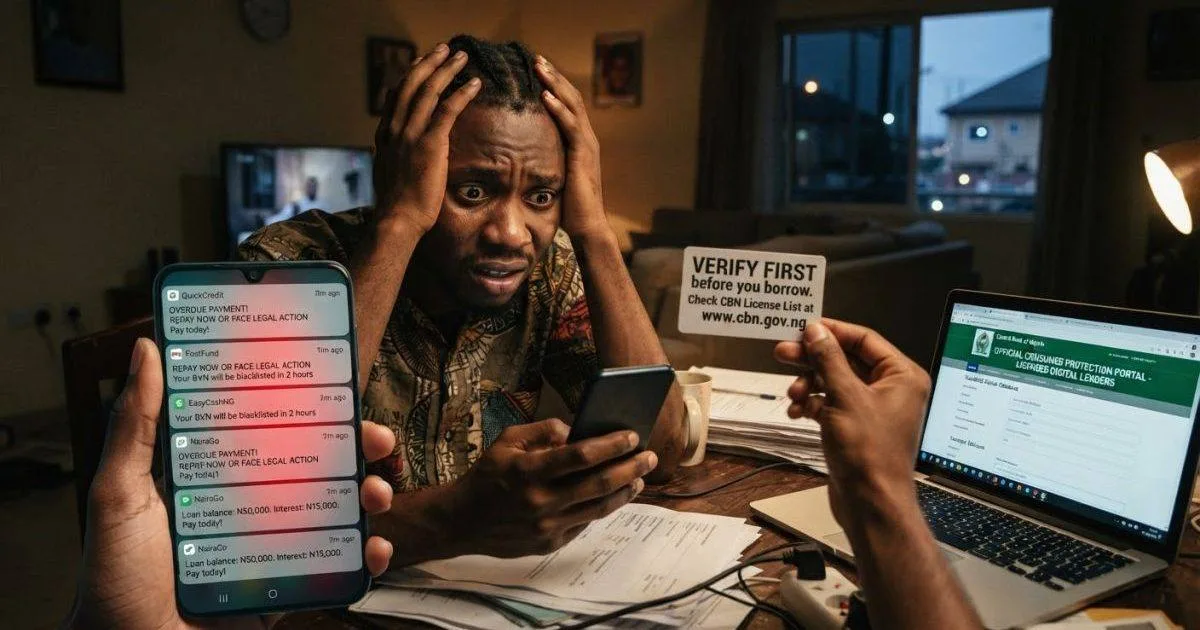
📌 Quick Summary: Digital lenders in Nigeria must now be approved by the Federal Competition and Consumer Protection Commission (FCCPC) under the Digital, Electronic, Online or Non-Traditional Consumer Lending (DEON) Regulations, 2025. Unregistered lenders are not allowed to operate, and companies that break the rules face fines of up to ₦100 million. On 20 July 2026, the Federal High Court in Lagos affirmed the FCCPC’s authority and lifted an interim order that had paused enforcement. Before you borrow, confirm the app’s company is approved on the FCCPC’s official list — old lists circulating online are out of date. If an app harasses you or your contacts, screenshot everything, report to the FCCPC, report privacy abuse to the Nigeria Data Protection Commission and report threats or defamation to the police. A harassment complaint does not cancel a genuine debt, so deal with repayment separately.
A lot of Nigerians have borrowed from a loan app at least once — a few thousand naira to cover rent, school fees or an emergency. Many have also had the nightmare version: a flood of calls, abusive messages and, worst of all, messages sent to friends, relatives and colleagues. In 2025 and 2026, the rules changed. This NaijaSabi guide explains what the new regulations say, how to check whether a loan app is approved, what lenders are not allowed to do, and exactly what to do if one crosses the line.
| Fact | Detail |
| Regulator | Federal Competition and Consumer Protection Commission (FCCPC) |
| Rules | Digital, Electronic, Online or Non-Traditional Consumer Lending (DEON) Regulations, 2025 |
| Who must register | Digital lenders, fintechs, loan apps and others giving unsecured consumer credit through digital channels |
| Penalties for breaking the rules | Companies: up to ₦100 million; individuals: up to ₦50 million (per one law-firm analysis) |
| Court ruling | 20 July 2026 — Federal High Court, Lagos, dismissed a challenge by the Wireless Application Service Providers Association of Nigeria and lifted the interim order pausing enforcement |
| Lending without your consent | Banned — lenders cannot send you a loan you did not request |
| Report a lender | FCCPC complaint channels (fccpc.gov.ng) |
| Privacy abuse | Nigeria Data Protection Commission |
| Does harassment cancel your debt? | No — you still owe a genuine loan, but you also keep your rights |
What Changed: The DEON Regulations and the 2026 Court Ruling
For years, Nigerian loan apps operated in a grey area. The FCCPC introduced interim guidelines in 2022 and began delisting offenders, but harassment, hidden charges and data misuse continued. The DEON Regulations replaced those interim guidelines with a formal framework. According to the Premium Times and law-firm summaries:
- Mandatory registration. Digital lenders must register with the FCCPC and meet standards on transparency, fair interest and ethical debt collection. No digital lending is allowed without FCCPC approval.
- No automatic lending. The regulations ban lending without the borrower’s consent — an app cannot simply send you money you never asked for and then charge you for it.
- No misleading advertising, and clear loan terms. Lenders must make the loan terms clear.
- Data protection. Lenders must comply with Nigeria’s data protection law, including the Nigeria Data Protection Act 2023.
- Credit bureau reporting. Lenders may be required to send borrower data to recognised credit bureaus.
- Penalties. A company that breaks the rules can be fined up to ₦100 million, and a natural person up to ₦50 million, according to one law-firm analysis. The Premium Times report also refers to a percentage-based alternative to the ₦100 million figure, so check the regulation text for the exact formula.
A note on dates. Sources differ on the exact start date: some say the regulations took effect on 21 July 2025, the date they were gazetted, while another law-firm summary says they came into effect on 3 September 2025, when the FCCPC publicly announced them. A further point: the enforcement timeline was disrupted when a trade association, the Wireless Application Service Providers Association of Nigeria (WASPAN), challenged the regulations in court. On 20 July 2026, the Federal High Court in Lagos affirmed the FCCPC’s authority to regulate digital lending, dismissed that challenge and lifted the interim order, allowing the FCCPC to resume full implementation.
What Loan Apps Are and Are Not Allowed to Do
Media coverage and legal commentary describe the following protections. One honest caveat first: a legal analysis of the regulations observes that there is no separate, explicit “no harassment” clause, but that lenders are barred from acting inconsistently with agreed terms or exploiting consumers and that the FCCPC Act prohibits unconscionable conduct. Other reports describe the rules as banning defamatory messages to borrowers’ contacts. In practice, regulators and commentators treat harassment and shaming as violations, which is why you should report them.
| Lenders SHOULD NOT | Lenders MUST |
| Lend to you without your request or consent | Be registered with the FCCPC before offering loans |
| Send defamatory or shaming messages to your contacts, friends, family or employer | Give clear loan terms — the amount, the cost and the repayment date |
| Use misleading advertising about rates or loan size | Protect your personal data and comply with the Nigeria Data Protection Act 2023 |
| Use recovery agents or outside vendors without the FCCPC’s knowledge | Handle complaints and keep records of lending transactions |
| Treat your contact list or photos as collateral or a pressure tool | Report borrower data to credit bureaus in line with regulatory requirements |
Google also tightened its own rules: in April 2023, Google announced that loan apps on the Play Store would lose access to users’ contacts and photos from 31 May 2023 and that lending apps would need regulatory approval to stay on the store. That helped, but the FCCPC’s chief said at the time that the apps still harassing customers were often not on Google at all, and that many used names similar to registered apps.
How to Check Whether a Loan App Is Approved
- Find the company behind the app. Look at the app’s store listing, website and the “About” and terms pages for the registered company name. Approval is given to a company, not just an app name. An app with no named company is a warning sign.
- Check the FCCPC’s official list. Go to the FCCPC’s website (fccpc.gov.ng) and look for its register or list of approved digital lenders. Match the company name and the app name shown there to what you are about to install.
- Ignore old lists. Lists with figures such as 154, 164, 180 or 211 approved apps circulate widely on blogs and WhatsApp, but those numbers come from updates published between 2023 and 2025. Approvals, conditional approvals and delistings change, so rely only on the FCCPC’s current list, not a screenshot someone forwarded.
- Check the company too. A real lender should be a registered Nigerian company with a physical address, working customer-care channels and a privacy policy. You can look up registered companies through the CAC.
- If you cannot verify it, do not borrow from it. Registered lenders have nothing to hide; unverifiable ones often do.
Red Flags Before You Borrow
- It asks for access to your contacts, photos or messages as a condition of getting a loan. Pressure on your contact list is the main tool used in harassment.
- You are asked to pay a fee first before any money reaches you — “insurance”, “processing”, “activation” or “verification”. This is a classic scam, not lending.
- The real cost is hidden. A short tenor with a high charge, or terms that change after you accept, break the clear-disclosure expectation. Always find the total you will repay and the exact due date before accepting.
- No identifiable company, address or customer-care contact.
- Pressure and urgency. “Accept in five minutes” is designed to stop you reading the terms.
- A loan you never asked for appears in your account. Automatic lending is prohibited. Do not spend it; report it to the lender and the FCCPC.
Use NaijaSabi’s Loan Calculator to work out what a loan will really cost before you accept.
What to Do If a Loan App Harasses You
- Stay calm and keep the evidence. Screenshot every message, call log, threat and any message sent to your contacts. Note dates, times, phone numbers and the app and company name. Ask friends or relatives who received messages to screenshot them too.
- Do not respond to threats or insults. Reply only through official channels, politely and in writing, if you need to settle the loan. Do not argue by phone.
- Check whether the lender is approved. Use the steps above. If it is unregistered, say so in your complaint — unregistered lending is itself a violation.
- Report to the FCCPC. Use the commission’s official complaint channels on fccpc.gov.ng. Earlier FCCPC announcements reported by the ICIR listed a dedicated email address, lenderstasforce@fccpc.gov.ng, for reporting lender violations — confirm the current complaint address on the FCCPC website before sending. Include the app name, the company, your evidence and what you want done.
- Report data misuse. If the lender accessed or shared your contacts or personal data without proper basis, you can complain to the Nigeria Data Protection Commission under the Nigeria Data Protection Act 2023.
- Report threats and defamation to the police. Messages that threaten you or falsely label you a criminal or thief to your contacts can be reported. NaijaSabi’s guide on reporting a scammer to the EFCC explains how to report financial fraud if the app was a scam rather than a real lender.
- Warn your contacts. A short message — “I am dealing with a lender that is sending false messages; please ignore them and screenshot any you receive” — takes the sting out of the pressure.
- Protect your accounts. Change passwords and revoke the app’s permissions in your phone’s settings, then uninstall it after you have taken your screenshots.
If You Genuinely Owe the Money
Harassment is wrong, but it does not erase a real debt. If you borrowed from an approved lender and have not paid, you still owe it — and the debt can follow you in other ways:
- Your credit record. Lenders can report your repayment history to credit bureaus. A default can make future loans harder to get. See NaijaSabi’s guide on how to check your credit score and credit report in Nigeria to see what a lender will see about you.
- Talk to the lender in writing. If you cannot pay on time, ask for an extension or a repayment plan through official channels and keep a copy of the reply.
- Pay only through the lender’s official channels. Never pay to a personal account or to an “agent” who contacts you, and keep proof of every payment.
- Avoid borrowing from a new app to repay an old one. It is how a small debt becomes an unmanageable one.
Safer Options Than Quick Loan Apps
- Your bank’s regulated loan products or salary advance. These are covered by CBN supervision and banks have formal complaint channels.
- Licensed microfinance banks and established fintech lenders that appear on the FCCPC’s approved list.
- Cooperative societies or employer schemes with transparent terms. See NaijaSabi’s CrediCorp consumer credit scheme guide for one structured option for working Nigerians.
- Business borrowers should see NaijaSabi’s guide to business loans without collateral.
Frequently Asked Questions — Loan Apps Nigeria 2026
How do I know if a loan app is approved in Nigeria?
Find the registered company behind the app, then check the FCCPC’s official list of approved digital lenders on fccpc.gov.ng, matching both the company name and the app name. Do not rely on lists forwarded on WhatsApp or older blog posts that quote numbers such as 154, 164, 180 or 211 approved apps — those reflect updates published between 2023 and 2025, and approvals and delistings have changed since. If you cannot confirm the company and the app on the current official list, do not borrow from it and do not give it access to your phone.
Is loan app harassment illegal in Nigeria?
Harassing borrowers and shaming them to their contacts is treated as a serious violation by Nigerian regulators. Media reports on the FCCPC’s DEON Regulations 2025 say the rules prohibit defamatory messages to a borrower’s contacts, and companies that break the regulations face fines of up to ₦100 million. One legal analysis notes that the regulations contain no standalone “no harassment” clause, but that lenders cannot act inconsistently with agreed terms or exploit consumers, and the FCCPC Act bans unconscionable practices. Either way, you should keep evidence and report to the FCCPC, and report threats or defamation to the police.
Where do I report a loan app in Nigeria?
Report to the FCCPC through its official complaint channels at fccpc.gov.ng. Earlier FCCPC announcements reported by the ICIR listed lenderstasforce@fccpc.gov.ng for lender violations — confirm the current address on the FCCPC website before you send anything. Report misuse of your contacts or personal data to the Nigeria Data Protection Commission, and report threats or false accusations to the police. Include the app name, the company, screenshots, call logs and dates in every complaint.
Can a loan app contact my family and friends?
Not to shame or pressure you. Reports on the DEON Regulations say lenders are barred from sending defamatory messages to a borrower’s contacts, and they are expected to comply with the Nigeria Data Protection Act 2023, which limits how personal data can be used. Google’s Play Store policy has also removed loan apps’ ability to access users’ contacts and photos since 31 May 2023. If an app contacted your family or colleagues about your loan, screenshot the messages and report it to the FCCPC and the Nigeria Data Protection Commission.
What happens if I do not repay a loan app?
You still owe a genuine loan from an approved lender, and consequences can follow: late charges under the agreed terms, formal recovery through lawful channels and a negative entry that can be reported to credit bureaus and make future borrowing harder. What the lender may not do is harass you, defame you to your contacts or misuse your data. Pay only through official channels, ask for a repayment plan in writing and keep every receipt. If the lender is not registered, tell the FCCPC — unregistered lending is itself prohibited.
Did the 2026 court ruling change anything for borrowers?
Yes. On 20 July 2026, the Federal High Court in Lagos affirmed the FCCPC’s authority to regulate digital lending, dismissed a challenge by the Wireless Application Service Providers Association of Nigeria and lifted the interim order that had paused enforcement of the DEON Regulations. For borrowers, that means the FCCPC can resume full enforcement and unregistered or abusive lenders face real regulatory risk. It does not remove your responsibility to repay a genuine loan, but it strengthens the case for reporting lenders that break the rules.
Sources
- Premium Times — FCCPC issues new regulation to address loan app harassment (3 September 2025) — premiumtimesng.com
- Legal 500 — Demystifying DEON: Your Essential Guide to the FCCPC’s Latest Lending Rules — legal500.com
- Legal 500 — How the FCCPC’s 2025 DEON Regulation Is Reshaping Nigeria’s Digital Lending Landscape — legal500.com
- Legal 500 — Digital Lending Regulations in Nigeria: What Every Loan App Must Know After the FCCPC Court Victory (27 July 2026) — legal500.com
- Aluko and Oyebode — The FCCPC Digital, Electronic, Online and Non-Traditional Consumer Lending Regulations 2025 (penalties) — aluko-oyebode.com
- Orixin Consulting — Analysis of the FCCPC’s DEON Consumer Lending Regulations, 2025 — orixineconsulting.org
- Legit.ng — FCCPC Cracks Down on Loan Apps: 7 Key Rules Reshaping Nigeria’s Digital Lending Market — legit.ng
- ICIR — FCCPC delists two loan apps for violating customers’ privacy (complaint email reported) — icirnigeria.org
- Brandcom.ng — FG to Shut Loan Apps Harassing Nigerians (Google Play policy and FCCPC statements) — brandcom.ng
- FCCPC — official website for the current approved lender list and complaint channels — fccpc.gov.ng
Last updated: 10 October 2026 · NaijaSabi Finance Desk. Regulations, approved-lender lists and complaint channels change — always confirm the current position on the FCCPC’s official website. This article is general information, not legal or financial advice. NaijaSabi is not affiliated with the FCCPC, the Nigeria Data Protection Commission or any lender mentioned.



0 Comments
No comments yet. Be the first to share your thoughts!