

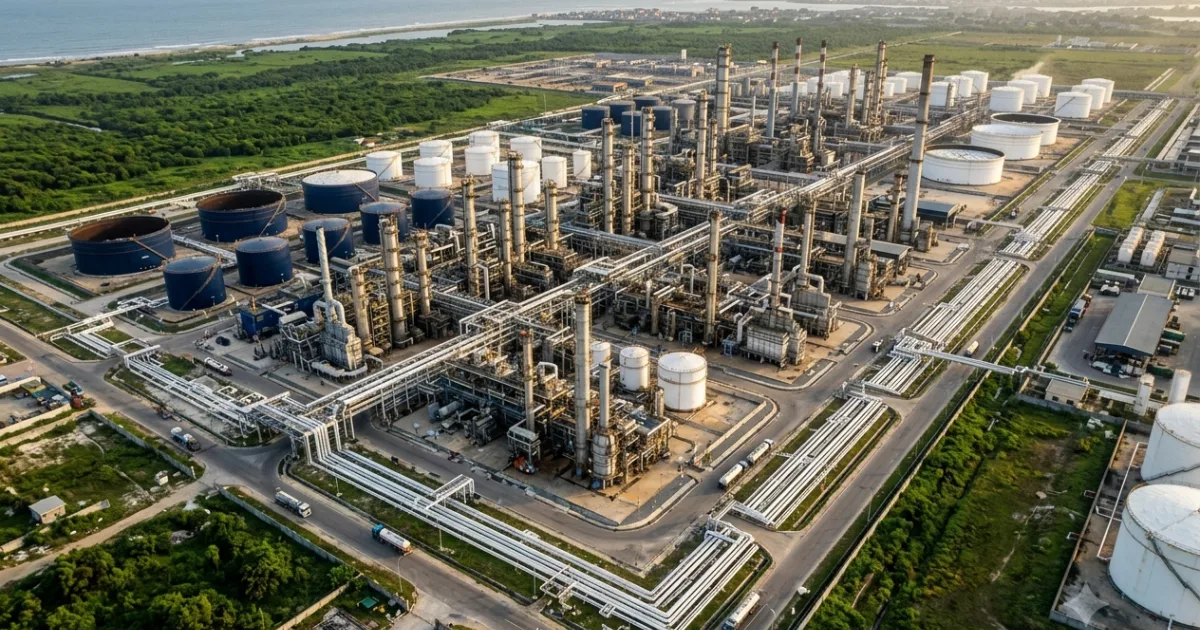
📌 Quick Summary: The Dangote Petroleum Refinery IPO — the largest initial public offering in African history — opened for subscription on Monday, 14 September 2026. The subscription window closes on 13 October 2026. Shares are priced at ₦525 per share. The company is offering 4.1 billion shares to raise approximately ₦2.15 trillion ($1.6 billion). Shares are expected to begin trading on the Nigerian Exchange (NGX) in late November 2026. The refinery — the world’s largest single-train refinery at 700,000 barrels per day — posted an after-tax profit of $1.82 billion in the first half of 2026. This NaijaSabi guide tells you everything Nigerians need to know: what the IPO is, how to buy shares, the risks, and whether this is a good investment for the average Nigerian.
Today is a historic day for Nigeria’s capital market. The Dangote Petroleum Refinery and Petrochemicals IPO subscription opened this morning — and for the first time in history, ordinary Nigerians can own a piece of the $20 billion refinery that has already transformed Nigeria’s fuel landscape. The IPO is the largest in African history. The refinery is the world’s largest single-train oil refinery. The man behind it is Africa’s wealthiest person. And the question on the lips of every Nigerian with any savings is simple: should I buy shares? This NaijaSabi guide gives you the honest, complete picture — the facts, the numbers, the process, and the real risks you need to understand before you put your money in.
| Fact | Detail |
| Company | Dangote Petroleum Refinery and Petrochemicals FZE |
| IPO description | Largest IPO in African history |
| Subscription opens | Monday, 14 September 2026 — TODAY |
| Subscription closes | Tuesday, 13 October 2026 |
| Share price | ₦525 per share (fixed offer price) |
| Shares being offered | 4.1 billion ordinary shares |
| Total IPO size | ~₦2.15 trillion (~$1.6 billion) |
| Green shoe option | 15% — can raise more if oversubscribed |
| Refinery valuation | $40–$49 billion |
| Expected trading start | Late November 2026 on NGX main board |
| H1 2026 after-tax profit | $1.82 billion (vs $476 million loss for all of 2025) |
| Refinery capacity | 700,000 barrels per day — world’s largest single-train refinery |
| Expansion plan | $14.3 billion expansion to 1.4 million bpd by 2029 |
| Exchange | Nigerian Exchange Group (NGX) main board |
What Is the Dangote Refinery IPO — Explained Simply
An IPO — Initial Public Offering — is when a private company sells shares to the public for the first time, listing on a stock exchange. Before today, the Dangote Petroleum Refinery was privately owned by Aliko Dangote, his family’s investment vehicles and institutional investors including the Nigerian National Petroleum Company (NNPC). From today, any Nigerian — any person anywhere in the world — can buy a slice of ownership in the refinery by purchasing shares at ₦525 each through the subscription process.
When you buy shares in an IPO, you become a shareholder — a part-owner of the company. If the company grows and becomes more valuable, your shares become worth more. If the company pays dividends — a share of its profits — you receive a portion based on how many shares you own. If the company performs poorly or the stock market falls, your shares may become worth less than what you paid. This is the fundamental nature of share ownership — the potential for returns comes with real risk.
The Dangote Refinery is not a startup or an unproven business. It is the world’s largest single-train oil refinery, operating at 700,000 barrels per day. It posted an after-tax profit of $1.82 billion in just the first six months of 2026 — compared to a $476 million loss for the entire year of 2025. That turnaround to profitability, combined with Aliko Dangote’s announcement that the refinery now supplies most of Nigeria’s petrol, is what has made this IPO the most anticipated investment event in Nigerian history.
The Numbers — What the Dangote Refinery IPO Tells Us
Here is what the IPO prospectus and official announcements confirm about the financial picture of the Dangote Refinery:
- Revenue growth: Dangote Group revenues have expanded from $3.3 billion to $18 billion over five years — more than a fivefold increase
- Profitability: After years of losses during construction and early operation, the refinery posted a $1.82 billion after-tax profit in H1 2026 alone
- Debt: The refinery carries $3.65 billion in debt — a significant liability, though proportionate to its projected revenue at full capacity
- Valuation: Analysts value the full refinery at $40–$49 billion. At the IPO price of ₦525, the 4.1 billion shares being offered represent a small fraction of this total valuation — meaning the majority of the refinery remains Dangote-owned after the IPO
- Capacity: Current capacity is 700,000 barrels per day. The $14.3 billion expansion aims to double this to 1.4 million barrels per day by 2029 — which Dangote claims will make it the largest refinery in world history, surpassing Reliance Industries’ Jamnagar complex in India (currently 1.24 million bpd)
- Middle East benefit: Aliko Dangote explicitly stated the refinery has profited from supply disruptions linked to Middle East conflicts — exporting jet fuel across Africa and into Europe. He also said investments will be sustainable over the long term regardless of conflict dynamics
- ADNOC interest: The UAE state oil company ADNOC is reportedly interested in investing in the refinery alongside others — a signal of international confidence in the project’s value
How to Buy Dangote Refinery IPO Shares in Nigeria
The subscription is open from today (September 14) to October 13, 2026. Here is how any Nigerian can participate:
Method 1 — Through a Stockbroker (Recommended)
The most reliable way to subscribe for Dangote Refinery IPO shares is through a SEC-registered stockbroker. If you already have a stockbroking account and a CSCS (Central Securities Clearing System) account, contact your broker immediately — subscription has already opened today.
If you do not have a stockbroking account:
- Open an account with a SEC-registered Nigerian stockbroker. Well-known brokers include Stanbic IBTC Stockbrokers, Cardinalstone Securities, ARM Securities, Meristem Securities, Chapel Hill Denham and FBNQuest Securities
- Request a CSCS account — this is your securities holding account in Nigeria’s clearing system. It is where your Dangote shares will be held after the IPO
- Complete your KYC — provide your BVN, NIN, valid ID and bank account details
- Fund your account and instruct your broker to subscribe for the Dangote Refinery IPO at ₦525 per share
- Your broker submits your subscription application before the October 13 deadline
Method 2 — Through Nigerian Banks
Several Nigerian banks are acting as receiving agents for the Dangote Refinery IPO — meaning you can walk into a participating bank branch and fill in a subscription form. Contact your bank’s investment services desk to confirm participation. Payment is typically by bank draft, USSD transfer or online banking to the designated IPO collection account.
Method 3 — Through Digital Investment Platforms
SEC-licensed Nigerian digital investment platforms — including Bamboo, Chaka, Trove, and I-invest — may offer access to the Dangote Refinery IPO through their apps. Check your preferred platform’s app or website for current availability. Ensure any platform you use is SEC-licensed before submitting payment.
Important: verify the official subscription account details from the NGX website (ngxgroup.com) or the Dangote Refinery’s official IPO prospectus before making any payment. Scammers will create fake IPO collection accounts during this subscription window — only pay to accounts confirmed on the official prospectus or your verified broker’s instruction.
What Happens After You Subscribe
- Allotment: If the IPO is oversubscribed (more applications than shares available), IRCC allocates shares proportionally or by ballot. You may receive fewer shares than you applied for, and the balance of your payment is refunded
- Shares credited to CSCS: After allotment, your shares are credited to your CSCS account — typically within 2–4 weeks of the subscription closing
- Trading begins: Shares are expected to begin trading on the NGX main board in late November 2026. From that date, you can sell your shares at market price through your stockbroker, or hold them
- 15% green shoe option: If demand exceeds supply significantly, Dangote can exercise a 15% overallotment option — issuing additional shares to meet demand. This may reduce price pressure after listing
The Real Risks — What Nigerians Must Understand Before Buying
NaijaSabi believes in giving Nigerians the full picture. This is not financial advice — it is an honest breakdown of the risks that any investor in the Dangote Refinery IPO must understand:
- Oil price risk: The refinery’s profitability is closely tied to global crude oil prices and refining margins. A significant fall in global oil prices reduces refinery margins and profitability. The current strong profit ($1.82 billion in H1 2026) partly reflects favourable global conditions including Middle East supply disruptions — conditions that may change
- Naira and forex risk: The refinery earns a significant portion of its revenue in USD (from fuel sales and exports) but reports and pays dividends in naira. Naira depreciation can affect the naira value of returns for domestic investors, even when dollar earnings are strong. Naira appreciation (unlikely but possible) could reduce naira earnings from dollar-denominated revenues
- Expansion execution risk: The $14.3 billion expansion to 1.4 million barrels per day by 2029 is an enormous engineering and financial undertaking. Delays, cost overruns and technical challenges are normal in large infrastructure projects — and the refinery’s construction history (announced 2013, inaugurated 2023) demonstrates that timelines can extend significantly
- Debt load: The refinery carries $3.65 billion in debt. High debt in a capital-intensive industry is not unusual, but it means a significant portion of cash flow services debt before reaching investors as dividends. Understand this before expecting near-term dividend income
- Regulatory and government policy risk: As Nigeria’s dominant domestic refinery, Dangote Refinery operates in a politically sensitive sector. Government fuel pricing policies, import regulations and NNPC-Dangote commercial dynamics could all affect profitability. Nigerian government policy toward the energy sector has historically been unpredictable
- IPO pricing risk: The ₦525 share price is a fixed offer price set by the company. When trading begins in late November, the market price could be higher (profitable for IPO subscribers) or lower (a paper loss). The first-day trading price of any IPO is uncertain — buying at IPO does not guarantee immediate gains
NaijaSabi is not a financial adviser. This article is for informational purposes only and does not constitute investment advice. Consult a qualified Nigerian financial adviser or SEC-registered stockbroker before making any investment decision.
Is the Dangote Refinery IPO a Good Investment for the Average Nigerian?
This is the question every Nigerian is asking — and NaijaSabi will answer it honestly, not with hype.
The case for investing: The Dangote Refinery is a proven, operating, profitable business — not a startup or a promise. Its $1.82 billion H1 2026 profit is real. Its position as Nigeria’s primary domestic fuel supplier gives it structural importance that few businesses in Africa can match. It is backed by Africa’s wealthiest man who has strong incentives to see the refinery succeed. International institutional investors — including reportedly ADNOC — see value in it. For Nigerians who can invest without needing the money back quickly, this is an opportunity to own equity in a generational Nigerian infrastructure asset.
The case for caution: At ₦525 per share, a meaningful investment — say 1,000 shares — costs ₦525,000. That is real money for most Nigerian households. Share prices can fall below the IPO price after listing. Dividends, if any, may take years as the refinery prioritises expansion spending. And all the risks above — oil prices, expansion delays, debt, government policy — are real.
NaijaSabi’s honest view: For Nigerians who have surplus savings — money beyond their emergency buffer and essential commitments — the Dangote Refinery IPO is worth serious consideration as a long-term investment. For Nigerians who would need to borrow money to participate, or who would be investing emergency funds, it is not. Never invest in any IPO, including this one, with money you cannot afford to lose or leave invested for several years.
Frequently Asked Questions — Dangote Refinery IPO Nigeria
How can I buy Dangote Refinery shares in Nigeria?
The Dangote Refinery IPO subscription is open from September 14 to October 13, 2026. To buy shares, contact a SEC-registered Nigerian stockbroker (Stanbic IBTC, Cardinalstone, ARM Securities, Meristem, FBNQuest), open a CSCS account if you do not have one, fund your account and instruct your broker to subscribe at the offer price of ₦525 per share. You can also subscribe through participating Nigerian bank branches acting as receiving agents for the IPO. Verify all payment details from the official NGX website (ngxgroup.com) or the official IPO prospectus before sending any money.
What is the Dangote Refinery share price for the IPO?
The Dangote Petroleum Refinery IPO share price is fixed at ₦525 per share (approximately $0.40 at current exchange rates). This is the price at which all IPO subscribers purchase shares during the September 14 to October 13 subscription window. The market price after trading begins in late November 2026 will be determined by market demand and may be higher or lower than the ₦525 offer price.
When will Dangote Refinery shares start trading on the NGX?
Dangote Refinery shares are expected to begin trading on the Nigerian Exchange (NGX) main board in late November 2026, according to the indicative listing timetable in the IPO prospectus. After the subscription window closes on October 13, allotment of shares takes place, shares are credited to investors’ CSCS accounts, and then listing and trading commences. Monitor the NGX website (ngxgroup.com) for the official listing date announcement.
How much money do I need to buy Dangote Refinery shares?
There is no officially stated minimum subscription amount in the public information available. At ₦525 per share, you could theoretically subscribe for as few shares as your broker permits — some brokers have minimum transaction thresholds. A meaningful participatory investment — for example 100 shares — would cost ₦52,500. One thousand shares would cost ₦525,000. Decide on an amount you are comfortable committing to a long-term equity investment before approaching your broker.
Is buying Dangote Refinery IPO shares safe?
All equity investments carry risk — the Dangote Refinery IPO is no exception. The refinery is a proven, profitable operating business ($1.82 billion after-tax profit in H1 2026) with strong structural advantages as Nigeria’s primary domestic fuel supplier. However, real risks exist including oil price volatility, expansion execution risk, naira currency risk, a $3.65 billion debt load and the uncertainty of post-listing trading prices. The IPO is listed and regulated on the NGX under SEC oversight — it is not a scam or an informal scheme. Whether it is a good investment for your specific financial situation depends on your circumstances, investment horizon and risk tolerance. Consult a SEC-registered financial adviser before investing. This article is for informational purposes only and does not constitute financial advice.
Last updated: 14 September 2026 · NaijaSabi Finance Desk. This article is for informational purposes only and does not constitute financial or investment advice. Always verify current IPO details on the official NGX website (ngxgroup.com) and the official Dangote Refinery prospectus. Consult a SEC-registered Nigerian financial adviser before making investment decisions.



0 Comments
No comments yet. Be the first to share your thoughts!