



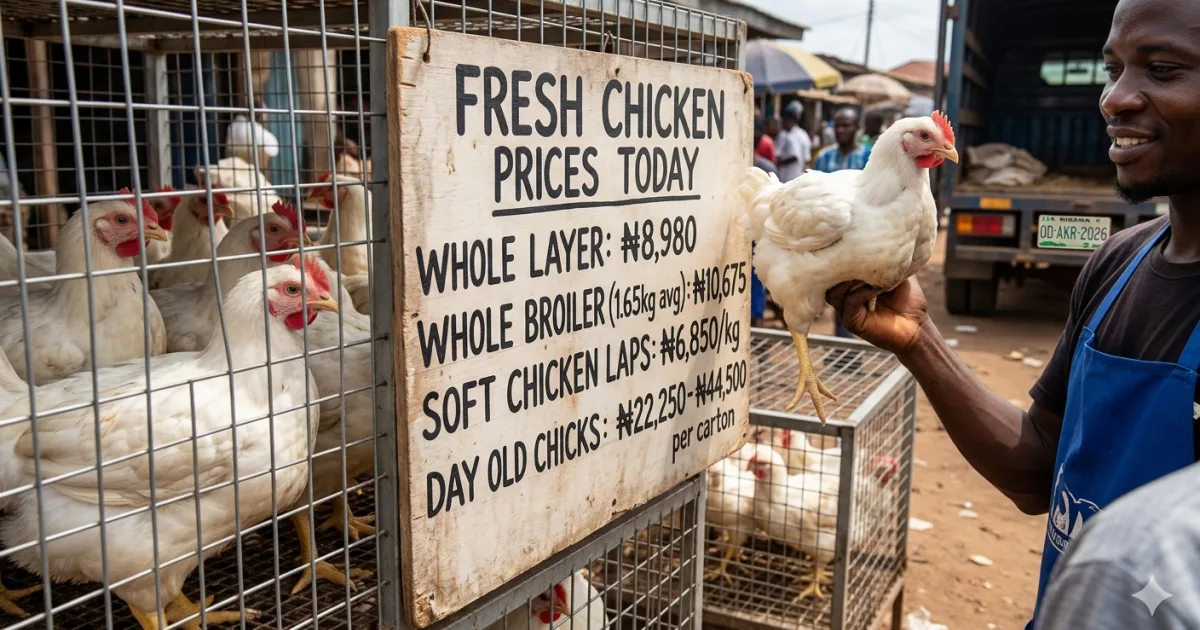
Chicken is Nigeria’s most popular protein — from jollof rice and fried chicken at parties, to pepper soup, suya, piri-piri, and everyday soups and stews. And in 2026, the price of chicken has risen significantly, driven by the same poultry sector crisis that has pushed egg prices to record highs. The core problem is identical to the egg crisis: a severe shortage of day-old chicks (DOCs) that has reduced the number of broilers reaching market weight, tightening supply against persistent demand. In April 2026, a mature live broiler chicken in Nigeria costs approximately ₦10,000–₦15,000 per bird, while fresh dressed chicken (slaughtered and cleaned) costs approximately ₦4,000–₦5,500 per kilogram at open markets. This guide gives you the full price breakdown — live, dressed, frozen, and by city — and everything you need to know about buying chicken cheaper in 2026.
Current Chicken Price in Nigeria — April 2026
| Type | Price Range | Notes / Source |
|---|---|---|
| Live broiler chicken (mature, 2–2.5kg) | ₦10,000 – ₦15,000 per bird | BestSales.ng (Sept 2025): “the average price of a mature broiler chicken costs between 10,000 to 15,000 Naira” — prices elevated further in 2026 due to DOC shortage |
| Live old layer chicken | ₦5,000 – ₦7,000 per bird | Smaller; spent laying hen; cheaper but tougher meat |
| Live cockerel (indigenous chicken) | ₦6,000 – ₦12,000 per bird | Highly seasonal; rises sharply during festive periods |
| Fresh dressed broiler (per kg) | ₦4,000 – ₦5,500/kg | Open market; slaughtered and cleaned; excludes entrails |
| Frozen chicken (whole, per kg) | ₦3,500 – ₦5,000/kg | Supermarkets; cold stores; GlobalProductPrices: $6.12 USD/kg = ~₦8,252 at April 2026 rate |
| Chicken laps/drumsticks (per piece) | ₦1,000 – ₦2,000 per piece | Cut retail; market price; weight-dependent |
| Chicken wings (per kg) | ₦3,000 – ₦4,500/kg | Retail market; popular for grilling and frying |
| Chicken gizzard (per kg) | ₦2,500 – ₦4,000/kg | Popular for soups and suya; prices elevated with general chicken shortage |
| Grilled/suya chicken (quarter) | ₦2,500 – ₦5,000 | Street vendors and fast food outlets; varies by portion size |
Sources: BestSales.ng (September 2025 — updated for 2026 market conditions); GlobalProductPrices.com (January 2026 — “The price of poultry in Nigeria is $6.12 USD” per kg whole chicken); 24HoursMarket.com (April 2026 — “Protein pricing remains steady across most markets”); market surveys across Lagos, Abuja, Port Harcourt.
Chicken Prices by City — Nigeria April 2026
| City | Live Broiler (per bird) | Fresh Dressed (per kg) | Notes |
|---|---|---|---|
| Lagos | ₦12,000 – ₦16,000 | ₦4,500 – ₦5,500 | Highest prices; urban premium + logistics cost from farms |
| Abuja | ₦11,000 – ₦15,000 | ₦4,200 – ₦5,200 | Similar to Lagos; high demand market |
| Ibadan (Oyo) | ₦10,000 – ₦14,000 | ₦4,000 – ₦5,000 | Close to South-West farms; slightly more competitive |
| Port Harcourt | ₦10,000 – ₦14,000 | ₦4,000 – ₦5,000 | Oil city; moderate pricing |
| Kano | ₦9,000 – ₦13,000 | ₦3,800 – ₦4,800 | North; some local production from area farms |
| Ogun State | ₦9,000 – ₦13,000 | ₦3,800 – ₦4,800 | Closer to farms; BestSales.ng: “For those who want to buy a cheap live chicken, I’ll recommend going to Ogun state” |
| Farm gate (any state) | ₦8,000 – ₦12,000 | ₦3,500 – ₦4,500 | Direct purchase; cheapest available; requires transport to farm |
Types of Chicken Available in Nigeria 2026
Broiler Chicken
The most common commercial chicken type in Nigeria, broilers are bred specifically for fast weight gain — reaching market weight (2–3kg) in approximately 6–8 weeks from hatch. They have tender, mild-flavoured meat ideal for frying, grilling, soups, and all Nigerian cooking styles. Broilers are the most widely available and most purchased chicken type at Nigerian markets, farms, and supermarkets. Their price is most directly affected by the current day-old chick shortage and high feed costs.
Noiler Chicken
Noilers are a hybrid breed developed by Nigeria’s NASC (National Animal Science Council) that combines the fast growth of commercial broilers with some of the hardiness and foraging ability of indigenous chickens. They take 10–12 weeks to reach market weight and are particularly popular with small-scale and backyard farmers who cannot maintain the intensive management that pure broilers require. Noiler prices generally fall between broiler and indigenous chicken prices.
Indigenous / Organic Chicken (Cockerel)
Traditional Nigerian-bred chickens (often called “local chicken,” “organic chicken,” or cockerel) grow more slowly — 6–12 months to market weight — but are prized for their distinct, richer flavour, particularly in traditional soups and pepper soup. They command premium prices over broilers on a per-bird basis despite being smaller. Indigenous chickens are particularly sought after for celebrations, traditional medicine, and older consumers who prefer the flavour. Their price is more resistant to the commercial DOC shortage because they are often raised in backyard settings rather than intensive commercial farms.
Old Layer Chicken
When laying hens reach the end of their productive lifespan (typically 18–24 months), they are sold as “old layer” chickens. They are smaller and tougher than broilers but significantly cheaper — typically ₦5,000–₦7,000 per bird. Their tougher meat is well-suited for pressure-cooked soups, nkwobi, and dishes where extended cooking softens the texture. Old layer chickens represent an economical protein option for budget-conscious households and are popular for making large pots of soup.
Frozen Chicken in Nigeria 2026: Imported vs Local
The Nigerian market also carries frozen chicken products, both locally processed and imported. Understanding the difference helps buyers make informed choices:
| Product | Origin | Price Per Kg (April 2026) | Notes |
|---|---|---|---|
| Locally frozen whole chicken | Nigerian farms, frozen | ₦3,500 – ₦5,000 | Cold stores and supermarkets; fresh frozen from local farms |
| Frozen orobo laps (big/fat laps) | Mostly imported (Brazil/EU) | ₦3,000 – ₦4,500/kg | Popular party and restaurant cut; “orobo” = big/fat in Yoruba slang |
| Frozen chicken wings | Imported or local | ₦2,500 – ₦4,000/kg | Popular for grilling; party food staple |
| Whole frozen imported chicken | Brazil, EU | ₦4,500 – ₦6,000/kg equivalent | Supermarkets; Shoprite, Spar, Grand Square |
Imported frozen chicken (particularly Brazilian and European laps) is available in Nigeria despite significant import tariffs and restrictions. It is often cheaper per kilogram than locally raised fresh broiler chicken at retail — which has historically created controversy, since cheap imports undercut local poultry farmers. The Federal Government has maintained import restrictions on frozen poultry products to protect domestic farmers, but enforcement at land borders has been inconsistent, with significant volumes of frozen chicken entering informally.
Why Is Chicken So Expensive in Nigeria 2026?
Day-Old Chick (DOC) Shortage
The same day-old chick shortage driving egg prices higher is also reducing the supply of broilers. Broiler production starts with day-old chicks sourced from hatcheries — if farmers cannot obtain DOCs promptly, fewer broilers enter the production pipeline, meaning fewer birds reach market weight to meet consumer demand. The Poultry Association of Nigeria (PAN) confirmed in March 2026 that hatcheries are fully booked months in advance, creating a production bottleneck that affects both eggs and broiler meat simultaneously.
High Feed Costs
Broiler chickens consume approximately 4–5 kg of feed per kg of body weight gained. With maize (the primary feed ingredient) prices elevated due to supply challenges, currency pressures on imported soya and premix, and general agricultural input inflation, the cost of producing a kilogram of broiler meat has increased substantially. These higher production costs flow directly to market prices.
Energy Costs
Commercial broiler farms require controlled temperature environments (brooding houses for chicks at 32–35°C), ventilation, lighting for 18–20 hours per day, and water pumping systems. All of these require electricity or generator power. Higher generator diesel costs since subsidy removal directly increase broiler farm operating costs per bird, which are recovered through higher farm-gate prices.
Where to Buy Chicken Cheapest in Nigeria 2026
- Direct from poultry farms: The cheapest chicken prices in Nigeria come from purchasing directly from registered commercial farms. BestSales.ng confirms: “Poultry farms are another great place to buy live chickens” — farm-gate prices are typically ₦2,000–₦4,000 per bird cheaper than market retail. Search for farms near you through PAN (poultryassociation.ng) or local agricultural extension offices.
- Ogun State: BestSales.ng recommends Ogun State as the best value destination for live chicken purchases — the state hosts numerous commercial farms and prices are more competitive than Lagos despite its proximity to the megacity.
- Open markets: “One of the best places to buy live chickens in Nigeria is in local markets. Some of the popular local markets include Mile 12 Market in Lagos, Bodija Market in Ibadan, and Garki Market in Abuja.” Market prices are 20–30% cheaper than supermarket prices for the same product.
- Buy whole birds: Purchasing a whole bird and cutting it yourself is consistently cheaper per kilogram than buying pre-cut pieces — butchers add margin to every cut. Buy a whole bird at market, slaughter on-site or at your butcher, and portion at home.
- Festive season avoidance: Chicken prices spike dramatically during Christmas, Easter, Eid al-Fitr, and Eid al-Adha as demand surges. “During festive periods such as Christmas, Easter, and Muslim holidays, the demand for live chickens increases, leading to a rise in prices. Outside these periods, prices may drop due to lower demand.” Buy in bulk and freeze before festive season if storage is available.
Starting a Poultry Business in Nigeria 2026: Is It Worth It?
Despite high input costs and supply chain challenges, the Nigerian broiler farming business remains one of the most accessible agricultural enterprises for small-scale entrepreneurs. With chicken prices at ₦10,000–₦15,000 per bird at market, a well-managed small farm can be profitable even after accounting for elevated feed and energy costs. Here is a realistic overview for anyone considering starting a broiler operation in 2026:
50-bird starter operation: Capital needed approximately ₦250,000–₦400,000 covering housing/pen construction, 50 day-old chicks (₦800–₦1,500 each depending on hatchery), 8 weeks of feed (approximately 250 kg total at current feed prices), vaccines and medications, and basic equipment (feeders, drinkers, heat lamp for brooding). Revenue from 50 birds at market weight (assuming average 2kg dressed weight and ₦12,000 per bird): approximately ₦600,000. After feed, chick, and running costs of approximately ₦350,000–₦400,000, a well-managed 50-bird cycle can generate ₦150,000–₦250,000 gross profit per 8-week cycle — equivalent to ₦900,000–₦1,500,000 annualised from a continuous three-cycle-per-year operation. The current elevated market prices make this more attractive than at any previous point, provided the day-old chick supply situation can be resolved.
Frequently Asked Questions — Chicken Price Nigeria 2026
How much is a chicken in Nigeria today 2026?
As of April 2026, a mature live broiler chicken costs approximately ₦10,000–₦15,000 per bird in most Nigerian markets. Fresh dressed (slaughtered and cleaned) broiler chicken costs approximately ₦4,000–₦5,500 per kilogram at open markets. Prices are higher in Lagos (₦12,000–₦16,000 per bird) and slightly lower near farming areas like Ogun State (₦9,000–₦13,000 per bird).
How much is chicken per kg in Nigeria 2026?
Fresh dressed broiler chicken costs approximately ₦4,000–₦5,500 per kilogram at open markets in April 2026. Frozen chicken (whole bird or cuts) at supermarkets costs ₦3,500–₦6,000/kg depending on the product and retailer. GlobalProductPrices.com’s January 2026 data puts Nigeria’s whole chicken price at $6.12 USD per kilogram — approximately ₦8,250 at the April 2026 exchange rate — reflecting premium supermarket pricing.
Why is chicken so expensive in Nigeria 2026?
The primary causes are: (1) a severe shortage of day-old chicks (DOCs) from hatcheries, reducing broiler supply; (2) high poultry feed costs (elevated maize and soya prices); (3) higher energy costs for running commercial farms after fuel subsidy removal; and (4) naira depreciation raising import costs for feed ingredients, vaccines, and equipment. These factors combine to make each kilogram of chicken significantly more expensive to produce in 2026 than in previous years.
🍗 Chicken Price Nigeria April 2026 — Quick Reference
- Live broiler (per bird): ₦10,000 – ₦15,000
- Fresh dressed (per kg): ₦4,000 – ₦5,500
- Frozen chicken (per kg): ₦3,500 – ₦5,000
- Old layer chicken: ₦5,000 – ₦7,000 per bird
- Cheapest source: Direct from farms; Ogun State markets; open markets vs supermarkets
- Avoid festive prices: Buy and freeze before Christmas/Eid — prices spike 30–50%
- Main price driver: DOC shortage + high feed + energy costs
- Business opportunity: 50-bird broiler operation profitable at current market prices
Also read: Egg Price Nigeria 2026 | Rice Price Nigeria 2026 | Fuel Price Nigeria 2026
How to Buy Chicken Safely in Nigeria 2026
Food safety is a serious concern with chicken in Nigeria’s warm climate. Unlike colder countries where whole birds can be displayed unrefrigerated for extended periods, Nigeria’s ambient temperatures of 28–38°C make improperly handled chicken a significant source of foodborne illness — Salmonella and Campylobacter are the primary pathogens associated with contaminated poultry. Here is how to buy chicken safely and what to look for to avoid contaminated product.
Signs of Fresh vs Spoiled Chicken
- Colour: Fresh chicken has pale pink flesh with white-yellow skin. Any grey, green, or dark discolouration is a sign of spoilage — do not buy
- Smell: Fresh chicken has a mild, neutral smell. Any sour, ammonia, or putrid odour indicates bacterial decomposition — reject immediately
- Texture: Fresh chicken flesh is firm and springs back when gently pressed. Soft, slimy, or sticky skin and flesh indicates deterioration
- Eyes (for live birds): A healthy live bird has bright, clear eyes. Cloudy, sunken, or closed eyes indicate illness
- Ask when it was slaughtered: For fresh dressed chicken at open markets, ask how recently the bird was slaughtered. In Nigeria’s heat, a bird slaughtered more than 4–6 hours ago without refrigeration should be cooked immediately upon purchase — not stored
Safe Handling After Purchase
Refrigerate or freeze chicken immediately upon getting home — never leave it at room temperature for more than 2 hours in Nigeria’s heat. If using the same day, refrigerate until cooking. If storing for later, freeze in portions sized for individual meals — refreezing partially thawed chicken is a food safety risk. Thaw frozen chicken in the refrigerator, not at room temperature — counter-thawing in Nigeria’s heat allows bacterial growth on the outer layers while the centre is still frozen. Always cook chicken to an internal temperature of at least 75°C (thoroughly cooked through with no pink flesh or red juices) to eliminate all Salmonella and Campylobacter risk.
Chicken Nutrition: Why It Remains Worth Buying Despite High Prices
At ₦4,000–₦5,500 per kilogram, fresh chicken is expensive by any Nigerian standard. Yet from a nutritional value standpoint, chicken breast remains one of the most efficient sources of complete protein available — approximately 31 grams of protein per 100 grams of cooked boneless breast, with low saturated fat content compared to red meat. A 500-gram portion of chicken breast (costing approximately ₦2,000–₦2,750 at market rate) provides over 150 grams of high-quality complete protein — enough for the daily protein requirement of an adult (0.8g per kg body weight, so roughly the full daily need for a 60kg adult) in a single reasonable meal serving.
For households trying to maintain adequate protein intake on a food budget, the most cost-effective chicken strategy in 2026 is: buy whole birds (cheaper per kg than pre-cut pieces), buy directly from farms or open markets rather than supermarkets, use every part of the bird including carcass for soup stock (eliminating waste), and supplement chicken meals with cheaper protein sources (eggs, beans, fish) on alternate days rather than serving chicken daily. This rotation approach provides nutritional variety while managing the impact of current high prices.
Chicken Price Calendar: When Prices Are Lowest and Highest
Chicken prices in Nigeria follow a strongly seasonal pattern driven by demand spikes around major religious and cultural celebrations. Understanding this calendar helps households and food businesses plan purchases strategically:
| Period | Price Trend | Reason |
|---|---|---|
| January – February | Moderate — post-Christmas normalization | Demand drops after December festive peak |
| March – May | Moderate to low — relatively affordable | Low demand period; reasonable supply; good buying window |
| Eid al-Fitr (date varies) | Spike +20–40% | Muslim celebration — high demand for all proteins |
| June – September | Moderate — school resumption effect | Steady demand; some supply variation by season |
| Eid al-Adha (date varies) | Spike +15–30% | Second major Muslim celebration |
| October – November | Moderately rising — pre-Christmas buildup | Demand begins increasing ahead of December |
| December (Christmas/New Year) | Peak — +40–80% above baseline | Highest demand period of the year for chicken |
The practical implication is clear: if you are a household that buys chicken in volume, or a food business that needs to manage chicken costs, the best buying windows are March–May and the weeks immediately following major festive periods when prices normalise. Buying and freezing in bulk during these lower-demand windows — if freezer capacity allows — delivers meaningful savings compared to buying at peak festive prices. At current prices of ₦10,000–₦15,000 per bird at baseline, a 40% Christmas premium takes the same bird to ₦14,000–₦21,000 — a difference of ₦4,000–₦6,000 per bird purely from timing.
Nigerian Chicken Dishes: Getting Maximum Value from Each Bird
At current chicken prices, maximising the yield and versatility from each bird purchased makes economic sense. Here is how professional Nigerian cooks get the most from every chicken:
- Use the carcass for stock: After removing all usable meat, simmer the carcass with onions, seasoning cubes, and pepper for 45–60 minutes to make rich chicken stock. This stock forms the base for jollof rice, pepper soup, egusi soup, and any number of other dishes — adding flavour at essentially zero additional cost
- Cook the liver, gizzard, and neck: These parts — often discarded or sold cheaply as “offal” — are highly nutritious and flavourful. Chicken liver is exceptionally rich in iron, vitamin B12, and zinc. Gizzard cooked in pepper sauce is a beloved Nigerian street food. Never discard these parts when buying a whole bird
- Portion strategically: One whole 2kg broiler, portioned correctly, can provide: 2 servings of breast (for frying or grilling), 2 drumsticks (for children’s meals or soups), 2 thighs (for stewing), 2 wings (for snacking), plus the back and carcass for stock — that is 6–8 separate meal components from a single bird
- Marinate and freeze portions separately: After portioning, marinate each section in your preferred spice blend and freeze in individual meal-sized portions. This meal-prep approach means each chicken purchase provides multiple ready-to-cook meals spread over 1–2 weeks, reducing the frequency of purchases at whatever the current market price is
Chicken Price Forecast: When Will Prices Ease?
The trajectory of chicken prices in Nigeria through the remainder of 2026 depends primarily on the same factor driving egg prices: the day-old chick shortage. Once hatcheries can supply adequate numbers of day-old chicks to broiler farmers, a new production cycle of 6–8 weeks begins — meaning market supply of broilers increases approximately 6–8 weeks after DOC supply normalises. The Poultry Association of Nigeria (PAN) indicated in March 2026 that the hatchery backlog could take up to 6 months to clear. This timeline, if accurate, suggests meaningful price relief from increased broiler supply is unlikely before October–November 2026.
Additional factors that could ease or worsen prices: if the naira continues its 2026 recovery trend, the cost of imported feed ingredients and veterinary supplies falls in naira terms, reducing farm operating costs; conversely, any reversal of naira gains or a global poultry feed commodity price spike would push prices higher. For consumers, the most actionable response to current prices is to use the buying strategies outlined in this guide — farm-gate purchasing, bulk buying and freezing during non-festive months, and strategic substitution with eggs, beans, and fish on alternate days — rather than simply absorbing the higher market prices passively.
Nigerian Chicken Import Policy and Its Effect on Prices
Nigeria maintains one of Africa’s most restrictive poultry import regimes. Frozen whole chickens, chicken parts, and other processed poultry are on Nigeria’s import prohibition list — meaning they cannot be legally imported through Nigerian seaports. This policy was deliberately designed to protect the domestic poultry industry by ensuring Nigerian consumers buy from Nigerian farmers rather than cheaper international producers (particularly Brazil and the European Union, which produce frozen chicken at costs far below what Nigerian farmers can match due to scale, climate, and feed cost differences).
In practice, the import ban is partially circumvented through land border smuggling — frozen chicken enters informally from Benin Republic, Niger, Cameroon, and other neighbouring countries where it is legally imported. This informal supply competes with domestic production at lower price points, benefiting some urban consumers while undermining the policy intent of supporting Nigerian farmers. The Federal Government periodically cracks down on smuggled frozen chicken (NAFDAC seizures, Customs enforcement at border points) but enforcement has historically been incomplete. During periods of crackdown, domestic prices tend to rise as the illegal supply is reduced; during periods of relaxed enforcement, some downward price pressure from smuggled product moderates the market.
The longer-term policy debate — whether to maintain the import ban, allow limited legal importation with tariffs, or fully liberalise the poultry market — remains active among Nigerian economists, farmers, and policymakers. Fully liberalising imports would likely reduce consumer prices significantly (Brazilian frozen chicken landed in Nigeria could compete at prices well below current domestic market rates) but would devastate the domestic poultry industry which employs millions of Nigerians across the production and distribution value chain. The current middle path — prohibition plus imperfect enforcement — satisfies neither consumers nor producers fully, and the 2026 price crisis has reinvigorated calls for a more coherent poultry policy framework.
Summary: Navigating Chicken Prices in Nigeria 2026
Chicken prices in April 2026 — broilers at ₦10,000–₦15,000 per bird and fresh dressed meat at ₦4,000–₦5,500/kg — are the result of structural poultry sector challenges that are unlikely to reverse before late 2026. The most effective household and food business strategies are: buy directly from farms or Ogun State markets for the lowest prices; time bulk purchases to non-festive periods and freeze; use whole birds rather than pre-cut pieces for better per-kg value; stretch each bird across multiple meals using every part including the carcass for stock; supplement with eggs (despite their own high prices, they remain cheaper per gram of protein than chicken), beans, and mackerel on alternate days. For entrepreneurs, current elevated prices make well-managed small-scale broiler farming genuinely profitable — a 50-bird operation can return ₦150,000–₦250,000 gross per 8-week cycle at current prices. Whether buyer or producer, understanding the supply dynamics — the DOC shortage as the core constraint, feed and energy costs as secondary pressures, and import policy as the structural backdrop — gives you the context to navigate 2026’s challenging chicken market with realistic expectations and informed decisions.
Chicken and Food Safety: NAFDAC Regulations for Poultry Businesses
Any business that processes, packages, or sells chicken products in Nigeria — including small-scale caterers, restaurant owners, poultry processors, and cold store operators — is subject to NAFDAC (National Agency for Food and Drug Administration and Control) regulations governing poultry handling, storage temperature, labelling, and processing hygiene. NAFDAC requires that all processed poultry products sold commercially are produced in registered premises with adequate refrigeration, potable water supply, waste management systems, and trained food handlers. Operating without NAFDAC registration exposes businesses to fines, product seizure, and premises closure.
For home-based chicken sellers, small caterers, and event food vendors — a growing category in Nigeria’s gig economy — the practical minimum compliance steps are: source chicken from verifiable farms or markets (not unknown sources), maintain cold chain from purchase to cooking (refrigerate or freeze immediately), cook to full internal temperature of 75°C minimum, and serve within 2 hours of cooking at room temperature. These steps protect your customers from foodborne illness and protect your business from liability. At current chicken prices where a single batch of improperly handled chicken represents thousands of naira in wasted food cost and potential customer health claims, food safety is simultaneously an ethical obligation and a sound business practice.
In summary: chicken in Nigeria in 2026 is expensive, the structural reasons are clear, and the price is unlikely to ease significantly before late 2026. The best response is a combination of smart buying (direct from farms, off-season bulk purchasing, whole birds over cuts) and smart cooking (every part of the bird, stock from carcasses, strategic protein rotation with eggs and beans). For entrepreneurs, the elevated prices signal a genuine market opportunity in broiler farming and chicken retail — with careful management, the margins at current market prices make small-scale poultry among the most accessible profitable agricultural businesses available to Nigerians in 2026.
Monitor PAN updates, buy strategically, cook waste-free, and let the current high prices motivate either smarter purchasing or a seriously considered foray into broiler farming — one of Nigeria’s most accessible agricultural business opportunities in 2026.
For Nigerians managing household food budgets in 2026, the most sustainable approach to chicken costs is meal planning — deciding at the start of each week which days chicken will be the protein and which days will use cheaper alternatives (eggs at ₦250 each, mackerel at ₦2,000–₦3,000 per fish, or beans at ₦500–₦700 per portion). This conscious rotation — rather than buying chicken impulsively at whatever the current market price is — gives you control over your protein spending and ensures adequate nutrition across the week at the lowest achievable total cost.

0 Comments
No comments yet. Be the first to share your thoughts!