




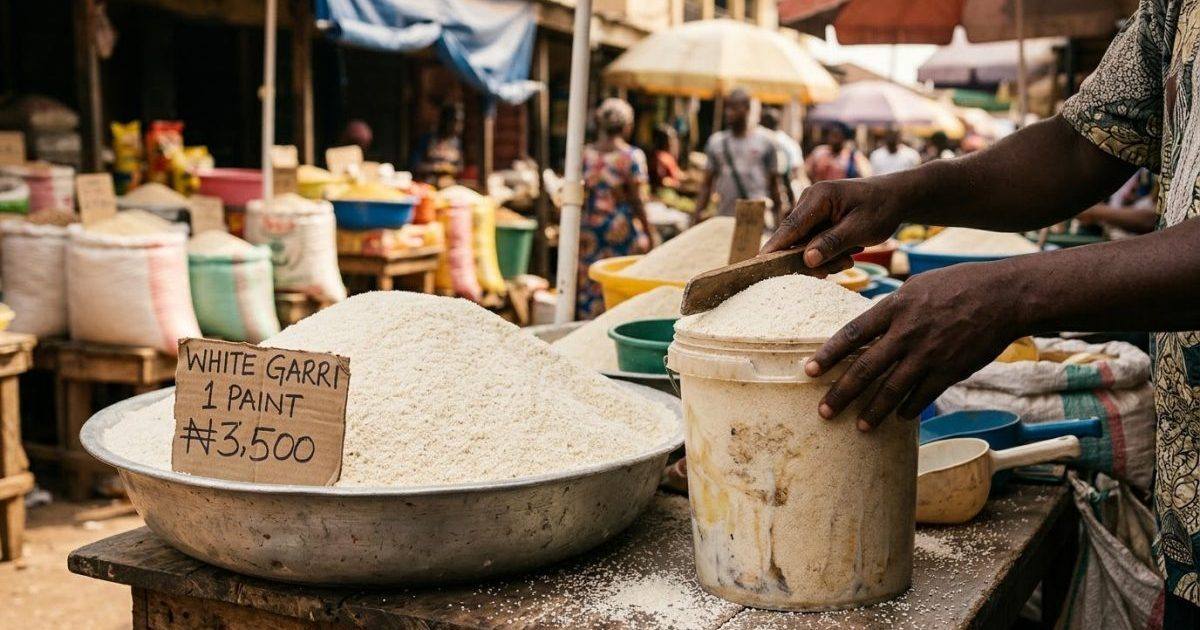
📌 Quick answer (checked 25 October 2026): The most recent National Bureau of Statistics (NBS) garri figure we could verify is for April 2026: 1kg of white garri (sold loose) averaged ₦808.96, up 0.93% from March’s ₦801.54 but down 39.86% from ₦1,345.10 in April 2025. Abia was the dearest state (₦1,075.47) and Plateau the cheapest (₦517.94). By zone, the South-East (₦944.58) was highest and the North-Central (₦673.88) lowest. The NBS data portal lists a May 2026 edition (dated 25 June 2026), but we could not open its figures, so we have not quoted them. The NBS release calendar shows the next Selected Food Prices report, for September 2026, due on 29 October 2026.
Garri is the staple many Nigerian households fall back on when other foods get expensive, so its price is one of the most closely watched numbers in the kitchen budget. This guide uses only the per-kilogram averages the NBS publishes in its monthly Selected Food Price Watch. Each figure is tied to a named NBS report and month, so you can see what garri cost in early 2026, how far it has fallen since 2025, and where in Nigeria it is cheapest and dearest.
Garri Price in Nigeria: NBS Figures for Early 2026
| Month | Average price per kg (white garri, loose) | Change on previous month | Change on same month a year earlier |
|---|---|---|---|
| March 2026 | ₦801.54 | +1.38% on February | −41.19% (March 2025: ₦1,362.96) |
| April 2026 | ₦808.96 | +0.93% on March | −39.86% (April 2025: ₦1,345.10) |
The picture is similar to other staples in 2026: small monthly rises of around 1%, against a very large fall compared with a year earlier. In April 2026, a kilogram of white garri cost about 40% less than in April 2025.
Why we stop at April 2026
The NBS now publishes its Selected Food Price Watch reports on its National Data Archive (NADA) portal. On 25 October 2026 that portal listed reports up to May 2026 (dated 25 June 2026). The May file is a compressed download we could not open, and we will not repeat figures we have not read from an NBS document or from a major outlet quoting NBS directly. April 2026 is therefore the latest month in this guide. When the September 2026 edition appears (scheduled for 29 October 2026 on the NBS release calendar), these numbers will be out of date.
Where Garri Is Cheapest and Dearest
| April 2026 | March 2026 | |
|---|---|---|
| Highest state | Abia: ₦1,075.47 | Abia: ₦1,075.45 |
| Lowest state | Plateau: ₦517.94 | Plateau: ₦513.78 |
| Highest zones | South-East ₦944.58; South-South ₦944.01 | South-South ₦942.68; South-East ₦942.04 |
| Lowest zone | North-Central: ₦673.88 | North-Central: ₦670.16 |
Abia and Plateau held the top and bottom spots in both months, and Abia’s price barely moved. In April 2026 garri in Abia cost about 2.1 times as much per kilogram as in Plateau. The South-East and South-South were almost tied as the dearest zones, while the North-Central was about ₦270 per kg cheaper than the South-East.
The NBS does not explain why prices differ between states, so treat this as a description of where garri was cheapest and dearest, not as a reason.
The rankings change over time
Earlier NBS reports show different leaders, which is a reminder not to assume a state stays cheap or expensive:
| NBS report | Highest state | Lowest state | Highest zone | Lowest zone |
|---|---|---|---|---|
| May 2024 | Gombe ₦1,613.29 | Kwara ₦825.70 | South-West ₦1,294.51 | North-Central ₦1,021.21 |
| June 2024 | Gombe ₦1,619.27 | Taraba ₦900.00 | South-West ₦1,199.62 | North-Central ₦1,055.87 |
| July 2024 | Gombe ₦1,624.72 | Taraba ₦892.98 | South-East ₦1,197.59 | South-South ₦1,111.73 |
| April 2025 | FCT Abuja ₦1,902.00 | Ondo ₦1,000.00 | North-West ₦1,503.74 | South-West ₦1,126.56 |
| April 2026 | Abia ₦1,075.47 | Plateau ₦517.94 | South-East ₦944.58 | North-Central ₦673.88 |
Notice how the zones swapped places: in April 2025 the North-West was the dearest zone and the South-West the cheapest, while a year later the South-East and South-South were dearest and the North-Central cheapest.
How Garri Prices Have Moved Since 2023
These national averages come from NBS Selected Food Price Watch reports we read directly or that a major outlet quoted from NBS:
| Month | Average price per kg | What the NBS report said |
|---|---|---|
| May 2023 | ₦371.42 | Base year for the May 2024 comparison |
| June 2023 | ₦403.15 | Base year for the June 2024 comparison |
| July 2023 | ₦429.89 | Base year for the July 2024 comparison |
| April 2024 | ₦851.81 | Base for May 2024 month-on-month change |
| May 2024 | ₦1,114.72 | +30.87% on April 2024; +200.12% on May 2023 |
| June 2024 | ₦1,135.51 | +1.86% on May 2024; +181.66% on June 2023 |
| July 2024 | ₦1,151.79 | +1.43% on June 2024; about +168% on July 2023 |
| March 2025 | ₦1,362.96 | Base for April 2025 month-on-month change |
| April 2025 | ₦1,345.10 | −1.31% on March 2025; +57.91% on April 2024 |
| March 2026 | ₦801.54 | −41.19% on March 2025 |
| April 2026 | ₦808.96 | −39.86% on April 2025 |
What the series shows:
- 2023 to 2024: prices roughly tripled. Garri went from ₦371.42 per kg in May 2023 to ₦1,114.72 a year later.
- Early 2025: the high point in this series. March 2025’s ₦1,362.96 is the highest monthly figure we have from NBS reports.
- 2025 to 2026: a fall of about 40%. April 2026 was 40.65% below March 2025 (our arithmetic from the two NBS figures).
- Still well above 2023. April 2026’s ₦808.96 is about 2.2 times May 2023’s ₦371.42, though about 5% below April 2024’s ₦851.81.
Garri Against Beans: What a Naira Buys
Garri remains much cheaper per kilogram than beans. In April 2026 the NBS put white garri at ₦808.96 per kg and brown beans at ₦1,338.93 per kg, so a kilogram of beans cost about 1.66 times a kilogram of garri, a difference of about ₦530. See our beans price per kg by state for the full beans breakdown.
What a Kilogram Price Means for Your Budget
The NBS publishes per-kilogram prices only. These simple calculations from the April 2026 NBS averages give a benchmark for common quantities. They are not market quotes:
| Quantity | National average (₦808.96/kg) | Abia, dearest state (₦1,075.47/kg) | Plateau, cheapest state (₦517.94/kg) |
|---|---|---|---|
| 1kg | ₦808.96 | ₦1,075.47 | ₦517.94 |
| 5kg | ₦4,044.80 | ₦5,377.35 | ₦2,589.70 |
| 10kg | ₦8,089.60 | ₦10,754.70 | ₦5,179.40 |
| 25kg | ₦20,224.00 | ₦26,886.75 | ₦12,948.50 |
| 50kg | ₦40,448.00 | ₦53,773.50 | ₦25,897.00 |
Worked example: a student’s monthly garri
A student who uses about 5kg of garri a month (for eba and for soaking) would spend about ₦4,045 at the April 2026 national average. The same 5kg would cost about ₦5,377 at Abia’s average and about ₦2,590 at Plateau’s. Swap in your own monthly quantity and your state’s figure to get a realistic budget line.
Worked example: checking a bag price
If a trader quotes a price for a 50kg bag, divide it by 50 to get a per-kg figure and compare it with the NBS average for your state or zone. A bulk price slightly below 50 times the retail average is normal. A price well above it is a sign to ask about the type (white, yellow, Ijebu) and quality, or to compare with other sellers.
What the NBS Figures Do and Do Not Cover
- White garri, sold loose, by the kilogram. The NBS does not publish separate figures for yellow garri or Ijebu garri, and it does not quote paint-bucket, mudu or bag prices.
- Survey averages, not shop prices. The NBS says its staff collect prices across all 774 local government areas from about 10,000 respondents and locations, and the state averages are combined into a national average. Your market can be above or below your state figure.
- Prices, not causes. The reports describe movements without explaining them, so we do not attribute the 2025 to 2026 fall to any single cause.
- A time lag. Each report comes out several weeks after the month it covers. The April 2026 report was released on 1 June 2026.
How to Use These Numbers When You Buy
- Use your state’s figure, not only the national average. In April 2026 the gap between Abia and Plateau was more than ₦550 per kg.
- Convert measures to kilograms. Weigh one paint bucket or mudu of garri once so you can turn any quote into a per-kg price.
- Know which garri you are buying. The NBS figure is for white garri. Yellow and Ijebu garri are often priced differently.
- Store it well if you buy in bulk. Garri keeps for a long time when it is dry and sealed, so buying a larger quantity can lower your per-kg cost.
- Recheck after each NBS release. Month-to-month moves in 2026 were small, but the yearly swings have been large.
For other staples and household costs, see our rice price guide, our egg price guide and our guide to living in Lagos on a tight budget.
Frequently Asked Questions
What is the price of garri in Nigeria in 2026?
The latest NBS figure we could verify is for April 2026: ₦808.96 per kilogram of white garri sold loose, up 0.93% from March 2026 and down 39.86% from April 2025.
Which state has the cheapest garri?
Plateau had the lowest state average in March 2026 (₦513.78) and April 2026 (₦517.94). The North-Central was the cheapest zone in both months.
Which state has the most expensive garri?
Abia had the highest state average in March 2026 (₦1,075.45) and April 2026 (₦1,075.47). The South-East was the dearest zone in April 2026 at ₦944.58 per kg, just ahead of the South-South.
Is garri cheaper than last year?
Yes, on the NBS figures. April 2026’s ₦808.96 per kg was 39.86% below April 2025’s ₦1,345.10, and March 2026 was 41.19% below March 2025.
How much is a paint bucket or bag of garri?
The NBS does not publish these. At the April 2026 national average, 50kg works out to about ₦40,448, but real bag prices depend on the type of garri and your market. Use the per-kg figure as a benchmark.
Why doesn’t this page show May to September 2026 figures?
We only quote figures we have read from an NBS report or from a major outlet citing NBS directly. The NBS portal lists a May 2026 report we could not open, and the September 2026 edition is scheduled for 29 October 2026. We will update this page when we can verify newer data.
Where can I check the official figures myself?
Go to the NBS website (nigerianstat.gov.ng) and follow the link to its National Data Archive (NADA). The Selected Food Price Watch entry lists each monthly report with a PDF and an Excel table of state prices.
Sources
- National Bureau of Statistics, “Selected Food Price Watch April 2026” (released 1 June 2026; figures as quoted by THISDAY, 2 June 2026)
- National Bureau of Statistics, “Selected Food Price Watch March 2026” (released 6 May 2026; figures as quoted by Channels Television, 7 May 2026)
- National Bureau of Statistics, “Selected Food Price Watch April 2025” (report PDF, 2025)
- National Bureau of Statistics, “Selected Food Price Watch” May, June and July 2024 reports (June to August 2024)
- National Bureau of Statistics, National Data Archive catalogue “Selected Food Price Watch” and Data Release Calendar (checked 25 October 2026)
Last updated: 25 October 2026 · NaijaSabi.



0 Comments
No comments yet. Be the first to share your thoughts!