



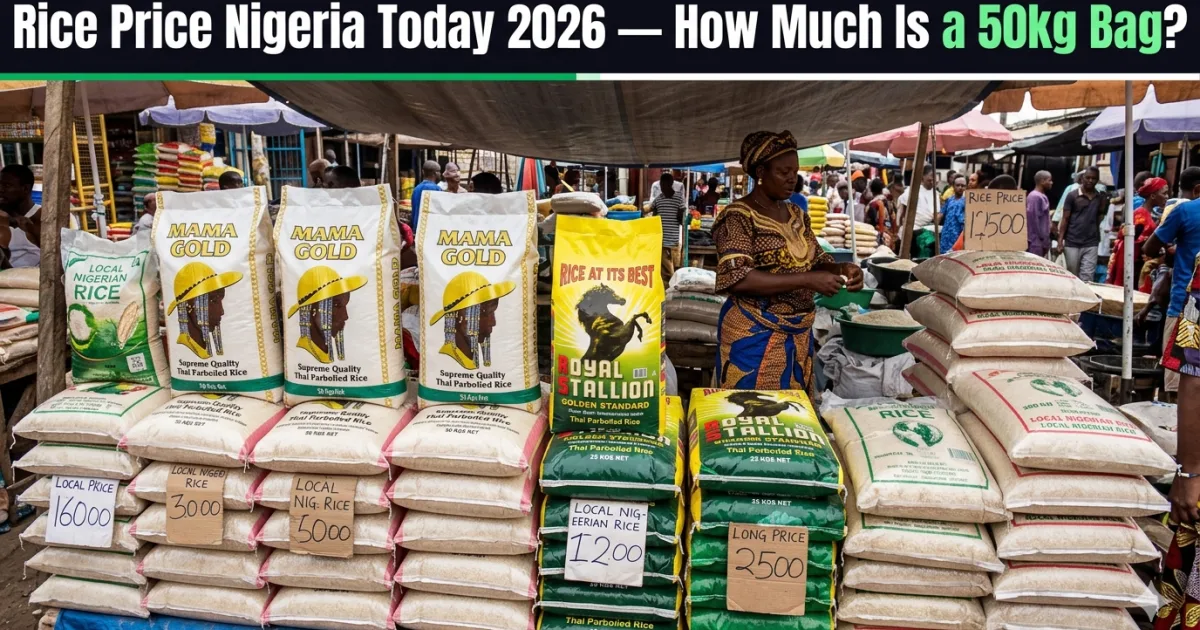
Rice is Nigeria’s most consumed staple food — and its price in 2026 continues to be one of the most searched and discussed topics across the country. Whether you are a household budgeting for monthly groceries, a food vendor calculating portion costs, a restaurant owner pricing your menu, or a trader stocking up at a wholesale market, the price of a bag of rice directly shapes your financial planning. In April 2026, rice prices have surged further than at any previous point in Nigeria’s history. Independent Nigeria’s April 2026 food price report confirmed that a 50kg bag of rice has climbed to about ₦61,000, while the Lagos State Ministry of Agriculture’s official April 2026 price tracker recorded imported long-grain rice at ₦61,125 per 50kg bag. These figures represent a price increase of more than 180% compared to 2022, when the same bag cost ₦20,000–₦28,000.
This guide provides the most current rice prices across every major brand, explains the difference between local and foreign rice, breaks down costs by state, analyses why prices are so high in 2026, and gives you six practical strategies to buy rice cheaper wherever you are in Nigeria.
Current Rice Price in Nigeria — April 2026
The most important distinction in Nigerian rice pricing is between local rice (grown and milled in Nigeria) and foreign rice (imported from Thailand, Vietnam, India, and other Asian countries). Both categories have risen sharply in 2026, driven by logistics costs, exchange rate pressure, and general food inflation. Here is the April 2026 overview based on the Lagos State Ministry of Agriculture Food Price Tracker, Independent Nigeria’s April 2026 report, and 24HoursMarket’s April 2026 market update:
| Category | 50kg Bag | 25kg Bag | 10kg Bag | Source |
|---|---|---|---|---|
| Imported long-grain rice | ₦61,000 – ₦65,000 | ₦30,188 – ₦33,000 | ₦13,000 – ₦14,000 | Lagos MAFA tracker April 2026: ₦61,125 |
| Imported short-grain rice | ₦55,000 – ₦60,000 | ₦28,100 – ₦30,000 | ₦12,000 – ₦13,500 | Lagos MAFA April 2026: short grain 50kg ₦56,800 |
| Local rice (general average) | ₦45,000 – ₦65,000 | ₦22,000 – ₦33,000 | ₦9,000 – ₦14,000 | 24HoursMarket April 2026; market surveys |
| Premium local brands | ₦65,000 – ₦90,000 | ₦33,000 – ₦47,000 | ₦14,000 – ₦20,000 | BestSales.ng 2026; BusinessDay Intelligence |
Rice Prices by Brand — Nigeria April 2026
Brand matters enormously in Nigerian rice pricing. Premium brands — whether imported or premium local — command prices well above the commodity average. Here is a brand-by-brand breakdown using data from NigerianSearchGuide, NigerianQueries, BusinessDay Intelligence, BestSales.ng, and market surveys:
| Brand | Type | 50kg Price | 25kg Price | Notes |
|---|---|---|---|---|
| Mama Gold | Local/Premium (Stallion Group) | ₦50,000 – ₦67,000 | ₦25,000 – ₦35,000 | NigerianSearchGuide 2026 confirms this range; top-selling brand in Nigeria |
| Mama’s Pride | Local (Olam Nigeria) | ₦45,000 – ₦85,000 | ₦22,000 – ₦43,000 | NigerianSearchGuide; BusinessDay: ₦70,000–₦85,000 at Lagos markets |
| Mama’s Choice | Local premium parboiled | ₦50,000 – ₦90,500 | ₦26,000 – ₦47,000 | BusinessDay Intelligence: avg ₦87,000–₦90,000; NigerianSearchGuide confirmed |
| Royal Stallion | Imported Thai (Stallion Group) | ₦85,000 – ₦95,000 | ₦40,500 – ₦48,000 | NigerianQueries Jan 2026: ₦85,000–₦95,000; one of the most expensive mainstream brands |
| Cap Rice (Caprice) | Imported Thai | ₦60,000 – ₦80,000 | ₦30,000 – ₦42,000 | BestSales.ng; NigerianSearchGuide confirms range |
| Elephant Rice | Local (Rivers State) | ₦60,000 – ₦83,000 | ₦30,000 – ₦42,000 | BusinessDay Intelligence survey |
| Pretty Lady | Local (Kaira Rice Mills) | ₦60,000 – ₦80,000 | ₦30,000 – ₦40,000 | BusinessDay Intelligence confirmed |
| Ofada Rice | Local specialty (South-West Nigeria) | ₦50,000 – ₦70,000 | ₦25,000 – ₦36,000 | Premium local; unpolished; higher fibre; popular in Yoruba cuisine |
| Abakiliki Rice | Local (Ebonyi State) | ₦38,000 – ₦55,000 | ₦19,000 – ₦28,000 | Among the most affordable mainstream brands; popular in South-East |
| Gerawa Rice | Local (Northern Nigeria) | ₦40,000 – ₦52,500 | ₦20,000 – ₦27,000 | NigerianSearchGuide confirmed price range |
| Foreign brand (general) | Imported | ₦60,000 – ₦95,000 | ₦30,000 – ₦48,000 | BusinessDay Lagos market survey: “50kg of any foreign brand ₦90,000–₦95,000” |
Rice Prices by State — Nigeria April 2026
Rice prices vary significantly across Nigeria’s 36 states, driven by the distance goods must travel from production areas (Kebbi, Kano, Niger, Benue states) or import landing points (Lagos ports) to each state’s retail markets. Closer to sources means cheaper; further away means more expensive. Here are estimated prices by major region:
| State / Region | Local Rice (50kg) | Foreign/Imported Rice (50kg) | Notes |
|---|---|---|---|
| Lagos | ₦50,000 – ₦65,000 | ₦61,000 – ₦80,000 | MAFA tracker April 2026: long-grain ₦61,125; best-documented prices in Nigeria |
| Abuja (FCT) | ₦52,000 – ₦68,000 | ₦63,000 – ₦85,000 | Higher than Lagos due to transport from either south or north |
| Kano | ₦40,000 – ₦55,000 | ₦58,000 – ₦72,000 | Close to Kebbi/Kano production zones; local rice significantly cheaper |
| Kebbi / Niger States | ₦35,000 – ₦50,000 | ₦62,000 – ₦80,000 | Major production states; local rice cheapest in country here |
| Port Harcourt (Rivers) | ₦50,000 – ₦65,000 | ₦60,000 – ₦80,000 | Import access via PH port; competitive on foreign rice |
| Ibadan (Oyo) | ₦48,000 – ₦62,000 | ₦60,000 – ₦78,000 | Major distribution hub; moderate pricing |
| Enugu / Anambra | ₦48,000 – ₦63,000 | ₦62,000 – ₦82,000 | Slightly higher logistics from Lagos or PH hubs |
| Borno / North-East | ₦45,000 – ₦62,000 | ₦70,000 – ₦92,000 | Very high transport cost on imported rice; insecurity adds logistics premium |
Why Is Rice So Expensive in Nigeria 2026?
Rice prices in Nigeria have roughly tripled since 2022 — from ₦18,000–₦28,000 per 50kg bag to ₦45,000–₦95,000 depending on brand in April 2026. Multiple structural forces have combined to drive this surge:
1. Naira Devaluation and Import Costs
Nigeria remains one of Africa’s largest rice importers despite years of ambitions for rice self-sufficiency. Premium brands like Royal Stallion and Cap Rice are Thai imports paid for in US dollars. When the naira fell from approximately ₦450/dollar before the 2023 unified exchange rate policy to over ₦1,600/dollar at the 2024 peak, the naira cost of importing the same quantity of rice more than tripled. Even with the naira’s partial recovery to approximately ₦1,344–₦1,400 per dollar in April 2026, it remains far weaker than pre-devaluation levels — meaning all imported rice is dramatically more expensive in naira terms than it was three years ago. Even locally produced premium brands source some inputs (packaging, milling equipment maintenance, agrochemicals) in foreign currency, making them partially forex-sensitive too.
2. High Fuel and Transportation Costs
Getting rice from production areas in northern Nigeria (Kebbi, Kano, Niger, Benue) or from Lagos ports to consumers across 36 states requires enormous diesel-powered trucking. With diesel at ₦1,300–₦1,600 per litre in 2026, trucking costs have risen substantially. Independent Nigeria’s April 2026 food price investigation specifically identified “elevated transportation and logistics costs” as a key driver of the April price surge, alongside supply chain disruptions and currency pressures. These logistics costs add ₦2,000–₦8,000 per bag to the final retail price depending on the distance from source to market.
3. Insecurity in Farming Communities
Farmer-herder conflicts, banditry, terrorism, and kidnapping in major food-producing states — particularly in the North-West (Zamfara, Kaduna, Katsina) and North-Central (Benue, Plateau, Niger) — have disrupted rice farming at scale. Farmers have been killed, kidnapped, or displaced. Many communities have abandoned previously cultivated land due to security threats. This forced reduction in cultivated acreage reduces domestic supply and directly pushes prices higher. Food security experts consistently rank insecurity as one of the most damaging factors in Nigeria’s current food price crisis.
4. Production and Post-Harvest Inefficiencies
Despite government investment through programmes like the Anchor Borrowers’ Programme, Nigerian rice production is hampered by low mechanisation, inadequate irrigation, poor post-harvest handling, and underdeveloped milling capacity. A significant proportion of locally grown paddy rice is improperly stored, leading to quality problems and wastage that reduce effective market supply even from good harvest seasons. The gap between Nigeria’s current domestic production and its total rice consumption demand means imports will remain necessary for the foreseeable future — keeping prices linked to global rice markets and the naira/dollar exchange rate.
5. Import Tariffs and Trade Policy
Nigeria maintains import restrictions and high tariffs on foreign rice to protect domestic producers. While this policy intention is sound (supporting Nigerian rice farmers), the practical effect is that officially imported rice carries significant tariff and port charge costs that flow through to retail prices. Smuggled rice (avoiding these charges) competes at lower prices but of uncertain quality and with no tax contribution, creating a distorted market that makes transparent price comparison difficult.
Local vs Foreign Rice — Which Is Better Value?
This is the practical question every Nigerian household navigates when shopping for rice. Here is a clear comparison:
| Factor | Local Rice | Foreign (Imported) Rice |
|---|---|---|
| Price per 50kg | ₦38,000 – ₦70,000 | ₦60,000 – ₦95,000 |
| Cooking time | Longer — more parboiling often needed | Shorter — factory pre-parboiled |
| Swelling ratio | High (especially Mama Gold) | Good; consistent grain size |
| Flavour | Earthy, distinct; excellent in soups and stews | Neutral; better for jollof and fried rice |
| Consistency | Variable — quality differs by mill and batch | More consistent — industrial processing |
| Economic benefit | Supports Nigerian farmers; forex stays in Nigeria | Forex flows abroad; less domestic economic multiplier |
| Best for | Daily meals, soups, white rice dishes | Celebrations, jollof rice, fried rice, events |
Verdict: For everyday household cooking — white rice, rice and stew, rice and beans — quality local brands (Mama Gold, Mama’s Pride, Abakiliki rice) offer excellent value at 20–40% below comparable imported brands. For large events (owambe jollof, fried rice for ceremonies) where perfectly uniform grains are critical, many experienced caterers still prefer premium imported rice. The smartest household strategy is local rice for daily meals, premium imported for special occasions.
6 Ways to Buy Rice Cheaper in Nigeria 2026
1. Buy from Wholesale Markets Directly
The biggest price saving available to Nigerian rice buyers is cutting out the retail layer entirely by purchasing from wholesale markets. Nigeria’s major rice wholesale markets include Daleko Market and Trade Fair in Lagos, Kasuwan Alkama in Kano, Dawanau Market in Kano (the largest grain market in West Africa by volume), Bodija Market in Ibadan, and Relief Market in Enugu. Wholesale prices for the same brand are consistently ₦3,000–₦8,000 per 50kg bag cheaper than neighbourhood retail prices. You typically need to buy at minimum 5–10 bags and arrange your own transportation to access these savings.
2. Form a Cooperative Buying Group
If you cannot afford wholesale quantities alone, organise a cooperative with neighbours, colleagues, church, or mosque members. Ten households collectively buying 100 bags at wholesale pricing access price bands that none could reach individually. This model is increasingly common in Nigerian urban estates and can reduce the individual per-bag cost by ₦2,000–₦5,000 relative to retail purchase. It requires coordination and trust but delivers reliable savings for committed groups.
3. Choose Local Brands for Daily Cooking
Switching from Royal Stallion (₦85,000–₦95,000/bag) to quality local brands like Mama Gold (₦50,000–₦67,000/bag) or Mama’s Pride (₦45,000–₦65,000/bag) for everyday household cooking saves ₦20,000–₦30,000 per bag with minimal quality difference for typical Nigerian rice dishes. A household buying one 50kg bag monthly saves ₦240,000–₦360,000 per year purely by switching to quality local brands for daily cooking and reserving premium imports for celebrations.
4. Buy at Harvest Season (October–January)
Rice prices in Nigeria are lowest during and immediately after the main harvest season — October through January — when fresh supply from northern states enters the market. Prices then climb progressively from February through September as stored stock depletes. Families who can buy and properly store 3–6 months of supply at harvest-season lows save ₦5,000–₦10,000 per bag compared to peak-season prices. Store bags in a dry, cool, elevated, rodent-proofed location. Seal bags properly between uses.
5. Compare Prices Online Before Buying
Platforms including 24HoursMarket.com, Supermart.ng, and Jiji.ng list rice prices from multiple vendors. In cities with reliable delivery services (primarily Lagos, Abuja, Port Harcourt), comparing online prices before purchasing can reveal savings of ₦2,000–₦5,000 per bag versus neighbourhood shop prices. Always check delivery charges — meaningful savings only materialise when delivery cost is zero or minimal relative to the price difference.
6. Reduce Cooking Waste
At ₦60,000+ per 50kg bag, wasting 10% of purchased rice through over-cooking, spoilage, or over-portioning costs ₦6,000+ per bag. Measure portions consistently, use tight-fitting pot lids to reduce evaporation and cooking time, and store leftover cooked rice properly for consumption at the next meal. Small habit changes in how rice is prepared and stored extend the effective value of every bag purchased significantly.
Rice Price History: How Nigeria Got to ₦61,000 Per Bag
| Year | Local Rice (50kg) | Imported Rice (50kg) | Key Driver |
|---|---|---|---|
| 2020 | ₦18,000 – ₦22,000 | ₦22,000 – ₦28,000 | Pandemic disruptions; moderate naira ~₦360/$ |
| 2021 | ₦22,000 – ₦28,000 | ₦28,000 – ₦35,000 | Recovery; moderate price increases |
| 2022 | ₦28,000 – ₦38,000 | ₦35,000 – ₦45,000 | Global food surge post-Ukraine war; naira weakening |
| 2023 (post-subsidy removal) | ₦40,000 – ₦55,000 | ₦55,000 – ₦70,000 | Fuel subsidy removal May 2023; naira devalued; logistics cost surge |
| 2024 | ₦55,000 – ₦75,000 | ₦70,000 – ₦95,000 | Naira at record lows (₦1,600+/$); import costs peak |
| April 2026 | ₦45,000 – ₦70,000 | ₦61,000 – ₦95,000 | Some naira recovery; logistics costs remain high; food inflation persistent |
Frequently Asked Questions — Rice Price Nigeria 2026
How much is a bag of rice in Nigeria today 2026?
As of April 2026, a 50kg bag of imported long-grain rice costs approximately ₦61,000–₦65,000 in Lagos (confirmed by the Lagos State Ministry of Agriculture’s April 2026 price tracker at ₦61,125). Local rice 50kg bags cost ₦45,000–₦65,000 depending on brand. Royal Stallion is ₦85,000–₦95,000 and Mama Gold ₦50,000–₦67,000.
How much is Mama Gold 50kg rice in Nigeria 2026?
Mama Gold 50kg rice costs approximately ₦50,000–₦67,000 as of 2026, according to NigerianSearchGuide. It is produced by the Stallion Group and is Nigeria’s top-selling local brand — prized for its exceptional swelling ratio, making it excellent value per portion despite the price premium over basic local brands.
What is the cheapest rice brand in Nigeria 2026?
Abakiliki rice (from Ebonyi State) and Gerawa rice (from northern Nigeria) are consistently among the cheapest widely available brands at ₦38,000–₦55,000 per 50kg. They are locally grown and processed with minimal branding costs, keeping prices lower than premium brands. The trade-off is less consistent quality and longer parboiling time compared to polished branded rice.
Will rice prices come down in Nigeria 2026?
Some easing is possible if the naira continues its recovery (currently at ₦1,344–₦1,400 per dollar), global rice prices soften, or the harvest season (October–January 2027) brings increased domestic supply. However, structural issues — logistics costs, insecurity in farming areas, and limited domestic rice milling capacity — mean significant price reductions are unlikely in the short term. Most food economists expect prices to remain elevated with modest seasonal fluctuations.
🍚 Rice Price Nigeria April 2026 — Complete Quick Reference
- Imported long-grain rice (50kg): ~₦61,125 (Lagos MAFA official tracker April 2026)
- Local rice (50kg average): ₦45,000 – ₦65,000
- Mama Gold (50kg): ₦50,000 – ₦67,000
- Royal Stallion (50kg): ₦85,000 – ₦95,000
- Abakiliki/Gerawa (50kg): ₦38,000 – ₦55,000 (cheapest mainstream)
- April 2026 surge: Up from ₦56,000 in January to ₦61,000+ (Independent Nigeria)
- Main drivers: Naira devaluation, transport costs, farming insecurity, import tariffs
- Cheapest buying method: Wholesale market (Daleko, Dawanau, Bodija) + local brands
- Best harvest-season buying months: October–January for lowest annual prices
How to Cook Rice Perfectly with Nigerian Local Brands
One of the most common complaints about switching from imported rice to local Nigerian brands is inconsistent cooking results — clumpy rice, under-cooked grains, or a slightly earthy smell. These issues are almost always caused by improper preparation rather than the rice itself being inferior. With the right technique, Nigerian local rice brands including Abakiliki, Mama’s Pride, and even basic parboiled northern rice produce excellent results that match or beat many imported brands for texture and taste in Nigerian cooking styles.
Pre-Washing: The Critical First Step
All Nigerian local rice — and most imported rice — should be washed before cooking. Rinse in a bowl with cool water, swirling with your hand, then drain. Repeat two to three times until the water runs reasonably clear. This removes excess starch (which causes clumping), dust, and any surface contaminants from milling and packaging. Avoid over-washing — four or more rinses strip away water-soluble B vitamins that parboiling was designed to preserve. Two to three washes is the optimal balance between cleanliness and nutritional retention.
Parboiling Local Rice
Many Nigerian local brands benefit from parboiling (pre-cooking) before the main cook. Bring water to a boil, add the rice, and cook for five to eight minutes — just until the outer starch layer partially cooks. Drain completely, then proceed with your main cooking method. Parboiling softens the outer layer of the grain, resulting in more evenly cooked rice where the centre is tender rather than chalky, and it reduces the total main-cooking time by 20–30%. For Abakiliki and basic local varieties, this step is particularly important. Mama Gold is designed to be cooked without parboiling and cooks to an excellent texture directly.
Water Ratio for Nigerian Rice
The correct water ratio varies by rice variety and cooking method. As a starting point: for local parboiled rice (Mama Gold, Mama’s Pride), use 1.5 to 1.75 cups of water per cup of rice. For harder, less-processed local varieties (Abakiliki, Gerawa), use 2 to 2.25 cups of water per cup of rice. For imported Thai long-grain rice (Royal Stallion, Cap Rice), use 1.5 cups of water per cup of rice. These are starting points — adjust based on your specific pot, stove, and preference for drier or softer rice. Cooking with the lid on from the point of adding rice to the pot (after the water reaches a boil) and reducing heat to low gives the most consistent results.
Nigerian Rice Production: The Current Reality and Future Outlook
Understanding Nigeria’s rice production situation helps make sense of current prices and what might happen to them in future. Nigeria is both one of Africa’s largest rice producers and one of its largest rice importers — a paradox that speaks to the structural gap between domestic supply and the enormous demand of 220+ million people.
Nigeria’s rice farming is concentrated in the North-West (Kebbi, Zamfara, Kano, Katsina), North-Central (Niger, Benue, Kaduna), and smaller pockets in the South-East (Ebonyi, Cross River). The Federal Government’s Anchor Borrowers’ Programme (ABP), introduced under President Buhari, has expanded rice cultivation significantly over the past decade — providing seeds, fertiliser, and advisory support to smallholder farmers in return for selling their paddy to licensed mills. However, progress has been uneven. Farmers in insecurity-affected areas have been unable to fully benefit, and milling capacity (converting paddy to polished retail rice) remains insufficient relative to paddy supply in good harvest seasons.
The most optimistic scenario for Nigerian rice prices over the next 2–3 years involves: continued expansion of domestic cultivated area as security improves in farming states; growth in the number and capacity of modern rice mills; the ongoing ban on rice importation through land borders (which protects domestic producers from cheap Asian competition); and sustained naira recovery toward ₦1,200 per dollar or better. Under these conditions, domestic rice could eventually supply enough of Nigeria’s demand to keep local brand prices in the ₦40,000–₦55,000 per 50kg bag range. However, achieving this scenario requires significant sustained policy execution, improved rural security, and continued investment in agricultural infrastructure — none of which is guaranteed.
Rice Alternatives: When Rice Is Too Expensive
With rice at ₦61,000+ per 50kg bag, many Nigerian households have begun supplementing or substituting rice with cheaper carbohydrate sources. Here is how the price comparison looks across the major Nigerian staple carbohydrates in April 2026, giving a realistic picture of the alternatives available:
| Staple Food | Approximate Retail Price (April 2026) | Notes |
|---|---|---|
| Rice (imported, 50kg) | ~₦61,000 | Most expensive mainstream staple per kg |
| Rice (local budget, 50kg) | ₦38,000 – ₦55,000 | Significantly more affordable local options |
| Garri (white, per paint bucket) | ~₦1,255 per paint (~5kg equivalent) | Lagos MAFA April 2026; cheapest staple per calorie |
| Garri (Ijebu, per paint) | ~₦1,350 per paint | Slightly pricier but more sour/tart variety |
| Beans (white, 100kg) | ~₦90,000 (Mile 12 Lagos) | Nigerian Queries April 2026; per kg slightly more than budget rice but high protein |
| Yam (medium tuber) | ₦3,700 – ₦3,900 per tuber | Independent Nigeria April 2026; seasonal price variation |
| Semolina (1kg) | ₦1,500 – ₦2,200 | Widely used swallow alternative; imported wheat-based |
| Unripe plantain (per bunch) | ₦3,000 – ₦6,000 | Highly seasonal; excellent nutritional profile |
Garri remains by far the cheapest source of carbohydrate calories for Nigerians and functions as a critical food security buffer for low-income households when rice prices surge. A paint bucket of garri (~1.25kg) at ₦1,255 provides approximately the same number of cooked calories as 2.5kg of rice — making garri roughly five times cheaper per calorie than imported rice at current prices. Beans — high in protein, iron, and fibre — are an excellent nutritional complement to any staple and at ₦90,000 per 100kg (₦900/kg) is comparable in cost per kg to budget local rice while offering far superior protein content. Many nutrition educators in Nigeria advocate for a rice-and-beans combination as the optimal budget staple meal for Nigerian families.
The Rice Business: How to Start Selling Rice in Nigeria 2026
Rice trading and retailing is one of Nigeria’s most resilient small businesses — demand is constant regardless of economic conditions, turnover is fast, and profit margins at the retail level are predictable. Many Nigerians who inquire about rice prices are also exploring whether the rice business is viable for them. Here is a realistic overview of the rice retail and wholesale business in Nigeria in 2026.
Retail Rice Business (Small Scale)
Starting a small-scale retail rice business — selling from home, from a neighbourhood stall, or via WhatsApp — requires a minimum startup capital of approximately ₦300,000–₦600,000 to purchase initial stock (5–10 bags) and set up basic packaging and selling materials. The key metric is your margin per bag. A retailer buying a bag of Mama Gold at ₦55,000 (wholesale) and selling it at ₦65,000 retail earns ₦10,000 gross margin per bag. Selling smaller portions (paint buckets, half bags, 10kg bags) at proportionally higher per-kg prices improves the margin per bag to ₦12,000–₦18,000 — most successful small-scale rice sellers split bags into smaller portions for this reason. Working capital cycles fast: a bag of rice in a good location sells within 3–5 days, allowing 6–8 inventory turns per month per bag position.
Wholesale Rice Business (Medium Scale)
Operating as a rice wholesaler — buying trailer loads directly from manufacturer distributors or from major markets like Dawanau in Kano or Trade Fair in Lagos, then selling to smaller retailers — requires significantly more capital (₦5,000,000–₦15,000,000 minimum for a meaningful first position) but offers lower per-bag margins with much higher volume. A wholesaler might earn ₦2,000–₦4,000 per bag on a volume of 200–500 bags per week, generating gross revenue of ₦400,000–₦2,000,000 weekly before operating costs. This business is more capital-intensive but more scalable and less labour-intensive per unit than retail. Storage is the key challenge: rice bags must be stored properly (elevated, dry, secured against rodents) to prevent losses that can quickly erode margins.
Online Rice Selling (WhatsApp/Instagram Commerce)
An increasingly popular model is online rice retail — buying wholesale and selling to customers who order via WhatsApp or Instagram for home delivery. This model works particularly well in Lagos, Abuja, and Port Harcourt where delivery logistics are feasible and middle-class consumers value the convenience of home delivery over market shopping. The margin per bag can be ₦8,000–₦15,000 (similar to physical retail) with the advantage of lower overhead (no shop rent) and the disadvantage of delivery logistics costs and the trust-building required with new customers. Many successful Nigerian online food retailers started exactly this way during the 2020–2022 period and have built sizeable regular customer bases through consistent quality and reliable delivery.
Rice Price and Nigeria’s Food Inflation Problem
The price of rice is not just a household budgeting concern — it is a key indicator of Nigeria’s broader food inflation challenge. The National Bureau of Statistics (NBS) tracks food inflation monthly, and rice price movements are one of the primary contributors to NBS’s composite food price index. When rice prices surge — as they did in April 2026, with the 50kg bag climbing from approximately ₦56,000 in January to ₦61,000 in April — the NBS food inflation headline typically follows within 4–6 weeks as the price change propagates through the supply chain and is captured in the monthly survey.
Nigeria’s food inflation reached a peak of 40.9% in the twelve months to February 2025, one of the highest food inflation rates in Nigerian history, according to the NBS. The combination of naira devaluation, fuel subsidy removal, and supply disruptions from farming insecurity created an unprecedented food price shock that disproportionately hurt the bottom 40% of the income distribution — households that spend 60–70% of their income on food and have no financial buffers to absorb price shocks. The slight moderation in early 2026 (as the naira stabilised and some supply chains normalised) brought limited relief, but the April 2026 surge back above ₦61,000 for a bag of rice signals that the structural drivers of Nigeria’s food inflation remain firmly in place.
Sustained food price stabilisation in Nigeria requires addressing the root causes simultaneously: improving agricultural productivity and mechanisation, resolving insecurity in farming communities, building cold storage and milling infrastructure, and maintaining currency stability. These are medium-to-long-term challenges that no single policy intervention can solve quickly. In the interim, Nigerians managing household budgets must work with the prices as they are — using the strategies in this guide to minimise spending while maintaining adequate nutrition for their families.
Also read: Egg Price Nigeria Today 2026 | Fuel Price Nigeria Today 2026 | Dollar to Naira Rate Today 2026

0 Comments
No comments yet. Be the first to share your thoughts!