



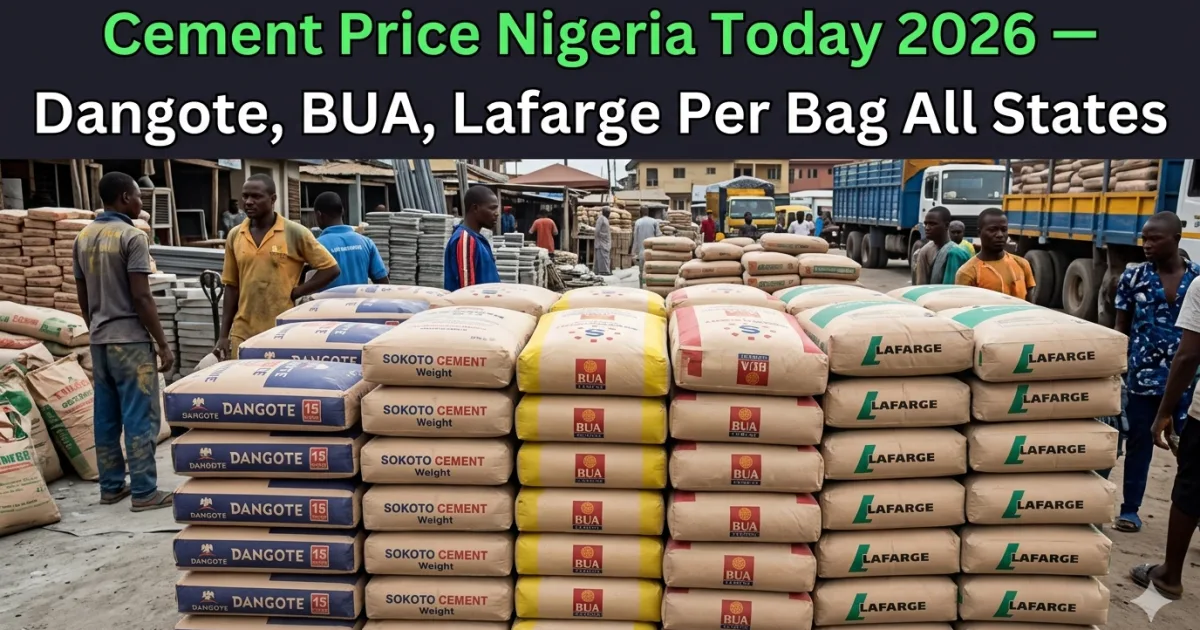
Cement is one of the most critical and expensive inputs in any Nigerian construction project — whether you are building a simple room in a village in Benue State, constructing a block of flats in Port Harcourt, or developing a large commercial building in Lagos. And in 2026, cement prices have risen sharply to levels that are straining budgets for builders, contractors, developers, and homeowners across the country.
Naija News documented the latest surge in April 2026: “Market checks revealed that cement prices now range between ₦11,800 and ₦12,000 per 50kg bag across several markets, with traders lamenting the absence of a stable pricing structure.” This follows a broader trend documented by Legit.ng (February 2026): prices climbed from approximately ₦9,000 per bag in December 2025 to ₦10,000 in January 2026, and then further to ₦11,500–₦12,000 in some markets by April 2026.
This guide gives you the most up-to-date cement prices in Nigeria for all major brands — Dangote, BUA, Lafarge, Ibeto, and others — across different cities and states, explains in detail why cement costs what it does in 2026, helps you calculate how much cement you need for your project, and gives you proven strategies to buy cement at a lower price per bag.
Current Cement Price in Nigeria — April 2026
Cement in Nigeria is sold primarily in 50-kilogram bags at the retail level, though it is also sold in bulk by trailer loads for large-scale construction projects. Here are the current retail prices by brand, based on market surveys from Naija News (April 2026), MyCityPrices (March 2026), and Legit.ng (February 2026):
| Brand | Price Per 50kg Bag (April 2026) | Market Position | Source |
|---|---|---|---|
| Dangote Cement | ₦10,200 – ₦12,000 | Market leader; highest quality reputation | MyCityPrices March 2026; Legit.ng Feb 2026; Naija News Apr 2026 |
| BUA Cement | ₦10,500 – ₦12,000 | Strong second; dominant in North | Legit.ng: “BUA ₦11,200 per bag at some Abuja outlets” |
| Lafarge / Elephant Cement | ₦10,000 – ₦11,500 | Strong brand; Spiritlevel: “₦9,500–₦11,500” | Spiritlevel.com.ng; Legit.ng Feb 2026 |
| Ibeto Cement | ₦9,500 – ₦11,000 | Usually slightly cheaper than Dangote/BUA | MyCityPrices: “BUA and Ibeto usually slightly cheaper” |
| Mangal Cement | ₦10,000 – ₦11,500 | Popular in northern Nigeria | Market surveys; Legit.ng |
| Unicem Cement | ₦10,000 – ₦11,000 | Regional brand; common in South-East | Various market reports |
| Purechem Cement | ₦10,000 – ₦11,500 | Less common; available in some southern markets | Market surveys |
Important: Cement prices change frequently in Nigeria’s current economic environment — sometimes weekly. MyCityPrices advises: “Because cement prices change frequently, it is always advisable to check with local building material suppliers before purchasing.” The prices above are the most current available data as of writing; always verify at your local market before buying.
Cement Prices by State and City — Nigeria April 2026
Just as with fuel prices, cement costs more in states that are far from manufacturing plants. The Dangote Cement plants in Nigeria are located in Obajana (Kogi State), Ibese (Ogun State), and Gboko (Benue State). BUA Cement has plants in Sokoto, Edo, and Obu (Cross River). Getting cement from any of these plants to different parts of Nigeria involves varying transportation costs — and these logistics costs are passed directly to the buyer.
| State / City | Approximate Price Per 50kg Bag | Notes |
|---|---|---|
| Lagos (general) | ₦10,000 – ₦11,500 | Legit.ng: Climbed from ₦9,000 (Dec 2025) to ₦10,000 (Jan) to ₦11,500 in some areas (Feb 2026); Naija News Apr: ₦11,800–₦12,000 |
| Abuja (FCT) — Utako area | ₦10,800 – ₦12,000 | Legit.ng confirmed BUA at ₦11,200; Dangote at ₦10,800 at Utako market (Feb 2026) |
| Ilorin (Kwara) | ₦10,500 – ₦10,700 | Legit.ng: “Up from ₦9,300–₦9,700 in January 2026” |
| Kano | ₦10,500 – ₦11,500 | Higher logistics cost from southern plants; BUA Sokoto plant helps moderate northern prices |
| Kaduna | ₦10,500 – ₦11,500 | Legit.ng market survey confirmed this range |
| Jigawa | ₦10,500 – ₦11,500 | Legit.ng confirmed |
| Port Harcourt (Rivers) | ₦10,000 – ₦11,000 | Access to coastal depots; Unicem plant in Cross River nearby |
| Enugu / Anambra | ₦10,000 – ₦11,000 | Close to Dangote Ibese distribution; reasonable logistics |
| Ibadan (Oyo) | ₦10,000 – ₦11,000 | Close to Dangote Ibese plant; competitive pricing |
| Benin City (Edo) | ₦10,000 – ₦11,000 | BUA Edo plant proximity; moderate pricing |
| Remote northern states | ₦11,500 – ₦13,000+ | Very high logistics costs in Borno, Yobe, Zamfara, Kebbi |
Cement Price in Bulk: Trailer Load Rates 2026
For large construction projects — building a house, constructing multiple rooms, or developing commercial buildings — buying cement by the trailer load is significantly cheaper per bag than retail purchase. Here are the bulk pricing dynamics in 2026:
| Purchase Volume | Approximate Price Per Bag | Typical Order Size |
|---|---|---|
| Retail (single bags) | ₦10,200 – ₦12,000 | Any quantity; highest per-bag price |
| Wholesale (from market dealer) | ₦10,000 – ₦11,000 | 20–50 bags; small discount vs retail |
| Full trailer (from distributor) | ₦10,000 – ₦10,500 | 600–900 bags; best retail-accessible price |
| Direct from manufacturer | ~₦9,500 – ₦10,000 | Multiple trailer loads; manufacturer minimum order |
Legit.ng’s February 2026 Abuja market report confirmed: “Buyers who purchase a full truckload of 900 bags can secure prices around ₦10,500 per bag, but such discounts are out of reach for many small-scale builders.” The savings from bulk buying are real but require significant upfront capital and adequate on-site storage to protect cement from moisture damage (which can make cement unusable within days if not properly stored).
Why Is Cement So Expensive in Nigeria in 2026?
The dramatic increase in cement prices — from approximately ₦7,000 per bag in early 2025 to ₦11,800–₦12,000 per bag in April 2026 — is driven by a combination of structural and cyclical factors. Understanding these factors helps you anticipate future price movements and make smarter buying decisions.
1. Naira Devaluation and Forex Pressure
This is the single most powerful driver of cement price increases in Nigeria. Cement manufacturing is heavily dependent on imported inputs — particularly imported coal (used to fire the kilns), limestone additives, spare parts for machinery, lubricants, chemical grinding agents, and packaging materials. All of these inputs are priced in dollars. When the naira fell from approximately ₦780/dollar in 2023 to a peak of over ₦1,600/dollar in 2024–2025, the naira cost of manufacturing cement rose dramatically even though the manufacturing process itself didn’t change. Although the naira has recovered somewhat in 2026 (currently approximately ₦1,352 official rate), it remains significantly weaker than pre-2023 levels, keeping production costs elevated.
2. Energy Costs — Power and Gas
Cement production is one of the most energy-intensive industrial processes that exists. The rotary kilns used to produce clinker (the intermediate product from which cement is made) require sustained temperatures above 1,400°C. In Nigeria, cement manufacturers primarily use coal, gas, or heavy fuel oil to power these kilns, and they generate their own electricity because the national grid is insufficiently reliable for industrial production. Higher energy prices — driven by fuel subsidy removal and global energy market conditions — directly increase cement production costs, which manufacturers must pass on through higher prices.
3. Distribution and Transportation Costs
Getting cement from factory to market requires a fleet of heavy trucks capable of carrying 20–30 tonnes per load. These trucks use diesel — and diesel prices have remained elevated at ₦1,300–₦1,600 per litre in 2026. The fuel cost of transporting a trailer load of cement from Dangote’s Obajana plant in Kogi State to Lagos, or from BUA’s Sokoto plant to Port Harcourt, adds significant naira cost per bag. Legit.ng’s market analysts confirmed: “Transportation, loading costs, and distributor margins contribute to the final retail price.” The further you are from a manufacturing plant, the more you pay per bag.
4. Middlemen and Distribution Margins
The distribution chain for cement in Nigeria typically involves the manufacturer, the primary distributor (who buys directly from the factory), secondary dealers (who buy from primary distributors), and finally retail shop owners or market traders who sell to individual builders. Each layer adds a margin. Legit.ng’s February 2026 market report noted frustration in the industry: “Some retailers accused dealers and middlemen of inflating prices beyond what manufacturers charge.” This layered distribution structure adds ₦500–₦1,500 per bag between factory gate price and the final consumer price.
5. Strong Construction Demand
Despite the high prices, demand for cement in Nigeria remains strong. Nigeria’s housing deficit is estimated at between 17 and 28 million units — meaning millions of Nigerians need new housing that has not been built yet. Government infrastructure projects (roads, bridges, public buildings) also consume large volumes of cement. This sustained demand from both private construction and public infrastructure means cement manufacturers face little pressure to reduce prices, since their products sell readily regardless of cost.
6. Government Price Cap Attempts Failed
In February 2025, the Federal Government — led by Minister of Works David Umahi — attempted to negotiate a cement price cap of ₦7,000 per bag with manufacturers. Legit.ng reported that Dangote, BUA, and Lafarge representatives attended the meeting and BUA’s Alhaji Kabir Rabiu stated: “We gave our commitment that we don’t believe cement should sell for more than ₦7,000 anywhere in Nigeria.” Despite these commitments, prices have continued to rise well above ₦10,000 in the months since, with manufacturers citing the economic factors above as making the ₦7,000 target commercially unviable under current cost conditions. This episode illustrates the gap between government aspirations and market realities in Nigeria’s deregulated cement sector.
How Much Cement Do You Need? Quick Reference Guide
One of the most common mistakes Nigerian builders make is either buying too little cement (causing costly delays when they have to source more mid-project at potentially higher prices) or buying too much (wasting money on excess that may be damaged by moisture before use). Here are general estimates for common construction tasks — always get a precise quantity survey from a structural engineer or quantity surveyor for your specific project:
| Construction Task | Estimated Cement Bags Needed | Notes |
|---|---|---|
| Foundation (1-bedroom building) | 50 – 80 bags | Depends on foundation depth and soil type |
| Foundation (3-bedroom bungalow) | 80 – 150 bags | Strip or raft foundation; structural engineer specifies |
| Block-laying (3-bedroom bungalow, full) | 200 – 350 bags | For mortar; depends on wall thickness and height |
| Plastering (3-bedroom bungalow, inside + outside) | 100 – 180 bags | Internal and external plaster; render thickness |
| Floor screed / tiling bed (3-bed bungalow) | 30 – 60 bags | Depends on screed thickness and tile size |
| Decking / roof slab (per sqm) | ~1 bag per 1–1.5 sqm | Varies with slab thickness; structural engineer specifies |
| Complete 3-bedroom bungalow (all works) | 400 – 650 bags total | Full build including foundation, walls, plaster, floor; widely cited range |
| Complete 4-bedroom duplex (all works) | 700 – 1,000+ bags | Two floors; significantly more concrete work |
At current prices of approximately ₦11,000 per bag average, the cement alone for a complete 3-bedroom bungalow costs between ₦4,400,000 and ₦7,150,000. This is a major cost component that must be carefully planned and budgeted before any construction begins.
How to Buy Cement Cheaper in Nigeria 2026 — 6 Practical Strategies
Strategy 1: Buy Directly from a Manufacturer-Authorised Distributor
Every major cement company — Dangote, BUA, Lafarge — has a network of authorised first-tier distributors who buy directly from the factory. These distributors sell at prices closer to the factory gate price than market traders or retail shops. Finding and buying from an authorised distributor rather than a general market retailer can save ₦300–₦800 per bag depending on the brand and location. Contact the cement company’s customer service directly to get the list of authorised distributors in your state — Dangote at their official customer line or website, and BUA and Lafarge similarly. This is the single most effective cost-saving strategy for anyone building a house in 2026.
Strategy 2: Buy by the Full Trailer Load
A full trailer of cement (typically 600–900 bags for major brands) purchased directly from a distributor consistently yields ₦500–₦1,500 per bag cheaper than buying in smaller quantities from a retail dealer. The per-bag saving on a 600-bag order at ₦1,000 per bag is ₦600,000 total. The challenge is that this requires significant upfront capital (₦6,000,000–₦9,000,000+ for a full trailer at current prices), storage space adequate for 600+ 50kg bags, and a construction schedule that will use all the cement before moisture damage can set in. It is most practical for people building 3-bedroom houses or larger, or for construction companies with ongoing projects.
Strategy 3: Form a Buying Group with Neighbours or Friends
If you are building in the same estate, street, or neighbourhood as others, organise a collective purchase. If five families each need 100 bags of cement for their builds, purchasing 500 bags collectively gets you bulk pricing that none of you could access individually, while splitting the logistics cost of a single large delivery. This cooperative buying approach is increasingly common in Nigerian estates and self-help groups and can yield ₦400–₦700 per bag savings.
Strategy 4: Buy During Off-Peak Construction Season
Construction activity in Nigeria peaks during the dry season (November through March) and slows significantly during the heavy rainy season (June through September). During the rainy season, cement demand drops and dealers — sitting on unsold inventory that risks moisture damage — are more willing to negotiate prices. Historical patterns show cement prices ease by ₦300–₦700 per bag during mid-rainy season compared to peak dry season prices. If your project timeline allows, purchasing cement stockpiles for a planned dry season build during the preceding rainy season can yield meaningful savings.
Strategy 5: Compare Brands — Not All Cement Is Equal in Price
For non-structural applications — block moulding, garden walls, finishes, floor screed, or internal partitions — Ibeto Cement or regional brands are consistently cheaper than Dangote or BUA and perform adequately for these purposes. MyCityPrices confirmed: “BUA Cement and Ibeto Cement are usually slightly cheaper than other brands.” Work with your structural engineer to identify which parts of your build require higher-grade cement (structural columns, beams, foundation, decking) and which can use more economical options. Using premium Dangote for structural work and a cheaper alternative for block-laying or plastering can yield meaningful savings across a full building project.
Strategy 6: Hire a Qualified Quantity Surveyor
Many Nigerian self-build projects waste enormous amounts of cement through poor specification, incorrect mixing ratios, overestimation, over-ordering, and theft on site. A qualified Quantity Surveyor (QS) provides a precise Bills of Quantities — telling you exactly how many bags of each cement grade you need for each phase of construction. The QS fee (typically ₦200,000–₦500,000 for a residential project depending on size and complexity) is almost always recovered through reduced material waste, optimised ordering, and prevention of the common problem of running short mid-project (which forces panic purchases at retail prices). On a ₦20 million+ project, a QS is not an optional luxury — it is a cost-saving investment.
Nigeria’s Major Cement Manufacturers — Company Profiles
Dangote Cement Plc
Dangote Cement is Africa’s largest cement producer by capacity and Nigeria’s undisputed market leader. The company operates three manufacturing plants in Nigeria — Obajana in Kogi State (its largest plant and one of the largest single cement plants in the world at 13.25 million tonnes per annum nameplate capacity), Ibese in Ogun State, and Gboko in Benue State. Dangote Cement’s extensive distribution network covers all 36 states and the FCT, and the brand commands a premium price premium over competitors because of its strong quality reputation and widespread consumer trust. Dangote is consistently the most expensive major brand at retail — but also the most commonly specified by structural engineers for premium construction work.
BUA Cement Plc
BUA Cement (a subsidiary of BUA Group, owned by billionaire Abdul Samad Rabiu) is Nigeria’s second-largest cement producer. BUA’s plants are located in Sokoto (north-west Nigeria), Edo State (south), and Obu in Cross River (south-east). The company’s Sokoto plant gives it a significant logistics advantage in northern Nigeria — BUA cement can be transported to northern markets from Sokoto at lower cost than southern-based Dangote products, which is why BUA is often the dominant brand in Kano, Katsina, and surrounding northern markets. BUA has historically been slightly cheaper than Dangote at retail, though both brands have converged in the current high-price environment. BUA Cement’s Group Executive Director Alhaji Kabir Rabiu made headlines in 2025 when he pledged that “we don’t believe cement should sell for more than ₦7,000 anywhere in Nigeria” — a target that market conditions have subsequently made impossible to maintain.
Lafarge Africa Plc (Elephant Cement)
Lafarge Africa (part of the global LafargeHolcim group) is Nigeria’s third-largest cement producer, operating the Ewekoro plant in Ogun State and the Ashaka plant in Gombe State. Lafarge markets its products under the “Elephant Cement” brand — a name that has been associated with quality construction in Nigeria for decades. Lafarge’s prices generally track Dangote closely, sometimes slightly lower in markets near their plants. Spiritlevel.com.ng’s 2025/2026 review confirms Lafarge prices in the ₦9,500–₦11,500 range depending on location.
Ibeto Cement
Ibeto Cement (part of the Ibeto Group) is a smaller producer with a plant in Enugu/Anambra area, primarily serving the South-East market. It is consistently priced slightly below Dangote and BUA, making it a popular choice for cost-conscious builders in the South-East who don’t have brand-specification requirements from their engineers. MyCityPrices notes Ibeto as “usually slightly cheaper than other brands” — a reputation it has maintained as prices across the industry have risen in 2025–2026.
Cement Price History — How Did We Get to ₦12,000 Per Bag?
Understanding the trajectory of cement prices in Nigeria over the past five years helps put the current situation in context and gives a sense of the structural forces at work:
| Period | Approximate Price (50kg Bag) | Key Driver |
|---|---|---|
| 2020 (pre-COVID) | ₦2,500 – ₦3,000 | Subsidised energy; lower naira depreciation; lower input costs |
| 2021 | ₦3,000 – ₦3,800 | Post-COVID recovery; rising energy costs |
| 2022 | ₦3,800 – ₦5,000 | Naira weakening; increasing input costs |
| 2023 (post-subsidy removal) | ₦5,000 – ₦7,500 | Fuel subsidy removed; energy costs jump; naira devaluation accelerated |
| 2024 (naira at lows) | ₦7,500 – ₦10,000 | Naira hit ₦1,500–₦1,600/dollar; dramatically higher import costs |
| December 2025 | ~₦9,000 | Prices easing slightly with naira recovery |
| January 2026 | ~₦10,000 | Price reversal; logistics and energy costs rising again |
| April 2026 | ₦10,000 – ₦12,000 | Sustained high levels; Naija News: “₦11,800–₦12,000 in several markets” |
The data above shows that cement prices in Nigeria have risen approximately 300–400% in four years — from ₦2,500–₦3,000 per bag in 2020 to ₦10,000–₦12,000 in 2026. This extraordinary increase is primarily a consequence of the broader macroeconomic pressures on the Nigerian economy: fuel subsidy removal (which hit all energy costs), naira devaluation (which hit all dollar-denominated input costs), and general inflation. These forces affect every building material — not just cement — which is why the overall cost of construction in Nigeria has risen so dramatically in recent years.
Will Cement Prices Come Down in Nigeria 2026?
This question is at the forefront of every builder’s mind. Here is a balanced assessment of the factors that could push cement prices down and those that may keep them elevated:
Factors That Could Reduce Prices
- Naira strengthening: The naira has already strengthened from its 2024 lows. If this recovery trend continues and the naira stabilises at ₦1,200–₦1,300 per dollar (or better), the dollar-cost component of cement production inputs will fall in naira terms, potentially allowing manufacturers to reduce prices.
- New refinery capacity and cheaper energy: As the Dangote Refinery increases output and domestic petrol and diesel prices stabilise or fall, the energy cost component of cement production may ease slightly.
- New cement plant capacity: Additional investments in cement production capacity in Nigeria (beyond existing plants) would increase supply competition and put downward pressure on prices over the medium term.
- Reduced construction demand (economic slowdown): If Nigeria’s economy slows significantly and construction activity drops, lower demand would give builders more pricing power relative to manufacturers and dealers.
Factors That Could Keep Prices High
- Persistent naira weakness: If the naira weakens again (due to falling oil prices, political uncertainty, or capital outflows), production costs rise and cement prices follow.
- High energy prices: Diesel prices remain elevated; if global energy markets tighten, the cost of operating cement kilns and transport trucks rises.
- Strong underlying construction demand: Nigeria’s housing deficit of 17–28 million units provides a persistent demand floor that prevents prices from falling dramatically even in softer market conditions.
- Limited price competition: The cement industry in Nigeria is highly concentrated — Dangote, BUA, and Lafarge together control more than 80% of the market. This oligopolistic structure limits the competitive pressure that would normally drive prices down in response to falling costs.
Frequently Asked Questions — Cement Price Nigeria 2026
How much is a bag of cement in Nigeria today 2026?
As of April 2026, a 50kg bag of cement costs approximately ₦10,000–₦12,000 at retail depending on brand and location. Naija News’ April 2026 market check reported ₦11,800–₦12,000 in several markets. Dangote typically sells for ₦10,200–₦12,000, BUA for ₦10,500–₦12,000, and Ibeto slightly cheaper at ₦9,500–₦11,000. Prices vary by state — Lagos and Abuja are among the most expensive, remote northern states even more so.
How much is a trailer of cement in Nigeria 2026?
A standard trailer carries 600–900 bags of cement depending on the truck capacity and brand. At bulk pricing of approximately ₦10,000–₦10,500 per bag for a full trailer, a 600-bag trailer costs approximately ₦6,000,000–₦6,300,000 and a 900-bag trailer costs approximately ₦9,000,000–₦9,450,000. Prices vary by brand, location, and your relationship with the distributor.
Which cement brand is cheapest in Nigeria 2026?
Among the major national brands, Ibeto Cement is consistently the cheapest, followed by BUA (which is often cheaper than Dangote at retail in most markets). MyCityPrices confirms “BUA Cement and Ibeto Cement are usually slightly cheaper than other brands.” For small regional brands (Unicem, Purechem), prices can also be competitive in the areas where they are manufactured. However, always confirm quality and SON (Standards Organisation of Nigeria) certification for any brand before using on structural work.
How many bags of cement do I need to build a 3-bedroom house?
A complete 3-bedroom bungalow in Nigeria typically requires 400–650 bags of cement in total across all works — foundation, block-laying, plastering, floor screed, and finishes. The exact quantity depends on the building size, foundation type, wall thickness, plaster thickness, and construction method. Always get a precise quantity survey from a Quantity Surveyor for your specific building design. At ₦11,000 average per bag, the cement budget for a 3-bedroom bungalow is approximately ₦4.4 million to ₦7.15 million for cement alone.
🏗️ Cement Price Nigeria April 2026 — Complete Quick Reference
- Dangote Cement: ₦10,200 – ₦12,000 per 50kg bag
- BUA Cement: ₦10,500 – ₦12,000 (₦11,200 at Abuja Utako — Legit.ng Feb 2026)
- Lafarge / Elephant: ₦10,000 – ₦11,500
- Ibeto Cement: ₦9,500 – ₦11,000 (usually cheapest national brand)
- Naija News April 2026 spot price: ₦11,800 – ₦12,000 in several markets
- Bulk (full trailer, 600–900 bags): ~₦10,000 – ₦10,500 per bag
- Most expensive state: Remote northern states (₦11,500 – ₦13,000+)
- Price 4 years ago (2020): ₦2,500 – ₦3,000 per bag
- Main cost drivers: Naira devaluation, energy costs, transport, middlemen
- How to save: Buy from authorised distributor; buy in bulk; compare brands; use QS
Also read: Iron Rod Price Nigeria 2026 | How Much to Build a House in Nigeria 2026 | Dollar to Naira Rate Today 2026
How to Store Cement Properly in Nigeria to Prevent Wastage
At ₦10,000–₦12,000 per bag, improperly stored cement can represent a significant financial loss. Cement absorbs moisture from the air — even in bags — and once it sets inside the bag, it is useless for construction. Nigerian builders have lost millions of naira to cement that hardened in storage. Here is how to store cement correctly to protect your investment:
- Elevate bags off the ground: Never store cement bags directly on earth or concrete floors — moisture wicks upward through the bag. Place wooden pallets, planks, or plastic sheeting beneath all bags. Elevation of at least 15cm is recommended.
- Keep away from walls: Moisture seeps through walls, particularly during rainy season. Store bags at least 30cm away from any wall surface.
- Cover with polythene or tarpaulin: Cover stored bags completely with waterproof polythene sheeting or heavy tarpaulin when not in use. Re-seal the cover after each withdrawal.
- Stack no higher than 10 bags: Over-stacking causes compression of lower bags. Maximum recommended height is 10 bags per stack — above this, bags at the bottom begin to compact and may partially set under pressure.
- Use oldest stock first: Cement has a shelf life — even properly stored cement begins to lose strength after 3 months. Use a first-in, first-out rotation. Mark delivery dates on bags with chalk or marker at time of delivery.
- Never store in open air: Even a single night’s exposure to heavy dew or rain can begin the hardening process in an open bag. Store under a proper roof structure or at minimum a raised, covered platform.
- Buy only what you need within 8 weeks: Do not stockpile more than 8 weeks of anticipated cement usage. The cost saving from buying in bulk is quickly eroded by losses from bags that harden in long-term storage.
Cement vs Concrete: Understanding What You Are Actually Buying
A common source of confusion for first-time builders in Nigeria is the relationship between cement, concrete, and mortar — three different materials that all start with a bag of cement. Cement alone is not a structural material — it is an ingredient. When cement is mixed with water, it forms a paste. When that paste is combined with sand (fine aggregate), it becomes mortar — used for block-laying and plastering. When cement paste is combined with sand and gravel or granite (coarse aggregate), it becomes concrete — the structural material used for foundations, columns, beams, slabs, and decking.
The mixing ratio (how much cement, sand, and aggregate per batch) is specified by your structural engineer and determines the strength grade of the concrete. Common ratios used in Nigerian residential construction: 1:2:4 (1 part cement, 2 parts sand, 4 parts granite) for general structural concrete; 1:3 (1 part cement, 3 parts sand) for mortar used in block-laying; and 1:4 (1 part cement, 4 parts sand) for plastering. Deviating from the engineer’s specified ratios — particularly reducing the cement proportion to save money — directly weakens the structure and can cause structural failure. Never instruct your builder to reduce cement ratios to cut costs.

0 Comments
No comments yet. Be the first to share your thoughts!