


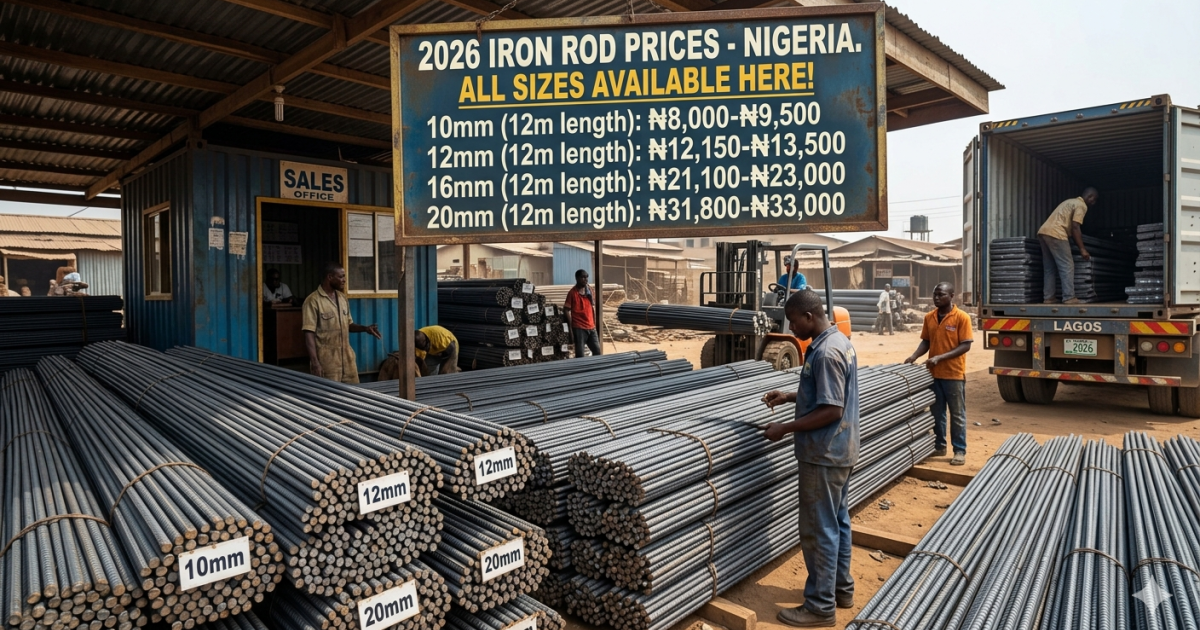
Iron rods — formally known as reinforcement bars or rebars — are the steel skeleton inside every concrete structure in Nigeria. Foundations, columns, beams, slabs, decking, and lintels all depend on iron rods to give concrete its tensile strength and prevent cracking under load. In 2026, iron rod prices have risen sharply alongside cement and other building materials, driven by naira depreciation, higher energy costs, and global steel market dynamics. Spiritlevel.com.ng’s March 2026 iron rod price guide confirms: “The average price of iron rods per ton in Nigeria in this month of March is ₦1,100,000 per ton.” This makes iron rods one of the most expensive single material inputs in any Nigerian construction budget.
This guide gives you the complete 2026 price list by rod size — from 8mm to 25mm — explains the difference between TMT and local rods, tells you how many rods you get per tonne for each size, breaks down the factors driving prices higher, and shows you where and how to buy iron rods cheaper in Nigeria in 2026.
Iron Rod Prices Per Tonne — Nigeria 2026 (All Sizes)
Iron rods in Nigeria are primarily sold per tonne (1,000 kilograms) at the wholesale level, though retail markets also sell by individual piece. Here is the current price breakdown based on data from BestSales.ng (February 2026), Spiritlevel.com.ng (March 2026), and Titanium Building Solutions (January 2026):
| Size | Type | Price Per Tonne | Pieces Per Tonne (12m lengths) | Source |
|---|---|---|---|---|
| 8mm | TMT (imported) | ₦750,000 | ~210 pieces | BestSales.ng Feb 2026 |
| 8mm | Local | ₦700,000 – ₦750,000 | ~210 pieces | Market surveys |
| 10mm | TMT | ₦850,000 – ₦950,000 | ~134 pieces | BestSales.ng; market surveys |
| 12mm | TMT | ₦1,010,000 | ~93 pieces | BestSales.ng Feb 2026 confirmed |
| 12mm | Local | ₦950,000 | ~93 pieces | BestSales.ng Feb 2026 |
| 16mm | TMT | ₦1,010,000 | ~52 pieces | BestSales.ng: “average price of 16mm iron rods in Nigeria is ₦1,010,000 per ton” |
| 16mm | Local | ₦950,000 – ₦1,000,000 | ~52 pieces | Market surveys |
| 20mm | TMT | ₦1,100,000 – ₦1,200,000 | ~34 pieces | Market surveys; Spiritlevel |
| 25mm | TMT | ₦1,200,000 – ₦1,400,000 | ~21 pieces | Market surveys |
| 32mm | TMT | ₦1,300,000 – ₦1,500,000 | ~13 pieces | Market surveys; heavy-duty construction |
| Average (all sizes) | — | ~₦1,100,000 | — | Spiritlevel March 2026: confirmed average |
Note: BestSales.ng confirms: “The price of iron rods per ton in Nigeria is subject to fluctuations due to the cost of importation, the cost of raw materials, and the economic situation of the country.” Prices vary by market, location, and supplier. Always verify current prices before purchasing large quantities.
Iron Rod Prices Per Single Piece — Nigeria 2026
For small-scale buyers purchasing individual rods rather than full tonnes, here are the approximate retail prices per 12-metre rod in 2026:
| Size | Approximate Retail Price Per Rod (12m length) | Notes |
|---|---|---|
| 8mm TMT | ₦3,500 – ₦4,000 | Lightest; used for stirrups, ties, and lightweight works |
| 10mm TMT | ₦6,500 – ₦7,500 | Intermediate size; slabs and medium structures |
| 12mm TMT | ₦10,000 – ₦11,500 | Most used residential construction size; columns, beams, foundations |
| 16mm TMT | ₦18,000 – ₦22,000 | Heavy structural use; duplex decking, large beams |
| 20mm TMT | ₦30,000 – ₦38,000 | Commercial/heavy structures; large columns and foundations |
| 25mm TMT | ₦55,000 – ₦70,000 | High-rise, bridges, industrial structures |
TMT vs Local Iron Rods: Which Should You Use?
BestSales.ng explains: “TMT stands for Thermo-Mechanically Treated, a process that strengthens iron rods, making them ideal for construction purposes. TMT iron rods are preferred for their superior strength, ductility, and weldability compared to traditional iron rods.”
| Factor | TMT Rods | Local (Mild Steel) Rods |
|---|---|---|
| Manufacturing process | Thermo-mechanically treated — heat and rapid cooling creates tough outer layer with ductile core | Hot-rolled deformed bars — standard manufacturing |
| Tensile strength | Higher — better for structural loads | Adequate for standard residential construction |
| Flexibility/ductility | Better — tolerates bending during construction without cracking | Can be more brittle under stress |
| Corrosion resistance | Better — outer layer provides additional protection | Standard protection; adequate with proper concrete cover |
| Cost | Higher — 8mm TMT ₦750,000/tonne vs ₦700,000 local | Cheaper — typically ₦50,000–₦100,000/tonne less |
| Recommended for | All structural elements: columns, beams, foundations, decking; high-rise; earthquake-prone areas | Basic residential construction where engineer confirms suitability; non-structural elements |
| SON certification | Must carry SON (Standards Organisation of Nigeria) certification — always check | Must also carry SON certification — verify before purchase |
Professional guidance: Titanium Building Solutions’ 2026 construction guide is explicit: “Always check with a construction expert before buying iron rods. Using the wrong size can weaken your building.” Always follow your structural engineer’s specifications for both size and type — do not substitute based on price alone without engineering approval.
How Many Iron Rods Per Tonne? Complete Reference
The number of 12-metre rods in a tonne depends entirely on the diameter. Heavier rods (larger diameter) contain more steel per metre, so fewer pieces make up a tonne. Here is the standard reference for 12-metre lengths:
| Rod Diameter | Weight Per 12m Rod (approx.) | Pieces Per Tonne |
|---|---|---|
| 8mm | ~4.74 kg | ~211 pieces |
| 10mm | ~7.40 kg | ~135 pieces |
| 12mm | ~10.65 kg | ~94 pieces |
| 16mm | ~18.95 kg | ~53 pieces |
| 20mm | ~29.60 kg | ~34 pieces |
| 25mm | ~46.25 kg | ~22 pieces |
| 32mm | ~75.78 kg | ~13 pieces |
How to use this table: Your structural engineer will give you a cutting schedule showing the total metres of each size rod required for your project. Divide the total metres by 12 (the standard rod length) to get the number of rods needed, then divide by the pieces-per-tonne figure to calculate how many tonnes to order. Always add 5–10% for waste (cutting offcuts, errors, and damaged pieces).
Why Are Iron Rod Prices So High in Nigeria 2026?
1. Naira Depreciation and Import Costs
BestSales.ng identifies the core driver: “The price of iron rods per ton in Nigeria depends on the size. Iron ore, the primary raw material used in the production of iron rods, is extracted from the earth. The cost of mining, refining, and transporting this ore affects the final price of both Y6, y10, y12, y16, y18, y30, y25, and y32 iron rods.” Nigeria imports a significant proportion of its iron rods — particularly TMT bars from Asia — and pays for them in US dollars. When the naira fell from approximately ₦450/dollar before 2023 to over ₦1,600/dollar at the 2024 peak, the naira cost of the same tonne of imported iron more than tripled. Even with partial naira recovery to ₦1,344–₦1,400 per dollar in April 2026, import-linked steel prices remain dramatically above pre-devaluation levels.
2. Global Steel Market Dynamics
The global price of steel is set on international commodity markets and is influenced by iron ore prices, coking coal prices, Chinese steel production decisions, and global construction demand. When global steel prices rise — as they have periodically due to post-COVID supply chain disruptions, the Russia-Ukraine conflict’s impact on steel-producing regions, and high energy costs for steel smelting — Nigerian importers and local manufacturers both face higher input costs that flow through to market prices.
3. High Energy Costs for Local Manufacturers
Nigerian steel rolling mills that produce local iron rods use electric arc furnaces and induction furnaces that require enormous amounts of electricity or generator power. With electricity costs elevated by distribution infrastructure problems and generator diesel at ₦1,300–₦1,600 per litre in 2026, the energy cost per tonne of locally manufactured iron rod has risen substantially — pushing up local rod prices even though they don’t face the same import costs as TMT bars.
4. Transportation and Logistics
Iron rods are heavy and bulky — moving them from manufacturing facilities or import depots (primarily Lagos and Port Harcourt) to building sites across Nigeria’s road network requires heavy trucks consuming significant diesel. The combination of higher diesel prices and longer routes to sites in northern or remote states adds significant logistics cost per tonne that buyers absorb in the final purchase price.
Which Size Iron Rod Do You Need? Guide by Construction Type
Titanium Building Solutions provides the standard engineering guidance: “Use 12mm and 16mm rods for a bigger house or duplex. Use 16mm, 20mm, or 25mm rods for a high-rise building. For bridges, flyovers, or heavy structures, use 25mm and 32mm rods. If your structure will carry a lot of weight, use thicker iron rods. If it’s a simple structure, smaller rods are enough.”
| Construction Type | Recommended Sizes | Notes |
|---|---|---|
| Foundation (1–2 bedroom) | 12mm main bars + 8mm stirrups | Standard residential; engineer specifies based on soil conditions |
| Columns (residential) | 12mm or 16mm + 8mm links | 16mm preferred for 3-bed duplex and above |
| Beams and lintels | 12mm or 16mm main + 8mm stirrups | 16mm for spanning long openings |
| Decking / roof slab | 12mm @ 200mm centres (both ways) | Standard residential slab; engineer specifies spacing |
| 3-bedroom bungalow (total) | Typically 3–5 tonnes across sizes | Exact quantity from structural engineer’s cutting schedule |
| 4-bedroom duplex (total) | Typically 6–10 tonnes across sizes | Significantly more due to two floors and larger spans |
| Commercial building | 16mm, 20mm, 25mm | Heavier loads; always engineer-specified |
| Bridge / flyover | 25mm, 32mm | Heavy structural engineering only |
How to Detect Fake or Substandard Iron Rods
Substandard iron rods — including undersized rods fraudulently sold as the specified size — are a serious and dangerous problem in the Nigerian building materials market. Titanium Building Solutions warns: “Avoid buying rods without measuring — they might be smaller than they should be. Sometimes, fake suppliers sell iron rods that are thinner than the correct size. For example, they may call a rod ’12mm’ when it is actually 10mm. This can make your building unsafe.”
- Use a vernier calliper or digital micrometer: Measure the actual diameter of rods before purchase. A “12mm” rod should measure 12mm (±0.3mm tolerance) at the cross-section. Any rod consistently measuring 10.5mm or 11mm when called 12mm is substandard and should be rejected.
- Sound test: “One simple way to check quality is by hitting two rods together and listening to the sound. If the rods sound dull or weak, they may contain impurities. A high-quality iron rod makes a clear, ringing sound when tapped. A weak or fake iron rod makes a dull, low sound.”
- Check for SON certification mark: All iron rods sold in Nigeria must bear the Standards Organisation of Nigeria (SON) certification mark. Rods without this marking are not officially certified for use in structural construction. Ask to see the manufacturer’s SON certification before purchasing any consignment.
- Buy from established, reputable dealers: Major iron rod markets include Alaba/Isale Eko in Lagos, International Building Materials Market in Dei-Dei Abuja, and Onitsha Building Materials Market. Established dealers with verifiable track records are less likely to sell substandard stock than roadside or informal sellers.
- Weigh a sample tonne: A genuine tonne of 12mm TMT rods should contain approximately 94 pieces of 12m length. If the seller delivers significantly more pieces than the standard quantity for a claimed tonne, the rods may be undersized — more pieces would be needed to reach a tonne if each rod weighs less than it should.
Where to Buy Iron Rods Cheaper in Nigeria 2026
1. Major Iron Rod Markets
BestSales.ng confirms: “Reinforcement bars seem cheap in Lagos, you can buy iron rods in major markets in Lagos state.” The primary iron rod wholesale markets in Nigeria are: Alaba International Market and Mile 2 area (Lagos) for the South-West; International Building Materials Market, Dei-Dei (Abuja) for the North-Central and FCT; Bridgehead Onitsha (Anambra) for the South-East; and Sabon Gari Market (Kano) for the North. Buying directly in these markets rather than through agents or secondary dealers saves 5–15% per tonne on typical orders.
2. Buy in Full Trailer Loads
A standard trailer carries 15–20 tonnes of iron rods. Ordering a full trailer directly from a manufacturer’s distributor or a major importer consistently yields better per-tonne pricing than buying in smaller quantities from market retailers. For large projects (3-bedroom and above), consolidating your iron rod order into a single large purchase negotiated with a major dealer is one of the most effective cost-saving strategies available.
3. Use a Quantity Surveyor
Many builders over-purchase iron rods out of caution — ending up with significant offcut waste and unused rods that represent pure cost with no structural value. A licensed Quantity Surveyor (QS) provides a precise cutting schedule that calculates the exact metres of each size needed, minimises offcut waste by optimising how rods are cut, and gives you a definitive quantity to order. QS fees of ₦200,000–₦500,000 on a residential project are typically recovered through reduced material waste and better bulk purchasing decisions.
4. Check Jiji.ng and Online Platforms
Jiji.ng lists over 381 iron rod sellers in Nigeria, with prices from as low as ₦3,000 for single rods. Online price comparison across Jiji, Buildingsandmore.ng, and other building materials platforms gives you visibility into current market pricing before approaching a supplier, helping you negotiate from a position of price knowledge rather than guesswork.
Iron Rod Price History: How Nigeria Got to ₦1,100,000 Per Tonne
| Year | Average 12mm TMT Price Per Tonne | Key Driver |
|---|---|---|
| 2020 | ~₦180,000 – ₦220,000 | Pre-inflation baseline; moderate naira |
| 2021 | ~₦250,000 – ₦350,000 | Post-COVID supply chain disruptions |
| 2022 | ~₦350,000 – ₦480,000 | Global steel price surge; Ukraine war impact; naira weakening |
| March 2024 | ~₦420,000 | Vanguard Nigeria: “The average price per ton of TMT iron rods for March 12, 2024, is ₦420,000” |
| February 2026 | ₦1,010,000 (12mm TMT) | BestSales.ng confirmed; naira at post-devaluation levels |
| March 2026 | ~₦1,100,000 (average all sizes) | Spiritlevel.com.ng March 2026 confirmed average |
Iron rod prices have risen approximately 500% in four years — from ₦180,000–₦220,000 per tonne for 12mm TMT in 2020 to ₦1,010,000–₦1,100,000 in 2026. This reflects the combined impact of naira devaluation (more than doubling import costs in naira terms), higher global steel prices, elevated energy costs for local manufacturers, and higher logistics costs from fuel price increases.
Frequently Asked Questions — Iron Rod Price Nigeria 2026
How much is iron rod per tonne in Nigeria 2026?
Spiritlevel.com.ng’s March 2026 guide confirms: “The average price of iron rods per ton in Nigeria in this month of March is ₦1,100,000 per ton.” Specifically: 8mm TMT ₦750,000/tonne; 12mm TMT ₦1,010,000/tonne; 16mm TMT ₦1,010,000/tonne; 20mm and above ₦1,100,000–₦1,500,000/tonne depending on size. Local rods are approximately ₦50,000–₦100,000 per tonne cheaper than equivalent TMT sizes.
How many pieces of 12mm iron rod are in a tonne?
A standard 12-metre length of 12mm iron rod weighs approximately 10.65 kg. One tonne (1,000 kg) therefore contains approximately 94 pieces of 12mm × 12m rod. Spiritlevel.com.ng confirms the piece count varies by size: “8mm, 10mm, 12mm, 16mm and 32mm iron rods have different prices except 12mm and 16mm that has same price both local and TMT.”
What is the difference between 12mm and 16mm iron rod?
12mm iron rods are used for medium structural loads — standard residential foundations, columns in single-storey to 2-storey buildings, beams, and decking in residential construction. BestSales.ng explains: “16mm provide stability to heavy construction loads and withstand stress in buildings. They’re always deployed to withstand good heavy load even during concrete road construction.” Your structural engineer’s specification is the definitive guide for your specific project — never substitute sizes without engineering approval.
🔩 Iron Rod Price Nigeria 2026 — Quick Reference
- 8mm TMT: ₦750,000/tonne (~211 pieces per tonne)
- 12mm TMT: ₦1,010,000/tonne (~94 pieces) — most used residential size
- 16mm TMT: ₦1,010,000/tonne (~53 pieces)
- 20mm TMT: ₦1,100,000–₦1,200,000/tonne (~34 pieces)
- Average all sizes: ~₦1,100,000/tonne (Spiritlevel March 2026)
- Local rods: ₦50,000–₦100,000/tonne cheaper than equivalent TMT
- Use TMT for: All structural work — columns, beams, foundations, decking
- Detect fakes: Measure actual diameter; sound test; check SON certification
- Buy cheapest: Major markets (Alaba Lagos, Dei-Dei Abuja, Onitsha); full trailer loads
- Always: Follow structural engineer’s specifications — never substitute size or type
Also read: Cement Price Nigeria 2026 | How Much to Build a House Nigeria 2026 | Dollar to Naira Rate Today 2026
Iron Rod Price Outlook for 2026: Will Prices Drop?
Whether iron rod prices ease in 2026 depends on three interconnected variables: the naira exchange rate, global steel market dynamics, and domestic energy costs. The naira has strengthened from its 2024 lows of ₦1,600+ per dollar to approximately ₦1,344–₦1,400 in April 2026 — and a continued naira recovery toward ₦1,200 per dollar would meaningfully reduce the naira cost of imported TMT rods and iron ore inputs for local manufacturers. If the CBN’s monetary policy continues to support naira stability and foreign reserve accumulation, this could translate to price easing in the second half of 2026. Global steel prices, meanwhile, are influenced primarily by Chinese production decisions — China accounts for approximately 57% of global steel output, and any significant reduction in Chinese export volumes (due to domestic demand or trade policy) tightens global supply and pushes prices higher. Domestic energy cost relief — possible if the Dangote Refinery’s full output further moderates diesel prices — would reduce the energy component of local rod manufacturing costs. The most realistic scenario for 2026 is modest price stabilisation rather than dramatic reduction: a movement from ₦1,100,000/tonne average toward ₦950,000–₦1,000,000/tonne if naira recovery continues and global steel markets remain stable. A return to the ₦200,000–₦300,000/tonne levels of 2020–2021 is extremely unlikely without a fundamental reversal of the exchange rate depreciation that has occurred since 2023.
Nigerian Steel Industry: Who Manufactures Iron Rods Locally?
Nigeria has a small but growing domestic steel manufacturing sector. Understanding who makes iron rods locally helps builders identify domestic sources that may be less exposed to import cost fluctuations than fully imported TMT bars. The major local steel manufacturers and rollers include: Delta Steel Company (DSC) in Ovwian-Aladja, Delta State — one of Nigeria’s oldest steel plants with a troubled history of rehabilitation; Ajaokuta Steel Company in Kogi State — Nigeria’s largest and most expensive industrial project, still not fully operational after decades of delays and investments; Osogbo Steel Rolling Mill in Osun State; and numerous smaller rolling mills across Lagos, Ogun, Anambra, and Rivers states that import billets (raw steel semi-finished products) and roll them into rods locally. The distinction matters for buyers: a “local” rod may be made from imported billets rolled in Nigeria — meaning its cost is still significantly influenced by the naira/dollar exchange rate, just not to the same extent as a fully imported finished TMT bar.
Iron Rod Maintenance After Construction: Protecting Your Investment
Once iron rods are embedded in concrete, they require no specific maintenance — the alkaline environment of concrete provides a natural protective barrier against corrosion (rusting). However, during the period between delivery and concrete pouring, exposed rods are vulnerable to rust if left in damp conditions. Titanium Building Solutions notes this concern in their guide: “Always store iron rods in a dry place away from water. Rusted iron rods weaken your building.” Rust on iron rods before casting is a serious structural concern — surface rust (light orange discolouration) is generally acceptable and does not significantly reduce bond strength, but deep pitting rust that reduces the rod’s cross-sectional area is structurally dangerous and such rods should be rejected. Store delivered rods elevated off the ground on timber bearers, covered with waterproof sheeting during rainy periods, and use them within the construction cycle rather than storing for extended periods. At ₦1,010,000 per tonne, protecting your rod investment from preventable rust damage is straightforward and worth the small effort.
Hiring a Structural Engineer vs DIY: Why the Former Always Wins
At current iron rod prices of ₦1,010,000 or more per tonne, the stakes of getting your structural specification wrong are extremely high. A structural engineer who identifies that your design requires 4 tonnes of 12mm rod rather than the 6 tonnes you had assumed saves you ₦2,020,000 in materials alone — several times more than the engineer’s fee. Conversely, a self-built structure that uses the wrong rod sizes, wrong spacing, or wrong concrete ratios for its loading conditions can develop structural cracks, settlement problems, or in the worst case, collapse — creating personal injury risk and total loss of the building investment. In Nigeria, where buildings do periodically collapse with tragic consequences, the evidence consistently points to structural engineering neglect (absence of proper drawings, wrong rod specifications, inadequate concrete quality control) as the primary cause. The cost of a registered structural engineer for a residential project — typically ₦100,000–₦500,000 for drawing and supervision depending on project size and complexity — is the single best investment any self-building Nigerian can make, delivering materials savings, structural safety, and peace of mind that no amount of building materials market knowledge can substitute for.
Iron Rods and Building Permits: What You Need to Know
Many Nigerians who build private homes use iron rods without obtaining the required building permits from their state’s Ministry of Physical Planning or Local Government building authority. This is a significant legal and financial risk. A building constructed without a valid permit can be demolished by government authorities regardless of how much you have spent on it — and demolished buildings represent total loss of all materials, labour, and iron rod investment. Before purchasing any iron rod or beginning any foundation work, ensure you have obtained the required building permit for your state. Lagos State, FCT, and most states with active urban planning enforcement have stepped up demolition of unpermitted structures in recent years. The process of obtaining a building permit — submitting architectural and structural drawings for approval — also ensures your structural engineer’s iron rod specifications are reviewed by state building control authorities, adding another layer of safety validation to your project.
Summary: Managing Iron Rod Costs on Your Building Project in 2026
Iron rod prices at ₦1,010,000–₦1,100,000 per tonne in April 2026 are painful but manageable with the right strategy. The most impactful actions any builder can take to reduce iron rod spending without compromising structural integrity are: engage a qualified structural engineer whose cutting schedule minimises wasteful over-ordering; buy in the largest single consignment your project cash flow and storage capacity allow to access the best bulk pricing; source from major established markets (Alaba Lagos, Dei-Dei Abuja, Onitsha) or directly from manufacturer distributors rather than secondary retail; verify rod dimensions with a calliper before payment to confirm you are receiving the specified size; check SON certification on every consignment; store rods properly off the ground and covered until use; and obtain your building permit before beginning construction to protect the entire investment from demolition risk. At current prices, the iron rod budget for a typical 3-bedroom bungalow runs ₦3,000,000–₦5,500,000 — a figure that makes every one of these cost and quality controls financially worthwhile. Monitor global steel price news and naira movement for signals of any market easing, and consider timing large purchases accordingly where project scheduling allows.
One practical tip worth noting for builders: iron rod prices in Nigeria fluctuate not just monthly but sometimes weekly in response to exchange rate movements and global steel news. If you receive a price quote from a dealer that seems significantly lower than the current market average, verify it is not for substandard stock before assuming you found a bargain. Genuine below-market pricing does occasionally occur — a distributor clearing old inventory before a shipment arrives, or a large trader offering a discount for immediate full payment — but any price more than 15–20% below the confirmed market average warrants scrutiny. Ask to see the SON certification, measure a sample rod, and if possible, get the price in writing before committing funds. Iron rod procurement at this price level — ₦1,010,000 per tonne for a 3-bedroom project requiring 3–5 tonnes means ₦3,000,000–₦5,050,000 in rod spending alone — demands the same diligence you would apply to any major financial transaction.
In closing, iron rods are a non-negotiable structural input where quality must never be compromised for price. The gap between a genuine certified 12mm TMT rod and a substandard undersized substitute may seem small in physical dimensions but is enormous in structural consequence — it is the difference between a building that stands for generations and one that fails under load. At ₦1,010,000 per tonne, buy right the first time: verify dimensions, check SON certification, buy from reputable dealers, follow your structural engineer’s specification, and store rods properly until use. The investment in quality materials is the foundation of every naira subsequently spent on the building above them.
Iron rods remain the backbone of every Nigerian building — buy right, build safe, and protect the investment of everyone who will ever live or work inside the structure you build.
Finally, always insist that your contractor returns all offcut iron rod pieces to you at the end of each construction phase. Offcuts that are 300mm or longer have reuse value for stirrups, ties, and connector bars in later phases. Unscrupulous contractors sometimes sell offcuts from your project at the market — a double loss since you paid for the full rod and lose the offcut value too. Keeping tight control of your materials on site, ideally through a site manager or trusted family member who monitors deliveries and consumption, protects your iron rod investment and ensures every naira spent on rods goes into your structure rather than into the market.



0 Comments
No comments yet. Be the first to share your thoughts!