




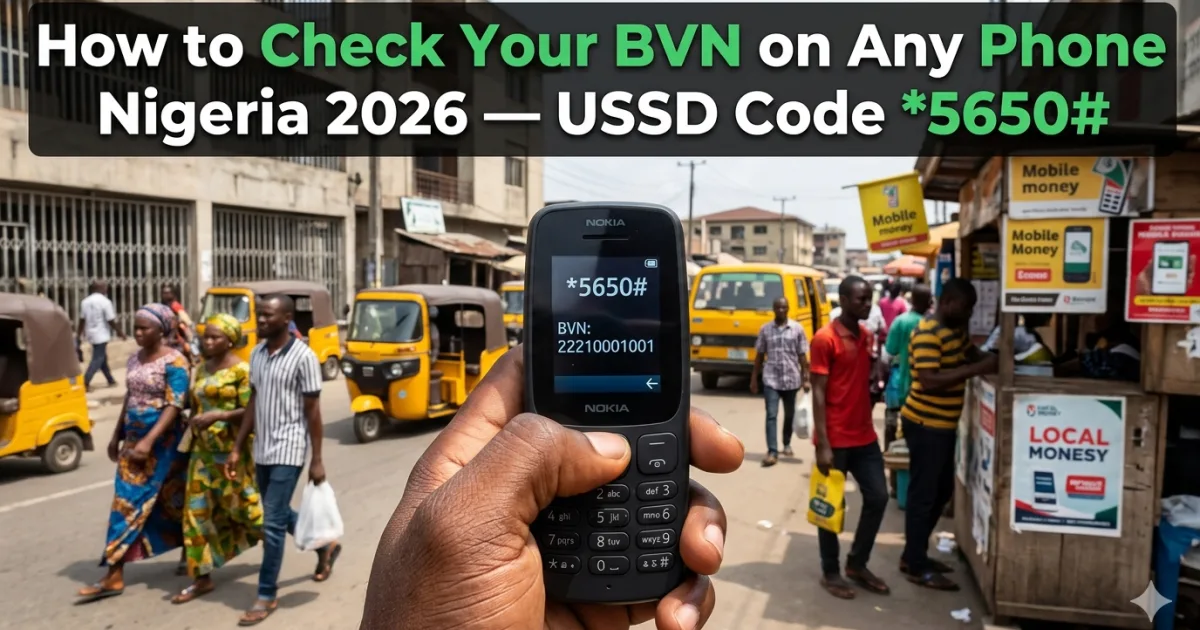
Your Bank Verification Number (BVN) is the 11-digit unique identifier that ties all your Nigerian bank accounts together under a single financial identity. Issued by the Central Bank of Nigeria through the Nigeria Inter-Bank Settlement System (NIBSS), it is one of the most important numbers you need to know in 2026 — required for opening new bank accounts, applying for loans, accessing government services like NYSC, applying for your passport, registering for JAMB, signing up for fintech apps like Kuda and OPay, processing credit facilities, and verifying your identity across dozens of platforms and services. If you have forgotten your BVN, lost the slip, changed your phone, or simply never memorised it, this guide gives you every available method to retrieve it instantly.
The good news: you can retrieve your BVN from your phone in under two minutes using a USSD code that works on any phone — no smartphone required, no internet needed, no bank visit necessary. This guide walks you through every method: the universal USSD code that works on all networks, bank-specific codes, mobile banking app methods, and online portal options — plus full troubleshooting for every situation where the standard methods don’t work.
The Universal Method: Check BVN with USSD Code *565*0#
📱 The BVN USSD Code — Works on ALL Networks (MTN, Airtel, Glo, 9mobile):
- Pick up the phone with the SIM card registered to your bank account — this is critical
- Open the phone’s dialler/dial pad
- Dial *565*0#
- Press the Call button and wait 5–10 seconds
- Your 11-digit BVN will appear on your screen
- Note: A service charge of approximately ₦20 is deducted from your airtime
This code works across MTN, Airtel, Glo, and 9mobile networks. It is the official NIBSS BVN enquiry code maintained by the Central Bank of Nigeria.
BVNCheck.ng’s 2026 guide confirms: “The code will only work if the SIM card is the one registered in the bank’s database — i.e., the phone number you provided when you enrolled for BVN at a bank branch.” If you are using the wrong SIM, the system will return an error message rather than your BVN. Ensure you have at least ₦20 airtime on the line before dialling.
Bank-Specific BVN USSD Codes 2026
Several Nigerian banks offer their own bank-specific USSD codes for BVN retrieval, which sometimes work more reliably than the universal *565*0# code during periods of network congestion. Here are the verified bank-specific codes:
| Bank | BVN USSD Code | Notes |
|---|---|---|
| GTBank (GTCO) | *737*6*1# | Nigerian Search Guide confirmed; GTBank-specific; free |
| All banks (universal) | *565*0# | Official NIBSS code; works on all networks; ₦20 charge |
| Access Bank | *901*5# → Select BVN | Via Access Bank USSD menu |
| Zenith Bank | *966*00# → Account Details → BVN | Within Zenith Bank USSD menu |
| UBA | *919*5# → BVN enquiry | Via UBA USSD service menu |
| First Bank | *894# → Settings → BVN | Via FirstBank USSD menu |
| Opay | *955# → Profile → BVN | BVN displayed if linked during registration |
Check BVN Using Mobile Banking Apps — All Major Banks
If you have a smartphone and your bank’s mobile app installed, you can retrieve your BVN completely free — no airtime charge, no USSD menu navigation. This is the most convenient method for smartphone users. Here is where to find it in each bank’s app:
| Bank App | Where to Find BVN | Cost |
|---|---|---|
| GTBank App | Log in → tap your account card → Account Details → BVN visible | Free |
| Access Bank App | Log in → Profile/Settings → Account Information → BVN shown | Free |
| Zenith Bank App | Log in → Menu → Profile → Account Details → BVN | Free |
| UBA App | Log in → More → Account Details → BVN displayed | Free |
| FirstBank App | Log in → Profile → My Information → BVN | Free |
| Kuda Bank App | Log in → Home → Account Details icon → BVN shown | Free |
| Opay App | Log in → Profile → Personal Information → BVN | Free |
| PalmPay App | Log in → Profile → Account Settings → BVN | Free |
Pro tip: If you have already linked your BVN to any of these fintech apps (Opay, Kuda, PalmPay), you can retrieve it from any of them — even if you have temporarily lost access to your traditional bank account app. BVN is the same across all your accounts, so any app where it is stored will show the same number.
Check BVN Online — NIBSS Portal Method
The Nigeria Inter-Bank Settlement System (NIBSS) operates an official online BVN verification portal at bvnenrollment.nibssplc.ng (also accessible through the CBN’s consumer portal). This method is useful when you don’t have the registered SIM card available but do have internet access and your other details handy:
- Visit bvnenrollment.nibssplc.ng
- Click on “BVN Validation” or “Verify BVN”
- Enter your BVN number (if you have it and just want to verify details) — or select the option to retrieve BVN using your registered phone number and personal details
- Provide the required identity details: first name, last name, date of birth, and registered phone number
- A verification code will be sent to your registered phone number
- Enter the OTP to complete verification and your BVN details will be displayed
This method requires access to your registered phone number for the OTP, so if you have lost access to that number entirely (SIM stolen, number deactivated), this method is unavailable. In that scenario, a bank branch visit with your valid ID is the only remaining option.
Troubleshooting: What to Do When *565*0# Doesn’t Work
The *565*0# USSD code works for the vast majority of Nigerians — but there are specific situations where it returns an error or no response. Here is a complete troubleshooting guide for each scenario:
Error: “BVN Not Found” or “Invalid Number”
This error almost always means you are dialling from the wrong SIM card. Your BVN is linked to the specific phone number you provided when you enrolled at a bank branch. If you have changed your phone number since enrollment, gotten a new SIM, or are dialling from a different line, you will get this error. Solution: identify the original phone number associated with your BVN (check old bank statements, account opening documentation, or previous SMS alerts from your bank which show the associated number) and dial *565*0# from that specific line.
Error: “Insufficient Airtime”
The *565*0# service charges approximately ₦20 from your airtime balance. If your airtime balance is below ₦20, the request will be rejected. Solution: top up at least ₦50 airtime on the registered SIM, then dial the code again.
Error: Service Unavailable / No Response
Occasional network congestion or NIBSS system maintenance can make the *565*0# service temporarily unavailable. Solution: wait 15–30 minutes and try again. If the service remains unavailable for several hours, use the bank-specific USSD code (e.g., *737*6*1# for GTBank, *901*5# for Access Bank) as an alternative. These bank-specific codes query your bank’s own database rather than NIBSS and are often available even when the central NIBSS system is under maintenance.
Situation: Registered SIM Lost or Deactivated
If the phone number linked to your BVN has been lost, stolen, or deactivated by the network (SIM cards expire after prolonged inactivity), you cannot use USSD methods. Your options are: (1) Recover the SIM from your network provider — visit a network service centre with your NIN and proof of identity to reclaim the number. (2) Visit your bank branch in person with your valid NIN and government-issued ID — a bank officer can look up your BVN using your in-person identity verification. (3) Visit a NIBSS enrolment centre with your original BVN enrollment documents and valid ID.
Situation: You Have Multiple Bank Accounts with Different Phone Numbers
Your BVN is the same across all your accounts — it is a single unique number per individual. However, the phone number used during BVN enrollment (not the number linked to a specific account) is what the *565*0# code checks against. If you have updated your phone number with your bank after initial enrollment, the BVN remains the same but the “registered” number in the NIBSS system may still be the original enrollment number. Use the bank app method to retrieve your BVN free of charge without needing the original enrollment number.
What Is the BVN and Why Does It Matter So Much?
The Bank Verification Number programme was launched by the Central Bank of Nigeria in 2014 as the foundation of Nigeria’s Know-Your-Customer (KYC) framework for the financial system. Before BVN existed, different banks maintained separate customer records with no way to cross-reference identities — making it easy for fraudsters to open multiple accounts under different names and for financial criminals to operate across the banking system without detection.
The BVN enrollment process captures biometric data — photographs and fingerprints — along with personal details, and links them to a unique 11-digit number that applies across the entire Nigerian banking system. Once you have a BVN, any bank in Nigeria can verify your identity by checking your biometrics against the NIBSS database. This has significantly improved fraud detection, reduced identity theft in the banking system, and made it possible to link bank accounts to government identity infrastructure (NIN, tax records, voter registration).
What Your BVN Is Used For in 2026
The applications requiring your BVN in 2026 have expanded well beyond basic banking:
- Opening any Nigerian bank account: No BVN = no new account at any regulated Nigerian bank
- Fintech apps (Opay, Kuda, PalmPay, Moniepoint): All require BVN verification during registration for Tier 2 and Tier 3 account access
- Passport application: NIS requires BVN for passport processing
- JAMB registration: BVN is required for some JAMB registration processes
- NYSC registration: Corps members need BVN to receive monthly allowance payments
- Government social programmes: Federal government cash transfer programmes use BVN to verify eligible recipients
- Loan and credit applications: All formal credit facilities require BVN; credit bureaus use BVN to aggregate your credit history across lenders
- TIN (Tax Identification Number): FIRS uses BVN to auto-generate TINs for individuals
- Remittance services: International money transfer services to Nigerian bank accounts verify recipient BVN
BVN Security: What You Must Never Do
Your BVN is purely an identification number — not a transaction authorisation code. Understanding the difference is critical for protecting yourself from fraud. Here are the absolute rules for BVN security in 2026:
Never Share Your BVN with Anyone — Including Apparent Bank Staff
Youverify.co’s BVN security guide is emphatic: “Never share your BVN with anyone, not even bank staff.” A legitimate bank employee already has access to your BVN through their internal systems when they can verify your identity in person — they never need to ask you to provide it verbally. Anyone asking for your BVN over the phone, via SMS, via WhatsApp, or through a website should be treated as a fraudster. Report such requests to your bank immediately and to EFCC at info@efcc.gov.ng.
BVN Is Not Your PIN, Password, or Transaction Code
Many Nigerians confuse BVN with transaction PINs. Your BVN cannot authorise a bank transfer, payment, or withdrawal by itself. It is an identity reference number — knowing your BVN allows someone to look up your bank accounts in the system, but it does not give them the ability to access your funds. However, your BVN combined with other personal information (date of birth, address, account number) could be used for identity theft — opening fraudulent accounts in your name, applying for loans, or impersonating you for other financial crimes. Protect all these data points together, not just your PIN.
Common BVN Fraud Schemes in Nigeria 2026
The most common BVN-related fraud in Nigeria involves phishing: fraudsters send SMS messages or WhatsApp broadcasts claiming your account has been blocked, your BVN is expiring, or your account will be deactivated unless you confirm your BVN by clicking a link or calling a number. These are always scams. Nigerian banks never send BVN confirmation requests via SMS links. If you receive any such message, do not click the link, do not call the number, and do not provide your BVN or any other account details. Delete the message and if you are concerned about your account, call your bank using the official number on the back of your debit card or on the bank’s official website.
How to Get a New BVN (Enrollment for First-Timers)
If you have never enrolled for a BVN, here is the complete enrollment process. BVN enrollment is free and mandatory for all individuals who want to operate any Nigerian bank account:
- Visit any commercial bank branch in Nigeria — you do not need to already have an account at that bank for BVN enrollment
- Bring a valid government-issued ID: NIN slip / National ID card, International passport, Driver’s licence, or Voter’s card
- Request a BVN enrollment form from the customer service desk
- Fill in your personal details: full legal name (exactly as on your ID), date of birth, gender, phone number, residential address
- Your photograph will be taken at the bank’s enrollment station
- Your fingerprints (both hands, all ten fingers) will be scanned
- Your details are submitted to NIBSS for processing
- Your 11-digit BVN is typically issued within 24–48 hours and sent to your registered phone number via SMS
Important: BVN enrollment is completely free. Any bank that attempts to charge you for enrollment is violating CBN regulations. Report fee-charging to the CBN Consumer Protection Department at cpd@cbn.gov.ng.
How to Update Your BVN Details (Modification)
If your BVN contains incorrect information — a misspelled name, wrong date of birth, or incorrect gender — you need a BVN modification. This is particularly urgent in 2026 because your BVN details must match your NIN, passport, and bank account records exactly for government services and financial applications to process without rejection.
To modify your BVN: visit any commercial bank branch with your original enrollment documents. Bring the ID document that shows the correct information. Request a BVN modification form. The bank submits the correction request to NIBSS with your supporting documentation. Corrections to critical fields (name, date of birth) require original documentation — you cannot simply request a change without evidence. Processing takes 5–10 working days. During this period, your existing BVN remains active and usable.
Frequently Asked Questions — Checking BVN in Nigeria 2026
What is the code to check BVN on any phone?
Dial *565*0# from the phone number registered with your bank account. This universal code works on MTN, Airtel, Glo, and 9mobile. Your 11-digit BVN appears on screen within seconds. A charge of approximately ₦20 is deducted from your airtime. For GTBank specifically, you can also dial *737*6*1# at no charge.
How do I check my BVN without the registered phone number?
If you no longer have access to the SIM registered with your BVN, your options are: (1) log into any bank mobile app where your BVN is stored and retrieve it from Profile/Account Details — this requires no USSD; (2) visit your bank branch in person with a valid ID — staff can retrieve your BVN; (3) recover the original SIM from your network provider using your NIN.
Is checking my BVN free?
Checking via *565*0# costs approximately ₦20 in airtime. Checking via your bank’s mobile app is completely free. Checking via a bank-specific USSD code (like GTBank’s *737*6*1#) is also usually free. A bank branch visit to retrieve your BVN is free.
Can someone use my BVN to steal my money?
Your BVN alone cannot be used to access your funds or authorise transactions. It is an identification number, not a transaction code or PIN. However, your BVN combined with other personal information could potentially be used for identity theft — to open fraudulent accounts in your name or apply for loans. Protect all your financial identifiers together and never share your BVN in response to any unsolicited request.
What is the difference between BVN and NIN?
Your BVN (Bank Verification Number) is issued by the Central Bank of Nigeria / NIBSS for banking system identification purposes. Your NIN (National Identification Number) is issued by NIMC for general national identity purposes. Both are 11-digit numbers tied to your biometrics, but they are separate systems managed by separate agencies. In 2022, the CBN mandated that all BVNs be linked to NINs — so your two numbers are now tied together, but they remain different numbers. You need both in 2026 for most significant financial and government transactions.
🔒 How to Check BVN Nigeria 2026 — Complete Quick Reference
- Universal USSD (all networks): *565*0# — costs ~₦20 airtime
- GTBank only: *737*6*1# — free
- Access Bank: *901*5# via USSD menu
- Mobile app (all banks): Log in → Profile/Account Details → BVN shown (free)
- Opay/Kuda/PalmPay app: Log in → Profile → BVN (free)
- Online: bvnenrollment.nibssplc.ng (requires registered phone for OTP)
- Must use: The SIM card registered to your BVN for USSD codes
- SIM lost? Use bank app or visit branch with valid ID
- Security: Never share BVN with anyone — no legitimate bank ever asks for it over phone/SMS
- Enrollment (new BVN): Free at any bank branch; bring valid government ID
Also read: How to Check Account Number on Phone Nigeria 2026 | How to Open Kuda Bank Account 2026 | How to Open Opay Account 2026
BVN and Your Credit History in Nigeria
One of the most important but least understood functions of your BVN in 2026 is its role as the spine of your Nigerian credit history. Every loan you take from any regulated Nigerian lender — commercial bank, microfinance bank, fintech lender (FairMoney, Carbon, Renmoney, Kuda Overdraft) — is reported to Nigeria’s licensed credit bureaus under your BVN. The three main credit bureaus in Nigeria are CRC Credit Bureau, FirstCentral Credit Bureau, and XDS Credit Bureau. Each of them maintains a file on your borrowing and repayment history, identified by your BVN.
This has significant practical consequences. If you borrowed ₦50,000 from FairMoney and repaid late or not at all, that delinquency is reported to all three bureaus under your BVN. When you later apply for a larger loan from a bank or a mortgage from a housing finance institution, that lender will pull your credit report using your BVN — and the FairMoney delinquency will appear. Conversely, consistent on-time repayment of small loans — even ₦5,000 emergency loans from fintech apps — builds a positive credit history under your BVN, making future access to larger loans, mortgages, and credit facilities progressively easier and at better rates.
The practical advice: protect your credit history as carefully as you protect your BVN itself. Never borrow from a regulated lender unless you have a realistic plan to repay. Never take multiple loans simultaneously without a clear budget for repayment. And before applying for any significant credit facility, request your own credit report from one of the three bureaus (CRC, FirstCentral, or XDS) using your BVN to verify what is on file — errors in credit bureau records do occur and can be corrected before they cause a loan rejection.
How BVN Links All Your Nigerian Bank Accounts
Many Nigerians have multiple bank accounts — a GTBank account from university, an Access Bank account opened for a specific salary payment, a Kuda account for everyday transactions, and an Opay wallet for transfers. All of these accounts are linked under a single BVN — your 11-digit unique financial identity. The NIBSS database maintains a complete picture of every account associated with your BVN, and any Nigerian bank or licensed financial institution can query this database when processing transactions or applications involving your identity.
This BVN linkage has several practical implications. First, government social intervention programmes (like the Conditional Cash Transfer for vulnerable households) use BVN to ensure payments go only to verified individuals and to prevent double-dipping (one person collecting from multiple accounts). Second, when you apply for a loan, lenders use your BVN to check all your existing accounts and any existing loan obligations you have outstanding — ensuring they have a complete picture of your financial position. Third, if any of your BVN-linked accounts becomes involved in regulatory action (for example, a court order to freeze an account), all accounts under that BVN can potentially be affected, depending on the specific order. This is another reason why financial discipline — maintaining accounts in good standing — matters across all your accounts, not just your primary one.
Step-by-Step: What to Do If Someone Uses Your BVN Fraudulently
If you discover that someone has used your BVN to open a fraudulent account, take out a loan in your name, or carry out any other financial fraud, act immediately through these steps:
- Call your primary bank immediately — report the fraud and request a flag on your BVN. Most banks have a dedicated 24-hour fraud line (GTBank: 0700GTCONNECT; Access Bank: 01-2802500; Zenith Bank: 0700ZENITHBANK).
- File a formal complaint with NIBSS — visit the NIBSS website (nibss-plc.com.ng) or call their customer service line to report BVN misuse and request a formal investigation.
- Report to the CBN Consumer Protection Department — email cpd@cbn.gov.ng or call +234 700 225 5226 with full details of the fraud.
- File a police report — obtain a police extract documenting the fraud, which you will need for all subsequent regulatory and legal processes.
- Report to EFCC — financial fraud involving BVN misuse is an EFCC matter. File through efcc.gov.ng or the EagleEye app.
- Request your credit report from all three bureaus (CRC, FirstCentral, XDS) to identify any fraudulent credit lines opened in your name. Dispute any fraudulent entries with the bureau using your police report as supporting evidence.
BVN Enrollment for Nigerians in the Diaspora
Nigerians living abroad who need to open or maintain Nigerian bank accounts, access government services, or manage Nigerian financial affairs remotely often face challenges with BVN enrollment and updates. The CBN has made provisions for diaspora BVN enrollment at Nigerian diplomatic missions. Here is what diaspora Nigerians need to know:
Nigerian High Commissions and Consulates in the UK, USA, Canada, and other countries with significant Nigerian diaspora populations have been designated as approved BVN enrollment centres. A Nigerian citizen abroad can visit their nearest Nigerian mission with a valid Nigerian passport, present for biometric capture (photograph and fingerprints), and be enrolled for a BVN which is then registered in the NIBSS database. The process typically takes 30–60 minutes at the mission, and the BVN is issued within 48–72 hours via SMS to the registered phone number.
For diaspora Nigerians who already have a BVN and need to update their registered phone number (to a foreign number), the process requires visiting a Nigerian bank branch in person during a visit to Nigeria, or contacting the bank’s customer service to request the update with appropriate identity verification. Some banks allow phone number updates through their international customer service lines for diaspora customers — check with your specific bank for their current policy.
Future of BVN in Nigeria: The National Identity Framework
Nigeria is moving toward a unified digital identity framework in which the BVN, NIN (National Identification Number), Tax Identification Number (TIN), and other identity numbers are increasingly linked and cross-referenced. The CBN’s 2022 directive mandating BVN-NIN linkage was the most significant step in this direction — requiring all bank customers to link their BVN to their NIN before a specified deadline or face account restrictions.
Looking ahead to 2027–2030, the trajectory is toward a single unified digital identity number for every Nigerian — one identifier that serves all government, banking, tax, health, and social service purposes simultaneously. This mirrors similar developments in countries like India (Aadhaar), Ghana (Ghana Card), and Kenya (Huduma Number). The BVN is likely to either be replaced by or subsumed into this unified identity framework. For now in 2026, your BVN and NIN remain the two most important identity numbers every Nigerian must maintain, protect, and keep updated across all the systems where they are registered.
In summary, your BVN is the cornerstone of your financial identity in Nigeria. Treat it with care — keep your registered phone number active, never share it in response to unsolicited requests, and verify it periodically using the *565*0# USSD code or your bank app to ensure it remains correctly registered and accessible when you need it.




0 Comments
No comments yet. Be the first to share your thoughts!