




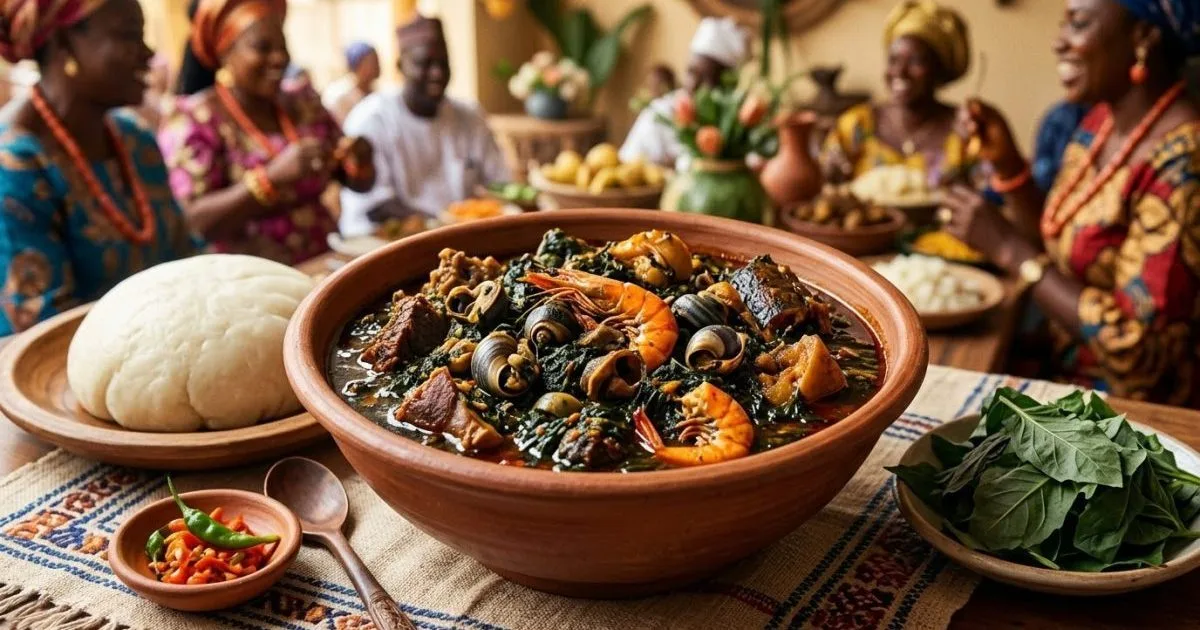
📌 Quick Summary: Afang soup is a rich, nutritious vegetable soup from the Efik and Ibibio people of Cross River and Akwa Ibom States — made with afang leaves (Gnetum africanum / okazi leaf), waterleaf, assorted meats, seafood, palm oil, and crayfish. Like its close relative edikang ikong, afang is a celebration soup — served at weddings, naming ceremonies, and major occasions across southeastern Nigeria. The key difference from edikang ikong: afang uses afang/okazi leaves (wild, slightly bitter, dark green, requires pounding) instead of fluted pumpkin leaves. Prep and cook time: 1.5 to 2 hours. Serves: 6 to 8. This recipe covers sourcing and preparing the afang leaf correctly, the cooking sequence, and how to achieve the authentic, deeply flavoured version of this celebrated soup.
Afang soup is one of Nigeria’s great soups — and one of the least known outside its Cross River and Akwa Ibom homeland despite being, by any objective measure, among the most flavourful, nutritious, and texturally distinctive soups in the entire Nigerian canon. The soup’s defining ingredient — the afang leaf (Gnetum africanum), a wild forest vine leaf with a firm texture and a characteristic mildly bitter, slightly earthy flavour — is what gives the soup its identity and makes it impossible to replicate with any substitute. Combined with the generous quantity of waterleaf that softens and moistens the base, the extraordinary range of proteins (assorted meats, stockfish, dried fish, periwinkle, and sometimes fresh fish or snail), and the deep umami of crayfish and palm oil, afang soup is a complete, magnificent meal that deserves to be known and made far beyond its original geographic home.
Afang Leaf vs Okazi Leaf: Are They the Same?
Yes — afang leaf and okazi leaf are two names for the same plant, Gnetum africanum. “Afang” is the Efik and Ibibio name (Cross River and Akwa Ibom States); “okazi” is the Igbo name (southeastern Nigeria). The leaf is also called “eru” in Cameroon, where it is used in a similar soup preparation. The plant is a wild forest vine with dark green, leathery, glossy leaves. It grows abundantly in Cross River, Akwa Ibom, Rivers, Ebonyi, Imo, and Anambra States and is sold fresh or dried at Nigerian markets. Fresh afang/okazi is always superior to dried — dried leaf loses most of its characteristic flavour and becomes difficult to pound properly. When shopping for afang leaf, look for dark green, firm leaves without yellowing or wilting. A bunch of fresh afang leaf sufficient for one pot of soup costs approximately ₦300 to ₦1,000 depending on location and season.
Preparing the Afang Leaf: The Critical Technique
Afang leaf is not used raw and whole — it must be finely shredded or pounded before adding to the soup. The traditional method: wash the leaves thoroughly, then pound in a mortar (or shred very finely with a knife or food processor) until the leaves are broken down into fine, dark green threads. Properly prepared afang leaf looks like very finely shredded dark spinach — the cell walls of the tough leaf must be broken down for the flavour and nutrients to release into the soup. Coarsely chopped afang leaf produces a stringy, tough texture and inferior flavour compared to properly pounded or finely shredded leaf. If using a food processor: pulse in short bursts rather than blending continuously — you want shredded leaf, not a paste.
Ingredients
| Ingredient | Quantity | Notes |
| Afang leaves (fresh, washed and finely shredded/pounded) | 400 to 500g (before prep) | This is the primary vegetable — be generous. The soup’s character comes from having enough afang leaf. |
| Waterleaf (Talinum triangulare) | 500 to 700g | Washed and roughly chopped. Used in larger quantity than afang to provide moisture and softness. |
| Assorted meat (beef, goat, tripe, pomo, bokoto) | 500 to 700g | Pre-cooked until tender, stock reserved |
| Stockfish (okporoko) | 200 to 300g | Soaked overnight until soft, cleaned and deboned |
| Dried fish (panla or smoked catfish) | 200g | Cleaned and deboned |
| Periwinkle (isam) | 2 cups | Cleaned. Highly traditional in authentic afang soup. |
| Fresh prawns or dry prawns | 200g | Optional but traditional and adds flavour depth |
| Palm oil | ½ to ¾ cup | Afang uses generous palm oil — it coats the tough leaf and integrates the flavours |
| Ground crayfish | 3 tablespoons | Freshly ground. This soup needs a generous quantity. |
| Scotch bonnet pepper | 2 to 3, ground | Adjust to heat preference |
| Onion | 1 large | Sliced |
| Stock cubes | 2 to 3 | |
| Salt | To taste |
Step-by-Step Afang Soup Recipe
Step 1: Cook the Proteins
Cook the assorted meats with onion, one stock cube, pepper, and salt until tender. Reserve all the cooking stock — this is the flavour base for the soup. Clean the stockfish and dried fish, add to the meat in the last 15 minutes of cooking so they absorb the meat stock flavours. Set all proteins aside.
Step 2: Wilt the Waterleaf
In a large wide pot, heat the palm oil over medium heat. Add the sliced onion and fry briefly for 1 to 2 minutes. Add the chopped waterleaf directly. Stir and cook for 5 to 8 minutes — the waterleaf will wilt significantly and release substantial water. Cook until the waterleaf is wilted and most of the released water has reduced. Do not add extra water at this stage.
Step 3: Add Proteins and Season
Add all the cooked meats, stockfish, dried fish, periwinkle, and prawns to the pot. Add the reserved meat stock (start with 1 cup). Add the ground crayfish, ground pepper, and remaining stock cubes. Stir to combine. Taste and adjust salt. Bring to a gentle boil and cook for 5 minutes to allow the flavours to develop.
Step 4: Add the Afang Leaf
Add the finely shredded or pounded afang leaf to the pot. Stir thoroughly to combine with all the other ingredients — the dark green afang threads should be evenly distributed through the soup. Cook on medium heat for 7 to 10 minutes, stirring occasionally. Afang leaf takes slightly longer than ugwu to cook through — it needs enough time for the tough cell walls to soften and the full flavour to develop. Unlike ugwu, which should stay vibrantly green, afang can cook a little longer without significant quality loss. The soup is ready when the afang is tender, the broth is thick and integrated, and the distinctive afang aroma is fully developed.
Step 5: Final Seasoning and Serve
Taste one final time. Adjust salt, pepper, or crayfish as needed. The soup should be thick from the combination of vegetables, richly coloured from the palm oil, and deeply savoury from the layered proteins. Serve hot with pounded yam, starch (traditional Calabar accompaniment), semolina fufu, or eba.
Afang Soup vs Edikang Ikong: The Differences
Both soups come from the same Efik/Ibibio culinary tradition and use waterleaf as a base vegetable. The key differences: afang uses afang/okazi leaf (wild forest vine, bitter and earthy, must be pounded or finely shredded) versus edikang ikong which uses ugwu/fluted pumpkin leaf (cultivated vegetable, milder flavour, sliced rather than pounded). Afang has a stronger, more complex flavour profile with the characteristic bitter earthiness of the okazi leaf. Edikang ikong has a cleaner, greener flavour profile that showcases the sweetness of the ugwu. Both are equally traditional and celebrated — in Calabar, afang and edikang ikong are both served at major occasions, with neither considered superior to the other. Outside their homeland, edikang ikong is slightly more widely known (partly because ugwu is more widely available than afang leaf) — but connoisseurs of Nigerian vegetable soups consistently rate authentic afang among Nigeria’s finest.
The Nutritional Value of Afang Leaf
Gnetum africanum (afang/okazi/eru) is among the most nutritionally dense wild vegetables consumed in West and Central Africa. Scientific analysis of the leaf shows protein content of 15 to 30 percent by dry weight — exceptionally high for a leafy vegetable, comparable to some legumes. The protein quality is also notable: afang leaf contains a complete set of essential amino acids, making it one of the most nutritionally valuable plant protein sources in the Nigerian diet. Beyond protein: very high fibre content, significant quantities of calcium, iron, potassium, magnesium, and zinc, and antioxidant flavonoids and polyphenols. The traditional preparation method — pounding or shredding the tough leaf — improves nutrient bioavailability by breaking down the cell wall structures that would otherwise limit nutrient absorption. Afang soup, with its combination of high-protein wild vegetable, diverse animal protein sources, and palm oil providing fat-soluble vitamins, is one of the most nutritionally complete meals in Nigerian cuisine.
Frequently Asked Questions
Where can I buy afang leaves in Nigeria?
Fresh afang/okazi leaf is most readily available at markets in Cross River, Akwa Ibom, Rivers, Imo, Anambra, Ebonyi, and Delta States. In Lagos, look for it at Mile 12 Market (traders from the southeast bring it regularly), Tejuosho Market, and markets near significant Igbo or Efik communities. Dried afang leaf is available at most Nigerian market stalls that stock dried vegetables and spices — but fresh is strongly preferred for both flavour and nutritional value.
Can I make afang soup with just afang leaf and no waterleaf?
Technically yes — but the result lacks the moistness and balance that waterleaf provides. Afang leaf alone produces a very dry, dense soup that is difficult to eat comfortably. The waterleaf provides the liquid, softness, and contrast that makes afang soup its characteristic combination of textures. If waterleaf is unavailable, substitute with spinach or any tender leafy green — though the authentic flavour profile requires genuine waterleaf.
What is the difference between afang soup and eru soup?
Both use the same primary leaf — Gnetum africanum. Eru soup is the Cameroonian version, typically made with waterleaf and the eru leaf, palm oil, and various proteins — very similar to afang soup. The differences are in specific seasoning details and protein combinations that reflect Cameroonian versus Nigerian culinary traditions. If you can make authentic afang soup, you can make eru soup with minimal adaptation. Afang soup made well — with fresh afang leaf properly pounded, genuine periwinkle, full assorted proteins, generous crayfish, and good-quality palm oil — is a soup that transcends its regional origins and speaks to any person who loves genuinely complex, deeply nutritious, beautifully made food. The work of preparing it — sourcing fresh afang leaf, pounding it properly, assembling the full range of proteins — is exactly the kind of intentional cooking that produces food worth remembering. That is a high standard — and worth meeting.
Sources
- Original recipe — NaijaSabi Lifestyle Desk, October 2026
Last updated: 2 October 2026 · NaijaSabi Lifestyle Desk.
Afang Soup in the Efik Cultural Tradition
To understand afang soup fully, you must understand the Efik people of Calabar — one of Nigeria’s most historically significant cultural groups, known for their sophisticated culinary tradition, elaborate ceremony culture, and the distinct pride they take in their food heritage. The Efik people were among Nigeria’s earliest cosmopolitan communities — Calabar was one of colonial Nigeria’s most important trading ports, and the Efik culinary tradition reflects centuries of cultural confidence, abundance, and the social centrality of hospitality. Afang soup is not simply a recipe in this tradition: it is a statement of identity, a measure of a host’s generosity (a well-made afang with full proteins and fresh afang leaf communicates that the host has invested significantly in their guests), and a tangible connection to the Efik homeland for the millions of Efik and Ibibio people living in Lagos, Abuja, and abroad. Making authentic afang soup — with fresh afang leaf properly pounded, with periwinkle and dried prawns alongside the assorted meats, with generous palm oil and crayfish — is an act of cultural continuity as much as cooking. For Nigerians from outside the Efik tradition who encounter the soup for the first time, it is often one of those food experiences that resets their understanding of what Nigerian cuisine is capable of — a genuinely world-class soup that deserves international recognition alongside the jollof rice and egusi that have already achieved it.




0 Comments
No comments yet. Be the first to share your thoughts!