




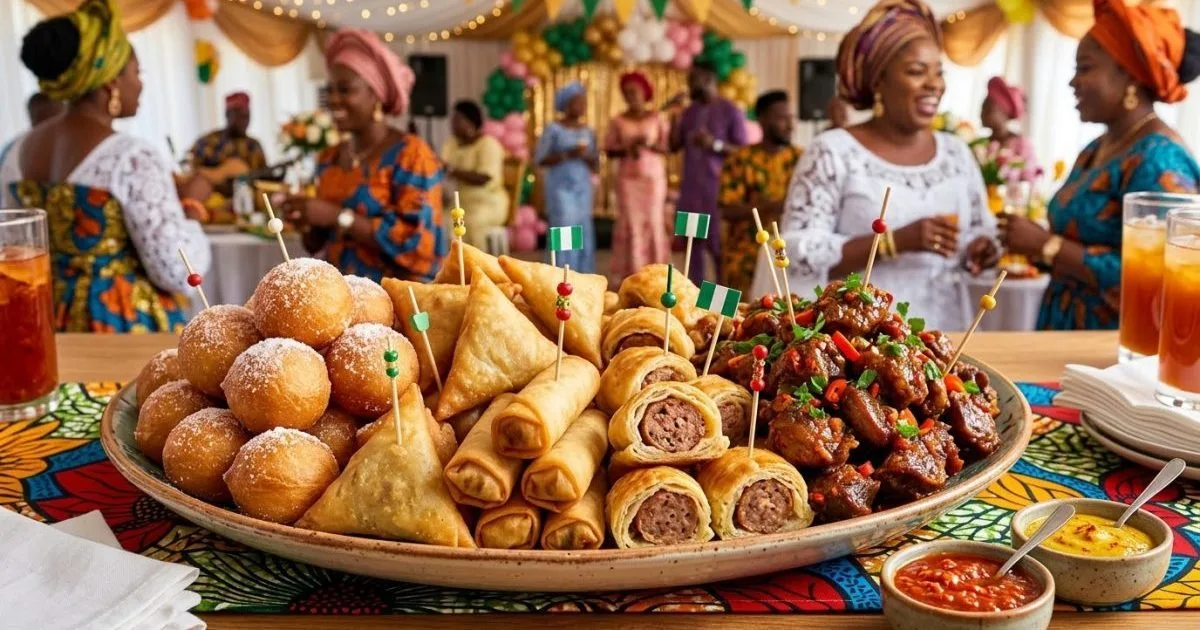
📌 Quick Summary: Nigerian small chops is the collective name for a platter of bite-sized fried snacks served at owambe parties, weddings, corporate events, and celebrations — the tray that guests reach for immediately after being seated. The classic Nigerian small chops platter includes: puff puff (fluffy deep-fried dough balls), fried samosa (crispy triangular pastries filled with spiced meat or vegetables), spring rolls (crispy cylindrical rolls with vegetable and meat filling), sausage rolls (minced meat in flaky pastry), and peppered gizzard (spicy stir-fried chicken gizzard). This recipe guide covers all five, with detailed recipes, tips for frying each correctly, and how to set up a small chops production line for events.
Small chops is where Nigerian party culture and Nigerian food culture intersect most visibly. No owambe is complete without the small chops tray making its way around the room — that first hour when guests are arriving and settling, before the main food service begins, when a platter of hot puff puff, samosas, and peppered gizzard circulating through the crowd sets the energy of the event and signals immediately whether the host has invested in quality hospitality or not. For the food entrepreneur, the small chops business is one of Nigeria’s most accessible entry points into event catering — the products are individually simple to make, they travel and hold their quality reasonably well, and the demand at Nigerian events is essentially constant year-round. This guide covers the full small chops platter: how to make each component to a professional standard.
1. Puff Puff: The Foundation of the Small Chops Platter
Puff puff is the most beloved item on any Nigerian small chops tray — simple, universally liked, and deceptively tricky to get perfectly right at scale.
Puff Puff Ingredients (makes approximately 40 to 50 pieces)
| Plain flour | 3 cups (375g) |
| Instant dry yeast | 2 teaspoons |
| Sugar | 4 tablespoons |
| Salt | ½ teaspoon |
| Warm water | 1 to 1.5 cups |
| Vegetable oil (for frying) | Sufficient for deep frying |
| Nutmeg (optional) | ¼ teaspoon |
Puff Puff Method
Combine flour, yeast, sugar, salt, and nutmeg in a bowl. Gradually add warm water while mixing until a thick, pourable batter forms — slightly thicker than pancake batter but looser than bread dough. Cover and allow to rise in a warm place for 45 to 60 minutes — the batter should visibly puff up and become airy. Heat vegetable oil to 175 to 180°C in a deep pot — enough oil that the puff puff floats freely. Using a spoon or ice cream scoop, drop rounded scoops of batter into the hot oil. The puff puff will puff up and turn over automatically as they fry — this is the sign of well-made batter and properly heated oil. Fry for 3 to 4 minutes until deep golden brown on all sides. Drain on paper towels. The perfect puff puff: a thin, golden, slightly crisp exterior and a soft, fluffy, slightly doughy interior. If flat and dense, the batter did not rise enough. If hollow inside, the oil was too hot and the exterior set before the interior could cook.
2. Nigerian Fried Samosa
Nigerian samosas differ from Indian samosas in their filling (more meat-forward, with less potato) and their pastry (typically made with plain flour rather than the specific samosa pastry sheets). They are triangular, thin-shelled, deeply fried, and absolutely addictive.
Samosa Pastry Ingredients (makes 20 to 25 samosas)
| Plain flour | 2 cups (250g) |
| Salt | ½ teaspoon |
| Vegetable oil | 2 tablespoons |
| Cold water | 6 to 8 tablespoons |
Samosa Filling
| Minced beef or chicken | 300g |
| Onion, finely chopped | 1 medium |
| Mixed vegetables (carrots, peas, green pepper), diced small | ½ cup |
| Scotch bonnet or curry powder | To taste |
| Stock cube, salt | To taste |
Samosa Method
Make the pastry: combine flour and salt, rub in the oil with your fingertips until it resembles breadcrumbs, then add cold water tablespoon by tablespoon until a firm but pliable dough forms. Knead for 3 minutes, wrap and rest for 20 minutes. Make the filling: sauté onion until soft, add minced meat and cook until brown, add vegetables and seasoning, cook until dry — the filling must be completely dry or the samosas will become soggy. Roll the pastry thin (2mm), cut into strips approximately 8cm wide, fold into a cone shape, fill with a tablespoon of filling, seal the top firmly with a flour-and-water paste, and deep-fry at 170°C for 3 to 4 minutes until deeply golden. The key to good samosas: very thin pastry (thick pastry produces a heavy, doughy shell), very dry filling (wet filling steams the pastry from inside), and not overcrowding the oil during frying.
3. Nigerian Spring Rolls
Spring rolls in Nigerian small chops are typically cylindrical, tightly rolled, and filled with a combination of shredded vegetables (cabbage, carrots, green pepper) and sometimes minced chicken or beef.
Spring Roll Method
Use commercial spring roll wrappers (available at Nigerian supermarkets and wholesale food stores — saves significant preparation time). Make the filling: sauté finely shredded cabbage, grated carrots, diced green pepper and onion, add minced chicken or beef if using, season with stock cube, curry powder, and salt, cook until completely dry. Place 2 tablespoons of filling near one edge of a spring roll wrapper, fold the edges in, and roll tightly. Seal the end with egg wash or flour-water paste. Deep fry at 175°C for 2 to 3 minutes until crisp and golden. Serve immediately — spring rolls lose their crispness quickly and should be fried as close to serving time as possible.
4. Sausage Rolls
Nigerian sausage rolls use a short pastry or rough puff pastry wrapped around a well-seasoned minced meat filling and baked until golden. They are the most substantial item on the small chops platter and the one most guests take two of.
Sausage Roll Method
Filling: mix 400g minced beef with 1 finely chopped onion, 1 egg (as binder), stock cube, mixed herbs, white pepper, and salt. The mixture should hold together when squeezed. Pastry: use ready-made puff pastry sheets (widely available in Nigerian supermarkets — saves hours of preparation) or make a simple short pastry from 300g flour, 150g butter, a pinch of salt, and cold water. Roll pastry to 3mm thickness. Place a long sausage of filling along one edge, roll the pastry around it, seal with egg wash, and cut into 7 to 8cm lengths. Brush the top with egg wash and bake at 200°C for 20 to 25 minutes until deeply golden.
5. Peppered Gizzard
Peppered gizzard is the spicy, deeply savoury anchor of the Nigerian small chops platter — the one that generates the most enthusiastic response from event guests and the one that distinguishes a quality small chops platter from a basic one.
Peppered Gizzard Method
Clean chicken gizzard thoroughly (trim excess fat and membrane). Parboil with onion, stock cube, and salt for 20 to 25 minutes until tender but not soft — gizzard should have a firm, slightly chewy bite, not mushy. Drain and pat dry. Fry in hot oil for 3 to 5 minutes until lightly browned and slightly crispy on the outside. In a separate pan: sauté finely sliced onion and scotch bonnet in a little oil until fragrant, add a tablespoon of tomato paste, cook 2 minutes, add soy sauce (optional but adds umami depth) and a pinch of sugar. Toss the fried gizzard in this sauce and cook for 2 to 3 minutes until coated and slightly caramelised. The peppered gizzard should be spicy, slightly sticky, crispy-outside-tender-inside, and deeply savoury.
The Small Chops Business: Pricing and Packaging
Small chops is one of Nigeria’s most consistently profitable food businesses at the event catering level. A tray of 50 assorted small chops (puff puff, samosa, spring rolls, sausage rolls, peppered gizzard) costs approximately ₦4,000 to ₦8,000 in raw materials and sells for ₦15,000 to ₦35,000 per tray at events. Production capacity: a single well-organised small chops kitchen can produce 10 to 20 trays per day for event orders. At ₦20,000 per tray average, that is ₦200,000 to ₦400,000 daily revenue. The business model scales with the event calendar — Nigerian party season (October to December, and again March to June) generates maximum demand, while January to February and July to September are slower months to use for recipe development, staff training, and marketing.
Frequently Asked Questions
Why does my puff puff come out flat?
Flat, dense puff puff is almost always caused by one of three things: the batter did not rise sufficiently (yeast may be old, water was too hot and killed the yeast, or the resting time was too short); the oil was not hot enough (puff puff needs 175 to 180°C to puff properly); or too much flour made the batter too stiff to puff. The batter should look visibly airy and bubbly before frying.
How far in advance can I make small chops for a party?
Puff puff and spring rolls should be fried as close to service time as possible — they are at their best within 30 to 45 minutes of frying. Samosas and sausage rolls hold reasonably well for 1 to 2 hours. Peppered gizzard can be made 2 to 3 hours ahead and rewarmed. For large events, set up a frying station that produces small batches continuously rather than frying everything hours before service.
Setting Up a Small Chops Production Line for Events
Professional small chops production for events requires a systematic approach that produces consistent quality at volume without the chaos that kills quality under pressure. The production line setup that works. Station 1 — dough and batter station: puff puff batter mixed and resting, samosa and sausage roll pastry made and resting. Station 2 — filling station: all fillings prepared, cooked, and cooled before service — samosa filling, spring roll filling, sausage roll filling, peppered gizzard base sauce. Station 3 — assembly station: samosas folded and sealed, spring rolls rolled and sealed, sausage rolls cut and glazed. Station 4 — frying station: temperature-controlled deep fryer or large pot, one person managing oil temperature and frying batches in sequence. Station 5 — finishing and plating station: draining, cooling, arranging on platters, garnishing with toothpicks and decorative elements. The discipline of this production line — every item assembled before frying begins, frying in controlled batches at consistent temperature, plating immediately after draining — is what separates a professional small chops business from the chaotic approach that produces some burnt items, some undercooked items, and inconsistent quality from batch to batch. For a 200-person event requiring 400 pieces of assorted small chops, a team of 3 to 4 working the production line can produce the entire volume in 3 to 4 hours, with everything plated and ready for service. Without the production line discipline, the same volume takes 6 to 8 hours and produces lower-quality results.
Pricing Small Chops for Events in Nigeria
Pricing small chops for Nigerian events requires understanding both your production costs and the market rates clients expect to pay. Cost structure per tray of 50 pieces (10 puff puff, 10 samosas, 10 spring rolls, 10 sausage rolls, 10 peppered gizzard): raw materials ₦4,000 to ₦7,000 (ingredients, packaging, cooking fuel/gas, oil), labour ₦1,000 to ₦2,000 (allocated per tray from total production labour), transport ₦500 to ₦2,000 (delivery to event venue). Total cost per tray: ₦5,500 to ₦11,000. Market rate per tray: ₦15,000 to ₦40,000 depending on quality positioning, event type, and client budget. Gross margin per tray: ₦4,000 to ₦29,000. The pricing lesson: small chops is a premium service business as much as a food production business. Clients who hire small chops caterers for their owambe are not comparison-shopping on price — they are buying confidence that the food will be good, arrive on time, and not embarrass them in front of their guests. A small chops vendor known for consistently excellent quality commands premium rates and stays fully booked through the Nigerian party season. Building this reputation — through consistent quality, reliable delivery, professional presentation, and genuine hospitality at events — is the highest-return investment a Nigerian small chops business can make.
Sources
- Original recipe guide — NaijaSabi Lifestyle Desk, October 2026
Last updated: 1 October 2026 · NaijaSabi Lifestyle Desk.


0 Comments
No comments yet. Be the first to share your thoughts!