




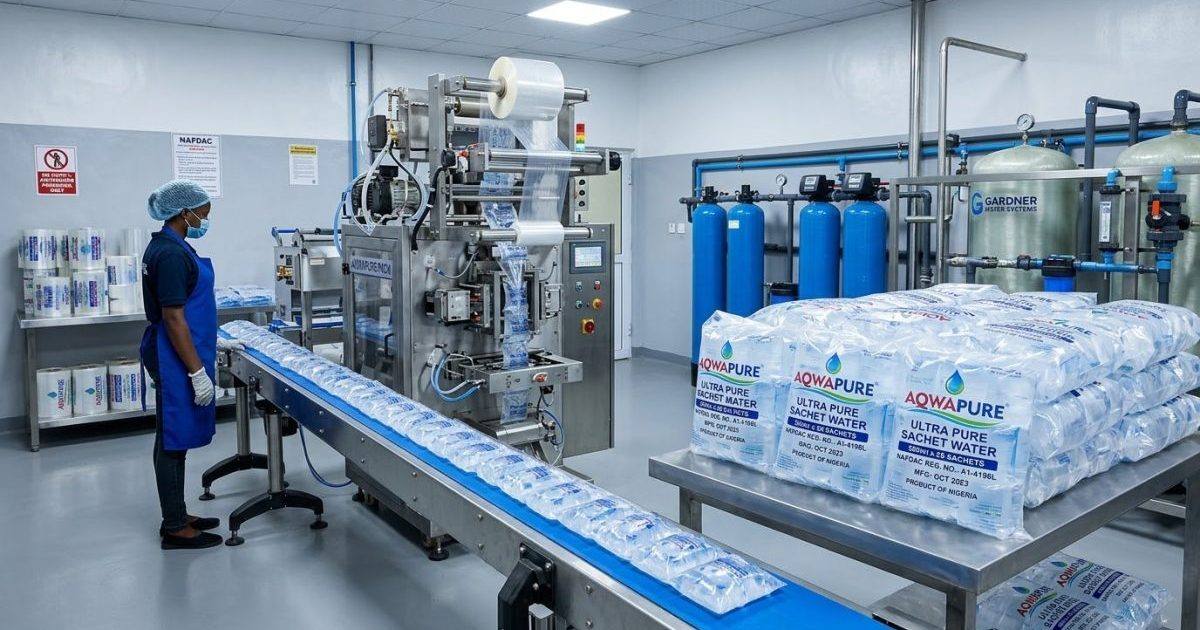
📌 Quick Summary: A sachet water (pure water) production business in Nigeria requires startup capital of ₦500,000 to ₦3,000,000 depending on machine capacity. A small sachets-per-hour machine (1,000 to 2,000 sachets/hour) costs approximately ₦400,000 to ₦900,000. Each sachet of pure water costs approximately ₦8 to ₦20 to produce (water treatment, nylon, labour, utilities) and sells at ₦20 to ₦40 per sachet wholesale or ₦200 to ₦500 per bag of 20 sachets retail. A machine producing 20,000 sachets per day generates gross revenue of ₦400,000 to ₦800,000 daily at wholesale rates. NAFDAC registration and a borehole or treated water source are mandatory. This guide covers equipment, water treatment, NAFDAC requirements, production process, costing and where to sell.
Sachet water — the small, clear plastic bags of purified drinking water sold at ₦20 to ₦50 each at every roadside stall, motor park, school gate, and market in Nigeria — is the most widely consumed packaged food product in the country. Millions of Nigerians drink “pure water” from sachets daily because municipal tap water supply is either unavailable or unreliable across most Nigerian cities, and sachet water provides affordable, accessible hydration for the majority of Nigerians who cannot afford bottled water at ₦200 to ₦500 per bottle. The sachet water industry is one of Nigeria’s largest and most competitive cottage manufacturing sectors — but competition has not eliminated profitability for well-run, NAFDAC-compliant producers who maintain water quality standards and build reliable distribution networks.
NAFDAC Regulation: The Non-Negotiable Starting Point
Sachet water production is one of Nigeria’s most strictly regulated food manufacturing businesses — and for good reason. Contaminated sachet water has caused cholera outbreaks, typhoid fever clusters, and waterborne disease in Nigerian communities where unregistered producers sold unsafe products. NAFDAC registration is not optional, not deferrable, and not something to do after you start production. You register first, receive your NAFDAC number, print it on your sachets, and then sell. Selling sachet water without a valid NAFDAC number is a criminal offence that carries product seizure, fines, and potential prosecution. The NAFDAC registration process for sachet water: register your business with CAC, secure and equip your production facility to NAFDAC-specified standards, apply through NAFDAC’s processed water registration pathway, submit water quality test results from a NAFDAC-approved laboratory, pass a facility inspection, and receive your registration number. Budget ₦100,000 to ₦300,000 and 3 to 6 months for the registration process. This timeline means you need to plan your facility setup, water source installation, and equipment procurement before the registration application is complete.
Water Source and Treatment: The Most Critical Quality Factor
The quality of your final sachet water product begins with your water source. Most Nigerian sachet water producers use borehole water as their primary source — municipal water supply is too unreliable for a manufacturing operation that requires consistent daily production. A borehole installation for a sachet water factory costs approximately ₦300,000 to ₦800,000 depending on depth required to reach a suitable aquifer in your location. Borehole water must be treated to meet NAFDAC’s drinking water quality standards before being packaged. The standard water treatment train for sachet water production in Nigeria: sand filtration (removes suspended particles and turbidity), activated carbon filtration (removes taste, odour, chlorine, and organic compounds), microfiltration (removes bacteria and parasites at 0.1 to 1 micron level), ultraviolet (UV) sterilisation (inactivates viruses and residual bacteria), and reverse osmosis (RO) optional but increasingly standard — removes dissolved solids, heavy metals, and produces very pure water. The complete water treatment system for a small sachet water factory costs approximately ₦200,000 to ₦600,000 installed. Water quality must be tested quarterly by a NAFDAC-approved laboratory and the results submitted to NAFDAC as part of ongoing compliance.
Equipment List and Costs
| Equipment | Capacity | Cost (2026) | Notes |
| Sachet water filling and sealing machine (automatic) | 1,000 to 2,000 sachets/hour | ₦400,000 – ₦900,000 | The core production equipment. Fills, seals, and cuts sachets automatically from a roll of nylon. Chinese-manufactured machines widely available in Nigeria; local agents in Lagos (Trade Fair, Alaba) and Aba. |
| Sachet water filling machine (medium capacity) | 3,000 to 6,000 sachets/hour | ₦900,000 – ₦2,500,000 | For operations targeting wholesale distribution to multiple areas |
| Water treatment system (sand filter + carbon filter + UV) | Matched to machine capacity | ₦200,000 – ₦600,000 | Must produce water meeting WHO and NAFDAC drinking water standards |
| Borehole | Dependent on local geology | ₦300,000 – ₦800,000 | Required in most locations — municipal supply cannot support production reliability |
| Overhead storage tank (5,000 to 10,000 litres) | Buffer storage between borehole and treatment | ₦50,000 – ₦150,000 | |
| Generator (for machine, treatment system, and lighting) | 10 to 20 kVA | ₦300,000 – ₦800,000 | Power reliability is essential — sachet water machines cannot run on NEPA power alone |
| Nylon rolls (raw material — printed with your NAFDAC number and brand) | Per production run | ₦80,000 – ₦200,000 per month | Printed nylon must carry NAFDAC registration number, production date, batch number, and producer details |
| Production space (rented) | Minimum 100 square metres | ₦100,000 – ₦400,000/year | NAFDAC requires a dedicated production facility — not a residential space |
| Complete small sachet water factory | 1,000-2,000 sachets/hour | ₦1,500,000 – ₦3,500,000 |
Production Process
The daily sachet water production cycle: borehole pumps water into the overhead storage tank (overnight or as needed). Water flows through the treatment system — sand filter, carbon filter, UV steriliser, and optionally RO system — into a treated water storage tank. The filling machine draws from the treated water tank, fills the nylon sachets with a pre-set volume (usually 500ml), heat-seals each sachet, and cuts it from the roll. Filled sachets fall into crates or collection baskets. Quality check: randomly sample 5 to 10 sachets per hour and check for proper sealing (no leaks), correct fill volume, and clean appearance. Crate filled sachets and move to storage. Load onto delivery vehicle for morning distribution. Clean the machine filter screens and treatment system as per maintenance schedule. The production operation runs most efficiently with a team of 3 to 5 people: one machine operator, one water treatment monitor, two packers/quality checkers, and one delivery driver.
Costing and Profitability
| Production cost per sachet (water treatment chemicals, nylon, electricity, labour amortised) | ₦10 – ₦18 |
| Wholesale price per sachet (to distributors and retailers) | ₦25 – ₦40 |
| Retail bag price (20 sachets per bag) | ₦300 – ₦600 |
| Machine output per 8-hour shift (1,500 sachets/hour machine) | 12,000 sachets |
| Daily gross revenue (12,000 sachets × ₦30 wholesale) | ₦360,000 |
| Daily production cost (12,000 sachets × ₦14) | ₦168,000 |
| Daily gross profit (one shift, one machine) | ₦192,000 |
| Monthly gross profit (22 production days) | ₦4,224,000 |
The numbers above represent the theoretical maximum for a well-run single-machine operation. Real-world profitability is affected by: distribution efficiency (unsold sachets that melt or burst before sale are wasted production cost), generator fuel (a significant daily operating cost), equipment maintenance (sachet water machines require regular cleaning and occasional part replacement), and competition from established local producers who have lower cost bases from amortised equipment. The sachet water business is genuinely profitable at scale — it is also capital-intensive to start, requires ongoing NAFDAC compliance, and is operationally demanding to run every day. Approach it as a serious manufacturing business, not a quick-money scheme.
Distribution: How to Sell Your Pure Water
The distribution model determines how much of the theoretical production revenue you actually capture. Four channels. Direct delivery to retailers (kiosks, shops, roadside stalls): you load your tricycle or truck and drive a fixed route every morning, selling to retailers at ₦25 to ₦35 per sachet wholesale. Retailers sell at ₦50 per sachet to consumers — the markup makes it attractive for them. Institutional supply (schools, offices, construction sites, events): bulk supply at negotiated prices for a fixed daily or weekly quantity. Revenue is slightly lower per sachet but more predictable. Water distribution agents: appoint agents in different areas who buy from you at factory price and distribute within their territory — removes your logistical burden but reduces your margin. Community hawking: sachet water hawkers (who buy from you in the morning and resell at street price) provide very high-volume sales but at the lowest per-sachet price (₦20 to ₦25 factory gate).
Frequently Asked Questions
How much does it cost to start a sachet water business in Nigeria?
₦1,500,000 to ₦3,500,000 for a complete small-scale factory including machine, water treatment system, borehole, generator, facility setup, NAFDAC registration costs, and initial raw material stock. Lower capital options exist (buying treated water from a supplier rather than treating your own) but reduce your margin and quality control.
Is sachet water business profitable in Nigeria?
Yes — a well-run, NAFDAC-registered, single-machine sachet water factory generating 10,000 to 15,000 sachets daily at ₦30 wholesale price and ₦14 production cost earns ₦160,000 to ₦240,000 daily gross profit. Net profit after generator fuel, distribution, maintenance, and staff wages is typically 40 to 60 percent of gross.
What NAFDAC number do I need for pure water in Nigeria?
All sachet water producers require a NAFDAC Processed Water registration number, obtained through the NAFDAC Abuja headquarters or zonal offices. The number must be printed on every sachet produced. Registration requires facility inspection, water quality laboratory tests, and compliance with NAFDAC’s Good Manufacturing Practice (GMP) standards for water packaging.
Competition and Market Positioning in the Sachet Water Industry
The sachet water market in Nigeria is intensely competitive — in most Nigerian neighbourhoods, there are multiple sachet water brands competing for the same retailers and consumers. Competing effectively requires more than just producing water that meets NAFDAC standards. Three positioning strategies that successful Nigerian sachet water producers use to differentiate. First: quality signalling through packaging and brand investment. A sachet water brand with a professionally designed logo, attractive packaging colours, and a clear NAFDAC number printed prominently signals quality to retailers and consumers who cannot directly test the water they are buying. In a market where many brands exist and water quality cannot be assessed at point of purchase, packaging quality is a credible signal of production quality. Second: distribution reliability — the producer whose delivery arrives on time, every morning, without excuses, builds retailer loyalty that price alone cannot sustain. Many Nigerian retailers will pay a small premium for a supplier they can rely on rather than switch to a slightly cheaper producer who sometimes delivers late or runs out of stock. Third: local community identity — sachet water brands that develop strong local recognition (through consistent van branding, active community presence, and reliable quality) build consumer preference that out-of-area producers find difficult to displace. The sachet water business is fundamentally a local business — your most defensible market is always the 2 to 5 kilometre radius around your production facility where your distribution reliability and community reputation are strongest.
Expanding Beyond Sachets: The Bottled Water and Table Water Opportunity
Many successful sachet water producers expand their operations to include bottled water (330ml, 500ml, and 1.5-litre bottles) and 20-litre table water dispensers as higher-margin product lines alongside sachets. The same water treatment infrastructure that supports sachet production supports bottled water production — the additional investment is in bottling equipment (₦200,000 to ₦800,000 for a semi-automatic bottling line) and bottle procurement. Bottled water commands ₦200 to ₦500 per bottle retail — significantly higher per-litre revenue than sachet water — and serves a different market segment (offices, hotels, restaurants, and higher-income households). The 20-litre table water dispenser market (refillable plastic demijohn bottles delivered to offices and households) is another high-margin extension: ₦800 to ₦1,500 per 20-litre refill, with the return logistics of collecting empty dispensers manageable at local distribution scale. Both extensions use the same NAFDAC-registered water treatment infrastructure and production facility, making them natural and low-incremental-cost expansions of an established sachet water operation. The sachet water business, started correctly with full NAFDAC compliance and quality investment, is one of the most durable manufacturing businesses available to Nigerian entrepreneurs — because the demand is structural, the product is essential, and Nigerians will always need clean drinking water regardless of what else changes in the economy.
Sources
- NAFDAC — sachet water regulation and registration requirements — nafdac.gov.ng
- Original business guide — NaijaSabi Business Desk, September 2026
Last updated: 23 September 2026 · NaijaSabi Business Desk. Equipment prices and production costs as at September 2026.


0 Comments
No comments yet. Be the first to share your thoughts!