




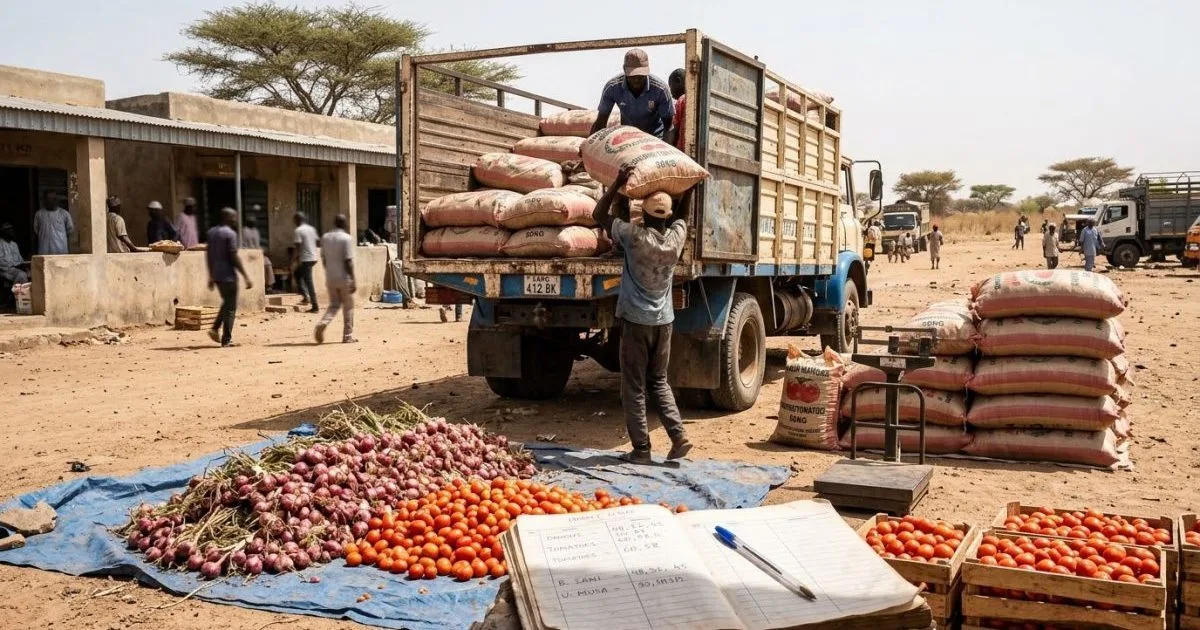
📌 Quick Summary: Agricultural commodity trading — buying produce from farmers at source prices and selling in urban markets — is one of Nigeria’s most profitable trading businesses. The price differential between farm-gate and urban market prices for key commodities reaches 200 to 400 percent on tomatoes, peppers, and onions. A trader buying 10 tonnes of tomatoes at ₦80,000 per tonne (₦800,000 total) and selling in Lagos at ₦250,000 per tonne earns ₦1,700,000 gross revenue — a ₦900,000 gross profit on a single shipment. Core requirements: transport access, storage capacity, farmer supplier relationships, and urban market buyer relationships. This guide covers the most profitable Nigerian agricultural commodities to trade, sourcing regions, transport and storage logistics, seasonal price patterns, and how to manage the key risks.
Agricultural commodity trading is one of Nigeria’s oldest and most persistently profitable trading businesses — and one of the least glamorous, least Instagram-able, and most genuinely wealth-creating. The economics are structural: Nigeria’s food production is concentrated in rural areas (primarily the North for grains and onions, the Middle Belt and Southeast for vegetables and tubers, the South-West for cocoa and plantain), while Nigeria’s food consumption is concentrated in urban areas (Lagos, Abuja, Kano, Port Harcourt, Ibadan). The price gap between where food is produced and where it is consumed is the opportunity that agricultural commodity traders exploit — and it is a gap that has persisted for decades and will persist as long as Nigeria’s rural-urban food supply chain remains as fragmented and inefficient as it currently is.
The Most Profitable Agricultural Commodities to Trade in Nigeria
| Commodity | Primary Sourcing Regions | Farm-Gate Price (2026) | Lagos/Abuja Market Price | Margin % |
| Tomatoes | Kaduna, Kano, Jos (plateau), Benue | ₦60,000 – ₦120,000/tonne | ₦200,000 – ₦400,000/tonne | 150 – 400% |
| Pepper (tatashe/shombo) | Kaduna, Plateau State, Benue | ₦80,000 – ₦150,000/tonne | ₦250,000 – ₦500,000/tonne | 100 – 300% |
| Onions | Kano, Sokoto, Kebbi, Zamfara | ₦70,000 – ₦120,000/tonne | ₦200,000 – ₦350,000/tonne | 100 – 300% |
| Garlic | Plateau State (primary Nigerian production) | ₦200,000 – ₦400,000/tonne | ₦500,000 – ₦900,000/tonne | 100 – 200% |
| Plantain | Edo, Delta, Cross River, Ekiti, Osun | ₦80,000 – ₦150,000/tonne | ₦200,000 – ₦350,000/tonne | 100 – 200% |
| Yam | Benue, Kogi, Taraba, Plateau | ₦150,000 – ₦250,000/tonne | ₦350,000 – ₦600,000/tonne | 100 – 200% |
| Groundnut | Kano, Kaduna, Sokoto, Niger | ₦300,000 – ₦500,000/tonne | ₦600,000 – ₦900,000/tonne | 50 – 100% |
| Sesame seeds | Benue, Nasarawa, Jigawa | ₦600,000 – ₦900,000/tonne | ₦1,000,000 – ₦1,500,000/tonne (export price) | 50 – 100% |
How Agricultural Commodity Trading Actually Works
The practical mechanics of a commodity trading transaction. You identify a commodity with a significant farm-to-urban price gap, travel to or connect by phone with farmers or rural market aggregators in the producing region, negotiate a purchase price for a specific quantity, arrange transport to your target urban market, sell to market traders (at wholesale price) or directly to restaurants, food processors, and households (at retail price). The key relationships: farmer suppliers (or rural market aggregators who consolidate supply from multiple small farms) in the producing region, and urban market buyers (wholesale market traders at Mile 12, Bodija, and similar markets, or direct institutional buyers like hotels, restaurants, and food processing companies) in your selling market. Both relationships take time to build and are the primary competitive advantage of an experienced commodity trader over a new entrant — a trader with reliable supply relationships in Kaduna and reliable buyer relationships in Lagos Mile 12 has a market position that is difficult for a new trader to replicate quickly.
Transport: The Critical Logistics Layer
Agricultural commodity trading is fundamentally a logistics business — the value you add is moving produce from where it is cheap to where it is expensive, as efficiently and quickly as possible. Transport options and economics. Road haulage by truck: the primary transport mode for Nigerian agricultural commodity trading. A 10-tonne truck hired from Kano to Lagos costs approximately ₦200,000 to ₦350,000 per trip (2026 fuel prices). The same truck carrying 10 tonnes of onions bought at ₦100,000/tonne (₦1,000,000) and sold in Lagos at ₦280,000/tonne (₦2,800,000) generates ₦1,800,000 gross profit on ₦300,000 transport cost — a 500 percent return on transport cost alone. The risk: perishable commodities (tomatoes, pepper) deteriorate in transit, and a truck breakdown or delayed shipment can turn a profitable load into a loss. Refrigerated trucks significantly reduce transit spoilage but cost 50 to 100 percent more than standard trucks. For non-perishable or semi-perishable commodities (onions, garlic, groundnuts, sesame seeds), standard truck transport is adequate. For tomatoes and pepper, the 12 to 24 hour journey from Jos or Kaduna to Lagos must be completed without delays — premium paid for reliable, fast trucks.
Seasonal Price Patterns: When to Buy and Sell
Understanding seasonal price patterns is the knowledge advantage that separates profitable Nigerian commodity traders from those who trade at the wrong time. For tomatoes: prices crash during peak harvest (September to November in Plateau State and Kaduna) when supply floods the market, and spike during the dry season (April to July) when supply contracts. A trader who buys in October at ₦60,000/tonne and sells in April at ₦400,000/tonne (storing in a cold room) captures the full seasonal premium. For onions: Kano and Sokoto onions peak in harvest from November to February — prices are lowest then and highest between July and October. For yams: new yam season (August to October) produces the season’s lowest prices; prices peak in April to June before the new harvest arrives. Learning these seasonal patterns — ideally through 2 to 3 cycles of trading observation before committing large capital — is the fastest way to improve commodity trading profitability.
Storage: Turning Seasonal Gluts into Year-Round Profit
The trader who can buy during peak harvest (when prices are lowest) and sell months later (when prices are highest) captures the full seasonal premium that the spot trader cannot access. Storage requirements vary by commodity. Onions: store well at ambient temperature in a dry, well-ventilated space for 4 to 6 months — no cold chain required. Onion storage is the most accessible commodity arbitrage trade in Nigeria. Tomatoes: require cold storage (4 to 8°C) for more than 7 days — a cold room investment of ₦1,000,000 to ₦3,000,000 enables 4 to 8 week storage and access to the off-season price premium. Garlic: stores for 6 to 9 months in dry, cool conditions — excellent long-term storage commodity. Groundnuts: store for 3 to 6 months in dry conditions. Building storage capacity — even a simple dry, well-ventilated warehouse — is the investment that most improves the financial return of an agricultural commodity trading business beyond simply moving produce from farm to city.
Managing Risk in Agricultural Commodity Trading
Three primary risks and how experienced Nigerian commodity traders manage them. Price volatility: commodity prices can move 50 to 100 percent in weeks during supply shocks or demand spikes. Manage by building confirmed buyer relationships before you buy (know where your produce is going and at what price before committing transport cost), limiting speculation (do not buy and hold solely on price expectation without a secured buyer), and diversifying across 2 to 3 commodities so a price crash in one does not destroy the whole trading cycle. Spoilage and transit loss: perishable commodities (tomatoes, pepper) can lose 20 to 50 percent of value during transit and storage without proper handling. Manage by using cold storage where feasible, selecting the fastest and most reliable transport, and pricing your purchase to absorb 15 to 20 percent loss without losing profitability. Capital risk: agricultural trading requires significant upfront capital that is illiquid during the trading cycle (you cannot sell a truck of tomatoes mid-journey). Manage by starting with smaller quantities (1 to 2 tonnes per trade) to build experience and supplier relationships before scaling to 10-tonne loads.
Frequently Asked Questions
How much capital do I need to start agricultural commodity trading in Nigeria?
₦200,000 to ₦500,000 for a first small trade (2 to 5 tonnes of a semi-perishable commodity like onions, bought in Kano or Sokoto and sold in Lagos). Scale requires ₦1,000,000 to ₦5,000,000+ for 10-tonne loads of premium commodities. Start small to build supply and buyer relationships before committing large capital.
Which agricultural commodity is most profitable to trade in Nigeria?
Tomatoes during the dry season supply squeeze (April to July) offer the highest price premium — but also the highest spoilage and transport risk. Onions offer the best combination of margin, storage-ability, and manageable risk for new traders. Garlic and sesame seeds offer strong margins with longer shelf life and export market access.
Do I need a truck to start agricultural commodity trading in Nigeria?
No — hire trucks per trip at first. Truck ownership becomes financially justified when you are trading at sufficient volume (weekly or bi-weekly loads) that the fixed cost of truck ownership is lower than the cumulative hire cost. Many successful Nigerian commodity traders operate entirely through hired transport for years before owning vehicles.
Agricultural Commodity Trading and Nigeria’s Food Security
Agricultural commodity traders occupy a structurally important but socially ambivalent position in Nigeria’s food system. They are simultaneously essential — without traders, the price gap between farm and city would be even more extreme, and supply would reach urban consumers even more erratically — and blamed for the high food prices that burden Nigerian households. The reality is more nuanced: commodity traders do not create price inflation, they respond to it. When tomatoes are scarce in Lagos in July because the northern harvest is months away, the trader who shipped tomatoes from cold storage in Jos in April and is selling them in July at high prices is not creating the scarcity — they are reducing it, at a cost that reflects the genuine economic value of moving produce through time and space. The Nigerian food system needs more agricultural commodity trading infrastructure, not less — more cold storage to extend the shelf life of seasonal produce across the lean months, more reliable transport to reduce transit time and spoilage, and more market information systems so that prices at the farm gate and at the consumer market reflect genuine supply and demand rather than information asymmetry. Every commodity trader who invests in cold storage, builds reliable transport relationships, and develops transparent pricing practices with both their supplier farmers and their urban market buyers is contributing to a more efficient Nigerian food system — and being paid fairly for doing so. The trader who understands and can articulate their role in this value chain — to other traders, to their farming suppliers, and to their urban buyers — operates with a clarity of purpose that translates directly into better business decisions and stronger long-term commercial relationships.
Sources
- Original business guide — NaijaSabi Business Desk, September 2026
- Nigerian commodity market research — NaijaSabi, September 2026
Last updated: 22 September 2026 · NaijaSabi Business Desk. Prices as at September 2026 and subject to seasonal and market variation.
Technology in Nigerian Commodity Trading: WhatsApp and Price Discovery
The mobile phone and WhatsApp have transformed Nigerian agricultural commodity trading more than any other technology — not through formal digital platforms (which have been proposed and launched repeatedly with limited adoption) but through the informal commodity price discovery networks that Nigerian traders maintain through WhatsApp groups. A Kano-based onion trader maintains WhatsApp groups with buyers in Lagos, Abuja, Port Harcourt, and Onitsha — asking daily what prices their markets are offering before deciding whether to sell locally or ship. A tomato trader in Jos tracks prices in 3 different Lagos market groups simultaneously, shipping to the market offering the best price on any given day. This real-time price intelligence dramatically reduces the information asymmetry that has historically allowed urban market middlemen to extract disproportionate margins from rural producers and early-stage traders. The new Nigerian commodity trader entering this market in 2026 has access to price information that traders 10 years earlier could only obtain through physical market visits or expensive phone calls — use this advantage actively, join commodity-specific WhatsApp trading groups for every commodity you trade, and make pricing decisions based on real-time market intelligence rather than historical price memory or guesswork.


0 Comments
No comments yet. Be the first to share your thoughts!