


📌 Quick Summary: A printing and branding business in Nigeria requires startup capital of ₦500,000 to ₦5,000,000 depending on equipment. The three entry points: digital printing reseller (₦100,000 to ₦300,000 — outsource printing, add markup), small digital printer (₦500,000 to ₦2,000,000 for an A3 digital printer and heat press), or full printing shop (₦2,000,000 to ₦10,000,000+ for large-format and offset equipment). Printing rates in Nigeria: ₦5,000 to ₦50,000 per flex banner; ₦3,000 to ₦15,000 per 1,000 business cards; ₦1,000 to ₦5,000 per branded t-shirt. A printing business with 10 to 20 active clients earns ₦200,000 to ₦800,000 monthly. This guide covers the three business models, equipment options, service pricing, client acquisition, and how to build recurring revenue through branding contracts.
Every business launch in Nigeria needs printed materials. Every church programme needs a flyer. Every political rally needs a flex banner. Every school needs uniform crests and merit badges. Every corporate conference needs branded roll-ups and name badges. The printing and branding business sits at the intersection of universal demand and scalable production — once you have the equipment or supplier relationships, the marginal cost of each additional job is low, and the market of potential clients is essentially every business and organisation operating in your city. This guide covers how to enter and build this business at multiple capital levels.
The Three Business Models
Model 1: Digital Printing Reseller (Lowest Capital — ₦100,000 to ₦300,000)
You market printing services to clients, collect orders and specifications, outsource the actual printing to established print shops (paying wholesale rates), add your markup (30 to 100 percent), and deliver to clients. You are the sales and client management layer, not the production layer. This model requires zero equipment investment and can be started with a laptop, a phone, and a WhatsApp Business account. The disadvantage: your margin per job is lower than a shop that does production in-house, and your quality control depends entirely on your print shop suppliers. The advantage: you can start immediately, test the market, build a client base, and use the revenue to eventually invest in your own equipment. Many successful Nigerian printing business owners started as resellers before buying their first printer.
Model 2: Small Digital Printer (₦500,000 to ₦2,000,000)
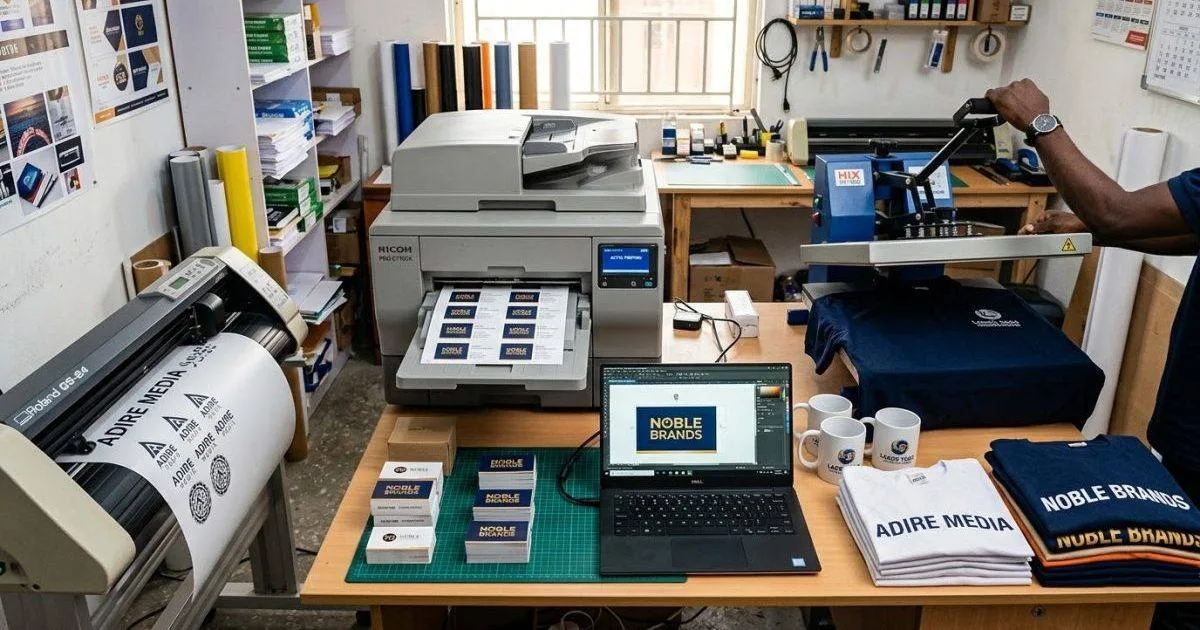
Invest in an A3 digital printer (for business cards, flyers, brochures, certificates, stickers) and a heat press (for custom t-shirts, mugs, caps, and branded merchandise). This setup handles the most common everyday print jobs in-house, giving you full quality control and higher margin per job, while outsourcing larger jobs (flex banners, large-format prints) to specialist shops. The A3 digital printer + heat press combination is the most common entry point for Nigerian printing entrepreneurs and the sweet spot of capital investment versus capability for a first-time buyer.
Model 3: Full Printing Shop (₦2,000,000 to ₦10,000,000+)
A full printing shop with large-format digital printer (for flex banners, X-banners, pop-up displays), cutting plotter, laminator, A3 digital printer, and possibly an offset press for high-volume business card and flyer printing. This is a full-service commercial printing operation serving other businesses, event companies, and individuals with a complete range of print products. Requires significant capital, a suitable business location with electricity and space, and the operational expertise to manage multiple production streams simultaneously.
Equipment List: Small Digital Printing Setup
| Equipment | Cost (2026) | What It Produces |
| A3+ digital printer (Epson L1800 or Canon PIXMA Pro) | ₦120,000 – ₦280,000 | Business cards, flyers, brochures, certificates, stickers, small posters |
| Heat press machine (38 × 38cm) | ₦60,000 – ₦150,000 | Custom t-shirts, polo shirts, mugs, caps, tote bags, phone cases |
| Cutting machine/plotter (vinyl cutter) | ₦120,000 – ₦350,000 | Vinyl stickers, car decals, logo cuts, custom signage elements |
| Laminator (A3) | ₦30,000 – ₦80,000 | Laminated ID cards, menu cards, certificates, table cards |
| Design software (Adobe Illustrator/Photoshop or Canva Pro) | ₦6,000 – ₦12,000/month | Creating designs for client jobs |
| Laptop (16GB RAM, colour-accurate screen) | ₦250,000 – ₦600,000 | Design workstation |
| Ink and substrate stock (first month) | ₦30,000 – ₦80,000 | Printer inks, sublimation paper, transfer paper, business card stock |
| Blank apparel and merchandise stock (t-shirts, mugs, caps) | ₦30,000 – ₦80,000 | Items to print on for custom merchandise orders |
| Generator (1.5 to 2.5 kVA for printer and press) | ₦80,000 – ₦200,000 | Power reliability for production |
| Small digital setup total | ₦726,000 – ₦1,820,000 |
Pricing Key Print Products
| Product | Production Cost | Market Rate (Lagos/Abuja 2026) |
| Business cards (1,000 pieces, full colour, double-sided) | ₦1,500 – ₦3,000 | ₦5,000 – ₦15,000 |
| A5 flyers (1,000 pieces, full colour) | ₦8,000 – ₦18,000 (outsourced offset) | ₦18,000 – ₦40,000 |
| Flex banner (3m × 1m) | ₦4,000 – ₦8,000 (outsourced large format) | ₦10,000 – ₦25,000 |
| Custom branded t-shirt (DTF or sublimation, per piece) | ₦800 – ₦1,500 (including blank t-shirt) | ₦2,500 – ₦6,000 |
| Custom mug (sublimation, per piece) | ₦700 – ₦1,200 (including blank mug) | ₦2,000 – ₦4,000 |
| Branded polo shirt (corporate, 12+ pieces) | ₦2,500 – ₦4,000 per piece | ₦6,000 – ₦12,000 per piece |
| Roll-up banner (₦85cm × 200cm, printed and assembled) | ₦8,000 – ₦15,000 | ₦20,000 – ₦45,000 |
| Certificate printing (A4, full colour, glossy) | ₦100 – ₦200 per piece | ₦500 – ₦1,500 per piece |
Building Recurring Revenue: The Branding Contract Model
The most financially stable printing business model is the corporate branding contract — where a company or organisation retains your services for all their ongoing printing needs at agreed monthly rates rather than placing one-off orders. A corporate client that orders business cards for new staff, event flyers for monthly programmes, branded merchandise for quarterly giveaways, and internal certificates for staff recognition generates ₦50,000 to ₦200,000 in printing revenue per month from a single client relationship. Ten such corporate clients represent ₦500,000 to ₦2,000,000 monthly recurring revenue — a level of income stability that one-off order businesses cannot achieve. Target corporate clients: banks (regular printed forms, branded stationery, ATM signage), schools (report cards, certificates, banners, uniforms), churches and mosques (event programmes, banners, branded items for members), hotels (menus, event materials, branded room items), and SMEs in your area who need regular marketing materials. Approach each with a specific proposal showing what you can produce for them and what the annual spend estimate would be if they consolidated their printing with you rather than using multiple ad-hoc suppliers.
Frequently Asked Questions
How much does it cost to start a printing business in Nigeria?
Reseller model: ₦50,000 to ₦150,000 (laptop, marketing, working capital). Small digital printer: ₦700,000 to ₦1,800,000. Full printing shop: ₦2,000,000 to ₦10,000,000+.
Is printing business profitable in Nigeria?
Yes — print margins of 100 to 300 percent on production cost are common for standard products. Profitability depends on client acquisition, equipment reliability (printer downtime kills revenue), and ink cost management (genuine OEM inks vs compatible inks significantly affect print quality and cost per page).
Do I need graphic design skills to start a printing business in Nigeria?
Basic design competence in Canva or Adobe Illustrator is needed for client jobs where you create the design as part of the service. Many clients bring their own designs (logos, artwork files) — for these jobs, you need only the technical printing skills. Investing in design skill development (Canva and Illustrator courses on YouTube are free) significantly expands the services you can offer and the premium you can charge.
Quality Control: Why Nigerian Printers Lose Repeat Clients
The most common reason Nigerian printing businesses fail to build long-term client relationships is not price — it is inconsistent quality and missed deadlines. A client who orders 1,000 business cards and receives them with a colour shift from the approved artwork, or whose urgently needed event banners are delivered the day after the event, does not return. They also tell their network. The Nigerian printing market has such low average quality and reliability that a printer who consistently delivers what was approved, on or before the promised date, at a fair price, builds a reputation that generates referrals without any additional marketing effort. Three quality practices that set professional Nigerian printers apart. First: always show the client a soft proof (digital preview of the final layout and colours) and get written approval before printing — disputes about colour or layout after printing waste both parties’ time and money. Second: never commit to a delivery date you cannot keep — it is better to quote an honest timeline that the client does not love than to overpromise and miss it. A late delivery that was honestly communicated in advance is forgivable; a late delivery that was promised on time is a broken trust. Third: check every job visually before handing it to the client — one misprinted business card in a pack of 1,000 is enough to justify a reprint request and a wasted afternoon. Five minutes of quality checking before delivery prevents hours of problem resolution afterward. The printer who invests in these disciplines — proof approval, honest timelines, visual quality checking — builds a reputation for reliability that is rarer and more valuable than any piece of equipment they could buy. The Nigerian printing business that combines technical quality with commercial reliability — delivering exactly what was approved, exactly when promised, every time — is not just a printing business: it is a trust business, and trust in the Nigerian commercial environment is the scarcest and most valuable commodity of all. Build the reputation first — the equipment can always be upgraded later, but reputation, once lost, cannot be bought back at any price.
Sources
- Original business guide — NaijaSabi Business Desk, September 2026
Last updated: 22 September 2026 · NaijaSabi Business Desk.
Large Format Printing: The Flex Banner Market
Flex banner printing is one of the highest-volume segments of the Nigerian printing market — driven by the political campaign, religious event, business promotion, and social announcement culture that plasters Nigerian streets and compound walls with banner advertising year-round. The flex banner market is well-served by existing providers in major Nigerian cities, which means new entrants compete primarily on turnaround time, price, and proximity to clients rather than on product differentiation. The highest-margin flex banner clients are not the ones who order one banner at a time — they are the political campaign offices, property developers, and large churches and mosques that need hundreds of banners on recurring schedules. Landing a political campaign client during the 2027 election cycle (which will drive enormous printing demand across Nigeria from late 2026 onward) represents a significant revenue opportunity for printing businesses that can handle volume production. Begin positioning for election season printing demand now — approach political party offices, campaign managers, and aspirants’ offices with your portfolio and pricing well before the campaign printing frenzy begins, so that when the orders start flowing, you are the established trusted supplier rather than one of dozens of printers cold-approaching a campaign on a deadline.
Digital Printing Skills: What You Need to Learn
Three skill sets that every Nigerian printing business owner needs to develop or hire, regardless of which business model they choose. First: basic graphic design in Adobe Illustrator or Canva Pro. Most clients bring poor-quality or incorrectly formatted artwork — a printer who cannot review, correct, and improve client artwork wastes significant time on production problems and produces mediocre output. The ability to convert a low-resolution WhatsApp-sent logo into a print-ready vector file is a specific, learnable skill that pays for itself in the first week of operation. Second: colour management — understanding colour profiles (CMYK for print vs RGB for screens), how to calibrate your monitor for accurate colour preview, and how to achieve consistent colour output across different substrates and inks. Colour inconsistency is the most common quality complaint against Nigerian printers. Third: substrate knowledge — understanding the difference between photo paper, matte paper, vinyl, fabric, ceramic coating, and the specific settings each requires for optimal print quality. Each substrate needs different ink types, temperatures (for heat transfer), and print profiles. These skills are teachable through YouTube, through supplier training workshops (many ink and substrate suppliers in Lagos offer free training for new buyers), and through deliberate experimentation with small test prints before committing to client production.




0 Comments
No comments yet. Be the first to share your thoughts!