

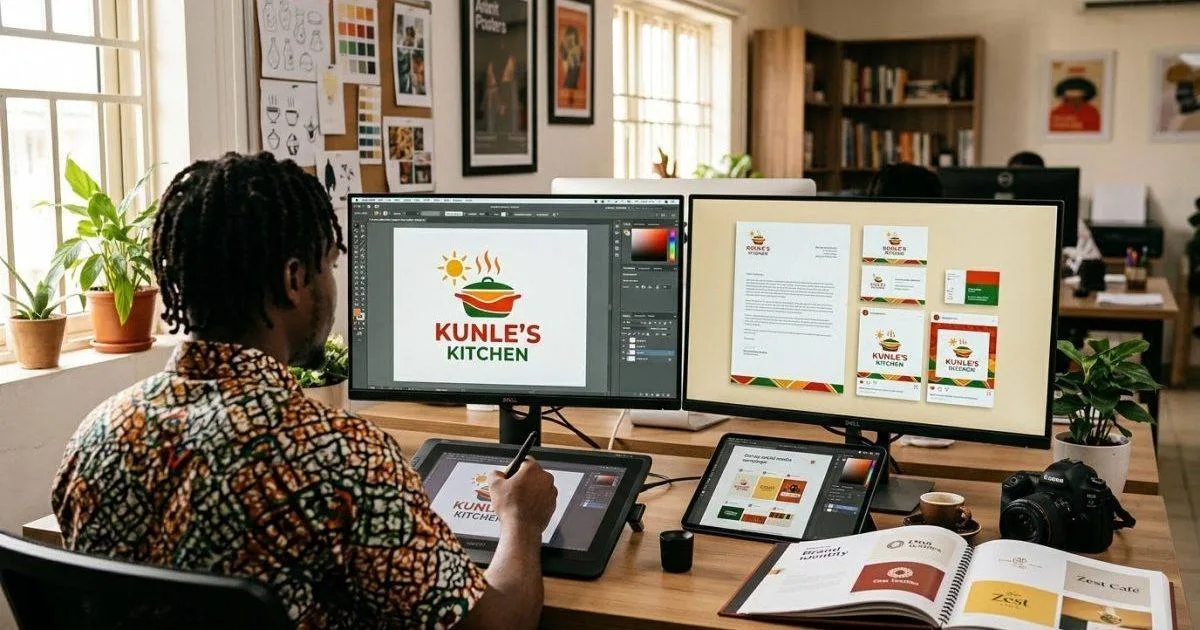
📌 Quick Summary: A graphic design business in Nigeria requires startup capital of ₦0 to ₦150,000 — a laptop, internet connection, and design software are the only requirements. Freelance graphic designers in Nigeria charge ₦5,000 to ₦50,000 per logo, ₦3,000 to ₦15,000 per social media graphic, and ₦50,000 to ₦300,000 per brand identity package. International clients on Fiverr and Upwork pay $50 to $500+ per project. A graphic designer with 5 to 10 active clients earns ₦200,000 to ₦800,000 monthly. The most in-demand skills: logo design, social media graphics, flyers, and brand identity. Primary tools: Canva Pro (beginner), Adobe Illustrator and Photoshop (professional). This guide covers how to learn graphic design for free, building a portfolio, pricing, finding Nigerian and international clients, and the most profitable niches.
Graphic design is one of the most accessible high-income skills available to Nigerians in 2026 — it requires no physical location, no manufacturing, and can be started with tools that are either free or low-cost. Every Nigerian business needs visual communication: logos, social media graphics, flyers, banners, packaging, brand identity, website graphics, and presentation slides. The gap between the demand for professional design and the supply of truly skilled designers creates consistent opportunity for designers who invest in learning their craft and building a strong portfolio. This guide covers the complete path from zero to a functioning graphic design business in Nigeria.
Design Tools: From Free to Professional
| Tool | Cost | Best For | Level |
| Canva Free | Free | Social media graphics, flyers, presentations, certificates — drag-and-drop templates | Beginner |
| Canva Pro | ₦5,000 – ₦8,000/month | Everything Canva Free does + brand kit, background remover, premium elements, larger storage | Beginner to Intermediate |
| Adobe Illustrator | ₦8,000 – ₦15,000/month (Creative Cloud) | Logo design, vector graphics, brand identity — the industry standard for professional logo work | Professional |
| Adobe Photoshop | Included in Creative Cloud | Photo editing, digital illustration, social media composites, mockups | Professional |
| Adobe InDesign | Included in Creative Cloud | Multi-page layouts — brochures, annual reports, magazines, catalogues | Professional |
| Figma | Free tier available; paid from ₦8,000/month | UI/UX design, web design, app interface design — browser-based, team collaboration | Intermediate to Professional |
| Affinity Designer | One-time purchase ₦20,000 – ₦30,000 | Professional vector design — Adobe Illustrator alternative without subscription | Professional |
Recommended learning path for Nigerian beginners: Start with Canva to understand design principles and serve first clients. Progress to Adobe Illustrator (for logos) and Photoshop (for image editing) as your client base grows and skill demands increase. Learning both Canva and Adobe skills makes you versatile enough to serve the full range of Nigerian design clients.
How to Learn Graphic Design for Free in Nigeria
Five learning pathways that cost nothing and produce professional results within 3 to 6 months of consistent practice. YouTube is the most comprehensive free graphic design education resource available — channels by Will Paterson (logo design), Satori Graphics (brand identity), and Piximperfect (Photoshop) teach professional techniques with the same depth as paid courses. Canva’s own Design School (design.canva.com) provides free structured courses covering design principles, colour theory, typography, and practical design skills — completing these courses alone produces designers capable of serving small Nigerian business clients. Adobe has free online tutorials and community forums at helpx.adobe.com covering every aspect of Illustrator, Photoshop, and InDesign — if you can access Adobe Creative Cloud, Adobe’s own learning resources are sufficient for self-teaching. Coursera and edX offer free auditing (learning without certification) of graphic design courses from universities including California Institute of the Arts — structured curricula covering design principles, typography, colour theory, and layout. Nigerian design communities on Twitter and Instagram — following Nigerian designers who share their process and critique design work — provides exposure to real-world Nigerian design standards and a network of peers whose work shows you where your own needs to develop.
The Most Profitable Graphic Design Niches in Nigeria
| Niche | Services | Rate Range | Client Source |
| Logo and brand identity | Logo, business card, letterhead, brand guidelines | ₦30,000 – ₦300,000 per package | New businesses, rebranding SMEs |
| Social media graphics | Monthly Instagram/Facebook post graphics, Reels covers, Story templates | ₦20,000 – ₦80,000/month per client | Any business with a social media presence |
| Print design | Flyers, banners, brochures, billboards, event programmes | ₦3,000 – ₦50,000 per project | Events, businesses, political campaigns |
| Packaging design | Product label, box packaging, sachet design | ₦30,000 – ₦200,000 per product | FMCG brands, food producers, cosmetics |
| Presentation design (PowerPoint/Google Slides) | Business presentations, pitch decks, investor decks | ₦30,000 – ₦150,000 per deck | Startups, corporate clients, consultants |
| UI/UX design | App interface, website layout, user experience design | ₦100,000 – ₦500,000+ per project | Tech startups, fintech companies |
| International freelancing (Fiverr/Upwork) | Logo, social media templates, brand identity for international clients | $50 – $1,000+ per project | International businesses via platforms |
Building Your Portfolio from Zero
The portfolio problem every new Nigerian graphic designer faces: clients want to see previous work before hiring you, but you have no clients because you have no portfolio. The standard solutions. First: design for yourself — create a fictional brand and design its complete identity (logo, business cards, social media template set, packaging). A well-executed fictional brand portfolio piece demonstrates the same skill as a real client project. Second: design for free for 3 to 5 businesses in your community — a friend’s new business, a neighbourhood shop, a local church. Do excellent work, photograph the results in professional mockups (using free mockup templates from Freepik or Mockup World), and add to your portfolio. Third: design competition platforms — Designhill and 99designs run design contests where you can participate and potentially win — win or lose, the work adds to your portfolio and the judges’ feedback is valuable. Fourth: redesign Nigerian logos as portfolio exercises — pick 3 to 5 poorly designed logos from Nigerian businesses and redesign them as concept projects. This demonstrates your ability to solve real design problems with real Nigerian context. Post these redesigns with before-and-after comparison on Instagram and LinkedIn — they consistently attract engagement and enquiries from business owners who see their competitors represented and think about their own brand.
How to Find Graphic Design Clients in Nigeria
Five client acquisition strategies that produce consistent results for Nigerian graphic designers. Instagram portfolio building: post your best design work consistently — 3 to 5 times per week — using Nigerian business, entrepreneurship, and design hashtags. Show process (sketches to final work), behind-the-scenes (your design software in action), and results (before-and-after brand makeovers). A designer who consistently posts professional work on Instagram for 3 to 6 months builds an inbound enquiry pipeline that replaces active pitching. LinkedIn outreach to business owners and marketing managers: connect with Nigerian SME founders, startup CEOs, and marketing managers, and send personalised messages offering a specific observation about their brand visual identity and a proposal to improve it. LinkedIn is underused by Nigerian designers relative to its potential — corporate clients with larger budgets are concentrated there. Referrals from existing clients: every satisfied client knows other business owners who need design. Ask explicitly for referrals at project completion — “Do you know anyone else who might need a logo or social media graphics?” Jiji and other classifieds: list your graphic design services on Jiji.ng — many Nigerian small businesses search for designers on classifieds platforms. International platforms (Fiverr and Upwork): create professional profiles targeting international clients. The currency advantage — earning $100 to $500 per project that takes a day to complete at a rate a Lagos-based client would not pay — makes international freelancing a significant income multiplier for skilled Nigerian designers.
Pricing Your Graphic Design Services
The most common pricing mistake Nigerian graphic designers make is charging by time rather than by value. A logo that takes you 3 hours to produce is not worth 3 × your hourly rate — it is worth what the logo does for the client’s business. A business owner whose brand looks unprofessional is losing customers every day because of the poor visual impression. A professionally designed logo that solves this problem and delivers business results is worth ₦30,000 to ₦150,000 regardless of how long it took to produce. Price by deliverable and value, not by hours. Build three service tiers: a Starter package (logo only, 2 concepts, 1 revision) at ₦25,000 to ₦50,000; a Growth package (logo + business card + letterhead + social media kit, 3 concepts, 3 revisions) at ₦80,000 to ₦200,000; a Premium Brand Identity package (logo + full brand guidelines + all stationery + social media templates + brand voice guide) at ₦200,000 to ₦500,000. Presenting tiered packages rather than quoting a single price gives clients options and reliably increases average project value — many clients who inquire about a ₦30,000 logo end up choosing the ₦150,000 growth package when they see the full value of what is included.
Frequently Asked Questions
Can I start a graphic design business in Nigeria with just Canva?
Yes — Canva Pro is sufficient to serve the majority of Nigerian small business clients who need social media graphics, flyers, simple logos, and presentation design. To serve clients who need professional vector logos (scalable to any size, usable by printers for large format), Adobe Illustrator becomes necessary. Many successful Nigerian designers use Canva for some projects and Adobe tools for others.
How much do graphic designers charge in Nigeria in 2026?
Logo design: ₦15,000 to ₦150,000. Brand identity package: ₦80,000 to ₦500,000. Social media monthly retainer: ₦20,000 to ₦80,000. Flyers: ₦3,000 to ₦15,000 per design. International Fiverr/Upwork rates: $50 to $500+ per project depending on complexity and your profile level.
Do I need to study graphic design formally in Nigeria?
No. Graphic design is entirely portfolio-based — clients hire designers whose work they admire, not those with degrees. YouTube, Adobe tutorials, Canva Design School, and deliberate practice on real projects are sufficient to reach professional standard. A design degree provides structured education but is not required to build a successful commercial design business.
Sources
- Original business guide — NaijaSabi Business Desk, September 2026
Last updated: 25 September 2026 · NaijaSabi Business Desk.
Design Principles Every Nigerian Graphic Designer Must Master
Technical skill with Canva or Adobe is necessary but not sufficient — the designers who consistently win clients and grow their income are those who understand the principles that make design effective, not just the tools that execute it. Five foundational design principles with direct Nigerian business application. Contrast: elements in a design should either be clearly similar or clearly different — never almost the same. A flyer where the headline text and body text are the same size and colour fails to guide the viewer’s eye. High contrast between headline (large, bold, high-contrast colour) and body text (smaller, lighter) creates hierarchy that makes the design scannable in seconds — critical for Nigerian social media graphics where the viewer is scrolling past at speed. Alignment: every element in a design should be intentionally aligned to an invisible grid — left-aligned, right-aligned, centred, or on a defined grid line. Randomly placed elements create visual noise. Alignment creates order that the brain perceives as professional and trustworthy. Typography: choosing the right fonts and using them consistently is one of the most impactful design decisions a Nigerian designer makes. Most amateur Nigerian design fails at typography — using 4 to 6 different fonts in a single design, mixing serif and sans-serif incorrectly, and using decorative fonts for body text. Professional rule: use maximum 2 fonts per design (one for headlines, one for body), always from the same type family or a deliberately contrasting pairing. Colour: Nigerian design clients often want “bright” and “colourful” — which is valid for the celebratory context of Nigerian events and social media. The designer’s skill is in creating colour palettes that are vibrant and energetic while still communicating brand values and maintaining readability. White space: Nigerian design clients frequently want to fill every available space with text and images. Learning to use and defend white space — explaining to a client why empty space makes their design look more premium, not less complete — is one of the most valuable commercial design skills. Designers who master these principles produce work that wins clients and generates referrals, regardless of which tool they use to execute it.
Growing from Freelancer to Design Agency
The graphic design career path in Nigeria follows a recognisable progression for designers who consistently deliver quality work and build their client base systematically. Phase 1 — Solo freelancer: 3 to 8 clients, handling all design work personally, generating ₦100,000 to ₦400,000 monthly. This phase builds the portfolio depth, client relationship skills, and process discipline that support scaling. Phase 2 — Specialised freelancer: developing a specific niche (logo design, packaging design, UI/UX, social media graphics) that commands premium Rates and attracts better-fit clients. Specialisation is the fastest path to income growth in Nigerian graphic design — a specialist commands 50 to 100 percent higher rates than a generalist at equivalent skill levels. Phase 3 — Small studio or agency: bringing in junior designers as the client base exceeds solo capacity. The studio takes on larger retainer contracts (monthly social media graphics for 10 to 20 clients managed by a small team) while the founder moves toward creative direction, client management, and strategy rather than daily production. The Nigerian design market can sustain this progression for any designer who treats graphic design as a serious profession — investing continuously in skill development, delivering consistently, and building client relationships with the same care that they invest in the designs themselves.

0 Comments
No comments yet. Be the first to share your thoughts!