




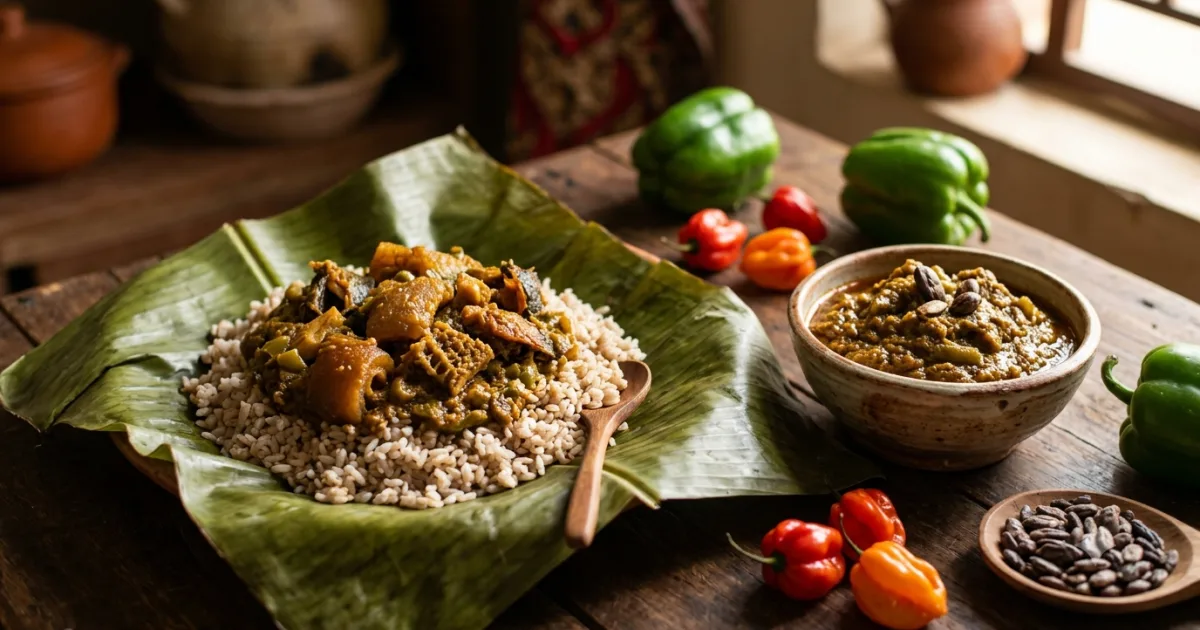
📌 Quick Summary: Ofada rice is a short-grain, unpolished Nigerian rice variety grown primarily in Ogun State — served with ayamase (designer stew), a rich, smoky sauce made from green bell peppers (tatase), green scotch bonnet, locust beans (iru), palm oil, and assorted offal. The stew’s distinctive green-to-brownish colour comes from the unripe/green peppers used instead of the red peppers of regular Nigerian stew. The ayamase sauce takes approximately 45 to 60 minutes to cook properly. This complete guide covers how to cook ofada rice correctly, the full ayamase stew recipe, why the stew is brown (not green), the offal protein options, and variations.
Ofada rice and ayamase (also called designer stew or ofada stew) is one of the most distinctly Nigerian and Lagos-associated food experiences — a dish so particular to southwestern Nigerian food culture that it is difficult to find a satisfying version outside Nigeria, and even within Nigeria it is most commonly associated with the Yoruba-dominated food scene of Lagos Island, Ibadan, and their surroundings. The rice is short-grain, slightly nutty from partial fermentation, and unpolished — its distinctive earthy flavour is entirely different from the long-grain parboiled rice used in jollof rice or fried rice. The stew is made from green peppers rather than red, creating a colour and flavour profile that is unlike any other Nigerian stew. Together, the combination is one of Nigeria’s most sought-after food experiences — and one of the most searched recipes by Nigerians who want to recreate the restaurant experience at home.
What Is Ofada Rice?
Ofada rice is a short-grain, unpolished (brown) rice variety indigenous to Ogun State, Nigeria — particularly the Ofada community in Obafemi Owode Local Government Area, which gives the rice its name. Unlike the long-grain parboiled rice used for Nigerian jollof rice, ofada rice retains its natural brown bran layer, giving it a nutty, slightly earthy flavour and a distinctly different texture when cooked — firmer, slightly chewy, and less sticky than polished white rice. The slight fermented aroma that ofada rice develops during the traditional processing (sun-drying and partial fermentation) is part of its identity, not a sign of spoilage. Ofada rice has a lower glycaemic index than polished white rice — its fibre and nutrient content make it genuinely more nutritious than regular white rice. It has gained significant popularity among health-conscious Nigerians for exactly this reason.
How to Cook Ofada Rice
Ofada rice requires a different cooking approach from regular Nigerian parboiled rice. The key steps: wash the rice thoroughly in several changes of water — ofada rice carries significant chaff and starch on the surface that must be washed off. Parboil in boiling water for 10 to 15 minutes, drain, and rinse again — the parboiling step removes the fermented aroma that some people find overpowering. Then cook in fresh water: add the parboiled ofada rice to a pot of fresh water in a 1:2 ratio (1 cup rice to 2 cups water), add salt, bring to a boil, reduce to very low heat, and cook covered for 20 to 25 minutes until the water is fully absorbed and the rice is tender. Ofada rice takes longer to cook than polished rice and requires slightly more water because the outer bran layer slows water absorption. Do not attempt to cook ofada rice in a rice cooker without parboiling first — the result will be unevenly cooked, with hard centres and mushy outsides.
Ayamase Stew (Designer Stew) — The Full Recipe
What Makes Ayamase Different From Regular Nigerian Stew
Regular Nigerian tomato stew uses red tomatoes, red bell peppers (tatashe), and red scotch bonnet — producing the characteristic deep red-orange colour. Ayamase uses green bell peppers (unripe tatase), green scotch bonnet or green habanero, and sometimes green tomatoes — producing a very different flavour profile that is sharper, less sweet, and more intensely pepper-forward. The stew is also palm oil heavy — significantly more oil than regular tomato stew — and this oil is bleached (cooked on high heat until it loses its natural red colour and becomes pale golden) before the peppers are added. It is the combination of bleached palm oil, green peppers, and generous iru (locust beans) that produces the distinctive smoky, deep, umami-rich flavour of ayamase.
Why Is Ayamase Brown, Not Green?
This is the most common question from first-time ayamase makers. Despite starting with green peppers, the finished ayamase stew is dark brownish-green to nearly brown — not a bright green colour. The reason: the combination of bleached palm oil (which is now golden, not red), long frying time (45 to 60 minutes of the pepper mixture cooking in hot oil), and the Maillard reaction caramelisation of the sugars in the pepper all combine to darken the stew significantly from its original green. A properly made ayamase is never bright green — the colour ranges from dark olive-green to deep brownish. Bright green ayamase has been under-fried.
Ingredients — Serves 8 to 10
| Ingredient | Quantity | Notes |
| Green bell peppers (green tatase) | 6 large | Fully green, unripe tatase. The defining ingredient. Do not substitute red bell peppers. |
| Green scotch bonnet (green atarodo) | 4 to 6 | Adjust to heat preference. Green scotch bonnet is significantly hotter and more pungent than red. |
| Palm oil | 1 cup (240ml) | Significantly more than regular stew — ayamase is oil-rich by design |
| Iru (locust beans) | 2 tablespoons | Essential — the iru is non-negotiable for authentic ayamase flavour. Do not substitute or omit. |
| Assorted offal and protein | 700g to 1kg | The traditional ayamase protein mix: ponmo (cowskin), shaki (tripe), abodi (intestine), stock fish, cow leg. Cook each protein separately until tender before adding to stew. |
| Ground crayfish | 2 tablespoons | |
| Onion | 1 medium, sliced | |
| Seasoning cubes | 2 | |
| Salt | To taste |
Step-by-Step Ayamase Method
- Blend the peppers. Roughly blend the green bell peppers and green scotch bonnet — not completely smooth. A slightly coarse texture is correct for ayamase. Do not add water. Pour into a pot and boil over high heat for 15 to 20 minutes to reduce the water content. The pepper mixture should reduce by approximately one-third.
- Bleach the palm oil. In a wide, deep pot, heat the palm oil over high heat — uncovered — until it begins to smoke and changes from red to pale golden. This is bleaching. It takes 10 to 15 minutes on high heat. The smell is intense — ensure good ventilation. Bleached palm oil is the foundation of ayamase; unbleached palm oil produces a different, inferior result.
- Add onion and iru. Carefully add the sliced onion to the bleached oil — it will sizzle aggressively. Fry for 2 minutes. Add the iru (locust beans) and fry for 1 minute, stirring, until fragrant.
- Add the blended pepper. Add the reduced green pepper mixture to the hot bleached oil. It will sizzle and splatter — stand back and use a long wooden spoon. Stir well to combine. Reduce heat to medium-low.
- Fry for 45 to 60 minutes. This extended frying is what makes or breaks ayamase. Stir every 5 to 7 minutes throughout. The pepper mixture will gradually darken from bright green to dark olive to brownish-green. Oil will begin separating and floating on the surface — this signals proper frying. The stew is ready when the oil has fully separated and the pepper mixture has a deep, caramelised, almost jammy consistency.
- Add proteins and season. Add the pre-cooked assorted offal, ponmo, stockfish, and any other proteins. Add crayfish, crumbled seasoning cubes, and salt. Stir well. Add a small amount of water or stock if needed. Cook for a further 10 minutes on medium-low heat to allow the proteins to absorb the stew flavour.
- Serve. Ayamase is traditionally served over ofada rice, wrapped in banana leaves or served on a plate. The banana leaf wrapping is the classic restaurant presentation style — it imparts a subtle herbal flavour to the rice and stew.
Serving Ofada Rice and Ayamase
The most authentic serving presentation is the banana leaf style: lay a large banana leaf on a flat surface, place a generous portion of cooked ofada rice in the centre, ladle the ayamase stew over the rice, and fold the banana leaf around the rice and stew into a parcel. Allow to rest for 2 to 3 minutes before serving — the steam inside the parcel slightly cooks the banana leaf, releasing its characteristic herbal aroma into the dish. This presentation, common at Lagos eateries and Yoruba food events, is part of what makes ofada rice and ayamase such a distinctive experience. At home without banana leaves: serve the rice on a wide plate or in a bowl, ladle the stew generously over the rice, and serve immediately.
Frequently Asked Questions
What is ofada rice?
Ofada rice is a short-grain, unpolished Nigerian rice indigenous to Ogun State. It has a nutty, slightly earthy flavour, retains its natural bran layer (making it nutritionally superior to polished white rice), and has a distinctive partial fermentation aroma from traditional processing. It is shorter and sturdier than regular Nigerian rice.
Why is my ayamase bright green?
Ayamase should not be bright green — it should be dark olive-green to brownish. Bright green colour indicates under-frying. Return the stew to the heat and continue frying on medium-low heat, stirring every 5 minutes, until the colour deepens and the oil fully separates on the surface.
Can I make ayamase without iru (locust beans)?
Technically yes, but the result is a significantly different soup. Iru provides the deep umami base note that distinguishes ayamase from a simple green pepper stew. If iru is unavailable, a small quantity of dried fermented fish or shrimp paste can provide some of the same fermented depth, but it is an imperfect substitute.
What protein goes in ayamase stew?
The traditional ayamase protein combination is assorted offal — ponmo (cowskin), shaki (tripe), abodi (intestine), cow leg, and stockfish. This offal base is authentic to the Yoruba preparation. Many modern versions add chicken or beef as well. The offal must be cooked until very tender before adding to the stew. The mastery of ayamase — the willingness to bleach palm oil, to fry green peppers for an hour, to cook assorted offal correctly — separates the confident Nigerian home cook from the tentative one, and the satisfaction of serving a correct ayamase at a gathering and watching guests react to the flavour is one of those specific culinary pleasures that no shortcut version of the dish ever produces.
Sources
- Original recipe — NaijaSabi Lifestyle Desk, September 2026
- Yoruba culinary tradition — ofada rice and ayamase stew preparation documented across southwestern Nigerian cooking practice
Last updated: 20 September 2026 · NaijaSabi Lifestyle Desk.
Ofada Rice and Ayamase: The Cultural Significance
Ofada rice and ayamase stew is not just a dish — it is a cultural statement and an economic identity. The rice and the stew together represent a deliberate choice to eat Nigerian rather than imported: ofada rice is grown by Nigerian farmers in Ogun State (with varieties now cultivated in Oyo, Osun, and Ekiti States as well), processed by Nigerian small-scale processors, distributed by Nigerian traders, and cooked using a Nigerian cooking technique with Nigerian-sourced ingredients throughout. Eating ofada rice and ayamase is, in a modest culinary way, a form of economic nationalism — a preference for a food product whose entire value chain stays within Nigeria. The Nigerian government’s various rice import restriction policies over the years have explicitly tried to build this kind of preference for domestic rice, and ofada has benefited — its status has risen from a regional Yoruba food to a pan-Nigerian culinary identity point that Nigerians of all ethnic backgrounds eat when they want to eat something distinctly, proudly Nigerian. For the home cook, mastering ofada rice and ayamase is mastering one of the key markers of serious Nigerian culinary skill — a dish that requires more technique than jollof rice, more patience than pepper soup, and more confidence with unfamiliar ingredients (green peppers, iru, assorted offal) than any of the other dishes in the standard Nigerian cooking repertoire.



0 Comments
No comments yet. Be the first to share your thoughts!