




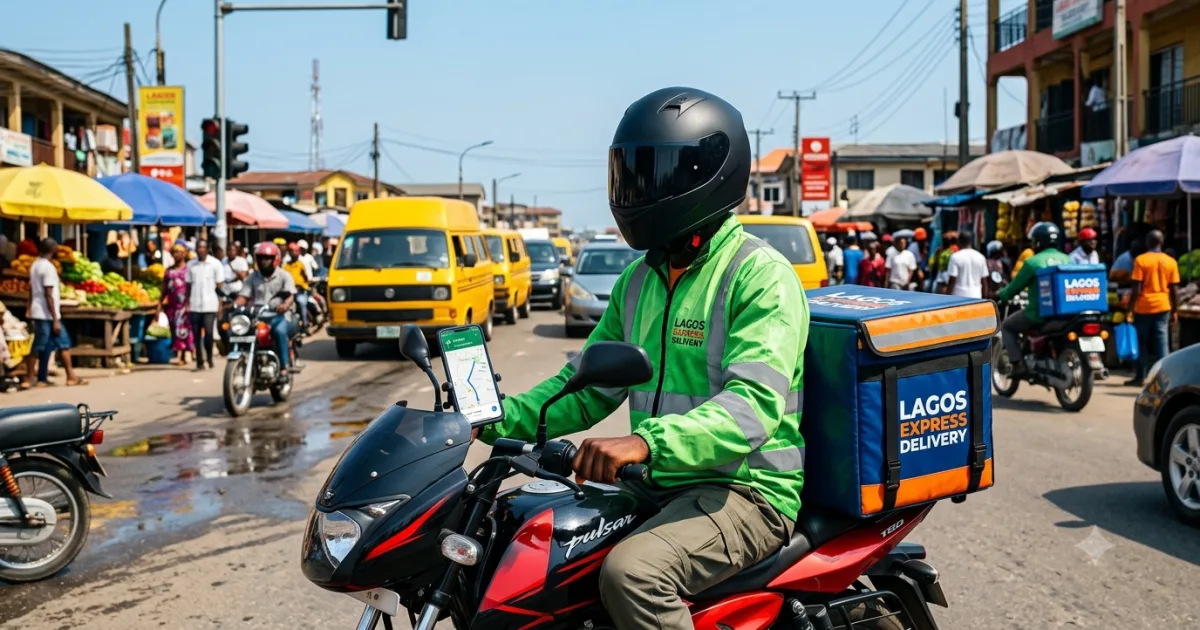
📌 Quick Summary: A food delivery and dispatch rider business in Nigeria requires startup capital of ₦300,000 to ₦800,000 for a motorcycle and safety equipment, or ₦1,500,000 to ₦3,500,000 for a tricycle (keke). Delivery fees: ₦500 to ₦2,500 per delivery for food; ₦1,000 to ₦5,000 per package for document and goods delivery. An independent dispatch rider doing 15 to 30 deliveries per day earns approximately ₦7,500 to ₦75,000 daily. The three business models: work for a platform (Kwik, Sendbox, GIG Logistics), supply riders to restaurants and businesses, or operate your own independent delivery service. This guide covers startup costs, platforms that pay dispatch riders in Nigeria, how to get your first delivery clients, and how to scale to a fleet.
Nigeria’s delivery business has undergone a structural transformation over the past five years — driven by the growth of online shopping, food delivery apps, and the recognition among Nigerian businesses that in-house logistics is expensive and inefficient. The COVID-19 period accelerated what was already a trend: Nigerian consumers got used to having food, groceries, packages, and documents delivered to their homes and offices. That habit has persisted and grown. Lagos, Abuja, and Port Harcourt now have mature food delivery ecosystems anchored by apps like Kwik, Chowdeck, Munch, and the restaurant-direct WhatsApp delivery model that has become even more common than app-based ordering for many Nigerian consumers. The dispatch rider has become a visible, essential part of Nigeria’s urban economy — and the business of owning and operating delivery capacity (whether as an individual rider, a fleet owner, or a logistics company) is one of the clearest opportunities in Nigerian services in 2026.
The Three Delivery Business Models
Model 1: Work for a Delivery Platform (Employee or Contractor)
Register as a rider on platforms like Kwik, Chowdeck, Sendbox, GIG Logistics, or DHL Nigeria. You use your own motorcycle and receive a per-delivery payment from the platform. Advantages: instant access to delivery orders, no need to find your own clients, platform handles payment collection and customer service. Disadvantages: you are a contractor, not an employee — no benefits; platform can deactivate your account; payment per delivery is fixed by the platform and you cannot negotiate. Income on major platforms: ₦600 to ₦1,800 per delivery on food apps; ₦800 to ₦2,500 on logistics platforms for package delivery. Doing 20 to 40 deliveries per day: ₦12,000 to ₦100,000 daily before fuel costs. This model requires the lowest capital (own motorcycle) and generates income immediately but has limited scalability beyond your own physical capacity.
Model 2: Contract Delivery Service for Businesses
Approach restaurants, pharmacies, grocery stores, laundry businesses, baked goods sellers, and other businesses that need daily or weekly delivery capacity — and offer a fixed monthly delivery contract. The business pays you a monthly fee for a guaranteed number of deliveries per day, rather than a per-delivery rate. Advantages: predictable, recurring monthly revenue; no dependence on platform algorithms; direct client relationship. Disadvantages: you must find and close the clients yourself; income starts after contracts are signed (no instant orders). Rate structure for contract delivery in Nigeria 2026: ₦50,000 to ₦150,000 per month per business client for 10 to 30 deliveries per day within a defined radius. Three to five restaurant or business clients at ₦80,000 per month each generates ₦240,000 to ₦400,000 monthly recurring revenue from a single rider.
Model 3: Independent Delivery Business — WhatsApp and Social Media Orders
Build your own delivery business brand — a name, logo, and WhatsApp Business profile — and market directly to Nigerian consumers and small businesses in your area. Individuals who need to send documents, packages, food, or goods within the same city contact you directly and pay you directly. Advantages: highest per-delivery margin (no platform taking a cut), direct customer relationships, ability to set your own rates. Disadvantages: requires consistent marketing effort to generate a steady order flow; cash collection responsibility is yours; customer service is entirely your own. This model is most viable in cities where app-based delivery has not yet fully penetrated (medium-sized Nigerian cities) and for specialised delivery categories (fragile items, large parcels, cold chain delivery) where general apps do not excel.
Startup Equipment and Costs
| Item | Cost (2026) | Notes |
| Motorcycle (TVS, Bajaj, Honda — new) | ₦400,000 – ₦700,000 | New motorcycle preferred for reliability. Bajaj Boxer and TVS Apache are most common among Nigerian dispatch riders. Used motorcycles from ₦150,000 to ₦300,000 — check mechanical history carefully. |
| Crash helmet (full-face, ECE certified) | ₦15,000 – ₦50,000 | Non-negotiable for safety. Lagos and Abuja traffic is dangerous. |
| Delivery box / insulated food bag | ₦8,000 – ₦30,000 | Insulated box for food delivery; hard box for document and package delivery. Branded box is marketing. |
| Phone mount for navigation | ₦2,000 – ₦5,000 | Google Maps is essential — do not attempt delivery work without reliable navigation |
| Reflective vest and protective jacket | ₦5,000 – ₦15,000 | Visibility and protection |
| Platform registration fees (Kwik, etc.) | ₦5,000 – ₦20,000 | Some platforms charge registration fees; others are free |
| Fuel budget (first month) | ₦30,000 – ₦60,000 | Fuel is the primary ongoing cost — manage routing carefully to minimise unnecessary distance |
| Minimum startup (used motorcycle) | ₦215,000 – ₦480,000 | |
| Recommended startup (new motorcycle) | ₦465,000 – ₦880,000 |
The Delivery Platforms: Which to Register With in Nigeria 2026
| Platform | Type | Pay Per Delivery | Coverage | Registration |
| Kwik (kwik.delivery) | On-demand logistics — packages and food | ₦600 – ₦1,500 | Lagos, Abuja, PH | Online + document verification |
| Chowdeck | Food delivery app | ₦500 – ₦1,200 per order | Lagos, Abuja, Ibadan | App registration + training |
| Sendbox | Parcel and e-commerce delivery | ₦800 – ₦2,500 | Lagos, Abuja, major cities | Partner registration |
| GIG Logistics | Intercity and last-mile delivery | ₦1,000 – ₦3,000 | Nationwide | GIG Logistics agent portal |
| Munch | Food delivery app | ₦500 – ₦1,100 | Lagos, Abuja | App-based registration |
Register with multiple platforms simultaneously — this maximises the number of available orders and reduces downtime between deliveries. Most platforms allow multi-platform operation (you are not exclusive to one).
How to Scale from One Rider to a Fleet
The natural growth path for a successful delivery business: start as a single rider, build a client base and platform reputation, then add riders. Each additional rider you hire and deploy multiplies your revenue without multiplying your personal time. The fleet model: you own the motorcycle(s) and hire riders at a daily or commission split arrangement — riders keep 60 to 70 percent of daily earnings, you keep 30 to 40 percent as the motorcycle owner and order source. A fleet of 5 motorcycles with competent riders, each averaging ₦20,000 daily earnings, generates ₦6,000 to ₦8,000 daily per motorcycle for you as the fleet owner — ₦30,000 to ₦40,000 daily or ₦600,000 to ₦800,000 monthly from the fleet without personally doing any deliveries.
Safety: The Non-Negotiable Reality
Dispatch riding is one of Nigeria’s most dangerous occupations — Nigerian road traffic accident rates are among the highest globally, and motorcycles are disproportionately represented in fatalities. Before starting any delivery business involving motorcycles: complete a defensive riding course if available in your city (offered by some driving schools in Lagos and Abuja). Always wear a full-face helmet — open-face helmets provide inadequate protection in serious collisions. Invest in motorcycle insurance — third-party motor insurance is legally required and comprehensive cover is strongly recommended for any dispatch rider. Avoid night deliveries in high-crime areas where motorcycle snatching is prevalent. Build regular motorcycle maintenance into your operating budget — brakes, tyres, and lights should be checked monthly. These precautions do not eliminate risk, but they substantially reduce it.
Frequently Asked Questions
How much does a dispatch rider earn in Nigeria per day?
An active dispatch rider on major platforms doing 15 to 30 deliveries daily earns ₦9,000 to ₦45,000 per day before fuel costs (₦3,000 to ₦6,000 daily). Net daily earnings: approximately ₦6,000 to ₦39,000 depending on platform, location, and number of active hours.
Which delivery platform pays the most in Nigeria?
GIG Logistics and Sendbox typically pay more per delivery than food apps like Chowdeck or Munch because package deliveries often cover longer distances. However, food apps generate more order volume per day in cities where the platforms are active. Registering on multiple platforms simultaneously maximises total daily earnings.
Do I need a commercial driver’s licence for dispatch riding in Nigeria?
A standard Nigerian driver’s licence that includes motorcycle authorisation is required for commercial dispatch riding. Riding without a valid licence is illegal and creates significant liability exposure in the event of an accident. The document delivery category also has a lower physical risk profile than food delivery: document packages are lighter, less fragile, and require no special handling or temperature management, making them easier to handle safely on a motorcycle and less prone to the client disputes that occasionally arise around food delivery condition on arrival. The full opportunity in Nigerian delivery — food, documents, packages, medical supplies, grocery — is large enough for hundreds of professional delivery businesses to operate profitably across Nigeria’s major cities without competing directly with each other, because the market is underprovided relative to demand in almost every segment. Start with one motorcycle, one reliable platform registration, and one corporate document client — build from there systematically, and the fleet that seems distant at the start becomes achievable within eighteen months of disciplined operation.
Sources
- Kwik, Chowdeck, Sendbox, GIG Logistics — official platform information — September 2026
- Original business guide — NaijaSabi Business Desk, September 2026
Last updated: 19 September 2026 · NaijaSabi Business Desk. Platform payment rates and registration requirements are subject to change — verify current terms directly with each platform before registering.
The Food Delivery Market in Nigeria: Where It Is Going
Nigeria’s food delivery market in 2026 is at an inflection point. The app-based food delivery segment — Chowdeck, Munch, and the remaining players after the consolidation that saw Jumia Food exit Nigeria in 2023 — has stabilised around a sustainable restaurant-rider-consumer model in Lagos and Abuja. The next phase of growth is coming from secondary cities (Ibadan, Kano, Enugu, Benin City, Owerri) where food delivery infrastructure is still being built, and from the WhatsApp-direct ordering model where restaurants and home-based food businesses take orders via WhatsApp and fulfil them through their own dispatch riders or through on-demand logistics platforms like Kwik. For the delivery entrepreneur, this fragmentation is an opportunity: every home-based food business, every small restaurant, and every growing food brand that does not yet have its own rider needs delivery capacity. The demand for professional, reliable, insured delivery service from small food businesses is growing faster than the supply of professional delivery operators in most Nigerian cities outside Lagos. The rider who presents professionally — branded jacket, insulated delivery box, trackable GPS sharing with the client, LASG or state motor licence up to date — and communicates reliably will always have more orders than capacity in this market, because the standard of service from informal dispatch riders is low enough that genuine professionalism stands out immediately.
Document and Legal Delivery: The Overlooked Delivery Category
While food delivery captures most of the attention in Nigerian delivery business discussions, the document and legal delivery category is consistently more profitable per delivery and requires no food-handling equipment. Nigerian businesses — law firms, courts, government agencies, banks, insurance companies, and corporate organisations — regularly need same-day or urgent document delivery within cities. A law firm that needs to file court documents by 4pm, a bank that needs to deliver a certified letter to a customer’s registered address, a company that needs to send a contract to a client for signature — these are daily occurrences across Nigerian commercial centres that are currently served by informal messengers, over-extended office staff, or general logistics companies that do not specialise in urgent, reliable document delivery. A dispatch rider who registers with one or two law firms or corporate legal departments as a trusted same-day document courier — with a guaranteed 2-hour city delivery window, document receipt confirmation, and professional packaging — can command ₦2,000 to ₦5,000 per delivery for a service that takes 30 to 60 minutes to complete. Three to five such corporate document delivery accounts, each generating 5 to 10 deliveries per week, represents a ₦100,000 to ₦250,000 monthly revenue stream from a single reliable commercial relationship.



0 Comments
No comments yet. Be the first to share your thoughts!