


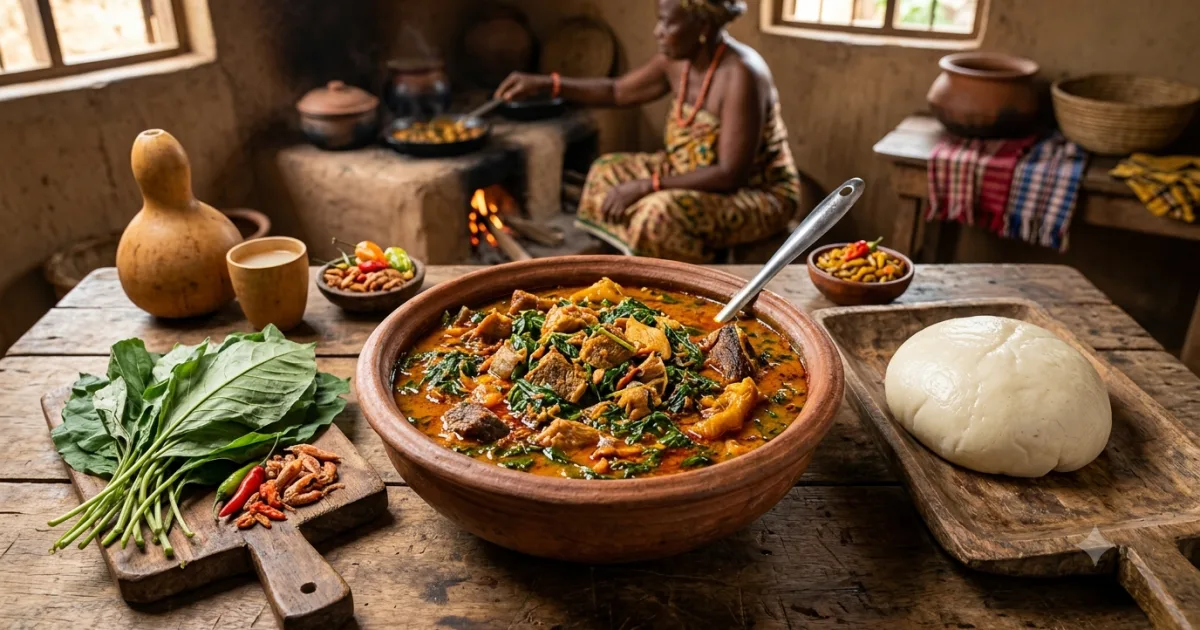
📌 Quick Summary: Oha soup (ora soup) is a traditional Igbo soup from southeastern Nigeria made from oha (ora) leaves (Pterocarpus mildbraedii), cocoyam as thickener, palm oil, assorted meat, stockfish, dried fish, and crayfish. The oha leaves are added raw at the very end — they cook in just 2 to 3 minutes in the hot soup. A pot serving 8 uses 2 handfuls of fresh oha leaves, 6 to 8 medium cocoyam corms as thickener, and ¼ cup of palm oil. Total cooking time: approximately 50 to 60 minutes. This complete guide covers the full recipe, the cocoyam thickening method, the difference between oha and uziza, what to eat oha soup with, and how to make it if you cannot find fresh oha leaves.
Oha soup holds a place of deep cultural significance in Igbo cooking — it is the soup served at major Igbo celebrations, at traditional marriage ceremonies, at titled-men’s gatherings, and as a mark of respect and welcome to honoured guests. Its name comes from the oha tree (Pterocarpus mildbraedii) whose tender leaves are the defining ingredient — leaves that cannot be substituted without producing a fundamentally different soup. The combination of the slightly bitter, delicate oha leaf with the richness of palm oil, the depth of cocoyam-thickened broth, and the layered umami of assorted meat, stockfish, dried fish, and crayfish produces a soup of exceptional complexity. Oha soup is, alongside egusi and bitterleaf soup, one of the pillars of Igbo culinary tradition.
Key Ingredients Explained
Oha (Ora) Leaves
Oha leaves come from the Pterocarpus mildbraedii tree — a large forest tree that grows across southeastern Nigeria and parts of Cameroon. The young, tender leaves are harvested and used fresh — they are not dried, not pounded, and not cooked for long. The leaves have a characteristic slightly bitter, slightly tannic flavour that distinguishes oha soup from every other Nigerian soup. They must be added at the very end of cooking and require only 2 to 3 minutes in the hot soup — over-cooking oha leaves produces a bitter, dark, unpleasant result. In southeastern Nigeria, fresh oha leaves are available in markets from October through February when the trees are in flush growth. During off-season periods, frozen oha leaves are available at some markets and from diaspora-focused African food stores internationally.
Cocoyam as Thickener
Unlike egusi soup (which is thickened by the ground melon seeds) or ogbono soup (thickened by the ground ogbono seeds), oha soup is thickened with boiled and pounded cocoyam — the small, round, fibrous corm variety, not the large ede cocoyam. Cocoyam is boiled until very soft, pounded or blended into a smooth paste, then added to the hot palm oil and broth base where it dissolves and thickens the soup to the characteristic consistency of oha soup — thick enough to coat a spoon heavily but not as thick as egusi. Alternatively, achi (Brachystegia eurycoma seed) — ground into powder and dissolved in a small amount of water — can be used as a faster substitute for the cocoyam thickener, particularly during the dry season when fresh cocoyam is less available.
Ingredients — Serves 8 to 10
| Ingredient | Quantity | Notes |
| Fresh oha (ora) leaves | 2 large handfuls (approximately 100 to 150g stripped) | Strip leaves from stems — only tender leaves. Do not wash after stripping — just before use rinse gently and tear into medium pieces. Do NOT shred finely — oha leaves should be visible as distinct leaf pieces in the finished soup. |
| Cocoyam corms (small variety) | 6 to 8 medium | Or 3 tablespoons of achi powder dissolved in ¼ cup water as substitute |
| Palm oil | ¼ cup (60ml) | Quality red palm oil — the flavour is foundational |
| Assorted meat (beef, goat, pomo, shaki) | 700g | Seasoned and boiled until tender |
| Stockfish | 200g, soaked overnight | The stockfish is essential — it provides the depth that makes oha soup more than the sum of its parts |
| Dried fish (panla or eja sawa) | 2 to 3 pieces | Cleaned and picked apart into large flakes |
| Ground crayfish | 3 tablespoons | Be generous — crayfish is critical in oha soup |
| Uziza leaves (optional) | Small handful | Some Igbo cooks add a few uziza leaves alongside the oha — the peppery uziza complements the bitter oha. Optional but authentic in many southeastern preparations. |
| Scotch bonnet pepper | 2 to 3, blended | |
| Seasoning cubes | 2 | |
| Salt | To taste | |
| Water or meat stock | 3 to 4 cups |
Step-by-Step Recipe
Step 1: Boil and Pound the Cocoyam
Peel the cocoyam corms and cut into quarters. Boil in water for 25 to 35 minutes until completely soft — easily pierced with a fork with no resistance. Drain and allow to cool slightly. Pound in a mortar until completely smooth with no lumps, or blend with a very small amount of water. The pounded cocoyam should form a smooth, cohesive paste. Set aside.
Step 2: Cook the Meat and Make the Stock
Season assorted meat with onion, seasoning cubes, and salt. Add soaked stockfish. Boil until meat is tender — 30 to 45 minutes. Remove the meat and stockfish. Reserve all cooking stock — this is the liquid base of the soup.
Step 3: Build the Soup Base
Pour the meat stock into a wide pot. Add the palm oil, blended scotch bonnet pepper, and crayfish. Stir to combine. Bring to a boil over medium heat and cook for 5 minutes. Add the cooked assorted meat, stockfish (broken into pieces), and dried fish flakes. Stir well. Season with crumbled seasoning cubes and salt.
Step 4: Add the Cocoyam Thickener
Add the pounded cocoyam paste to the boiling soup in small lumps — drop in 4 to 5 pieces at a time, spacing them around the pot. Do not stir immediately. Allow the cocoyam to soften further in the hot soup for 3 to 4 minutes, then stir vigorously to dissolve it into the soup. The soup will thicken noticeably. If using achi instead of cocoyam: dissolve the achi powder in ¼ cup of cold water until smooth, then pour into the boiling soup while stirring continuously. The soup will thicken within 2 to 3 minutes. Adjust the soup consistency by adding more stock if too thick, or cooking further if too thin.
Step 5: Add the Oha Leaves — The Final and Most Critical Step
This is the step that determines the quality of your oha soup. The oha leaves must be added last, into a fully seasoned and properly thickened soup, and cooked for only 2 to 3 minutes. Over-cooking oha leaves is the most common mistake — the leaves turn dark, become bitter, and lose the delicate character that makes oha soup special. Rinse the oha leaves gently. Tear each leaf into 3 to 4 pieces with your hands — do not use a knife, which bruises the leaves and accelerates bitterness. Add the torn oha leaves to the hot soup. Stir gently to submerge. Cover and cook for exactly 2 minutes. Taste — the leaves should be wilted but still vibrant, with their characteristic slight bitterness present but not overwhelming. Add uziza leaves if using (same timing — 2 minutes maximum). Remove from heat immediately.
Step 6: Serve
Oha soup is traditionally served with pounded yam — the combination is one of Igbo cuisine’s most celebrated pairings. Fufu, eba, and semovita are also excellent partners. Serve immediately — like most Nigerian soups with delicate leaf vegetables, oha soup is best eaten fresh.
Oha Soup vs Bitterleaf Soup: The Key Differences
| Feature | Oha Soup | Bitterleaf Soup (Ofe Onugbu) |
| Primary leaf | Oha (ora) leaves — Pterocarpus mildbraedii | Bitterleaf — Vernonia amygdalina (washed to reduce bitterness) |
| Leaf preparation | Raw, torn leaves added at the end — 2 to 3 minutes cooking | Washed repeatedly then added — 5 to 10 minutes cooking |
| Bitterness level | Mild, delicate bitterness | More pronounced bitterness — reduced but present by design |
| Thickener | Cocoyam or achi | Cocoyam or achi (same) |
| Cultural significance | Considered more prestigious — served at celebrations | Everyday and celebration soup — very widely eaten |
| Availability | Seasonal — peak October to February in southeastern Nigeria | Year-round — dried bitterleaf available when fresh is not |
Making Oha Soup Without Fresh Oha Leaves
Fresh oha leaves are primarily available in southeastern Nigerian markets (Enugu, Owerri, Onitsha, Umuahia, Aba, Abakaliki) and in Lagos markets with significant Igbo trade presence (Ladipo, Mushin). Outside these areas — and for diaspora Nigerians — frozen oha leaves are available at African food stores in the UK, USA, and Canada. Frozen oha leaves produce acceptable results when fresh are unavailable: thaw completely, pat gently dry, and use exactly as you would fresh leaves. The flavour is slightly less vibrant than fresh but the essential character of the soup is preserved. Dried oha leaves are also available in some markets — use approximately one-third of the quantity of fresh and rehydrate in warm water for 10 minutes before adding to the soup.
Common Mistakes
1. Over-Cooking the Oha Leaves
Two minutes only. The leaves go in last, into a fully finished soup, and come out of heat after two minutes. Every additional minute of cooking after that point increases bitterness and destroys the delicate leaf character that defines the soup.
2. Shredding the Oha Leaves with a Knife
Always tear oha leaves by hand. Knife-cut edges bruise the leaf cells and release bitter compounds more rapidly during cooking. Hand-torn pieces remain more intact and produce a better-tasting finished soup.
3. Under-Thickening the Base Before Adding Leaves
The soup must be fully thickened, seasoned, and at the right consistency before the oha leaves are added. Adding the leaves to a thin, under-developed base and cooking longer to thicken it will over-cook the leaves. Finish the soup completely, then add the leaves as the final step.
Frequently Asked Questions
What is oha soup made of?
Oha leaves (from the Pterocarpus mildbraedii tree), cocoyam or achi as thickener, palm oil, assorted meat, stockfish, dried fish, ground crayfish, scotch bonnet pepper, and seasoning. Optionally uziza leaves. The oha leaves are the defining ingredient — no other leaf produces the same soup.
How do you cook oha leaves without them becoming bitter?
Add torn oha leaves only at the very end of cooking, into a fully finished soup, and cook for exactly 2 to 3 minutes. Remove from heat immediately. Over-cooking — more than 3 minutes — is the primary cause of excessive bitterness in oha soup.
Can I use achi instead of cocoyam in oha soup?
Yes — achi (ground Brachystegia eurycoma seed) is a common and acceptable substitute for the cocoyam thickener. Dissolve 3 tablespoons of achi powder in ¼ cup of cold water until smooth, then stir into the boiling soup. Achi thickens faster than cocoyam and is more widely available during dry season when fresh cocoyam is scarce.
What swallow goes best with oha soup?
Pounded yam is the traditional and most celebrated pairing for oha soup — the smooth, elastic texture of pounded yam complements the richly thickened, leaf-studded soup perfectly. Fufu, eba, and semovita are also excellent accompaniments.
Sources
- Original recipe — NaijaSabi Lifestyle Desk, September 2026
- Igbo culinary tradition — oha soup preparation documented across southeastern Nigerian cooking practices
Last updated: 20 September 2026 · NaijaSabi Lifestyle Desk.
Oha Soup Across the Igbo Diaspora
For Igbo Nigerians living outside southeastern Nigeria — in Lagos, Abuja, Port Harcourt, or abroad — oha soup is one of the foods most strongly associated with home. The oha tree does not grow outside its native West African range, and fresh oha leaves are not something you find at a supermarket in London, Houston, or Toronto. The search for oha leaves by Igbo diaspora Nigerians drives consistent online traffic to any resource that explains where to find them, how to use frozen or dried alternatives, and how to make the soup correctly when you have not made it since leaving home. For this reason, oha soup content performs consistently well for Nigerian food publishers targeting both domestic and diaspora audiences — the search intent is immediate, specific, and action-oriented. In Nigeria’s major cities, fresh oha leaves are reliably available at markets in Igbo-dominated areas: in Lagos, Ladipo market in Mushin and parts of Mile 12 carry fresh oha seasonally; in Abuja, Karu market and Wuse Market vendors serving the eastern Nigerian community typically stock fresh oha between October and February. For the Igbo home cook in a Yoruba or northern city who cannot find fresh oha: frozen oha leaves from African food import stores, combined with the cocoyam thickening technique and the full protein base described in this recipe, produce a soup that is genuinely close to the best fresh-leaf version — close enough to satisfy the specific homesickness that oha soup addresses.




0 Comments
No comments yet. Be the first to share your thoughts!