




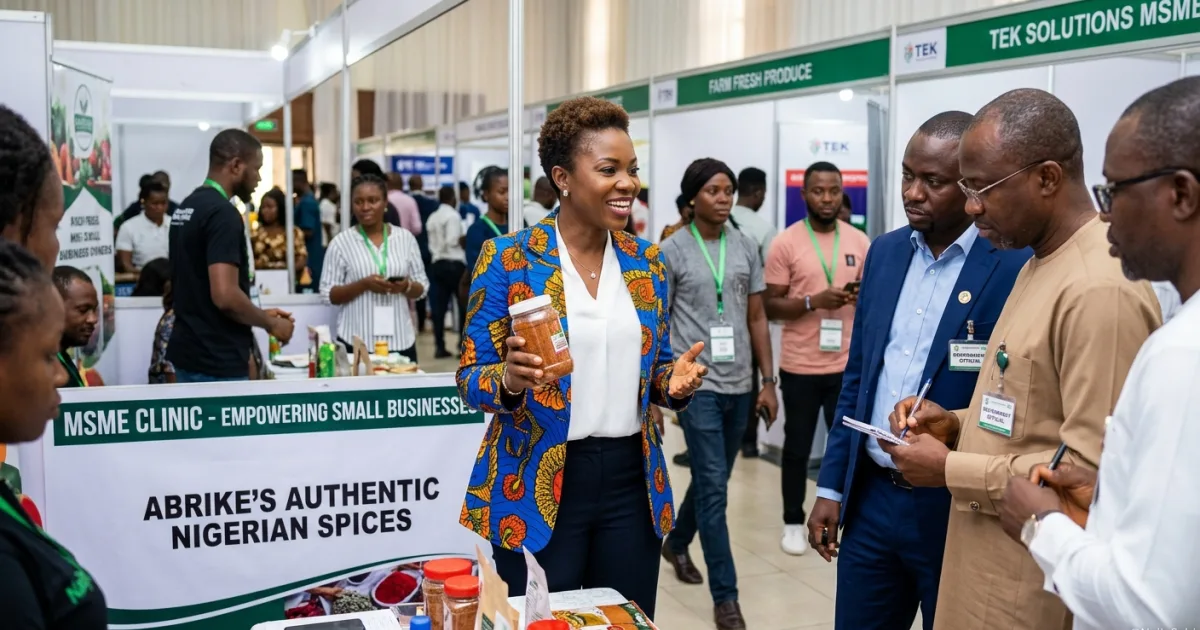
📌 Quick Summary: The Nigerian Federal Government has made billions of naira available for small businesses in 2026 through multiple active programmes — and most Nigerian entrepreneurs have no idea these funds exist or how to access them. Key programmes include the ₦200 billion MSME Support Fund (via the Bank of Industry), the Presidential Conditional Grant Scheme (₦250,000 unconditional grants for outstanding MSMEs at MSME Clinics), the Tony Elumelu Foundation ₦6 million TEF Programme, and free CAC business name registration for 250,000 MSMEs. This NaijaSabi guide covers every active grant and funding programme available to Nigerian small businesses in 2026, who qualifies, how to apply, and what the money can and cannot be used for.
Let us start with an inconvenient truth: most Nigerian small business owners who complain about lack of funding have never applied for a single grant or government funding programme. The applications are not easy — they require documentation, patience and follow-through. Some programmes are more accessible than others. Some require a registered business, some do not. But the money is real, the programmes are active, and Nigerians who understand how to navigate them are accessing tens of millions of naira that their peers are leaving on the table. This NaijaSabi guide maps every significant grant, fund and free support programme available to Nigerian small businesses in 2026, and tells you exactly how to pursue each one.
| Programme | Amount | Type | Who Manages It |
| Presidential Conditional Grant Scheme | ₦250,000 per MSME | Free grant — no repayment | Federal Ministry of Industry, Trade & Investment / BOI |
| FGN MSME Intervention Fund | Part of ₦200bn pool | Low-interest loan / grant blend | Bank of Industry (BOI) |
| FGN Manufacturing Sector Fund | Part of ₦200bn pool | Low-interest loan | Bank of Industry (BOI) |
| Tony Elumelu Foundation (TEF) Programme | $5,000 (~₦8m) + mentorship | Grant + training | Tony Elumelu Foundation — private |
| SMEDAN / YouWiN Connect | Varies | Grant + business training | SMEDAN |
| Free CAC Business Name Registration | ₦0 (registration fee waived) | Free service | CAC + SMEDAN partnership |
| BOI Youth Entrepreneurship Support (YES) Programme | Up to ₦5 million | Single-digit interest loan | Bank of Industry (BOI) |
| N-Power Business (NPower) | Monthly stipend + training | Employment/enterprise scheme | Federal Ministry of Humanitarian Affairs |
1. The Presidential Conditional Grant Scheme — ₦250,000 Free Money for MSMEs
The Presidential Conditional Grant Scheme is the most direct free-money programme currently available to Nigerian small business owners in 2026. Under this scheme, Vice President Kashim Shettima has announced ₦250,000 unconditional grants for outstanding exhibiting MSMEs at every Expanded National MSME Clinic — events organised by the Federal Ministry of Industry, Trade and Investment and held across all 36 states and the FCT.
What is the MSME Clinic? The Expanded National MSME Clinics are free government events where small businesses can register, exhibit their products and services, access regulatory services (CAC registration, NAFDAC, SON, etc.) at reduced or zero cost, connect with financial institutions and apply for grants. As of September 2026, the programme has completed 9 clinics across states including Ondo, Katsina and others. More clinics are scheduled across remaining states.
How to access the ₦250,000 grant:
- Monitor the Federal Ministry of Industry, Trade and Investment social media pages (@FMITINigeria on Twitter/X) and the SMEDAN website (smedan.gov.ng) for announcements of upcoming MSME Clinics in your state
- Register your business with SMEDAN — registration is free at smedan.gov.ng. A SMEDAN registration number strengthens your application profile and is increasingly required for federal funding access
- Attend the MSME Clinic in your state and exhibit your product or service. The ₦250,000 grants are awarded to outstanding exhibiting MSMEs identified during the clinic — so the quality of your presentation and your business’s credibility matter
- Ensure your business is CAC-registered — while some grants have been disbursed to unregistered businesses at clinics, CAC registration significantly improves your chances and is increasingly becoming a baseline requirement
Important note: VP Shettima described this as “not a loan — it is a gift.” It requires no repayment. However, the criteria for selection as an “outstanding MSME” at each clinic are not fully published in advance — your business presentation, story, and documentation quality all matter at the selection stage.
2. The ₦200 Billion MSME Support Fund — Three Programmes via BOI
The Federal Government earmarked ₦200 billion for MSME support under three distinct funds, all managed by the Bank of Industry (BOI). These are the largest government-backed funding programmes available to Nigerian small businesses in 2026:
Presidential Conditional Grant Scheme (PCGS) — Grant Component
Part of the ₦200 billion allocation is specifically designated as grants (not loans) for micro enterprises — the smallest category of businesses. This targets businesses with fewer than 10 employees and annual turnover below ₦25 million. The grant component is disbursed primarily through MSME Clinics and BOI-approved channels.
FGN MSME Intervention Fund — Small and Medium Businesses
A blended finance facility offering single-digit interest loans — significantly below commercial bank rates — to registered Nigerian small and medium businesses. Targeted at businesses with 10–200 employees. Access is through BOI directly at boi.ng or through participating microfinance banks and development finance institutions across Nigeria.
FGN Manufacturing Sector Fund
Specifically for Nigerian manufacturers — businesses that produce physical goods (food processing, textiles, furniture, building materials, agro-processing, pharmaceuticals). Provides low-interest financing for equipment purchase, factory expansion and raw material procurement. Manufacturing businesses in Nigeria have consistently underutilised this facility — the application volume is lower than for the general MSME fund, making access relatively easier for qualified manufacturers.
How to apply for BOI MSME funding:
- Visit boi.ng and create an account on the BOI customer portal
- Complete the MSME loan/grant application form — you will need your CAC registration certificate, BVN, SMEDAN registration number, business plan or financial projections, bank statements (6–12 months), and details of your business operations
- Alternatively, visit the nearest BOI branch in your state — BOI has offices in Lagos, Abuja, Port Harcourt, Kano, Enugu, Ibadan and all 36 states
- Select the appropriate product: grant (micro enterprises) or loan (small/medium businesses)
- Submit your application and await BOI’s assessment process
Practical reality check: BOI funding is significantly more accessible than commercial bank loans — the interest rates are lower, collateral requirements are more flexible, and the institution’s mandate is specifically to support Nigerian businesses. However, the application process requires documentation and patience. Undocumented businesses, businesses without CAC registration and businesses without clear financial records face significant challenges at assessment. Use the period before applying to get your documentation in order.
3. Tony Elumelu Foundation TEF Programme — $5,000 Grant for African Entrepreneurs
The Tony Elumelu Foundation (TEF) Entrepreneurship Programme is the most prestigious and most competitive grant programme available to Nigerian entrepreneurs. Each year, TEF selects 1,000 African entrepreneurs (Nigerians are the largest national group accepted) and provides each with:
- $5,000 in seed capital (approximately ₦8 million at current rates) — paid in two tranches, non-repayable
- 12-week online business training covering entrepreneurship fundamentals, financial management and business planning
- One-on-one mentorship from a TEF-assigned business mentor
- Lifetime access to the TEF Entrepreneurship Forum — a network of 20,000+ African entrepreneurs
TEF eligibility requirements:
- African citizen (Nigerian citizens qualify)
- Business must be less than 3 years old OR a business idea that has not yet launched
- Must not have previously received a TEF grant
- Business must be based and operating in Africa
TEF application timeline: Applications open once per year — typically in January, closing in March. For the 2027 TEF cycle, applications are expected to open January 2027. The 2026 cycle has already closed. Monitor tefelumelu.org and TEF’s social media from December 2026 for the 2027 application opening announcement.
What makes a winning TEF application: TEF receives hundreds of thousands of applications — the selection rate is under 1%. Strong applications share three characteristics: a clearly articulated problem the business solves in the African context, a realistic financial model with clear revenue streams, and evidence (even if early) of market validation — real customers, sales, or letters of intent. Generic business ideas without Nigerian market specificity rarely advance past the first screening.
4. Free CAC Business Name Registration for 250,000 MSMEs
This is one of the most overlooked but most practically useful programmes available to unregistered Nigerian small businesses in 2026. The Federal Government, through a CAC-SMEDAN partnership, has launched a programme to provide free business name registration for 250,000 Nigerian MSMEs under the Renewed Hope Agenda.
Why CAC registration matters: A CAC-registered business name is the foundation for accessing almost every other grant and funding programme listed in this article. BOI requires it. TEF requires a formal business structure. Bank accounts in your business name require it. Government contracts require it. Most Nigerian MSME funding programmes require CAC registration as a baseline. Getting your business registered for free through this programme removes the ₦10,000–₦25,000 cost barrier that has kept many Nigerian entrepreneurs informal.
How to access free CAC registration under this programme:
- Visit the CAC portal at cac.gov.ng or the SMEDAN portal at smedan.gov.ng for programme details and eligibility
- Register your business as a Business Name (the simplest and cheapest category for sole traders and small partnerships)
- Under this programme, the standard ₦10,000–₦25,000 CAC registration fee is waived for qualifying MSMEs
- Attend an MSME Clinic in your state — CAC registration services are available at reduced or zero cost at every clinic
5. BOI Youth Entrepreneurship Support (YES) Programme
The BOI YES Programme specifically targets young Nigerian entrepreneurs — typically aged 18–35 — who need funding to start or scale a business. It offers loans of up to ₦5 million at single-digit interest rates, significantly below commercial bank rates of 20–30%.
YES Programme requirements:
- Nigerian citizen aged 18–35
- CAC-registered business or willingness to register
- Viable business plan demonstrating repayment capacity
- Guarantor or minimal collateral (BOI’s collateral requirements are more flexible than commercial banks)
- SMEDAN registration recommended
Apply directly at boi.ng or visit the nearest BOI office. The YES Programme has supported thousands of young Nigerian entrepreneurs in sectors including agribusiness, technology, creative industries, hospitality and trade.
6. SMEDAN Support Programmes
The Small and Medium Enterprises Development Agency of Nigeria (SMEDAN) is the federal government body specifically mandated to develop and support Nigerian MSMEs. In addition to managing the MSME Clinic programme, SMEDAN offers:
- Free MSME registration — a SMEDAN registration number is increasingly required for government funding access. Register free at smedan.gov.ng
- Business development services — free business plan templates, market research, and capacity building workshops across Nigeria
- YouWiN Connect — a business plan competition and grant programme for young Nigerian entrepreneurs. When active (the scheme has run in multiple cycles), winners receive grants of ₦1–10 million alongside business training. Monitor smedan.gov.ng for the next cycle announcement
- Linkage to financial institutions — SMEDAN actively connects registered MSMEs to participating banks and microfinance institutions offering preferential rates
7. Other Active Grants and Funding Sources for Nigerian Small Businesses
- NEXIM Bank (Nigerian Export-Import Bank): If your business exports or produces for export — agricultural products, manufactured goods, creative content, software — NEXIM offers concessionary financing specifically for Nigerian exporters. Apply at nexim.gov.ng
- NIRSAL Microfinance Bank AGSMEIS: The Agri-Business, Small and Medium Enterprise Investment Scheme (AGSMEIS) provides loans at 5% per annum (far below market rates) to Nigerian businesses in agriculture, manufacturing, and related sectors. Apply through NIRSAL MFB at nirsal.com
- CBN Intervention Funds (various): The Central Bank of Nigeria periodically releases sector-specific intervention funds — for agriculture, creative industries, healthcare and manufacturing. Most are disbursed through participating commercial banks. Ask your bank’s SME desk about currently available CBN intervention fund facilities
- Lagos State Employment Trust Fund (LSETF): For Lagos-based businesses specifically — the LSETF offers loans at 5% per annum for Lagos entrepreneurs. Apply at lsetf.ng. Similar state-level funds exist in Rivers, Ogun, Oyo and other states — check your state government’s website for current schemes
- Development Bank of Nigeria (DBN): Provides wholesale funding to participating microfinance banks and finance institutions which on-lend to MSMEs at below-market rates. Access through DBN’s participating financial institutions listed at devbankng.com
How to Make Your Application Stand Out
The Nigerian entrepreneurs who successfully access grants and government funding share several practices that unsuccessful applicants often skip:
- Get properly documented before applying. CAC registration, SMEDAN number, TIN, and clean bank statements (at least 6 months showing business transactions) are the foundation. Applications with incomplete documentation are rejected at the first stage regardless of how good the business idea is
- Write a clear, specific business plan. “I want to sell clothes” is not a business plan. “I manufacture Ankara fashion wear for women aged 25–40 in Lagos, I currently sell 50 pieces per month through Instagram and Jumia at ₦15,000 average price, and I need ₦2 million to purchase a cutting machine and 3 industrial sewing machines to triple production” is the beginning of a fundable plan. Be specific — about your product, your customer, your numbers and what you will use the money for
- Apply to multiple programmes simultaneously. You are not disqualified from applying to BOI because you applied to TEF. Apply broadly and let the results determine which comes through first
- Attend MSME Clinics in your state. These events are where multiple funding agencies are physically present in one location — CAC, NAFDAC, SON, BOI, NIRSAL, commercial banks. One day at an MSME Clinic can accomplish what months of individual applications cannot. Register on smedan.gov.ng and monitor announcements for your state’s clinic date
- Be persistent. BOI loan applications take time. TEF selection takes months. MSME Clinic grants are awarded to a small number of exhibitors. Rejection or delay on one application does not mean your business is unfundable — it means you need to reapply, improve your documentation, and try a different programme
Frequently Asked Questions — Government Grants Nigeria 2026
What government grants are available for small businesses in Nigeria in 2026?
The main government grants available for Nigerian small businesses in 2026 include: the Presidential Conditional Grant Scheme (₦250,000 unconditional grants for outstanding MSMEs at MSME Clinics — no repayment required), the ₦200 billion MSME Support Fund managed by the Bank of Industry covering the Presidential Conditional Grant, the FGN MSME Intervention Fund and the FGN Manufacturing Sector Fund, and the BOI Youth Entrepreneurship Support Programme (loans up to ₦5 million at single-digit rates for entrepreneurs aged 18–35). Free business name registration under the CAC-SMEDAN partnership is also available for 250,000 qualifying MSMEs. The Tony Elumelu Foundation TEF Programme ($5,000 non-repayable grant) is a private-sector programme that runs annually.
How do I apply for the ₦250,000 MSME grant in Nigeria?
The ₦250,000 Presidential Conditional Grant is awarded to outstanding exhibiting MSMEs at the Expanded National MSME Clinics organised by the Federal Ministry of Industry, Trade and Investment across all 36 states. To access it: register your business with SMEDAN at smedan.gov.ng (free), monitor Federal Ministry of Industry, Trade and Investment (@FMITINigeria) and SMEDAN social media for MSME Clinic announcements in your state, attend and exhibit your business at the clinic, and ensure you have CAC registration and complete documentation. Grants are selected by government evaluators at each clinic — business presentation quality and documentation matter.
Does a small business need to be CAC-registered to get grants in Nigeria?
CAC registration is not an absolute requirement for every Nigerian grant programme — the ₦250,000 MSME Clinic grants have been awarded to some unregistered businesses. However, CAC registration is required or strongly preferred for BOI loans, NIRSAL AGSMEIS, NEXIM financing, DBN-linked funding, and most formal government programmes. More importantly, CAC registration opens a business bank account, builds credibility with partners and customers, and is an increasingly non-negotiable requirement as grant programmes mature. The free CAC business name registration programme (through CAC-SMEDAN partnership) removes the cost barrier — get registered now, before applying for funding.
Is the Tony Elumelu Foundation grant real and legitimate?
Yes — the Tony Elumelu Foundation (TEF) Entrepreneurship Programme is one of Africa’s most respected private-sector entrepreneurship initiatives. It is founded and funded by Tony Elumelu, the Nigerian billionaire founder of Heirs Holdings and chairman of UBA Group. Since 2015, TEF has funded over 20,000 African entrepreneurs with $5,000 grants each plus training and mentorship — a total commitment of over $100 million. Applications open once per year at tefelumelu.org (typically January–March). Beware of scams: TEF never charges application fees and never asks for money to “process” your grant. The only legitimate application channel is tefelumelu.org.
What is the Bank of Industry (BOI) and how does it help small businesses in Nigeria?
The Bank of Industry (BOI) is Nigeria’s oldest and largest development finance institution, established to provide long-term financing to Nigerian businesses at below-market rates. BOI manages the ₦200 billion federal MSME Support Fund and runs multiple lending programmes for micro, small, medium and large Nigerian businesses. BOI loans have interest rates of 5–15% per annum — significantly below the 20–30%+ charged by commercial banks. BOI has offices in all 36 states and the FCT. Apply online at boi.ng or visit the nearest BOI office. BOI is not a commercial bank and does not operate customer savings accounts — it is a wholesale and direct lender to businesses only.
Sources
- Voice of Nigeria — Nigeria Government Gives ₦250,000 Each to Small Businesses, Ondo State MSME Clinic — von.gov.ng
- Voice of Nigeria — VP Shettima launches 9th Expanded National MSME Clinic, Katsina — von.gov.ng
- DHL Discover Nigeria — Your Roadmap to Nigeria’s ₦200 Billion MSME Support Fund — dhl.com/discover/en-ng
- MSME Africa Online — Free CAC Business Name Registration for 250,000 MSMEs under FG-CAC-SMEDAN Programme — msmeafricaonline.com
- Tony Elumelu Foundation — TEF Entrepreneurship Programme official site — tefelumelu.org
- Bank of Industry Nigeria — BOI official portal — boi.ng
Last updated: 20 September 2026 · NaijaSabi Business Desk. Grant programme details, amounts and application windows change frequently. Always confirm current availability, eligibility requirements and application deadlines directly with the relevant agency — SMEDAN (smedan.gov.ng), BOI (boi.ng), CAC (cac.gov.ng) and TEF (tefelumelu.org) — before applying.


0 Comments
No comments yet. Be the first to share your thoughts!