




📌 Quick Summary: A photography business in Nigeria requires startup capital of ₦300,000 to ₦1,500,000 for a camera body, lenses, lighting, and editing software. Photography rates in Nigeria 2026: ₦50,000 to ₦500,000 per wedding (full day coverage); ₦30,000 to ₦150,000 per event (owambe/birthday party); ₦20,000 to ₦80,000 per product/commercial shoot; ₦15,000 to ₦50,000 per portrait session. A photographer shooting 4 to 6 events per month earns ₦200,000 to ₦1,500,000 monthly. The most profitable Nigerian photography niches are weddings, commercial/product photography, and corporate headshots. This guide covers starter equipment, building a portfolio, pricing, finding clients, and how to build a sustainable photography business.
Photography is one of Nigeria’s most consistently in-demand creative professions — driven by the Nigerian celebration culture that surrounds weddings, naming ceremonies, birthdays, graduations, and the owambe social events that fill Nigerian calendars year-round. Every significant event in a Nigerian life is documented, every business needs product and brand imagery, and the rise of social media has made professional-quality photography a near-essential business tool for any Nigerian brand seeking visibility. The photographer who masters their craft, builds a strong portfolio, and positions themselves in the right market segment can build a highly profitable solo business or agency from a single camera body and a set of lenses.
The Nigerian Photography Market: Four Profitable Segments
1. Wedding and Event Photography
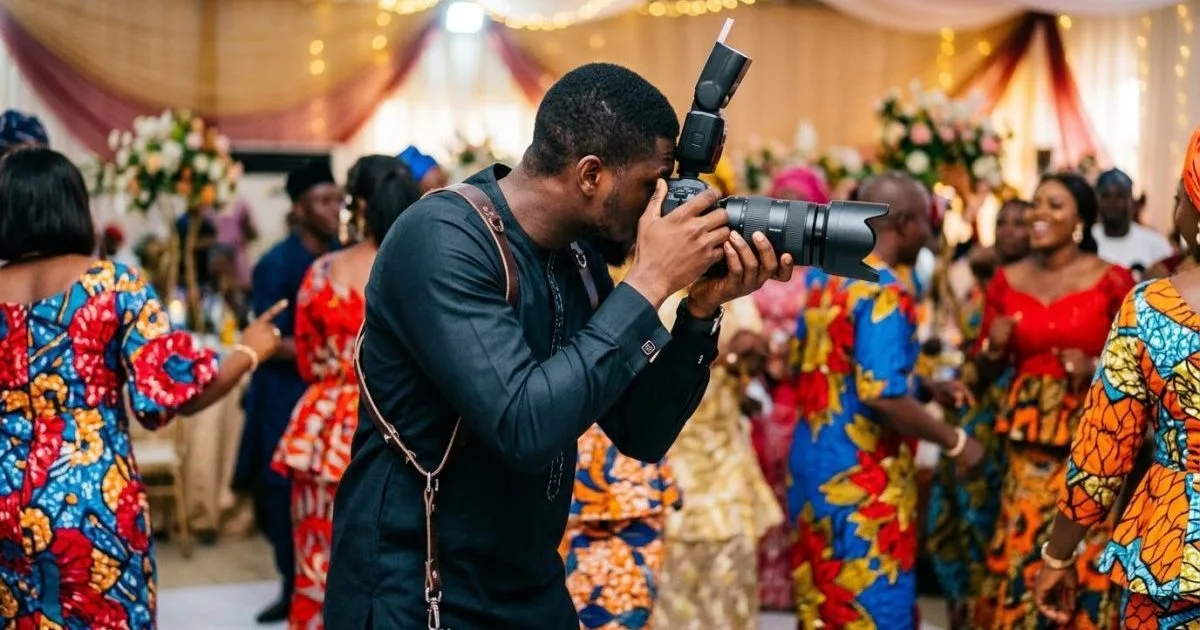
The largest and most financially rewarding segment for most Nigerian photographers. Nigerian weddings are multi-day, multi-event affairs — introduction ceremony, traditional wedding, white wedding, and reception — each requiring separate photography coverage. A photographer covering a full Nigerian wedding weekend charges ₦100,000 to ₦500,000 for complete coverage, depending on their experience, reputation, and the wedding’s budget tier. The owambe circuit — birthday parties, naming ceremonies, burial celebrations, and graduation parties — provides consistent weekly work at ₦30,000 to ₦150,000 per event. October through February is Nigeria’s peak wedding and celebration season — an established event photographer can be booked every weekend through this period.
2. Commercial and Product Photography
The most consistent income stream for photographers who prefer studio work to event coverage. Nigerian businesses — particularly those selling on Instagram, Jumia, and Konga — need high-quality product photography for their listings. A product photography session (shooting 20 to 30 product images for an e-commerce or social media brand) charges ₦20,000 to ₦80,000 per session. Corporate clients — banks, telecoms, FMCG brands, and government agencies — commission commercial photography for advertising campaigns, annual reports, and marketing materials at ₦100,000 to ₦500,000+ per project. This segment requires less social skills than event photography but demands technical precision and an understanding of commercial brief requirements.
3. Portrait and Personal Branding Photography
The fastest-growing photography segment in Nigeria in 2026 — driven by LinkedIn profile optimisation, personal brand building for entrepreneurs, and the general Nigerian awareness that professional headshots matter. A portrait session charges ₦15,000 to ₦50,000 for 1 to 2 hours of shooting with 10 to 20 edited images delivered. Corporate headshot packages (shooting an entire office team in one session) charge ₦50,000 to ₦200,000 for a full company session. The appeal of this segment for new photographers: it can be done in a simple home studio setup with a plain backdrop, requires no movement equipment, and can be scheduled flexibly on weekdays when event photographers have no bookings.
4. Real Estate Photography
A rapidly growing niche driven by Nigeria’s expanding real estate market, the growth of shortlet apartments, and the recognition by estate agents and developers that professional photography dramatically increases property enquiries and listing performance. Real estate photography rates: ₦15,000 to ₦60,000 per property. A photographer shooting 5 properties per week earns ₦75,000 to ₦300,000 weekly from real estate alone — and the demand is consistent year-round, unlike the seasonal peaks and troughs of event photography.
Starter Equipment List
| Item | Recommended Starter Option | Cost (2026) |
| Camera body (mirrorless or DSLR) | Sony A7 III, Canon R6, Nikon Z5 — full-frame mirrorless. Or Canon 90D, Nikon D7500 — APS-C DSLR for lower budget start. | ₦350,000 – ₦900,000 new; ₦180,000 – ₦500,000 used |
| Standard zoom lens (24-70mm f/2.8 or 24-105mm f/4) | The single most versatile lens for events and portraits | ₦150,000 – ₦500,000 |
| 50mm f/1.8 prime lens | Excellent portrait and low-light lens at low cost | ₦30,000 – ₦80,000 |
| External flash (speedlite) | Canon 600EX or Godox V860III — essential for indoor event photography in Nigeria’s often poorly lit venues | ₦40,000 – ₦120,000 |
| 2 to 3 extra batteries and dual charger | Nigerian events run long — you cannot risk running out of battery at the cutting of the cake | ₦15,000 – ₦40,000 |
| Memory cards (2 × 128GB, minimum) | High-speed cards (V60 or V90 rated) for fast burst shooting | ₦15,000 – ₦40,000 |
| Camera bag | Professional-looking, secure, padded | ₦10,000 – ₦30,000 |
| Laptop for editing | 16GB RAM minimum for Lightroom/Photoshop performance | ₦250,000 – ₦700,000 |
| Adobe Creative Cloud subscription (Lightroom + Photoshop) | ₦6,000 – ₦10,000/month | ₦72,000 – ₦120,000/year |
| Portable studio backdrop and stand (for portraits) | Grey or white seamless paper or fabric backdrop | ₦15,000 – ₦40,000 |
| Minimum viable event photography kit | ₦400,000 – ₦900,000 |
Building Your Portfolio Without Paid Clients
The portfolio problem every new photographer faces: clients want to see previous work before booking, but you have no previous work because you have no clients. Breaking this cycle requires deliberate portfolio-building before approaching paying clients. Five strategies that work in Nigeria. First: photograph family and friends’ events for free — a cousin’s birthday, a neighbour’s naming ceremony. You are not the hired photographer; you are a guest who happens to be shooting. The resulting images, edited well, are legitimate portfolio material. Second: offer 3 to 5 deeply discounted or free portrait sessions specifically to build your portrait portfolio — recruit interesting-looking friends, family members, or community members as subjects, shoot in interesting locations (Lekki waterfront, a colourful Lagos market, a Abuja park), and edit the results as if they were paying commissions. Third: approach small businesses and offer one free product shoot in exchange for permission to use the images in your portfolio. Fourth: shoot personal documentary projects — street photography in your city, a day in the life of a local market, the preparations for a Nigerian celebration — that demonstrate your eye and editing skill even without client work. Fifth: assisting an established photographer for free or at minimal pay for 3 to 5 events gives you real event shooting experience, portfolio images (with the lead photographer’s permission), and professional mentorship.
Pricing Your Photography Services
The correct pricing approach for Nigerian photographers: cost-plus pricing that accounts for all your actual costs, not competitor price-matching. Your costs per event: equipment depreciation (a ₦500,000 camera body amortised over 3 years of 100 events per year = ₦1,667 per event), editing time (4 to 8 hours at your hourly value), travel, any assistant costs, software subscriptions, and marketing costs. Add a profit margin of 50 to 100 percent above total cost. Many Nigerian photographers undercharge because they only think about their time on-site — forgetting that editing takes more time than shooting, equipment depreciates, and the visible parts of the job (showing up with a camera) represent only half the work. Price at a level that is sustainable — underpriced photography work burns out photographers and degrades the market for everyone.
Frequently Asked Questions
How much do photographers charge in Nigeria in 2026?
Wedding photography: ₦100,000 to ₦500,000 for full coverage. Owambe/birthday events: ₦30,000 to ₦150,000. Product/commercial: ₦20,000 to ₦80,000 per session. Portrait sessions: ₦15,000 to ₦50,000. Real estate: ₦15,000 to ₦60,000 per property.
What camera should I buy to start photography in Nigeria?
For events: Sony A7 III or Canon R6 (full-frame mirrorless) are the current professional standards. For a lower startup cost: Canon 90D or Nikon D7500 (APS-C DSLR) produce excellent results at significantly lower prices. A used full-frame body from a reputable dealer is often better value than a new APS-C camera for someone serious about photography as a profession.
Do I need a degree or certificate to be a professional photographer in Nigeria?
No formal qualification is required. Photography skill is demonstrated entirely through your portfolio — a photographer with a strong portfolio of real work will always be hired over someone with a certificate but weak images. Online courses (CreativeLive, Udemy, YouTube channels by Nigerian photographers), mentorship under established photographers, and deliberate practice are the skill development paths that work.
Photography as a Career: The Long Game in Nigeria
Photography in Nigeria rewards patience and deliberate skill development in a way that few creative businesses do. The photographer who tries to build a full-time income from photography in their first 6 months will struggle — the portfolio is not deep enough, the client referral network is not established, and the pricing confidence that comes from demonstrated value has not yet developed. The photographer who spends 12 to 18 months building skill, building portfolio, and building relationships while maintaining another income source will find that by month 18, the photography business is generating more consistent income than the other source — and that the transition to full-time photography, when it comes, comes from a position of established reputation rather than financial desperation. The Nigerian photography market is large enough and culturally rich enough — with its weddings, its celebrations, its vibrant commercial economy, its growing corporate sector — to support thousands of full-time professional photographers at good income levels. The constraint is not demand. The constraint is the quality and professionalism of the supply. Nigerian photography clients at every price point consistently report that finding a reliable, skilled, professional photographer who delivers edited images on time and communicates clearly throughout the process is harder than it should be. Be that photographer, and the market will find you.
Sources
- Original business guide — NaijaSabi Business Desk, September 2026
Last updated: 22 September 2026 · NaijaSabi Business Desk. Rates reflect Lagos and Abuja market pricing as at September 2026.
The Social Media Era: How Instagram Changed Nigerian Photography
Instagram transformed Nigerian photography in a way that is difficult to overstate. Before Instagram, a photographer’s reputation spread through word of mouth, printed portfolios, and physical gallery exhibitions — all slow, geographically limited channels. After Instagram, a photographer’s best work can be seen by 100,000 Nigerians within 48 hours of posting if the algorithm favours the content. This transformation cut both ways: it democratised discovery (a new photographer with exceptional work can build an audience faster than ever before) and it intensified competition (every aspiring photographer can now show their work to the same audience as established professionals). The Nigerian photographers who have built the most commercially successful businesses on Instagram in 2026 share several characteristics: they specialise clearly (wedding photographers who post only wedding work, product photographers who post only product work — not a mix of everything), they post consistently (3 to 5 times per week rather than sporadically), they engage authentically with their audience (responding to comments, asking questions, sharing behind-the-scenes content that shows personality alongside technical skill), and they use Instagram as a discovery channel that converts followers into enquiries and enquiries into bookings, rather than as a pure portfolio display. The photographer who treats Instagram as a business tool — tracking which posts generate enquiries, posting at optimal times for Nigerian audiences, using local hashtags and location tags strategically — will build a client pipeline that the photographer who treats it as a gallery never will.
Building a Photography Studio in Nigeria
As a photography business grows beyond event and location shooting, many Nigerian photographers invest in a studio space — a dedicated shooting environment with controlled lighting, backdrop options, and a professional setting for portrait, product, and corporate clients. Studio rental is the first step — renting a photography studio by the hour (₦5,000 to ₦20,000 per hour at established Lagos and Abuja studios) before investing in your own space. Once client demand justifies it, a home studio conversion (a spare bedroom or garage fitted with paper backdrops, studio strobes, and a softbox) costs ₦200,000 to ₦600,000 to set up and eliminates the studio rental cost entirely for shoots that can be done in a controlled environment. A commercial studio rental in a high-traffic area — available to other photographers by the hour when you are not using it — converts the studio investment into a revenue-generating asset rather than a pure overhead.




0 Comments
No comments yet. Be the first to share your thoughts!