




📌 Quick Summary: An ice block business in Nigeria requires startup capital of ₦500,000 to ₦3,000,000 for ice block making machines, a cold room or chest freezers, generator, and initial working capital. A standard ice block machine producing 50 to 100 blocks per day earns approximately ₦500 to ₦2,000 per block at wholesale, generating ₦25,000 to ₦200,000 daily gross revenue. The business runs 24 hours — machines freeze overnight, delivery happens in the morning. Primary customers: bars, restaurants, event caterers, fish sellers, hotels, and households. This guide covers machine types and costs, cold room vs chest freezer options, generator requirements, pricing, customer acquisition, and the most profitable Nigerian cities for ice block businesses.
The ice block business is one of Nigeria’s most structurally sound small businesses — its demand is created and sustained by one of Nigeria’s most persistent structural problems: unreliable electricity. In a country with stable, 24-hour grid power, household refrigerators and commercial cold rooms would eliminate the market for commercially produced ice blocks. In Nigeria, where DISCOM-supplied electricity averages 4 to 12 hours per day in most cities, millions of Nigerians and thousands of businesses cannot maintain consistent cold storage from their own refrigeration equipment. The ice block producer with a generator-powered ice machine fills this gap daily — supplying a product that everyone who sells perishables, chills drinks, or needs cold storage for any purpose depends on.
Who Buys Ice Blocks in Nigeria
Understanding your customer base is essential for sizing your business and choosing your location. Five primary customer segments. Bars and drinking spots: the largest single category of ice block buyers in most Nigerian cities — a busy bar in Lagos or Abuja uses 5 to 20 ice blocks daily to chill drinks. Building relationships with 10 to 20 bars in your area creates a reliable daily order base. Fish and seafood sellers: ice is the primary preservation method for fresh fish at market stalls — fish sellers are daily buyers who need ice delivered before 6am for morning market setup. Event caterers: owambe parties, weddings, corporate events, and outdoor celebrations require large quantities of ice for drink chilling and food preservation — bulk event orders at premium event-day prices. Hotels and restaurants: consistent weekly supply arrangements with hotels and restaurants at agreed monthly rates provide predictable recurring revenue. Households and general consumers: individuals without functional refrigerators or whose NEPA supply is particularly unreliable buy ice blocks for home use — lower volume per customer but broad market reach in dense urban areas.
Ice Block Machine Types and Costs
| Machine Type | Capacity | Cost (2026) | Notes |
| Small tube ice machine (50 blocks/day equivalent) | 100 to 200kg ice per day | ₦400,000 – ₦900,000 | Produces cylindrical ice tubes rather than traditional blocks. Faster to freeze, popular for drinks chilling. Good for bars and restaurants. |
| Block ice machine (20 to 50 blocks/day) | 500g to 5kg blocks | ₦600,000 – ₦2,000,000 | Produces traditional rectangular ice blocks in various sizes. Higher per-unit price than tube ice. Preferred for fish preservation and event catering. |
| Industrial block ice machine (100+ blocks/day) | 1,000 to 5,000kg per day | ₦2,000,000 – ₦15,000,000+ | Commercial scale production. For large wholesale operations supplying factories, hospitals, and multiple distribution routes. |
| Chest freezer alternative (low capital start) | 5 to 15 blocks per freezer | ₦80,000 – ₦250,000 per unit | Buy 3 to 5 chest freezers, fill with water in moulds, freeze using generator. Lowest startup capital but highest per-unit production cost and lowest capacity. Valid starting point before investing in a machine. |
Generator Requirements
The ice block business runs on generator power — NEPA supply alone is insufficient to maintain consistent production. The generator requirement depends on machine size: a 50-block-per-day ice machine typically requires a 5 to 10 kVA generator to run continuously. Running a generator 18 to 22 hours per day is the operating reality for a serious ice block business — fuel cost is therefore the primary ongoing operational expense. At current fuel prices (approximately ₦850 to ₦1,100 per litre for PMS in September 2026), a 5 kVA generator consuming 1.5 to 2 litres per hour over 20 hours consumes ₦25,500 to ₦44,000 in fuel daily. This fuel cost must be fully factored into your pricing — it is the most common reason ice block businesses underperform financially, because operators calculate revenue correctly but underestimate the fuel cost per block. Solar-powered ice block production is increasingly viable in 2026 — a solar system capable of running an ice machine overnight (when solar is not generating) combined with battery storage reduces fuel costs by 60 to 80 percent but requires ₦1,500,000 to ₦4,000,000 in additional solar infrastructure investment.
Pricing Ice Blocks in Nigeria
| Block size | Production cost per block (incl. fuel) | Wholesale price | Retail price |
| Small (500g to 1kg) | ₦80 – ₦150 | ₦150 – ₦300 | ₦300 – ₦600 |
| Medium (2 to 3kg) | ₦200 – ₦350 | ₦400 – ₦700 | ₦700 – ₦1,200 |
| Large (5kg) | ₦400 – ₦600 | ₦800 – ₦1,500 | ₦1,500 – ₦2,500 |
| Block (10 to 25kg) | ₦800 – ₦1,500 | ₦1,500 – ₦3,000 | ₦3,000 – ₦5,000 |
Location Strategy: Where to Set Up
The ice block business is hyper-local — your customers are within 2 to 5 km of your production facility. The ideal location combines: proximity to a cluster of bars, restaurants, or fish markets (your highest-volume daily buyers), a location on a main road for easy loading and delivery access, a large enough compound for the generator, machine, and storage/loading area, and reliable borehole or municipal water access (ice is water — water quality and consistency of supply directly affects production). The most profitable Nigerian cities for ice block businesses: Lagos (highest density of bars, restaurants, and events), Abuja (premium price tolerance from affluent buyers), Port Harcourt (oil industry hospitality demand), Kano (large market with consistent heat-driven demand), and Ibadan (large population, underserved market). Avoid locations where multiple established ice block producers already dominate the 2km radius — the market is local enough that saturation in a small area is a real constraint.
Delivery: The Logistics That Drive Revenue
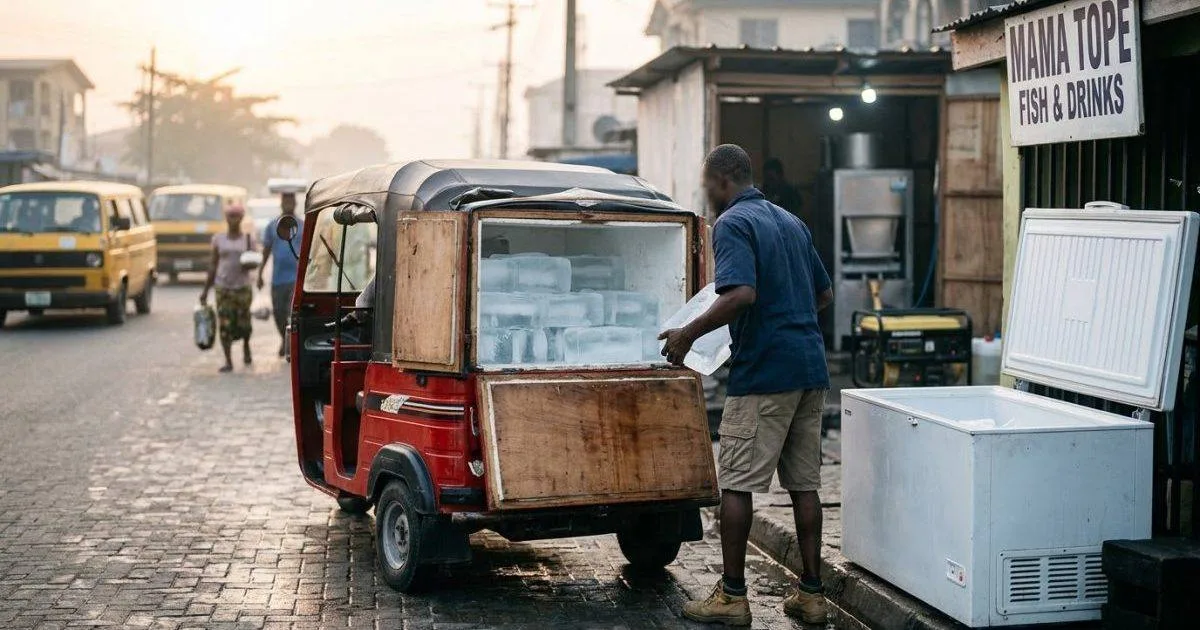
Ice block is a time-sensitive, weight-sensitive product — it melts and cannot be stored without cold infrastructure by the buyer. Your delivery logistics determine your effective market reach. A tricycle (keke NAPEP) fitted with an insulated box can deliver ice blocks within a 3 to 5 km radius with minimal melt loss. A larger delivery truck extends range to 10 to 15 km but requires higher operating cost. Delivery timing: most ice block buyers (bars, fish sellers, caterers) need delivery between 5am and 8am. This means your machines must run through the night, and your delivery operation must start at 4am to meet the first delivery window. This early morning operating cycle is the most physically demanding aspect of the ice block business — and it is why operators who cannot personally supervise the early morning operation need reliable staff from the first day of business.
Frequently Asked Questions
How much does it cost to start an ice block business in Nigeria?
Chest freezer approach (5 freezers): ₦400,000 to ₦1,000,000. Small ice machine approach: ₦800,000 to ₦2,000,000 including machine, generator, and first month working capital. Industrial scale: ₦3,000,000 to ₦20,000,000.
How profitable is an ice block business in Nigeria?
A 50-block-per-day operation at ₦800 average selling price per block generates ₦40,000 daily gross revenue. After fuel (₦25,000 to ₦35,000 daily at current PMS prices), labour, maintenance, and packaging, net daily profit is ₦5,000 to ₦15,000 — ₦150,000 to ₦450,000 monthly. Profitability improves significantly with solar power reducing the fuel bill.
What is the fuel cost for an ice block machine in Nigeria?
At ₦1,000 per litre of PMS and a 5 kVA generator consuming 1.5 litres per hour over 20 operating hours: approximately ₦30,000 per day in fuel. This is the primary cost to model carefully before starting — many ice block businesses fail because the fuel cost was underestimated at the planning stage.
Ice Block Business Success Factors: What Separates the Profitable Operations
The ice block businesses that survive and grow past their first year in Nigeria share several operational characteristics that distinguish them from the majority that plateau or close. First: they treat fuel cost as the primary variable to optimise — not the ice block selling price. A business that reduces its fuel cost from ₦35,000 to ₦20,000 per day through solar supplementation, generator efficiency improvements, or by negotiating a bulk fuel supply arrangement at below-pump prices adds ₦15,000 per day directly to net profit — more than most ice block businesses can achieve by raising prices. Second: they maintain their machines with religious discipline — a mechanical breakdown during a peak demand period (Christmas, Eid, a major owambe season) loses not just the production revenue but the customer relationships that were counting on the supply. Third: they build delivery reliability — customers who can count on ice delivery at 6am every day will pay a 10 to 20 percent premium over a supplier who sometimes delivers at 9am and sometimes not at all. Reliability in a market characterised by inconsistency is a genuine competitive advantage. Fourth: they understand their real cost per block and price above it — not by ₦50, but by a margin that covers equipment replacement, unexpected repairs, and the occasional lost production day. The ice block business is not a high-glamour operation, but it is one of the most durably necessary businesses in the Nigerian urban economy, and operators who manage it with the discipline it requires build income streams that compound reliably for years. The ice block business, run with discipline and genuine customer focus, is one of the most reliably necessary businesses in Nigeria — and necessity, in business, is the most durable competitive moat available. The Nigerian entrepreneur who starts an ice block business in 2026, masters the fuel cost equation through solar investment, builds institutional client relationships, and expands into cold storage services has built something that will be worth significantly more in five years than what they built it from.
Sources
- Original business guide — NaijaSabi Business Desk, September 2026
Last updated: 22 September 2026 · NaijaSabi Business Desk. Machine prices and fuel costs as at September 2026.
Ice Block Business and Nigeria’s Cold Chain Gap
The ice block business is more than a convenience — it is part of the critical cold chain infrastructure that Nigeria’s food system depends on. Nigeria loses an estimated 40 to 50 percent of its agricultural produce to post-harvest spoilage, largely because the cold chain from farm to consumer is severely underdeveloped. Commercial ice block producers are an informal but essential component of this cold chain — supplying the cooling capacity that fish sellers use at roadside markets, that fruit and vegetable vendors use to extend shelf life on hot days, and that meat sellers use to maintain product quality between slaughter and sale. As Nigerian agricultural processing and food service industries grow, demand for consistent, professional cold supply will only increase — meaning the ice block business operator of 2026 who develops institutional customer relationships (supplying hospitals, food processing factories, and large caterers regularly) is positioning themselves at the foundation of a cold chain that Nigeria’s food system will increasingly depend on. The operators who build that infrastructure now, when it is still informal and fragmented, are the ones who will be best placed when the market formalises and scales.
Expanding Beyond Ice Blocks: Cold Storage Services
The natural progression for a successful ice block business that has invested in a cold room is to offer cold storage as a service to other businesses — fish sellers who need overnight storage, meat traders who need 3 to 5 day storage between supply runs, caterers who need to store prepared food for large events. A 10-tonne cold room (₦1,500,000 to ₦3,000,000 to install) that generates ice block revenue during production hours can generate additional cold storage rental income during idle capacity periods — typically ₦500 to ₦2,000 per day per pallet of stored goods, or ₦5,000 to ₦30,000 per month for a regular storage client. This cold storage diversification converts the ice block business from a single-product operation into a cold chain services provider — a significantly more defensible and higher-revenue business model than ice block production alone.




0 Comments
No comments yet. Be the first to share your thoughts!