


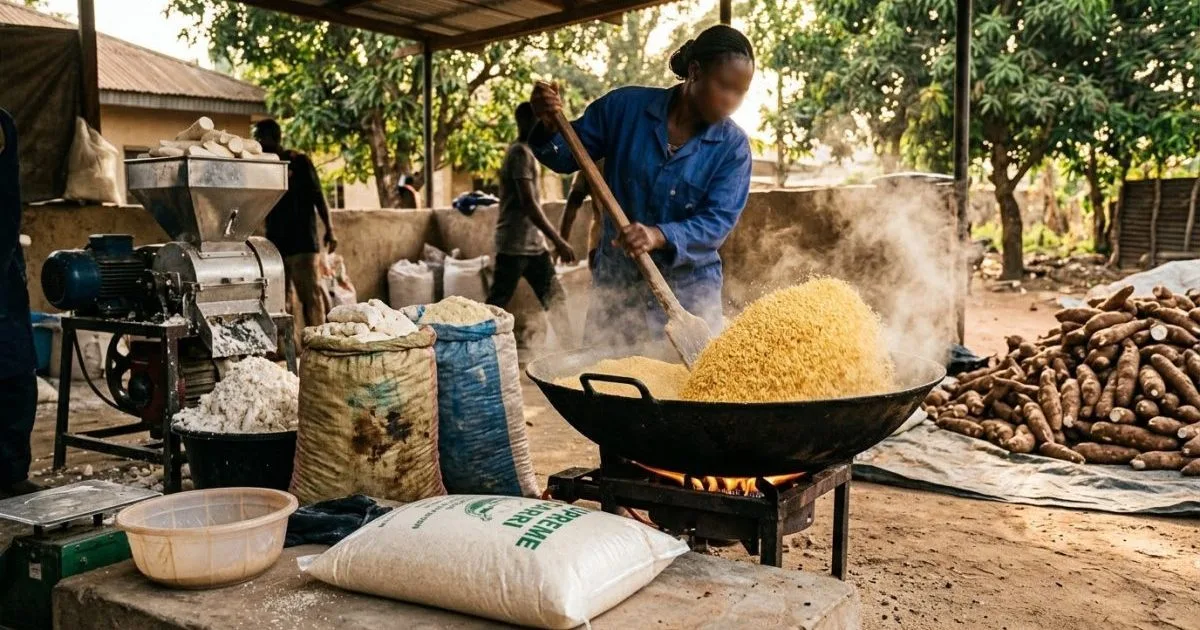
📌 Quick Summary: A garri processing business converts fresh cassava tubers into garri — Nigeria’s most widely consumed food staple. The production process: peel → grate → ferment (24 to 72 hours) → press/dewater → sieve → fry → package. A 1-tonne batch of fresh cassava (cost ₦80,000 to ₦150,000) produces approximately 250 to 300kg of finished garri that sells at ₦600 to ₦1,500 per kg, generating gross revenue of ₦150,000 to ₦450,000 per batch. Startup capital for a small-scale garri processing operation: ₦300,000 to ₦1,500,000 depending on mechanisation level. This guide covers the full production process, equipment options (manual vs mechanical), yellow vs white garri, NAFDAC requirements, and where to sell garri profitably in Nigeria.
Garri is the food that holds Nigeria together. Every economic stratum of Nigerian society eats garri — as eba (stirred into hot water to form a swallowable dough), as soakings (soaked in cold water with groundnuts, sugar, or milk), as a dry snack, or as an ingredient in other foods. The cassava-derived staple is eaten from Maiduguri to Lagos, from the Niger Delta to the North-East, and it is the single most important food security buffer for low-income Nigerians when rice prices rise. Nigeria produces more cassava than any other country in the world — approximately 60 million tonnes annually — and a significant portion of this cassava is processed into garri at village, small-scale, and industrial levels across the country. For the entrepreneur, this ubiquity creates a business with permanent, recession-proof demand and a well-established supply chain from cassava farmers to final consumers.
White Garri vs Yellow Garri: What You Need to Know
Garri comes in two main varieties distinguished by colour and flavour. White garri is the standard product across most of Nigeria — produced without palm oil addition during the frying stage. It has a clean, slightly sour taste from the fermentation process and is the most widely consumed variety. Yellow garri (also called Ijebu garri) is produced by adding red palm oil to the cassava mash during the frying stage — the carotenoids in palm oil produce the characteristic yellow colour. Yellow garri is more popular in southwestern Nigeria and commands a premium price over white garri in most markets (₦50 to ₦200 per kg more than equivalent white garri) because of the perceived flavour advantage and the additional ingredient cost. Ijebu garri specifically refers to a finer-grained, dryer, crisper variety from Ogun State that is considered premium — the best Ijebu garri has a distinctive sharp sourness, fine texture, and long shelf life. For a new garri processor, starting with standard white garri is recommended — it has the widest market, simplest production process, and requires no palm oil sourcing. Yellow garri can be added as a premium product line once the basic process is mastered.
Raw Material: Sourcing Cassava
The profitability of a garri business begins with raw material cost. Cassava is available year-round across most of Nigeria’s cassava belt (South-South, South-West, South-East, and parts of the Middle Belt), with price varying significantly by season and proximity to production areas. Farm-gate price for fresh cassava: ₦30,000 to ₦80,000 per tonne at rural farms in peak production season (typically September to February). Urban market price for fresh cassava: ₦80,000 to ₦150,000 per tonne. For a garri processing business, the single most impactful cost reduction lever is sourcing cassava directly from farmers at farm-gate prices rather than from urban markets. This requires either farm proximity (locating your processing facility in or near a cassava-producing area) or a reliable transport arrangement with cassava farmers (agreeing to collect directly from the farm on harvest days). The conversion ratio is approximately 3.5 to 4 kg of fresh cassava per 1 kg of finished garri — so a 1-tonne cassava purchase yields 250 to 285 kg of finished garri. This conversion ratio is why raw material cost dominates the garri business economics — every ₦10,000 reduction in the cost per tonne of cassava directly adds ₦2,500 to ₦2,850 to the net margin per tonne processed.
The Garri Production Process: Step by Step
Step 1: Harvesting and Washing
Fresh cassava must be processed within 24 to 48 hours of harvest — it deteriorates rapidly after uprooting. Wash the cassava tubers thoroughly to remove soil. Sort and discard any diseased or rotted tubers.
Step 2: Peeling
Remove the outer brown and inner pink skin layers — both are inedible and bitter. Peeling is typically done manually with knives at small scale (labour cost: ₦5,000 to ₦15,000 per tonne). Mechanical peeling machines (₦150,000 to ₦500,000) are available for larger operations and significantly reduce labour time.
Step 3: Grating
Grate the peeled cassava into a fine, wet mash. Manual grating is laborious and slow — practical only for very small batches. A mechanical cassava grater (₦80,000 to ₦300,000 for small commercial models) can process 500 to 1,000 kg of peeled cassava per hour and is the minimum equipment investment for any commercial garri operation. The grated mash should be fine and uniform — coarse grating produces lumpy garri.
Step 4: Fermentation
Pack the grated mash into sacks and allow to ferment for 24 to 72 hours at room temperature. The fermentation process: reduces the cyanide content of cassava (raw cassava contains hydrogen cyanide — fermentation and frying together reduce it to safe levels), develops the characteristic slightly sour flavour of garri, and partially breaks down the cassava starch. Standard garri ferments for 24 hours — producing mild sourness. Ijebu-style garri ferments for 48 to 72 hours — producing the distinctive sharp sourness. Temperature affects fermentation rate — in Nigeria’s tropical heat, 24-hour fermentation at ambient temperature is typically sufficient for standard garri.
Step 5: Pressing and Dewatering
After fermentation, the cassava mash must have as much water as possible pressed out before frying. Wet mash produces steamed, clumped garri rather than the dry, granular product. Press the sacks under heavy weights, or use a mechanical screw press (₦80,000 to ₦250,000) for more efficient dewatering. The pressed mash should feel damp but not wet — approximately 40 to 50 percent moisture content.
Step 6: Sieving
Break up the pressed mash and sieve through a wire mesh sieve to produce a uniform, granular texture. This stage removes fibrous cassava strings and large lumps. For yellow garri: mix palm oil into the sieved mash now, before frying — approximately 200 to 400ml of palm oil per 10kg of pressed mash to achieve the characteristic yellow colour.
Step 7: Frying (Garification)
This is the most critical stage — the garification (frying) process simultaneously dries the cassava mash into garri granules and eliminates residual cyanide through heat. Fry the mash in a large, wide frying pan (iron or clay pan, diameter 60 to 90cm) over a wood fire or gas burner, stirring continuously with a wooden paddle to prevent burning. The mash will gradually dry and separate into individual granules as moisture evaporates. Total frying time: 20 to 40 minutes per batch, depending on moisture content and heat intensity. Finished garri: crunchy, dry, uniformly granular, with a slightly toasted aroma. It should not clump when cooled — clumping indicates insufficient frying or excess residual moisture. Mechanical garri fryers (₦200,000 to ₦800,000) provide more consistent heat distribution and higher throughput than manual pan frying.
Step 8: Cooling and Packaging
Spread the freshly fried garri on clean surfaces to cool completely before packaging — hot garri packaged immediately will sweat inside the bag, causing moisture accumulation and mould growth. Package in polypropylene sacks (50 kg bags for wholesale) or smaller branded retail packs (1 kg, 2 kg, 5 kg). Label with NAFDAC registration number, production date, best-before date, and producer details for commercial retail sales.
Equipment List and Startup Costs
| Equipment | Cost (2026) | Notes |
| Cassava grater (mechanical) | ₦80,000 – ₦300,000 | The most critical equipment investment — manual grating cannot support commercial production volumes |
| Hydraulic or screw press | ₦80,000 – ₦250,000 | Faster and more efficient dewatering than weight-pressing |
| Garri frying pan (large iron pan) or mechanical fryer | ₦15,000 – ₦800,000 | Manual iron pan at lower cost; mechanical fryer for high throughput |
| Sieving equipment (wire mesh sieves) | ₦5,000 – ₦20,000 | |
| Sacks, knives, washing basins | ₦10,000 – ₦25,000 | |
| Packaging bags and sealer | ₦10,000 – ₦30,000 | |
| Generator (for mechanical grater and fryer) | ₦80,000 – ₦300,000 | Power reliability is essential for consistent production schedule |
| Minimum viable small-scale operation (mechanical grater + manual press + iron pan) | ₦280,000 – ₦700,000 |
Profitability: 1-Tonne Cassava Processing Batch
| Fresh cassava (1 tonne at farm-gate) | ₦80,000 – ₦120,000 |
| Labour (peeling, frying, packaging) | ₦20,000 – ₦40,000 |
| Fuel and utilities | ₦10,000 – ₦20,000 |
| Packaging materials | ₦5,000 – ₦15,000 |
| Total production cost per batch | ₦115,000 – ₦195,000 |
| Yield (260 kg of finished garri) | 260 kg |
| Wholesale price (₦700/kg to markets) | ₦182,000 |
| Retail price (₦1,200/kg packaged) | ₦312,000 |
| Gross profit (wholesale) | ₦-13,000 to ₦67,000 |
| Gross profit (retail packaged) | ₦117,000 – ₦197,000 |
The economics are clear: wholesale garri processing at urban cassava prices is thin or negative. The business becomes significantly profitable at farm-gate cassava sourcing (reducing raw material cost by 30 to 50 percent) and/or at retail packaging (selling branded, NAFDAC-registered garri at ₦1,000 to ₦1,500 per kg rather than ₦600 to ₦800 per kg bulk). Premium Ijebu garri commands ₦1,500 to ₦3,000 per kg in Lagos and Abuja markets — a price point that transforms the economics entirely.
Where to Sell Garri in Nigeria
Five sales channels with different margin profiles. Bulk wholesale to market traders (Mile 12, Bodija, Onitsha Main Market): lowest per-kg price, highest volume, fastest cash flow. Supermarkets and shops (branded retail packs): requires NAFDAC registration and professional packaging, but commands 50 to 100 percent premium over bulk wholesale price. Direct-to-consumer online and WhatsApp delivery: diaspora Nigerians abroad and health-conscious Nigerians in Lagos and Abuja will pay premium prices for certified, high-quality garri from identified producers. Export to Nigerian diaspora: dried garri has good shelf life (6 to 12 months properly sealed) and exports well — Nigerian diaspora communities in the UK, USA, and Canada have consistent demand for authentic garri at prices 5 to 10 times the Nigerian retail price.
Frequently Asked Questions
How much does it cost to start a garri processing business in Nigeria?
₦280,000 to ₦700,000 for a small mechanical operation (grater, press, frying equipment, first raw material batch). Locating in or near a cassava-producing area significantly reduces both raw material cost and transport expense.
How much profit can you make from garri processing in Nigeria?
₦50,000 to ₦200,000 per tonne of cassava processed, depending on cassava sourcing cost and garri selling price. Branded retail packaging and premium Ijebu garri production significantly improve the margin. Processing 4 to 8 tonnes per week generates ₦200,000 to ₦1,600,000 monthly gross profit at these margins.
What is the NAFDAC requirement for garri processing in Nigeria?
NAFDAC registration is required for any garri sold commercially with labelling and distributed beyond informal local markets. Register through NAFDAC’s food manufacturing registration pathway — budget ₦50,000 to ₦200,000 and 3 to 6 months for the process.
Sources
- FAO — cassava and garri production Nigeria — fao.org
- Original business guide — NaijaSabi Business Desk, September 2026
Last updated: 22 September 2026 · NaijaSabi Business Desk.
Garri Processing and Nigeria’s Cassava Economy
Nigeria’s cassava industry is the largest in the world by volume — yet most of its cassava is consumed in low-value forms (fresh consumption, unbranded garri, locally processed starch) rather than in the higher-value processed products that global food companies pay premium prices for. The gap between Nigeria’s cassava production potential and its cassava processing capacity represents one of the largest agricultural value-creation opportunities in Africa. A garri processor who builds reliable supply relationships, invests in consistent product quality, obtains NAFDAC certification, and develops a recognisable brand is positioned to benefit from the premium that processed, certified, branded Nigerian food products increasingly command — both in the Nigerian retail market and in the diaspora export market. The garri business is not glamorous, but it is built on the most fundamental food demand in Nigeria — a demand that has existed for centuries, will exist for centuries more, and is not threatened by import competition because fresh cassava cannot be economically imported and processed garri from other countries cannot compete with well-priced, freshly produced Nigerian garri. Building a garri brand is building on the most stable foundation available in Nigerian food manufacturing.


0 Comments
No comments yet. Be the first to share your thoughts!