




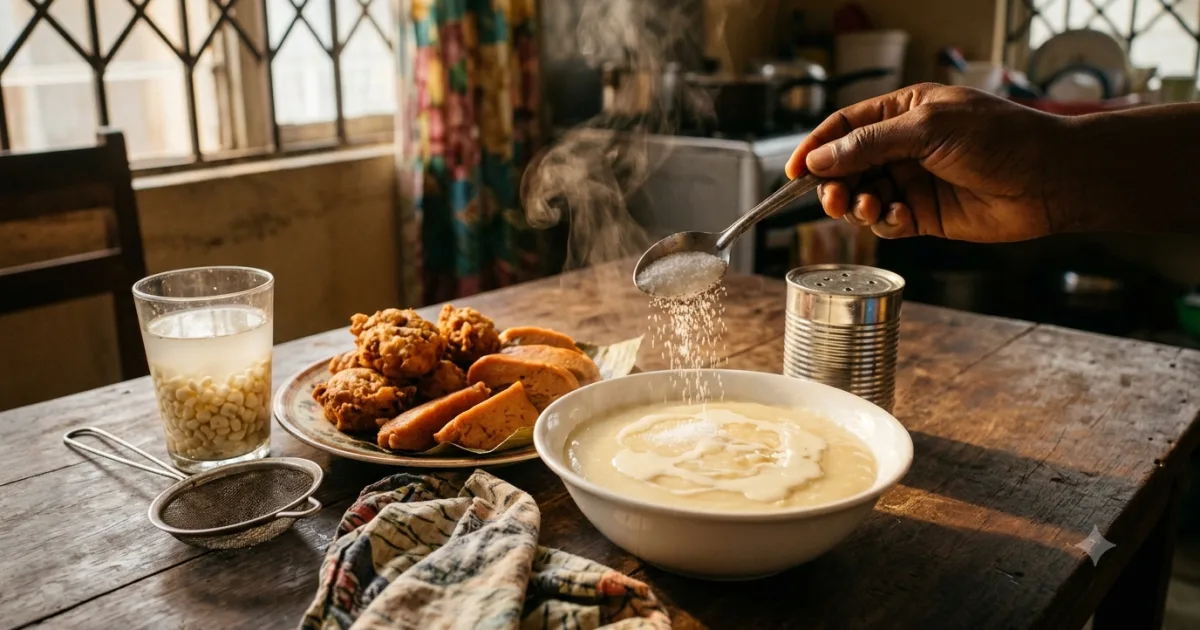
📌 Quick Summary: Nigerian pap (akamu in Igbo, ogi in Yoruba, kunu in Hausa) is a smooth, fermented corn porridge made from white or yellow maize, soaked for 2 to 3 days, wet-milled, sieved, and cooked into a smooth gelatinous porridge. A batch uses 500g of dry white maize and makes approximately 6 to 8 generous servings. Cooking time after preparation: 5 to 8 minutes. Pap is eaten at breakfast, served to babies and convalescing adults, and given to nursing mothers. The commercial pap business — selling fresh pap to households, hospitals, and maternity wards — is a ₦100,000 to ₦500,000 monthly revenue opportunity with minimal equipment. This guide covers the complete from-scratch recipe, the fermentation process, how to make smooth lump-free pap, the business model, and variations including tiger nut pap and soy-enriched baby pap.
Pap is one of Nigeria’s oldest, most universally eaten foods — and one of the most underrepresented in food guides and recipe content. Every Nigerian has eaten pap: the smooth, slightly sour, warmly familiar porridge that appears at breakfast tables from Lagos to Maiduguri, at naming ceremonies with akara and moi moi, in hospitals as the first food given to patients after procedures, in maternity wards as the traditional first food for nursing mothers, and in virtually every Nigerian household as the first solid food introduced to infants. Yet most published pap recipes use the commercial pap powder — the convenience form that, while useful, produces a noticeably inferior result to pap made from properly soaked and fermented whole maize. This guide covers both approaches but focuses primarily on the from-scratch method, which produces the best-tasting pap and is the foundation of the commercial pap business.
Understanding Pap: The Fermentation That Makes It What It Is
What distinguishes pap from ordinary cornmeal porridge is fermentation. The 2 to 3 day soaking process that precedes milling is not merely softening the grain — it is initiating a natural lactic acid fermentation by the bacteria present on the grain surface and in the water. This fermentation produces the characteristic slight sourness of pap (milder in white maize pap, more pronounced in yellow maize pap), breaks down some of the antinutrients in the maize that would otherwise reduce mineral absorption, and produces the smooth, slightly gelatinous texture that distinguishes pap from coarser corn porridges. It is the same biological process as the fermentation in African yoghurt, sourdough bread, and ogi in many West African cuisines. The fermentation also acts as a mild preservative — pap that has been properly fermented keeps better than unfermented cornmeal porridge. Understanding that the soaking period is a fermentation step (not merely hydration) explains why rushed pap — soaked for only a few hours rather than the full 2 to 3 days — tastes flat and starchy rather than having the characteristic pap flavour.
Making Pap From Scratch: Full Recipe
Ingredients
| Ingredient | Quantity | Notes |
| Dry white maize (corn) | 500g | White maize produces the classic light-coloured Nigerian pap. Yellow maize produces a darker, stronger-flavoured pap. Both work — white is more common commercially. |
| Water for soaking | Enough to cover maize by 5cm | |
| Water for cooking | 3 to 4 cups boiling water | |
| Sugar, milk, or honey to serve | To taste | Traditional serving: with sugar and evaporated milk. Baby pap: plain or with a small amount of powdered milk. Nursing mothers: sometimes with Tiger nut milk or crayfish for protein enrichment. |
Step 1: Soak the Maize (48 to 72 Hours)
Wash the dry maize in two changes of clean water. Place in a deep bowl or container and cover with water by at least 5 centimetres — the maize will absorb significant water and expand. Cover loosely with a cloth or lid (not airtight — the fermentation produces carbon dioxide that needs to escape). Leave at room temperature for 48 to 72 hours. The water will become slightly cloudy and may develop a mild sour smell by day 2 — this is correct. Fermentation is working. Change the water once per day to maintain cleanliness without stopping the fermentation. After 72 hours, the maize should be swollen, soft enough to break easily between your fingers, and the soaking water should have a noticeably sour smell.
Step 2: Wet-Mill the Fermented Maize
The traditional method is stone-grinding (using a corn mill), which produces the smoothest pap with the finest particle size. Modern home method: blend the soaked, drained maize in a blender with enough fresh water to allow smooth blending — add water gradually, blending until completely smooth. The blended mixture should be a smooth, white, slightly viscous liquid with no visible grain particles. Add more water as needed to achieve a liquid consistency that pours freely. For commercial pap production, a wet corn mill (available at Nigerian markets for ₦800 to ₦2,000 per milling session) produces better results than a home blender, particularly for large batches.
Step 3: Sieve Twice
Pour the blended mixture through a fine sieve or muslin cloth into a large bowl. This removes the corn husks and any coarse particles that would make the pap gritty. Press the mixture through with your hand or a spoon, extracting all the liquid. Discard the dry husk residue in the sieve. For the smoothest pap — particularly for infant feeding — sieve a second time through a finer cloth. Allow the sieved liquid to settle for 30 minutes: the pap starch will sink to the bottom, leaving clearer water on top. Pour off the top water and retain the thick white sediment at the bottom. This thick sediment is your raw pap paste — the purer and more concentrated the paste, the smoother the cooked pap.
Step 4: Store or Cook Immediately
The thick pap paste can be stored in the refrigerator for 3 to 5 days before cooking. This is the commercially sold form — vendors sell the raw paste by weight and customers cook it themselves. To cook pap: mix 2 to 3 tablespoons of the thick raw paste with 4 tablespoons of cold water in a bowl to form a lump-free slurry. In a separate pot, bring 2 cups of water to a rolling boil. Pour the paste slurry into the boiling water in a slow, steady stream, stirring continuously and vigorously with a wooden spoon to prevent lumps from forming. Cook on medium heat, stirring constantly, for 3 to 5 minutes until the pap thickens, becomes glossy, and gelatinous. The finished pap should pour smoothly but hold shape in a bowl — thick enough to coat the back of a spoon heavily.
Step 5: Serve
Serve immediately in bowls. Nigerian serving style: pour hot pap into a bowl, add sugar to taste, pour a generous amount of evaporated or fresh milk on top. Traditional pairing: akara (bean cakes) or moi moi alongside pap is one of Nigeria’s most celebrated breakfast combinations. For baby pap: serve plain or with a small quantity of powdered infant formula blended in — no sugar for infants under 12 months.
How to Make Smooth, Lump-Free Pap Every Time
Lumpy pap is the most common failure and has one primary cause: adding the raw paste to boiling water without first mixing it into a smooth cold-water slurry. Hot water immediately cooks the outer surface of any raw paste dropped into it, creating a cooked skin around an uncooked centre — these are the lumps. The correct method: always mix the raw paste with cold water first until completely smooth, then add to boiling water in a slow stream while stirring continuously. This distributes the starch particles evenly in the hot water before they begin to gelatinise, producing smooth pap without lumps.
The Pap Business in Nigeria
Commercial pap selling is one of Nigeria’s most enduringly viable food businesses — and one of the least capital-intensive. Pap vendors sell the raw fermented paste (not the cooked porridge) by weight or by cup — customers take it home and cook it themselves. A kilogram of raw pap paste sells at ₦500 to ₦1,500 depending on quality, location, and whether it is plain maize pap or enriched (tiger nut pap, soy-fortified baby pap, or corn-guinea corn blended pap). The economics: 1kg of dry white maize (cost: ₦400 to ₦700) produces approximately 2 to 2.5kg of wet pap paste after soaking and milling. At ₦800 per kilogram of paste, 1kg of dry maize generates ₦1,600 to ₦2,000 in revenue — a gross margin of ₦900 to ₦1,600 per kilogram of dry maize. The highest-value pap products are the enriched versions: tiger nut pap (chufa/ose oji + maize blend) commands ₦1,500 to ₦3,000 per kilogram; soy-fortified baby pap (maize + soybean blend ground together) sells at ₦2,000 to ₦4,000 per kilogram in packaging marketed to mothers of infants. Target customers for the pap business: maternity hospitals and antenatal clinics (consistent bulk buyers for nursing mother nutrition), baby shops and pharmacies (for packaged baby pap), household regular buyers through WhatsApp weekly delivery, and market stalls supplying morning akara sellers who serve pap alongside their bean cakes.
Variations: Tiger Nut Pap and Baby Pap
Tiger nut pap (ogi agbalumo or kunun aya): blend soaked tiger nuts (chufa) with soaked white maize in a 1:3 ratio and process exactly as above. The tiger nut adds natural sweetness, a distinctive creamy flavour, and significantly higher nutritional value — tiger nuts are rich in iron, magnesium, and healthy fats. Soy-fortified baby pap: the most commercially valuable pap variation. Blend soaked white maize with soaked dry soybean (washed and de-skinned, 3:1 maize to soy ratio) and process exactly as above. The soybean significantly increases the protein content of the pap — standard maize pap has low protein, which is why it should not be the sole food for babies. Soy-fortified pap addresses this nutritional gap and is actively recommended by Nigerian paediatricians and nutritionists for weaning infants from 6 months. Selling packaged, labelled soy-fortified baby pap through pharmacies, baby shops, and online channels is one of the most commercially compelling pap business models available in Nigeria.
Frequently Asked Questions
What is pap made of in Nigeria?
Nigerian pap (akamu/ogi) is made from white or yellow maize that is soaked for 2 to 3 days (fermenting naturally), wet-milled until smooth, sieved to remove husks, and allowed to settle into a thick paste. The paste is then cooked in boiling water into a smooth, slightly sour porridge.
How long does pap take to cook?
5 to 8 minutes from adding the raw paste slurry to boiling water to finished cooked pap. The preparation time (soaking 48 to 72 hours, milling, sieving, settling) takes 3 days — but the actual cooking is very fast.
Is pap good for babies?
Plain maize pap has low protein content and should not be used as the sole weaning food for infants. Soy-fortified pap (maize plus soybean, ground and processed together) significantly improves the protein content and is a more appropriate weaning food. Add crayfish powder, groundnut paste, or powdered infant formula to further enrich plain pap for baby feeding. Consult a paediatrician for infant feeding guidance specific to your baby.
Can I make pap without a corn mill?
Yes — a home blender produces acceptable pap, particularly for small quantities. Blend the soaked maize with enough water to allow smooth blending. The result is slightly coarser than mill-ground pap but sieving twice through a fine cloth compensates. For commercial production, a wet corn mill (₦800 to ₦2,000 per session) produces superior results.
Sources
- Original recipe — NaijaSabi Lifestyle Desk, September 2026
- Nigerian culinary tradition — pap (akamu/ogi) preparation documented across Yoruba, Igbo and Hausa food traditions
Last updated: 18 September 2026 · NaijaSabi Lifestyle Desk.
Selling Pap Commercially: Building a Pap Business in Nigeria
The commercial pap business in Nigeria operates on two distinct models that can be pursued separately or together. The first model is the daily market stall — selling raw pap paste by the cup or kilogram at a fixed market location, targeting household buyers who cook pap at home. This model has very low overhead (a market stall, a large bowl, and measuring cups), consistent daily revenue from repeat customers, and zero packaging cost — but is limited by the geography of one fixed location and the volume a single seller can prepare and sell daily. The second model is the packaged and delivered model — producing larger batches, packaging in sealed polythene bags or rigid containers with a label, and delivering to a portfolio of regular household, hospital, and pharmacy clients weekly. This model has higher production volume, lower per-unit revenue (clients expect a volume discount over market stall prices), but significantly more scalable and predictable revenue. The most commercially compelling version of the packaged model specifically targets the infant and maternal nutrition market: packaged, labelled soy-fortified baby pap, sold through pharmacies, baby shops, and online channels (Jumia, Konga, and WhatsApp groups for Nigerian mothers), commands premium prices of ₦2,000 to ₦5,000 per 500g pack. This price point reflects the perceived health benefit and the packaged convenience rather than the raw ingredient cost, which is very low. A pap producer making 50 packs of 500g soy-fortified baby pap weekly at ₦2,500 per pack earns ₦125,000 weekly — ₦500,000 monthly — from a business that requires a blender, a grinding mill relationship, and a consistent raw material supply of white maize and dry soybean.


0 Comments
No comments yet. Be the first to share your thoughts!