




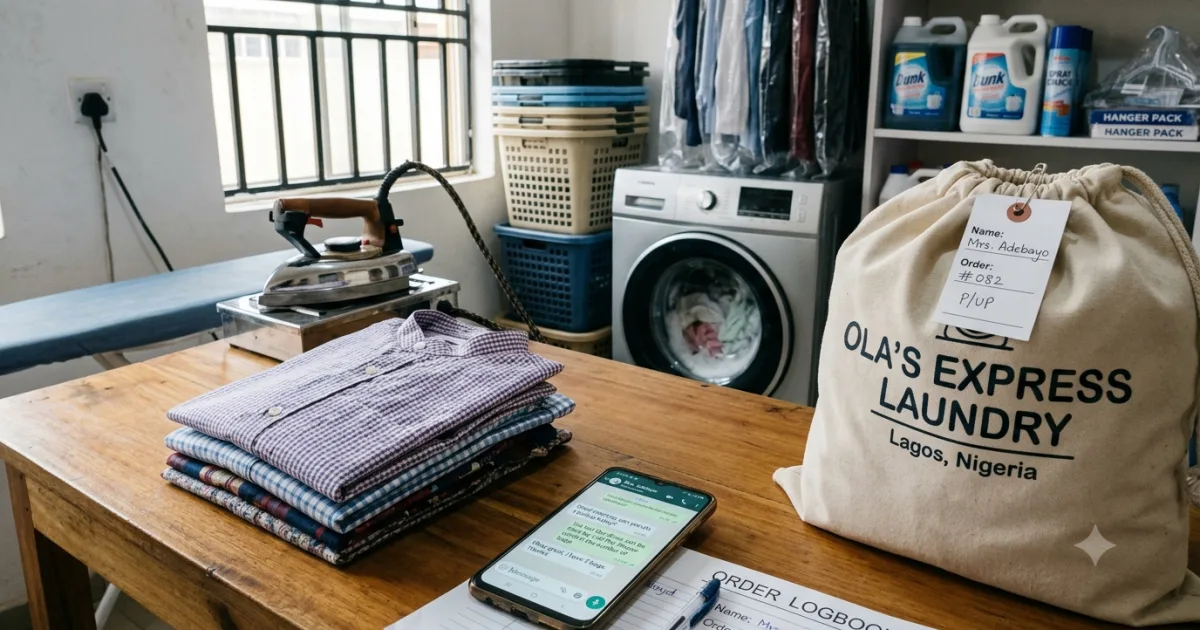
📌 Quick Summary: A laundry business in Nigeria requires startup capital of ₦150,000 to ₦600,000 for washing machines, dryers or drying racks, pressing irons, and initial supplies. Service rates: ₦500 to ₦2,000 per clothing item for dry cleaning; ₦3,000 to ₦15,000 per bag of laundry for regular wash-and-iron; ₦50,000 to ₦200,000 per month for corporate linen contracts. A laundry business with 15 regular household clients earns approximately ₦300,000 to ₦700,000 monthly gross revenue. The fastest way to grow: WhatsApp pickup-and-delivery service to busy professionals in your area. No formal certification required to start. This guide covers equipment, pricing, service types, how to find clients, and how to scale from a one-person operation to a small laundry enterprise.
The laundry business is one of Nigeria’s most consistently overlooked service business opportunities — overlooked not because the demand is unclear but because its ordinariness makes it seem like a small-scale activity rather than a scalable enterprise. The reality in Nigeria’s major cities in 2026 is that the laundry opportunity is genuine and growing. Young professionals working 10 to 12 hour days in Lagos and Abuja have neither the time nor the energy to do their own laundry. Dual-income couples managing children, careers, and daily commutes outsource laundry as a quality-of-life necessity. Hotels, hospitals, restaurants, and shortlet apartments need professional linen and uniform laundering on a recurring basis. The Nigerian laundry market is fragmented among informal operators, a few dry-cleaning chains, and the spread of self-service laundromats in high-income areas — leaving a large middle-market opportunity for professional, reliable, delivery-based laundry services targeting urban professionals.
Types of Laundry Services and Their Rates
| Service Type | What It Is | Price Range (Lagos/Abuja 2026) |
| Wash and fold (home laundry) | Machine or hand wash, dry, fold — no ironing | ₦3,000 – ₦8,000 per bag (5kg load) |
| Wash, dry and iron | Machine wash, dry, press each item — full service | ₦5,000 – ₦15,000 per bag |
| Dry cleaning (per item) | Professional dry cleaning for delicate fabrics, suits, gowns | ₦500 – ₦2,000 per item depending on type |
| Corporate linen service | Weekly or twice-weekly collection, washing, and delivery of hotel/restaurant/hospital linen | ₦50,000 – ₦250,000 per month per client |
| Staff uniform laundering | Weekly collection, wash, iron, and return of corporate staff uniforms | ₦30,000 – ₦120,000 per month per company |
| Bridal and event wear cleaning | Specialist cleaning for wedding gowns, aso-oke, agbada | ₦8,000 – ₦50,000 per outfit |
| Express laundry (same-day or next-day) | Priority service with guaranteed same-day or next-day return | 50 – 100% premium over standard rates |
Equipment List and Startup Costs
| Equipment | Cost (2026) | Notes |
| Semi-automatic or automatic washing machine (7kg) | ₦80,000 – ₦180,000 | Semi-automatic: lower cost, more manual operation. Automatic: higher cost, more professional, less labour. Start with one machine for residential clients, add as volume grows. |
| Pressing iron (heavy-duty steam iron) | ₦15,000 – ₦45,000 | Steam iron essential for professional pressing quality. Consumer irons are insufficient for commercial volume. |
| Ironing board (professional wide-board) | ₦8,000 – ₦20,000 | Wide-board ironing table speeds up pressing significantly for shirts and trousers |
| Drying rack or outdoor drying lines | ₦5,000 – ₦15,000 | Tumble dryers (₦80,000 to ₦200,000) speed up turnaround and enable rainy-season operation but are optional at startup |
| Laundry bags and tags (100 pieces) | ₦5,000 – ₦10,000 | Item tagging is essential — prevents mix-ups with multiple clients |
| Laundry detergent, softener, stain removers (1 month supply) | ₦10,000 – ₦25,000 | Buy wholesale from Shoprite or Makro-style outlets for better pricing |
| Delivery motorcycle or vehicle (optional at start) | ₦80,000 – ₦500,000 | Initially use Okada, Bolt courier, or personal transport. Add dedicated delivery as volume justifies it. |
| Hangers (100+) | ₦3,000 – ₦8,000 | |
| Branded laundry bags for client delivery | ₦8,000 – ₦15,000 | Branded bags are marketing — clients who carry your branded bag to/from their apartment building market your business to neighbours |
| Minimum viable startup (no tumble dryer, no vehicle) | ₦134,000 – ₦318,000 |
How to Get Your First Laundry Clients
The fastest client acquisition strategies for a new Nigerian laundry business in 2026. First: door-to-door leafleting in residential estates, apartment blocks, and compound housing in your immediate area. A simple A5 flyer with your service list, pricing, and WhatsApp number, distributed to 200 to 300 households in your neighbourhood, will generate 5 to 15 enquiries from which 2 to 5 regular clients can be converted. Second: WhatsApp Business profile with clear service menu, pricing, and a professional introduction message. Send to your existing contacts and ask friends and family to forward to anyone they know in your area who might need laundry service. Third: approach estate managers and property managers directly — they maintain communication channels with all residents and a single recommendation from an estate manager to 50 residents is worth more than 500 flyers. Offer the estate manager’s household free laundry for one month in exchange for a recommendation to residents. Fourth: target shortlet apartment operators (same strategy as the cleaning business) — shortlet operators need linen laundering after every checkout and are receptive to professional services that solve a recurring operational need. Fifth: Instagram and Facebook advertising targeting Lagos or Abuja residents within 5km of your location — a ₦3,000 to ₦5,000 budget for a 7-day targeted ad with before/after photos of professionally laundered and pressed shirts produces measurable enquiries for an established-looking laundry business.
Running a Pickup-and-Delivery Laundry Service
The highest-growth laundry business model in Nigeria’s urban market in 2026 is the pickup-and-delivery format — where the laundry business collects dirty laundry from clients’ homes, launders it, and returns it clean and pressed within 24 to 48 hours. This model removes the biggest friction point for busy urban Nigerians: the time required to drop off and pick up laundry. The key operational requirements for a pickup-and-delivery model: a WhatsApp booking system (clients message their pickup date, address, and quantity — simple and familiar), a reliable pickup and delivery schedule (2 to 3 fixed days per week works better than daily for a small operation), clear item tagging to prevent mix-ups across multiple clients’ laundry, and reliable transport for collection and delivery (Okada or Bolt courier for small volumes; a dedicated tricycle or motorcycle for larger operations). Premium pricing applies: clients pay 20 to 30 percent more for pickup-and-delivery than for drop-off service — and pay willingly because the time saving justifies the premium for the target market of urban professionals.
Frequently Asked Questions
How much does it cost to start a laundry business in Nigeria?
₦150,000 to ₦400,000 for a small residential pickup-and-delivery operation (one washing machine, steam iron, drying racks, supplies, and initial marketing). A more equipped laundry with tumble dryer and delivery motorcycle requires ₦400,000 to ₦800,000 startup capital.
How much can a laundry business make in Nigeria?
A laundry business with 15 regular residential clients (each sending laundry weekly at ₦8,000 per week average) earns ₦120,000 weekly or ₦480,000 monthly from residential clients alone. Adding corporate linen or uniform contracts at ₦80,000 to ₦150,000 per client per month significantly increases revenue. Net profit depends on equipment costs (already paid back), labour, and utilities — typically 40 to 60 percent of gross revenue for a well-run operation.
Do I need a washing machine to start a laundry business in Nigeria?
Not strictly at the smallest scale — many successful Nigerian laundry businesses started with hand-washing before investing in machines. However, a semi-automatic washing machine (₦80,000 to ₦120,000) dramatically increases capacity, reduces physical labour, and produces more consistent quality than hand-washing. For any operation targeting 10+ regular clients, a machine is practically necessary.
What is the difference between dry cleaning and laundry?
Regular laundry uses water and detergent — suitable for most everyday clothing. Dry cleaning uses chemical solvents instead of water — suitable for delicate fabrics (silk, wool, cashmere), tailored suits and gowns that would shrink or lose shape in water, and items with dry-clean-only labels. True dry cleaning requires professional equipment (₦500,000 to ₦2,000,000) and is typically offered by established dry cleaning chains. Most small Nigerian laundry businesses offer standard laundering and basic hand-washing of delicates rather than true dry cleaning.
The Laundry Business and Nigeria’s Water and Power Challenges
Any honest guide to running a laundry business in Nigeria must address the two operational realities that every Nigerian service business navigates: intermittent water supply and unreliable electricity. Water management: a laundry business requires consistent, reliable water supply. In areas where municipal water supply is unreliable, a water storage system — overhead tank (minimum 1,000 litres), ground-level storage tank, or direct borehole connection — is not optional but foundational infrastructure. Budget ₦30,000 to ₦150,000 for water storage infrastructure depending on your setup. Power management: automatic washing machines require stable power to function and can be damaged by voltage fluctuations. An automatic voltage regulator (AVR, approximately ₦15,000 to ₦40,000) protects your washing machine from the voltage irregularities common on Nigerian DISCOM supply. For extended power outages, a small generator (1.5kVA to 2.5kVA, approximately ₦80,000 to ₦180,000) provides operational continuity during grid failures — essential if your clients depend on you for same-day or next-day turnaround. Alternative power: solar-powered laundry operations are becoming increasingly viable in Nigeria as solar panel and inverter prices decrease. A solar system capable of powering a 7kg washing machine for 2 to 3 cycles daily costs approximately ₦400,000 to ₦800,000 installed — a significant upfront cost but one that eliminates generator fuel costs and provides indefinite operational independence from the grid. For a laundry business planning long-term operation in an area with unreliable power, solar is increasingly the economically rational infrastructure investment.
Sources
- Original business guide — NaijaSabi Business Desk, September 2026
Last updated: 18 September 2026 · NaijaSabi Business Desk. Service rates reflect Lagos and Abuja market pricing as at September 2026 and vary significantly by location, equipment level, and client type.
Managing Multiple Clients: The Operations System Every Laundry Business Needs
The most common reason Nigerian laundry businesses plateau at 5 to 8 clients and cannot grow further is the absence of a simple operations system. Without a system, each new client adds confusion rather than revenue — wrong items returned to wrong clients, items lost or damaged with no documentation, no record of what was collected when, and chaotic turnaround times that frustrate clients into leaving. The minimum viable operations system for a Nigerian laundry business handling 10 or more clients: a client register (a notebook or WhatsApp group list) that records every collection — client name, date collected, items collected (count and type), agreed delivery date, and agreed price. An item tag on every item collected — a small numbered luggage tag or a piece of masking tape with the client’s initials written in permanent marker. Items from different clients are never mixed in the same wash cycle. A WhatsApp update to every client when their laundry is collected, when it is being washed, and when it is ready for delivery — three messages per cycle that cost nothing and build client confidence and trust. A payment record for every transaction — who paid, how much, and when. These simple disciplines separate professional laundry operations from informal ones, and they are the reason some Nigerian laundry businesses grow to 30, 50, or 100 clients while operating at the same location, equipment, and staffing level — the system scales the capacity without scaling the chaos.
Scaling from a Home Laundry to a Laundry Enterprise
The growth path for a successful Nigerian laundry business follows a recognisable pattern. Phase 1 — Solo home operation: one person handling 10 to 15 clients with one washing machine and basic equipment from a home setting. Revenue: ₦200,000 to ₦500,000 monthly. Phase 2 — Small team with dedicated space: one or two additional staff (one for washing, one for pressing and delivery), a rented small shop or workspace as a professional base rather than home operation, and a second washing machine. Revenue: ₦500,000 to ₦1,500,000 monthly with 30 to 50 clients. Phase 3 — Adding corporate contracts: active pursuit of hotel, hospital, restaurant, and corporate uniform contracts that provide large monthly recurring revenue from single clients. One hotel contract at ₦150,000 monthly is equivalent in revenue to 20 additional individual household clients — but requires one relationship rather than 20. Phase 4 — Branded laundry chain or franchise: establishing a recognisable brand, potentially multiple locations, and a reputation strong enough to attract franchise interest or investment. Several Nigerian laundry businesses that started as home operations in the early 2020s are now operating multiple branches across Lagos — the model scales when the system, quality, and branding are strong enough to replicate.


0 Comments
No comments yet. Be the first to share your thoughts!