




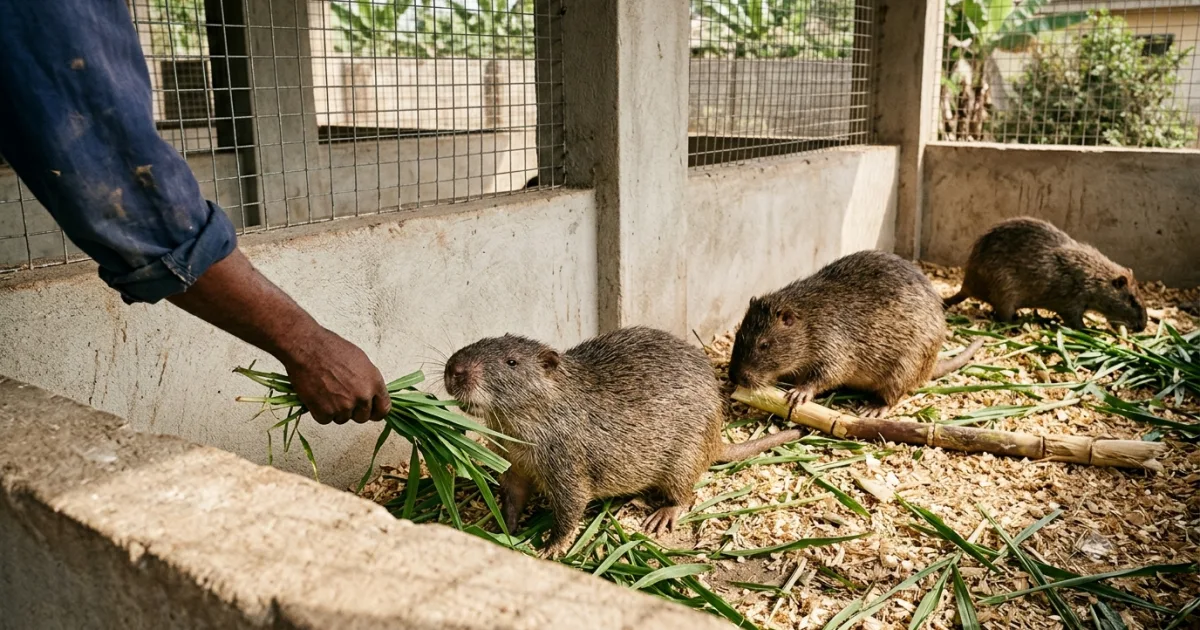
📌 Quick Summary: Grasscutter farming (greater cane rat, Thryonomys swinderianus) is one of Nigeria’s highest-margin livestock businesses. Grasscutter meat sells at ₦5,000 to ₦12,000 per kilogram — more expensive than beef and chicken, with consistent demand that exceeds domestic supply. A colony of 1 male + 4 females produces approximately 16 to 32 young per year. Startup capital: ₦150,000 to ₦400,000 for a starter colony, housing, and feeding. Grasscutters eat grasses, sugarcane, and agricultural by-products — feed cost is minimal compared to poultry or catfish. This guide covers housing setup, feeding, breeding, health management, and where to sell grasscutter meat profitably in Nigeria.
Grasscutter (Thryonomys swinderianus) — known locally as the greater cane rat and as “cutting grass” in southern Nigerian English — is a large African rodent that has been hunted in the wild across West and Central Africa for thousands of years. In Nigerian bush meat markets and restaurants, grasscutter is considered a premium protein — distinctly more expensive than chicken, beef, or even goat meat, and regarded by many Nigerians and Ghanaians as a delicacy with a unique, rich flavour that no domestic livestock species replicates. The paradox of grasscutter in Nigeria is that despite high demand and premium prices, commercial farming remains significantly underdeveloped. Most grasscutter consumed in Nigeria is still sourced from the wild — an unsustainable supply that is declining as habitat loss reduces wild populations. This supply constraint, combined with stable high demand, makes grasscutter farming one of the most compelling livestock business opportunities in Nigeria for anyone willing to invest the time to learn the animal’s specific management requirements.
Why Grasscutter? The Economic Case
Three economic characteristics make grasscutter farming unusually attractive in the Nigerian agricultural context. First: premium pricing. Grasscutter meat sells at ₦5,000 to ₦12,000 per kilogram at bush meat markets, restaurants, and high-end hotels across Lagos, Abuja, and major Nigerian cities — 2 to 4 times the price of chicken and 1.5 to 3 times the price of beef. A 3 to 4 kilogram adult grasscutter brings ₦15,000 to ₦48,000 at market — from an animal that cost approximately ₦8,000 to ₦12,000 as a juvenile and ate mostly free or very cheap grass and agricultural waste. Second: very low feed cost. Unlike poultry or catfish where commercial feed accounts for 60 to 70 percent of total production cost, grasscutters subsist on elephant grass, napier grass, sugarcane, guinea grass, and agricultural by-products (cassava peels, yam peels, groundnut shells). Many Nigerian farmers who grow or have access to these materials can produce grasscutter at near-zero feed cost. Third: strong and growing demand with constrained supply. Wild grasscutter populations are declining across Nigeria, making farmed grasscutter increasingly the only reliable source for bush meat restaurants and market vendors. Farmers who establish consistent, high-quality supply relationships with premium buyers — hotels, restaurants, catering companies — command prices at the upper end of the market range.
Housing: The Colony System
Grasscutters are housed in the colony system — one male (buck) housed with 3 to 5 females (does) in a pen. Each pen is one breeding unit. The colony system reflects grasscutter social structure: adult males are highly territorial and will fight to the death if housed together. Female grasscutters are more tolerant of each other. The practical housing design for Nigerian grasscutter farmers:
| Feature | Specification |
| Pen size (per colony of 1+4) | Minimum 2m × 1m × 0.6m (length × width × height) |
| Construction material | Concrete block walls with wire mesh top — grasscutters are strong burrowers and gnawers; wooden structures are quickly destroyed |
| Floor | Concrete floor — easier to clean than soil floor; reduce with wood shavings or dried grass bedding |
| Shelter section | One end of the pen enclosed (dark, sheltered box) for sleeping and giving birth — grasscutters are crepuscular and need shelter from direct sunlight |
| Feeding trough | Fixed concrete or heavy ceramic trough — grasscutters knock over light troughs |
| Water provision | Heavy drip drinker or water bowl — change daily. Grasscutters need fresh water consistently despite obtaining some moisture from fresh grass |
| Pen separation | Each colony pen must have solid walls (not wire mesh) separating it from adjacent male-containing pens — males can injure each other through mesh |
| Construction cost per pen | ₦25,000 – ₦60,000 for concrete block construction |
Feeding Grasscutters: What They Eat and How Much
Grasscutters are strict herbivores — they eat grass, leaves, stalks, and vegetables. The feeding program for commercially farmed grasscutters in Nigeria has two components: roughage (the bulk of the diet) and concentrates (a small protein and mineral supplement). Roughage — the 80 to 90 percent component: fresh elephant grass (Pennisetum purpureum, also called napier grass) is the ideal staple. Sugarcane stalk and leaves are particularly relished and improve weight gain. Guinea grass, Congo grass, king grass, and most other common West African pasture grasses are accepted. Banana leaves and stems, cassava leaves (in moderation), pawpaw leaves, and most agricultural by-products are also consumed. The ideal roughage feeding: cut fresh grass daily and provide in bundles that the grasscutters can browse through the day. Grasscutters will not eat wilted or dried grass readily — fresh-cut daily provision is ideal, though drying napier grass into hay is a viable alternative for the dry season when fresh grass is scarce. Concentrate supplement — the 10 to 20 percent component: a small daily quantity of commercial rabbit pellets (available at agricultural supply stores) or a homemade concentrate of groundnut cake, wheat offal, corn bran, and bone meal provides the protein, minerals, and vitamins that grass alone cannot fully supply. Approximately 50 to 80 grams of concentrate per adult grasscutter per day alongside unlimited fresh roughage produces excellent growth and reproductive performance.
Breeding and Reproduction
Grasscutter reproduction is slower than poultry or rabbit but produces larger, higher-value offspring. Key reproductive facts: sexual maturity — females reach maturity at 6 to 8 months; males at 8 to 10 months. Mating — the male should be introduced to the female pen (not vice versa, to prevent the male from being attacked in unfamiliar territory). Gestation period — 152 days (approximately 5 months) — the longest gestation of any micro-livestock species farmed in Nigeria. Litter size — 3 to 6 young per litter (average 4). Litters per year — 2 per female (some high-performing females produce 3 litters in favourable conditions). Birth weight — young grasscutters are born fully furred, eyes open, and mobile — not helpless like rats or rabbits. They begin eating grass within a few days of birth. Weaning — at 6 to 8 weeks. For a colony of 1 male + 4 females: expected annual production is 16 to 48 young per year (4 females × 2 litters × 2 to 6 young). Growth rate — young grasscutters reach marketable weight of 2 to 4 kilograms in 7 to 12 months from birth.
Profitability Calculator: Starter Colony of 1 Male + 4 Females
| Item | Cost/Revenue |
| Starter stock (1 male + 4 females, juvenile) | ₦80,000 – ₦150,000 |
| Housing (2 colony pens, concrete) | ₦60,000 – ₦120,000 |
| Feeding — Year 1 (fresh grass + concentrate supplement) | ₦30,000 – ₦60,000 |
| Medications and supplements | ₦10,000 – ₦20,000 |
| Year 1 Total Investment | ₦180,000 – ₦350,000 |
| Year 2 revenue: 20 young animals × 3kg average × ₦7,000/kg | ₦420,000 |
| Year 2 feed and maintenance cost | ₦40,000 – ₦70,000 |
| Year 2 Net Profit (starter colony) | ₦350,000 – ₦380,000 |
| Year 3 (4 colonies — reinvested stock) | ₦1,200,000+ annually |
Health Management: Common Grasscutter Health Problems
Grasscutters are generally hardy animals with fewer disease problems than poultry or fish. The most common health issues in Nigerian grasscutter farms: Coccidiosis — intestinal parasitic infection causing bloody diarrhoea, weight loss, and death in young animals. Prevention: keep pens clean and dry; use anticoccidial treatment in concentrate feed. Treatment: consult a veterinarian for approved treatment protocol. Pneumonia — respiratory infection from cold, wet conditions or poor ventilation. Prevention: adequate shelter, dry bedding, no cold draughts. Injuries from fighting — adult males will fight if they can reach each other. Prevention: solid walls between pens; never house adult males together. Ectoparasites (ticks, mites, lice) — cause skin irritation and reduced performance. Treatment: pour-on or spray acaricide products (consult veterinarian for appropriate products for grasscutters). Vitamin C deficiency — grasscutters cannot synthesise their own vitamin C (like humans) and develop scurvy if their diet lacks fresh green material. Symptoms: joint swelling, reluctance to move. Prevention: ensure adequate daily fresh grass or provide ascorbic acid supplement.
Where to Sell Grasscutter in Nigeria
The premium price of grasscutter creates correspondingly premium selling channels. Bush meat restaurants and pepper soup establishments: the primary market — these establishments pay premium prices for live or freshly dressed grasscutter with guaranteed regular supply. Build direct relationships with 2 to 4 restaurants in your area before your first harvest. Hotels and catering companies: high-volume buyers who pay premium prices for consistent, hygienic, professionally presented grasscutter. Requires relationship building and often a food safety certification. Markets and wholesalers: lower per-kilogram price than direct restaurant sales but higher volume and faster movement. Live animal sales directly from the farm: the highest-margin channel — buyers who come to your farm to select live animals typically pay retail price rather than wholesale. WhatsApp and social media direct sales to households: a growing channel in Lagos and Abuja where middle-class households buy bush meat directly from known producers. Breeding stock sales: established farms with high-quality breeding pairs or colonies command premium prices from new farmers entering the business — a male-female pair of proven breeders sells for ₦50,000 to ₦150,000, significantly more than meat price for the same animals.
Frequently Asked Questions
How much does it cost to start grasscutter farming in Nigeria?
A starter colony of 1 male and 4 females with concrete housing costs approximately ₦180,000 to ₦350,000 total first-year investment. This is higher than snail farming but lower than catfish or poultry farming, with significantly higher per-kilogram selling prices than any of those alternatives.
How long before grasscutter reaches market size?
7 to 12 months from birth to marketable weight of 2 to 4 kilograms. The gestation period of 152 days means the full production cycle from mating to marketable offspring takes approximately 13 to 17 months.
What do grasscutters eat in Nigeria?
Fresh elephant grass (napier grass), sugarcane, guinea grass, and other tropical pasture grasses form the bulk of the diet. A small supplement of groundnut cake, wheat offal, and bone meal or commercial rabbit pellets provides protein, minerals, and vitamins. Vitamin C supplementation is important — provide fresh citrus fruits, pawpaw, or ascorbic acid supplement regularly.
Where can I buy grasscutter for farming in Nigeria?
Research institutions including NASC (National Agricultural Seeds Council) extension offices, University of Agriculture Abeokuta (FUNAAB), and state agriculture development programmes (ADP) can direct you to registered grasscutter breeders in your region. Agricultural exhibitions in Lagos (NAIAS at Tafawa Balewa Square) and Ibadan (IITA) regularly feature grasscutter breeders. Avoid buying grasscutter from wild sources — wild-caught animals carry higher disease loads and often fail to thrive in captive farm conditions.
Sources
- FUNAAB extension publications — grasscutter production guide — funaab.edu.ng
- Original agricultural business guide — NaijaSabi Business Desk, September 2026
Last updated: 18 September 2026 · NaijaSabi Business Desk.
Grasscutter Farming and the Nigerian Bush Meat Restaurant Market
The primary commercial driver of grasscutter farming in Nigeria is the bush meat restaurant and pepper soup establishment market — a segment that has grown significantly in Nigerian cities as urbanisation brings demand for traditional foods into urban food service settings. Bush meat restaurants in Lagos (concentrated in areas like Ikorodu, Badagry, and satellite town areas), Abuja, Ibadan, Benin City, and Enugu are established businesses with consistent weekly grasscutter demand that is currently met inconsistently because wild supply is unreliable. A grasscutter farmer who signs a supply agreement with even two or three bush meat restaurants — committing to deliver a fixed number of live or dressed grasscutters weekly at an agreed price — has immediately solved the most difficult part of the farming business: guaranteed revenue with predictable volume. The negotiation dynamic favours established farmers: restaurant owners who have experienced the unreliability of wild grasscutter supply (seasonal availability, quality variation, price spikes) are strongly motivated to work with a reliable farm supplier even at a slightly higher per-kilogram price than the market average. Building two or three such relationships before your first harvest — by visiting restaurants during their operating hours, introducing your farm, and offering to supply a trial quantity — is the single most impactful business development activity a new grasscutter farmer can undertake. A restaurant that knows you and trusts your supply becomes a long-term revenue anchor around which you can scale your colony numbers with confidence in the revenue that will absorb the additional production.


0 Comments
No comments yet. Be the first to share your thoughts!