




📌 Quick Summary: A cleaning business in Nigeria requires startup capital of ₦50,000 to ₦300,000 for equipment and supplies. Service rates: ₦10,000 to ₦50,000 per residential cleaning session, ₦30,000 to ₦200,000 per office deep clean, ₦150,000 to ₦600,000 per post-construction clean. A cleaning business with 5 regular residential clients and 2 regular office clients earns approximately ₦400,000 to ₦800,000 monthly gross revenue. The fastest way to get clients: WhatsApp outreach to estate managers, facility managers, and Airbnb/shortlet operators. No formal certification is required to start — but CAC registration and professional presentation are important for landing corporate clients. This complete guide covers startup costs, service types, pricing, equipment, and how to find your first 10 clients.
The cleaning business is one of Nigeria’s most systematically undervalued service business opportunities — and one of the easiest to start with low capital. As Nigerian cities grow, as more dual-income households cannot clean their own homes, as corporate offices multiply and shortlet apartments proliferate, the demand for professional cleaning services grows consistently. Yet the cleaning business remains dominated by informal, unbranded operators who provide inconsistent quality and have no systematic way to find and retain clients. This creates a clear opportunity for anyone willing to operate professionally — with proper equipment, reliable scheduling, professional communication, and consistent quality — in a market where the bar is low and the demand is real.
Types of Cleaning Services in Nigeria
| Service Type | Typical Rate (Lagos/Abuja 2026) | Frequency | Equipment Needed |
| Residential cleaning (regular) | ₦10,000 – ₦30,000 per session (2-4 bedroom flat) | Weekly or bi-weekly | Mop, bucket, vacuum cleaner, cleaning chemicals |
| Residential deep clean (one-time or quarterly) | ₦25,000 – ₦80,000 per session | One-time or quarterly | Full kit + carpet cleaner, pressure washer |
| Office cleaning (daily or weekly) | ₦30,000 – ₦120,000 per month (regular contract) | Daily, 3x/week, or weekly | Industrial mop, vacuum, floor polisher |
| Post-construction cleaning | ₦150,000 – ₦600,000+ per job | One-time after construction | Heavy-duty industrial equipment, chemical cleaning agents |
| Shortlet/Airbnb turnover cleaning | ₦8,000 – ₦25,000 per turnover | After every guest checkout | Standard residential kit |
| Event venue cleaning (before/after) | ₦50,000 – ₦300,000 per event | One-time per event | Industrial equipment for large spaces |
| Industrial/warehouse cleaning | ₦200,000 – ₦800,000 per contract | Monthly contracts | Heavy industrial equipment |
Recommendation for beginners: Start with residential regular cleaning and shortlet/Airbnb turnovers — lowest equipment cost, fastest client acquisition, and recurring revenue from repeat bookings. Add office cleaning contracts once you have reliable staff and equipment. Post-construction cleaning requires specialised heavy equipment and is best added after 6 to 12 months of operation.
Startup Equipment List and Costs
| Equipment | Cost (2026) | Notes |
| Industrial mop and bucket set (2 sets) | ₦8,000 – ₦15,000 | Microfibre mops preferred — absorb more, spread less bacteria |
| Vacuum cleaner (handheld or upright) | ₦15,000 – ₦50,000 | Essential for carpeted offices and bedrooms |
| Cleaning chemicals (starter supply) | ₦10,000 – ₦25,000 | Multi-surface cleaner, floor cleaner, toilet cleaner, glass cleaner, disinfectant. Buy from Jumia, wholesale chemical suppliers, or Shoprite in bulk for better pricing. |
| Microfibre cloths (10 to 20 pieces) | ₦5,000 – ₦10,000 | Colour-code by area (bathroom cloths ≠ kitchen cloths ≠ general surface cloths) for hygiene |
| Scrubbing brushes and toilet brushes | ₦3,000 – ₦6,000 | |
| Rubber gloves (multiple pairs) | ₦2,000 – ₦5,000 | |
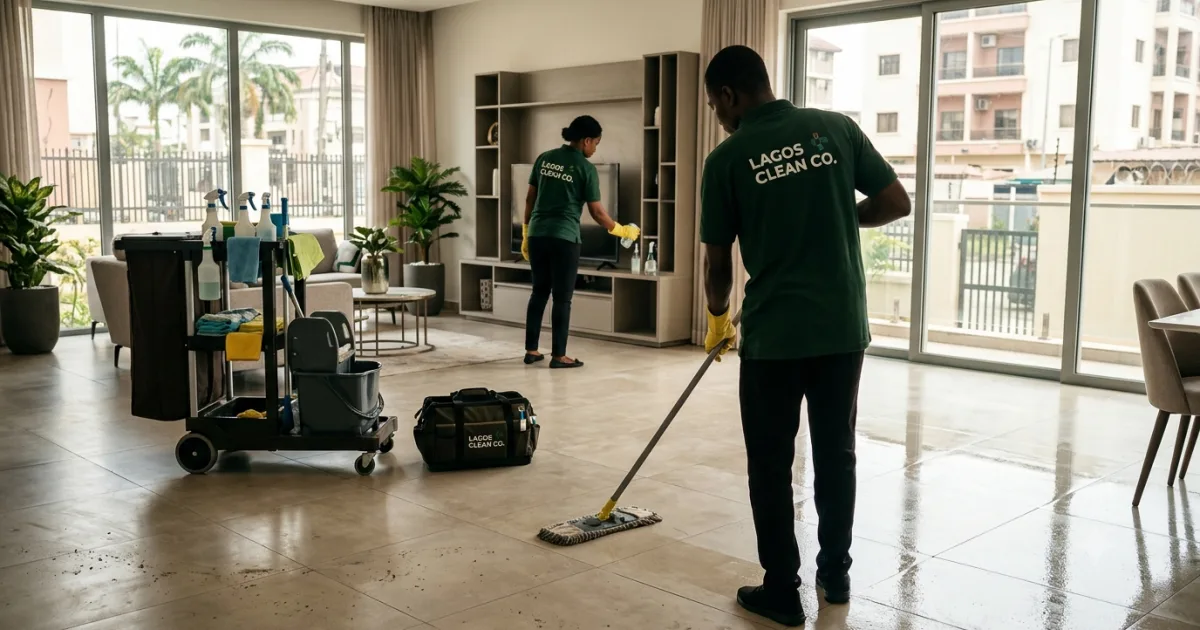
| Uniform/branded clothing (2 sets) | ₦8,000 – ₦20,000 | Professional appearance is a client trust signal — invest in it from day one |
| Branded cleaning kit bag or trolley | ₦5,000 – ₦15,000 | Carrying equipment professionally makes an impression |
| Business cards | ₦3,000 – ₦5,000 | Leave one at every completed job |
| Total minimum startup | ₦59,000 – ₦151,000 |
Pricing Your Services Correctly
The most common mistake new Nigerian cleaning businesses make is underpricing — setting rates so low that the business is not profitable after cleaning supplies, transport, and labour costs. The pricing calculation every cleaning business owner must run: Time for the job (hours) × your hourly target earnings + chemicals and supplies cost + transport cost = your minimum price for that job. For a 3-bedroom flat regular cleaning that takes 3 hours with one cleaner, at an hourly target of ₦3,000 plus ₦1,500 in chemicals and ₦1,000 transport: minimum viable price is ₦11,500. Charging ₦8,000 for the same job means you are earning below minimum viable rate. In Lagos and Abuja’s middle-income residential markets, ₦15,000 to ₦25,000 for a 3-bedroom flat regular clean is the correct market rate in 2026 — not the ₦8,000 to ₦10,000 that inexperienced operators charge to win business and then provide unsustainably low quality.
How to Get Your First 10 Clients
The fastest paths to first clients for a new Nigerian cleaning business in 2026. First: WhatsApp outreach to estate managers. Every gated estate in Lagos, Abuja, and other major Nigerian cities has an estate manager who coordinates services for residents. Getting listed as a recommended cleaning service with 2 to 3 estate managers immediately gives you access to hundreds of potential residential clients. Second: shortlet and Airbnb operators. Nigeria’s shortlet apartment market has grown enormously — operators need reliable turnover cleaning after every checkout. Search for Nigerian Airbnb hosts and shortlet operators on Instagram and WhatsApp groups, offer a first clean at a discounted trial rate, and deliver exceptional quality. A shortlet operator who is happy with your work becomes a recurring weekly client. Third: corporate social media. LinkedIn outreach to facility managers and HR managers of medium-sized Nigerian companies positions your business for office cleaning contracts — higher value and longer-term than residential. Fourth: referrals from existing clients. Every client you satisfy becomes a referral source — ask explicitly at the end of every successful job: “Do you know anyone else who might need our services?” A business card left behind makes the referral easy. Fifth: Jiji.ng and other Nigerian classified platforms. List your service with clear pricing, professional photos of your team in uniform, and client testimonials — Nigerian consumers actively search these platforms for cleaning services.
Frequently Asked Questions
How much does it cost to start a cleaning business in Nigeria?
₦60,000 to ₦200,000 for basic residential cleaning equipment, chemicals, uniforms, and initial marketing. Post-construction and industrial cleaning requires ₦500,000 to ₦2,000,000 in heavy equipment. Start with residential and shortlet cleaning at the lower capital requirement and scale into commercial cleaning as revenue grows.
Do I need any certification to start a cleaning business in Nigeria?
No formal certification is legally required for general cleaning services. CAC business registration (approximately ₦50,000 to ₦75,000) is strongly recommended — corporate clients require a registered business name before signing contracts. For specialised services (hospital cleaning, industrial cleaning), specific health and safety certifications may be required by the client organisation.
How much can a cleaning business make in Nigeria?
A solo operator with 5 regular residential clients earns ₦150,000 to ₦300,000 monthly. A business with 2 staff, 10 residential clients, and 2 office contracts earns ₦500,000 to ₦1,200,000 monthly gross revenue. Post-construction cleaning contracts of ₦150,000 to ₦600,000 each, closed twice monthly, represent the highest-earning cleaning business model in Nigeria.
What cleaning chemicals should I buy to start in Nigeria?
Multi-surface disinfectant cleaner (Mr. Muscle or equivalent), floor cleaner (Izal or industrial floor cleaner), toilet bowl cleaner (Harpic or Domestos), glass cleaner (Windowlene), and a general-purpose bleach solution for deep disinfection. Buy from wholesale chemical suppliers in major markets for better pricing than supermarkets.
The Cleaning Business and Nigerian Real Estate Growth
One of the structural forces driving consistent growth in Nigerian cleaning service demand is the country’s real estate expansion — particularly the growth of purpose-built shortlet apartments, serviced residences, and co-working spaces in Lagos, Abuja, Port Harcourt, and secondary cities. Shortlet apartments require professional cleaning after every guest turnover — typically 2 to 4 times per week for busy properties. A cleaning business that builds a portfolio of 10 to 20 shortlet apartment clients in a densely shortlet-populated area like Lekki, Victoria Island, Ikeja, or Wuse 2 has a reliable, recurring weekly income stream that is less dependent on individual client retention than standard residential cleaning. The shortlet cleaning market in Nigeria is also structurally underserved — most shortlet operators in Nigeria use informal cleaners hired through word of mouth, with no standard service agreement and inconsistent quality. A cleaning business that approaches shortlet operators with a written service agreement, a fixed per-turnover price, guaranteed same-day availability, and a checklist-based quality standard immediately stands out from this informal competition. The shortlet cleaning niche is the recommended starting point for any Nigerian cleaning business in 2026 precisely because the volume of demand, the willingness to pay professional rates, and the underservice of the existing market create conditions where a well-run small business can establish a strong client base within 60 to 90 days of launch. That 60 to 90 day window to first profitable shortlet client portfolio is shorter than almost any other Nigerian service business — and it is the reason the cleaning business, properly positioned and professionally executed, remains one of the most accessible paths from employment to entrepreneurship available to Nigerians in 2026.
Sources
- Original business guide — NaijaSabi Business Desk, September 2026
- CAC registration requirements — cac.gov.ng — September 2026
Last updated: 13 September 2026 · NaijaSabi Business Desk. Service rates reflect Lagos and Abuja market pricing as at September 2026 and vary significantly by location and client type.
Staffing Your Cleaning Business: When and How to Hire
Most Nigerian cleaning businesses start as one-person operations — the owner cleans everything personally. This is correct at the beginning: it keeps costs minimal, ensures quality control (you are doing the work and can see the standard), and builds the direct customer relationships that generate referrals. The trigger point for hiring your first staff member: when you have more confirmed bookings than you can service alone in a week. A residential cleaning schedule of 6 to 8 clients per week is approximately the maximum one person can service with consistent quality while also managing client communication and admin. At that point, hire one part-time cleaner to take on 2 to 3 jobs per week under your supervision. Supervision is critical in the early staffing phase — quality control lapses when an unsupervised new hire works alone at a client’s home, and one bad clean can cost you that client permanently. The practical Nigerian staffing reality: cleaning work is physical, daily-paid, and has high turnover in Nigeria’s informal labour market. Invest in training every new hire before they go to a client site — a half-day training covering your cleaning standards, chemical safety, client interaction protocol, and the specific checklist you use for each job type produces significantly better results than sending untrained staff to learn on the job. As the business grows, appoint a supervisor from your best-performing cleaners rather than hiring an external manager — someone who already knows your standards and has earned your clients’ trust.
Building a Cleaning Business Brand in Nigeria
Professional branding is the single fastest way to separate a cleaning business from the sea of informal operators in the Nigerian market and command premium pricing. Five brand elements that cost relatively little but dramatically improve how corporate and high-income residential clients perceive your business. First: a business name and logo. A registered business name with a clean, professional logo (designed on Canva or by a Fiverr designer for ₦5,000 to ₦15,000) immediately communicates seriousness. Second: matching uniforms for all staff — branded t-shirts or polo shirts with your business name. Clients who see uniformed staff with matching equipment bags trust the service more than they trust an unmarked operative arriving in street clothes. Third: a WhatsApp Business profile with your logo, service list, pricing, and photos of completed work. This is your primary marketing channel — 90 percent of Nigerian service business leads come through WhatsApp in 2026. Fourth: a simple one-page service menu in PDF format that you can send via WhatsApp to any prospective client. It lists your services, rates, availability, and contact information with your logo at the top. Fifth: before-and-after photos from every completed job (with client permission) — the most powerful cleaning business marketing content. A photo of a pristine bathroom that was previously dirty is more persuasive than any written description of your service quality. Build a WhatsApp status update and Instagram archive of these photos from your first week of operation.



0 Comments
No comments yet. Be the first to share your thoughts!