


📌 Quick Summary: Snail farming (heliculture) is one of Nigeria’s most accessible agricultural businesses — requiring as little as ₦50,000 to ₦150,000 to start with 50 to 100 Giant African Land Snails (Archachatina marginata). Snails take 7 to 12 months to reach market size of 200g to 500g from juvenile. A pen of 100 adult snails produces 5 to 8 clutches of eggs per year, each with 5 to 20 eggs — rapidly expanding your stock. Market price for adult snails in Nigeria: ₦800 to ₦2,500 per snail depending on size and location. This complete guide covers housing setup, feeding, breeding, common problems, and how to sell snails profitably in Nigeria.
Snail farming is the agricultural entry point with the lowest barrier of any livestock business in Nigeria. The startup capital is so modest that it is achievable for almost any working Nigerian — a small pen in a backyard, 50 starter snails, and the patience to let the natural multiplication of the animals do most of the work. Yet the economics that emerge from this low entry point are genuinely compelling: snails are among the highest-priced protein sources per unit in Nigerian markets, the production inputs (food scraps, leaves, fruits, calcium sources) are largely free or very cheap, and the demand — from restaurants, pepper soup spots, hotels, and households — is consistent and growing. This guide covers everything you need to understand before starting.
Why Snail Farming? The Economic Case
Three characteristics make snail farming unusually attractive in the Nigerian agricultural context. First: extremely low feed cost. Snails are herbivores that thrive on agricultural waste, kitchen scraps, leaves, and fruits that would otherwise be discarded. Pawpaw leaves, cocoyam leaves, banana leaves, watermelon rinds, cassava peels, garden vegetables — all are accepted and relished by Giant African Land Snails. The effective feed cost per kilogram of snail produced is a fraction of the feed cost per kilogram in poultry or catfish farming. Second: natural multiplication. A single healthy female snail lays 5 to 20 eggs per clutch and produces 5 to 8 clutches per year — meaning 100 starter snails can theoretically produce 2,500 to 16,000 new snails annually (accounting for hatchability and juvenile mortality). The starting stock multiplies itself without any additional purchase. Third: Nigeria’s snail demand consistently exceeds supply — snails are eaten across all major Nigerian ethnic groups (particularly in the South), are a featured protein in restaurants and bars, and are used medicinally and cosmetically (snail slime for skincare has created an entirely new demand category). Nigeria also exports snails to European markets, particularly France and Spain, where they are considered a delicacy.
The Species: Archachatina marginata — Why It Is the Right Choice for Nigerian Farmers
Nigeria is home to several Giant African Land Snail species, but Archachatina marginata — locally called the giant West African land snail — is the species most recommended for Nigerian commercial farming for four reasons: it is the largest species (reaching 500g to 800g adult weight — the highest market value per unit), it is native to West Africa and adapted to Nigerian climate conditions without special management, it has the highest reproductive rate of the major Nigerian snail species, and it is the species most familiar to Nigerian consumers and restaurants (the flavour and texture is exactly what the market expects). The other species commonly farmed in Nigeria — Achatina achatina and Achatina fulica — are smaller and command lower prices per unit. Archachatina marginata is the correct species for any Nigerian snail farmer targeting maximum profitability.
Housing: The Snailery Setup
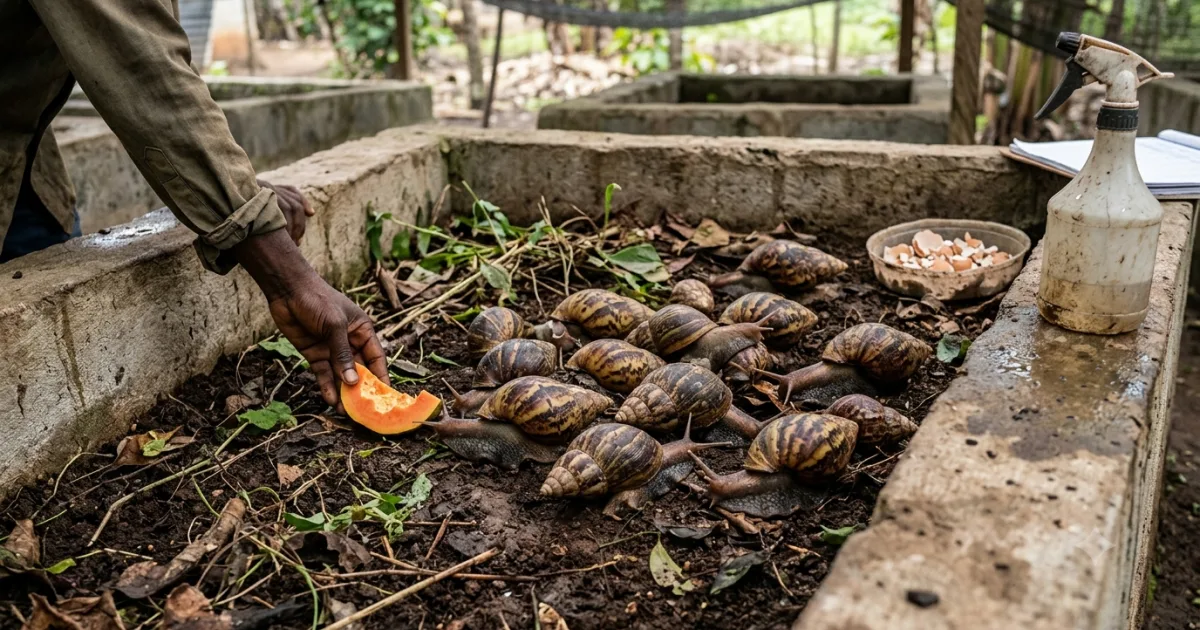
Snails require specific housing conditions — particularly regarding humidity, temperature, and predator protection. The most practical housing options for Nigerian snail farmers:
| Housing Type | Setup Cost | Best For | Key Requirements |
| Wooden box pen | ₦5,000 – ₦15,000 | Beginner trial (10 to 30 snails) | Wire mesh top for ventilation; moisture-retaining substrate; shade from direct sun |
| Concrete block pen | ₦30,000 – ₦100,000 | Small commercial (50 to 200 snails) | Wire mesh cover; drainage; shade structure above; smooth interior walls (snails cannot escape smooth concrete) |
| Old tyres stacked | ₦3,000 – ₦8,000 | Ultra-low-budget starter | Stack 3 to 4 tyres, fill bottom with substrate, wire mesh on top; works for 10 to 20 snails |
| Free-range pens (trenches) | ₦15,000 – ₦50,000 | Large scale (500+ snails) | Walled trench in ground; roof structure for shade and rain protection; deep enough to prevent escape |
Critical Housing Conditions
Humidity: 75 to 85% relative humidity is essential for snail health and growth. Nigerian harmattan season (November to March) is the most challenging period — low humidity causes snails to aestivate (go dormant) and stops growth and reproduction. Spray water on the pen walls and substrate during harmattan to maintain moisture. Temperature: 24 to 30°C is the optimal range — Nigerian climate is naturally suitable. Avoid direct sunlight on the pen, which causes overheating. Substrate: the pen floor should be filled with loose, moist topsoil to a depth of 15 to 25cm — snails lay eggs in soil and need it for burrowing. Change the substrate every 3 to 4 months to prevent disease buildup. Avoid waterlogged soil — wet soil causes snail death from bacterial infection. Shade: all snail pens must be shaded from direct sunlight. Plant banana trees around outdoor pens or build a simple shade structure above.
Feeding Snails: What They Eat and What They Need
Snails are generalist herbivores — they eat most plant material. The key nutrients for growth are carbohydrates (energy) and calcium (shell development). Calcium deficiency produces thin, brittle shells and stunted growth — it is the most common nutritional problem in poorly managed Nigerian snail farms. Foods accepted by Archachatina marginata: leaves — pawpaw, banana, cocoyam, cassava, waterleaf, ugwu; fruits — pawpaw, watermelon, mango, banana (ripe or overripe); vegetables — lettuce, cabbage, sweet potato; calcium sources — crushed oyster shell, limestone powder, crushed eggshells, wood ash. Always provide a dedicated calcium source separate from the main food — snails eat calcium specifically and purposefully, not just incidentally from their food. Place crushed eggshells or limestone powder in a small dish inside the pen at all times. Feed once daily in the evening — snails are nocturnal feeders. Remove uneaten food the following morning to prevent mould and bacterial growth in the pen.
Breeding and Multiplication
Archachatina marginata is hermaphroditic — each snail has both male and female reproductive organs. Two snails are required for mating (they cannot self-fertilise), and both snails typically lay eggs after mating. Mating occurs most frequently during the rainy season (April to October in southern Nigeria) and slows or stops during harmattan. Egg laying: 5 to 20 eggs per clutch, laid in a small hole the snail digs in the substrate. Eggs are cream-coloured, marble-shaped, approximately 1cm diameter. Incubation: 28 to 42 days depending on temperature and humidity. Hatchlings: small (approximately 1cm) copies of adults. Move hatchlings to a separate nursery pen to prevent crushing by adults. Keep hatchlings separate until they reach 4 to 5cm (approximately 3 to 4 months) before introducing to the main growing pen.
Profitability Calculator: 100 Starter Snails
| Item | Cost/Revenue |
| 100 starter snails (Archachatina marginata, juvenile) | ₦30,000 – ₦50,000 |
| Pen construction (concrete block, medium) | ₦40,000 – ₦80,000 |
| Substrate (topsoil) | ₦5,000 |
| Feeding (mostly kitchen scraps + calcium supplements) | ₦3,000 – ₦6,000/month |
| Year 1 Total Investment | ₦111,000 – ₦177,000 |
| Year 2 Saleable snails: 100 adults × 5 clutches × 10 eggs × 60% hatchability × 70% survival to adult | 210 adult snails |
| Revenue: 210 adult snails × ₦1,500/snail average | ₦315,000 |
| Feed and maintenance cost Year 2 | ₦36,000 – ₦72,000 |
| Year 2 Net Profit | ₦243,000 – ₦279,000 |
| Year 3+ (stock now 300+ adults) | ₦800,000+ annually |
Snail farming is a compound growth business — the multiplication rate means that patient farmers who reinvest their stock rather than selling all adults see exponentially growing returns from Year 3 onward.
Where to Sell Snails in Nigeria
The most profitable sales channels for Nigerian snail farmers in 2026. Live snails direct to restaurants and pepper soup spots: the highest per-unit price — ₦1,500 to ₦2,500 per large adult snail, or ₦8,000 to ₦15,000 per kilogram. Target restaurants, hotels, and pepper soup establishments that specifically feature snail dishes. Fresh market sales: lower per-unit price (₦800 to ₦1,500) but faster volume movement at market stalls. Online and WhatsApp sales: growing channel — post-pandemic, more Nigerian households buy food directly from producers via WhatsApp and Instagram. Snails pack and ship reliably over short distances in ventilated boxes. Live snails with health certificates for export: Nigerian snails are exported to European markets (primarily France, Spain, and Italy) where they command premium prices as escargot. NAFDAC certification and phytosanitary clearance are required — a significant administrative investment but one that opens a much larger margin for established producers.
Common Problems and Solutions
| Problem | Cause | Solution |
| Snails not eating | Too dry, wrong food, or stress from handling | Spray pen with water; try different foods; reduce handling |
| Thin or broken shells | Calcium deficiency | Add crushed eggshells or limestone powder to pen immediately |
| Snails dying in wet season | Waterlogged soil causing bacterial infection | Improve drainage; change substrate; ensure pen floor is not flooded |
| Snail growth stopped (aestivation) | Harmattan — low humidity and temperature | Increase watering frequency; cover pen to retain moisture; reduce ventilation slightly during harmattan |
| Egg predation | Rats, ants, or other insects reaching eggs in substrate | Ensure pen is rat-proof; place ant barriers (petroleum jelly on pen legs); check substrate regularly |
Frequently Asked Questions
How much does it cost to start snail farming in Nigeria?
As little as ₦50,000 to ₦100,000 for a backyard operation with 50 to 100 starter snails, a wooden or concrete pen, and substrate. This is one of the lowest entry-cost agricultural businesses available in Nigeria.
How long before snails reach market size?
7 to 12 months from juvenile (hatchling) to adult market size of 200g to 500g. Adult Archachatina marginata can reach 500g to 800g with excellent nutrition over 18 to 24 months — commanding the highest market prices.
Where can I buy snails to start farming in Nigeria?
Local markets sell snails that can be used as breeding stock — buy the largest available adults. Dedicated snail farm suppliers exist in Lagos (Ikorodu), Ogun State, Anambra, and Enugu. Agricultural institutes including the University of Agriculture Abeokuta (FUNAAB) sell starter stock and provide training. Avoid buying snails from roadsides during harmattan — aestivating snails in poor health make poor breeding stock.
Sources
- Original agricultural guide — NaijaSabi Business Desk, September 2026
- Heliculture research — University of Agriculture Abeokuta (FUNAAB) extension publications
Last updated: 15 September 2026 · NaijaSabi Business Desk.
Snail Slime: The New Revenue Stream Nigerian Farmers Are Missing
Snail slime (snail mucin) has become one of the most sought-after ingredients in the global skincare industry — featured in Korean beauty products, European cosmetics, and increasingly in Nigerian skincare brands. The mucin from Archachatina marginata and other African snail species is rich in glycoprotein, hyaluronic acid, and glycolic acid — compounds that have demonstrated effects in wound healing, skin hydration, and anti-aging. Nigerian cosmetics companies and individual skincare entrepreneurs are beginning to source snail slime from local farmers for use in serums, creams, and face masks. The price point is significant — processed snail mucin extract sells for ₦50,000 to ₦200,000 per litre depending on purity and processing. For an established snail farm, collecting mucin from snails (a non-lethal process — snails produce slime when gently stimulated on a mesh surface) creates an additional revenue stream from the same animals without harvesting them for food. The market for Nigerian-made snail slime skincare products is small but growing rapidly — a snail farmer who establishes a relationship with a local skincare brand or launches their own snail mucin-based product line is positioned at the intersection of Nigeria’s booming natural beauty industry and its agricultural sector. This is not a primary revenue strategy for a beginning snail farmer — but it is a genuinely interesting premium revenue layer for an established operation with 500+ adult snails. The convergence of Nigerian agriculture and the Nigerian beauty industry in the snail mucin market is one of the more unexpected opportunities in Nigerian food and agri-business in 2026.




0 Comments
No comments yet. Be the first to share your thoughts!