




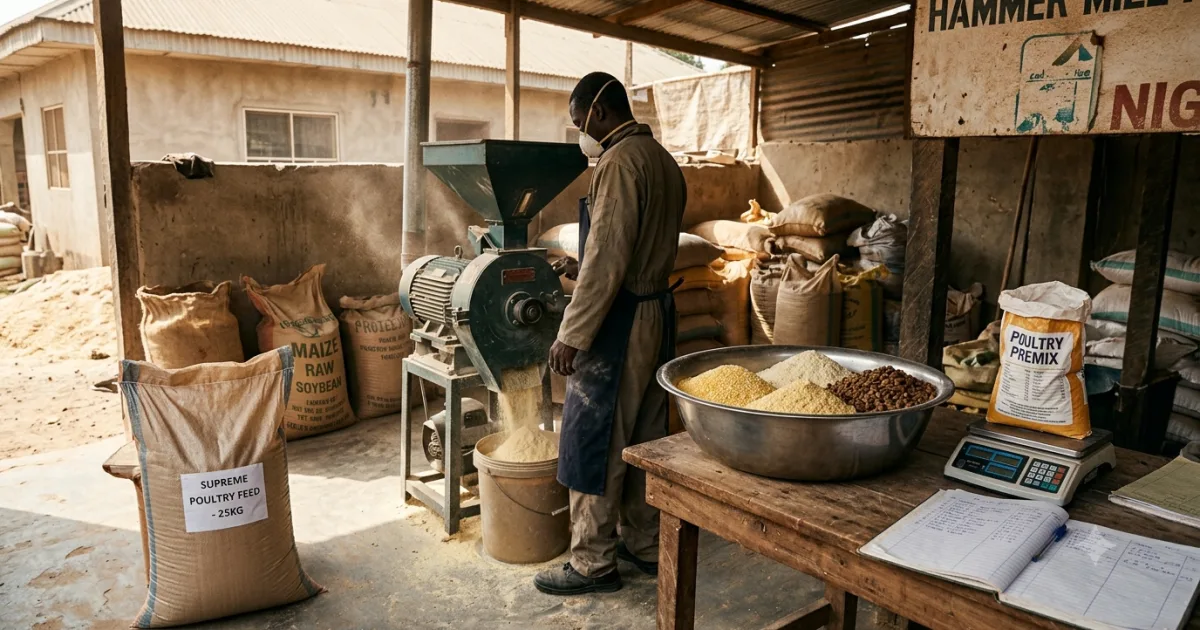
📌 Quick Summary: A poultry feed business in Nigeria involves producing or supplying compound feed for broilers, layers, and other poultry — either through a feed mill (grinding raw ingredients into pellets) or through reselling commercial feed. A small feed mill setup costs ₦800,000 to ₦2,500,000 for a hammer mill and pelletiser. Homemade broiler starter feed contains approximately 55% maize, 25% soybean meal, 5% fish meal, 8% groundnut cake, and 7% premix, limestone and salt. A feed business supplying 10 poultry farms monthly can earn ₦500,000 to ₦1,500,000 monthly gross profit. This complete guide covers the feed formulation basics, equipment needed, the broiler and layer feed recipes, NAFDAC requirements, and how to find customers.
Every poultry farmer in Nigeria faces the same problem: feed costs too much and takes too big a share of their production budget. As established in NaijaSabi’s poultry farming guide, feed accounts for 60 to 70 percent of total broiler production cost. At ₦700 to ₦850 per kilogram for commercial feed in 2026, a 1,000-bird broiler farm spends over ₦2,000,000 on feed per cycle. This cost pressure creates two business opportunities simultaneously: the opportunity to produce your own feed and reduce your own farming costs, and the opportunity to produce and sell feed to the thousands of small-scale poultry farmers in your area who face the same pressure. The poultry feed business, when set up correctly, addresses one of Nigerian agriculture’s most consistent pain points — and that pain point is large enough to build a significant business around.
Understanding Poultry Feed Composition
Poultry feed is a precisely formulated mixture of energy sources, protein sources, vitamins, and minerals — designed to meet the specific nutritional requirements of different bird types (broiler vs layer) at different growth stages. Getting the formulation wrong produces birds that grow slowly, convert feed inefficiently, or develop nutritional deficiency diseases. The four fundamental components of any poultry feed:
| Component | Function | Common Sources |
| Energy sources | Fuel for growth, movement, and body heat | Maize (corn) — the primary energy source in Nigerian poultry feed; also sorghum, millet |
| Protein sources | Building blocks for muscle, feathers, and eggs | Soybean meal (most important), groundnut cake, fish meal, blood meal, cotton seed cake |
| Vitamins and minerals | Immune function, bone development, egg production | Premix (a concentrated blend of vitamins and minerals sold commercially), limestone (calcium), dicalcium phosphate |
| Additives | Health, growth, and feed preservation | Antibiotics (regulated), probiotics, antifungals, salt |
Broiler Feed Formulation: Basic Recipes
Broiler Starter Feed (Day 1 to Day 21) — 100kg Batch
| Ingredient | Quantity | Protein Contribution |
| Maize (ground) | 55kg | Energy base — approximately 9% protein |
| Soybean meal (45% protein) | 25kg | Primary protein source |
| Fish meal (65% protein) | 5kg | High-quality protein and amino acids |
| Groundnut cake (40% protein) | 8kg | Secondary protein source — watch for aflatoxin risk in stored groundnuts |
| Broiler premix | 2.5kg | All vitamins and trace minerals |
| Limestone (calcium carbonate) | 2kg | Bone development |
| Dicalcium phosphate | 1.5kg | Phosphorus and calcium balance |
| Salt (iodised) | 0.3kg | Electrolyte balance |
| Toxin binder (mycotoxin adsorbent) | 0.5kg | Binds aflatoxins from maize and groundnut |
| Vegetable oil (optional) | 0.5kg | Increases energy density; pellet quality |
| Total | ~100kg | Target: 22–24% crude protein |
Broiler Finisher Feed (Day 28 to Market) — 100kg Batch
| Ingredient | Quantity |
| Maize (ground) | 60kg |
| Soybean meal | 22kg |
| Groundnut cake | 10kg |
| Fish meal | 3kg |
| Broiler finisher premix | 2.5kg |
| Limestone | 1.5kg |
| Salt | 0.3kg |
| Toxin binder | 0.5kg |
| Total | ~100kg — Target: 18–20% crude protein |
Equipment for a Feed Mill Business
| Equipment | Function | Cost (Nigeria 2026) |
| Hammer mill (grinding machine) | Grinds whole maize, sorghum, and other grains to the required particle size | ₦300,000 – ₦800,000 |
| Feed mixer (horizontal or vertical paddle mixer) | Blends ground ingredients uniformly — critical for feed quality consistency | ₦250,000 – ₦700,000 |
| Pelletiser (feed pellet machine) | Converts the mixed mash feed into pellets — improves feed efficiency and reduces waste | ₦400,000 – ₦1,500,000 |
| Weighing scale (platform scale) | Accurate ingredient measurement — essential for consistent formulation | ₦30,000 – ₦80,000 |
| Storage bags and sewing machine | Packaging finished feed in 25kg or 50kg bags | ₦20,000 – ₦50,000 |
| Storage facility | Dry, cool, pest-proof storage for raw ingredients and finished feed | Existing structure if available; ₦200,000+ for new construction |
| Total equipment cost (small mill) | ₦1,000,000 – ₦3,130,000 |
Raw Material Sourcing: Where to Buy Feed Ingredients in Nigeria
The profitability of a feed business depends heavily on raw material cost management. Maize: buy in bulk from northern Nigerian grain markets (Kano, Kaduna, Jos) during harvest season (October to January) when prices are lowest — prices typically rise 30 to 50 percent between harvest season and the dry season pre-harvest low. Store adequately with proper fumigation and moisture control. Soybean meal: buy from Soy processing companies and depots in Kwara, Niger, Benue states where soy is processed. Groundnut cake: available from oil mills in Kano, Kaduna, and Jigawa. Fish meal: available from fish processing facilities in Lagos, Rivers, and coastal states. Premix: available from Agriquest, Animal Care, CHI Limited, and agricultural input suppliers in major Nigerian cities.
NAFDAC Registration for Feed Businesses
Any animal feed produced and sold commercially in Nigeria requires NAFDAC registration. The registration covers: the production facility (inspection and approval), the feed formulation (laboratory analysis to confirm nutrient content), and the product label (which must state protein content, energy content, feeding instructions, and expiry). The NAFDAC animal feed registration process involves: application at a NAFDAC office, facility inspection, product sample submission for laboratory analysis, and issuance of a NAFDAC registration number. Operating a commercial feed mill without NAFDAC registration exposes the business to regulatory sanctions and product seizure. Factor the registration cost (approximately ₦150,000 to ₦400,000 depending on number of products) and timeline (3 to 6 months) into your business planning.
Profitability: Feed Supply Business Model
| Metric | Small feed supplier | Growing mill |
| Monthly production | 5,000kg (100 bags of 50kg) | 20,000kg (400 bags) |
| Cost per kg (raw materials) | ₦580 | ₦520 (bulk purchasing savings) |
| Selling price per kg | ₦720 | ₦700 |
| Gross profit per kg | ₦140 | ₦180 |
| Monthly gross profit | ₦700,000 | ₦3,600,000 |
| Less: labour, electricity, packaging | ₦200,000 | ₦800,000 |
| Monthly net profit | ₦500,000 | ₦2,800,000 |
Finding Customers for Your Feed Business
The ideal customer for a poultry feed business is a local poultry farmer who currently buys commercial feed and is looking for a cheaper alternative without sacrificing quality. Your competitive advantage: lower price than commercial brands (achievable through bulk ingredient purchasing and lower overhead than large feed companies) and local availability (no transport costs or delays). Customer acquisition strategy: start with poultry farmers in your immediate area — introduce yourself, offer a free 25kg trial bag, and ask for honest feedback on bird growth and health. A farmer whose birds grow well on your feed becomes a loyal regular customer and a referral source. Build relationships with poultry farming cooperatives in your state — cooperative members buy in bulk and represent significant volumes from a single customer relationship. Social media marketing through WhatsApp farmer groups and Facebook agricultural communities reaches a large number of poultry farmers at very low cost.
Frequently Asked Questions
How do I start a poultry feed business in Nigeria?
Start by learning the basic broiler and layer feed formulations, sourcing a small hammer mill and mixer (approximately ₦600,000 to ₦1,500,000 for entry-level equipment), sourcing raw ingredients from wholesale markets, and beginning production at a small scale (1,000 to 2,000kg per week) to validate your formulations and build a local customer base before scaling. Register the business with NAFDAC before selling commercially.
Is poultry feed production profitable in Nigeria?
Yes — significantly. The margin between raw ingredient cost and commercial feed selling price is approximately ₦100 to ₦200 per kilogram, which compounds to ₦500,000 to ₦3,000,000+ monthly at modest production volumes. The business benefits from the consistent, non-seasonal demand for poultry feed across Nigeria.
What are the main ingredients in Nigerian poultry feed?
Maize (55 to 65% of the feed by weight — the energy base), soybean meal (20 to 25% — the primary protein source), groundnut cake (5 to 10%), fish meal (3 to 5%), premix (2 to 3%), limestone, dicalcium phosphate, and salt. The exact ratio varies by bird type (broiler vs layer) and growth stage (starter, grower, finisher).
The Feed Business and the Poultry Farming Ecosystem
A poultry feed business does not exist in isolation — it sits at the centre of a local agricultural ecosystem that includes poultry farmers, veterinary drug suppliers, day-old chick hatcheries, and live bird markets. Understanding this ecosystem and positioning your feed business within it strategically multiplies your growth opportunities. The feed mill that also provides advisory support to its farmer customers — helping them diagnose feed-related performance problems, recommending vaccination schedules, connecting them with reliable fingerling or chick suppliers — becomes indispensable rather than merely a commodity supplier. Nigerian agricultural supply chains are characterised by information gaps: farmers often do not know why their birds are underperforming, and they attribute performance problems to disease when the actual cause is feed quality or formulation. A feed supplier who can correctly diagnose a feed-related performance problem and adjust the formulation builds a loyalty that price alone cannot replicate. This advisory positioning is available to any feed mill owner who invests in learning the basic principles of poultry nutrition — and the investment required is modest: a good poultry feed formulation manual, a relationship with a local veterinarian or animal nutritionist, and the habit of asking every customer how their birds are performing on your feed. The answers will improve both your product and your customer relationships simultaneously.
Sources
- NAFDAC — animal feed registration requirements — nafdac.gov.ng
- Original agricultural business guide — NaijaSabi Business Desk, September 2026
Last updated: 16 September 2026 · NaijaSabi Business Desk. Raw material prices reflect September 2026 market rates and are subject to change.
Quality Control: The Difference Between Good Feed and Bad Feed
The single biggest quality risk in Nigerian poultry feed production is aflatoxin contamination — a toxic compound produced by Aspergillus fungi that grows on improperly stored maize and groundnuts in Nigeria’s humid climate. Aflatoxin in feed causes liver damage in birds, suppresses immune function, reduces growth rate, and in severe cases kills entire flocks. It is tasteless and invisible — birds eating contaminated feed show no immediate signs, but performance deteriorates steadily over weeks. The three practices that prevent aflatoxin from reaching your feed: buy maize from reputable suppliers and inspect for mould, discolouration, or musty smell before accepting any batch; store raw maize in dry, ventilated conditions with moisture content below 13 percent — use moisture meters to verify (approximately ₦8,000 to ₦15,000 at agricultural supply stores); and add a mycotoxin binder (toxin adsorbent) at 0.5kg per 100kg of feed as a standard precaution. Reputable toxin binders available in Nigeria include Mycofix Plus, Toxisorb, and Xtract. Beyond aflatoxin, the most common feed quality failures are incorrect protein percentage (usually too low — underdeclared protein is how some cheap feed producers cut costs), incorrect premix inclusion (skipping or reducing premix to save cost destroys bird health), and excessive moisture in the finished pellet (causes mould growth during storage). Invest in a laboratory protein analysis for your first few batches — most state Ministry of Agriculture laboratories and NAFDAC facilities offer feed analysis for approximately ₦5,000 to ₦15,000 per test. Confirming your formulation produces the declared protein content before you sell commercially is both a quality practice and a legal requirement.
Scaling the Feed Business: From Small Mill to Feed Brand
The natural growth path for a successful small feed mill follows a clear progression. Start at small scale (1,000 to 2,000kg per week) with a hammer mill and mixer, supplying feed to 5 to 10 local poultry farmers. This phase validates the formulation, builds trust with customers, and generates the cash flow for reinvestment. At 5,000kg per week capacity, add a pelletiser — pelleted feed commands a premium price over mash feed (approximately ₦50 to ₦100 per kg more) and is preferred by most commercial poultry farmers for its reduced waste and better feed conversion. At 10,000kg per week, begin NAFDAC registration and branded packaging — moving from bulk sack sales to branded 25kg bags with your mill’s name and NAFDAC number. This transition enables sales to agricultural supply stores, veterinary drug stores, and eventually supermarket pet and livestock sections. Nigerian feed brands that began as small local mills — Hybrid Feeds, Farm Support, Agriquest — built their businesses exactly this way: local quality reputation first, then brand and distribution second. The Nigerian poultry feed market is large enough to support hundreds of regional feed brands, and the consistent pain point of high feed costs means farmers actively seek out cheaper local alternatives when those alternatives have demonstrable quality.



0 Comments
No comments yet. Be the first to share your thoughts!