


📌 Quick Summary: Catfish farming is one of Nigeria’s most profitable agricultural businesses in 2026. Nigeria is the world’s largest African catfish producer — yet still imports 2.5 million tonnes of frozen fish annually to meet demand. A 1,000-fish catfish pond cycle (5 to 6 months) requires startup capital of approximately ₦800,000 to ₦1,500,000 and generates gross revenue of approximately ₦1,800,000 to ₦2,500,000 — a gross profit of ₦300,000 to ₦1,000,000 per cycle. The key cost items are juvenile fish (fingerlings), feed, pond construction, and water management. This complete guide covers earthen vs concrete ponds, feed management, the 5-month production cycle, common diseases, and how to sell your catfish profitably.
Nigeria’s catfish farming opportunity is one of the most clearly documented agricultural supply gaps in Africa. The numbers tell the story plainly: Nigerian annual fish demand is 3.6 million metric tonnes. Domestic production covers only 1.2 million tonnes. The remaining 2.4 million tonnes — worth billions of naira — is imported as frozen fish, depleting Nigeria’s foreign exchange reserves and creating an enormous opportunity for domestic producers. Nigeria is simultaneously the world’s largest producer of African catfish (Clarias gariepinus) and massively short of meeting its own population’s demand. That gap — between what Nigerians eat and what Nigerian farmers currently produce — is the business opportunity that makes catfish farming one of the most consistently recommended agricultural ventures in Nigeria in 2026.
Why Catfish? The Case Over Other Fish Species
African catfish (Clarias gariepinus) dominates Nigerian aquaculture for specific biological and commercial reasons. It is extraordinarily hardy — tolerating low oxygen levels, high stocking densities, and temperature ranges that would kill tilapia or other species. It grows rapidly — reaching market weight of 800g to 1.5kg within 5 to 6 months under good management. It accepts a wide range of feeds including locally produced feed, kitchen waste supplements, and formulated pellets. It commands strong market prices across all segments — live weight at farm gate, fresh at wet markets, smoked for long-distance trade, and dried for export to the Nigerian diaspora. And critically for a Nigerian producer — every Nigerians eats catfish. Point-and-kill catfish pepper soup is the country’s most iconic bar and restaurant dish. Catfish is in every major Nigerian market every day. The demand is not seasonal, not uncertain, and not dependent on export markets. It is domestic, consistent, and growing.
Pond Types: Earthen vs Concrete vs Tarpaulin
| Pond Type | Construction Cost (per 100sqm) | Advantages | Disadvantages | Best For |
| Earthen pond | ₦150,000 – ₦400,000 | Cheapest to construct; supports natural food organisms; most like natural habitat | Requires land; difficult to drain completely; harder to control water quality; predator access | Large-scale farms with land access; rural locations |
| Concrete pond | ₦400,000 – ₦1,200,000 | Durable (10+ years); easy to drain and clean; precise stocking control; urban/peri-urban friendly | Highest construction cost; no natural food organisms; requires pH management initially (new concrete is alkaline) | Commercial urban farms; long-term investment |
| Tarpaulin/plastic pond | ₦80,000 – ₦200,000 | Cheapest entry point; portable; can be set up in small spaces; backyard-friendly | Shorter lifespan (2 to 3 years); temperature management challenges in Nigerian heat; structural integrity risk | Beginners; small-scale trials; backyard farmers |
Recommendation for Nigerian beginners: Start with 2 to 4 tarpaulin ponds (each approximately 3m × 2m × 1m) as a low-cost trial — this limits your initial investment to ₦200,000 to ₦400,000 for pond setup while you learn management. If the first cycle is profitable, reinvest into concrete ponds for long-term commercial production.
The 5 to 6 Month Production Cycle
| Month | Stage | Key Activities | Critical Points |
| Month 1 | Stocking and nursery | Stock fingerlings (5 to 7cm, 3 to 5g each) at 50 to 100 per square metre in nursery tank. Feed 3 to 5 times daily with 45% protein starter crumble. | Fingerling quality determines everything. Buy from reputable hatcheries only. Poor-quality fingerlings produce poor yields regardless of feed quality. |
| Month 2 | Early juvenile | Transfer to growout pond at 50 to 75 fish per square metre. Transition to 45% protein floating pellet. Begin twice-daily feeding. | Monitor for cannibalism — catfish are cannibalistic when sizes diverge. Grade (size-sort) fish at end of month 2 to keep size-uniform batches together. |
| Month 3 to 4 | Peak growth phase | Continue floating pellet feed at 3 to 5% of body weight daily. Monitor water quality — ammonia and dissolved oxygen are critical. Partial water changes weekly. | This is the highest feed consumption period. Feed represents 60 to 70% of total production cost. Feed exactly to appetite — overfeeding wastes money and degrades water quality; underfeeding reduces growth. |
| Month 5 | Market preparation | Reduce feeding rate. Begin marketing — notify buyers and market contacts. Assess average weight (target: 800g to 1.5kg). Plan harvest date. | Most catfish reach optimal market weight at month 5. Holding beyond 6 months increases feed cost without proportional weight gain in most Nigerian farming conditions. |
| Month 5 to 6 | Harvest and sale | Harvest progressively or all at once depending on market demand. Sell live (highest price), fresh-killed, or to smokers/processors. | Coordinate your harvest with buyers in advance. A pond full of mature catfish with no confirmed buyer is a serious risk — negotiate buyers before harvest month. |
Feed Management: Your Biggest Cost and Biggest Variable
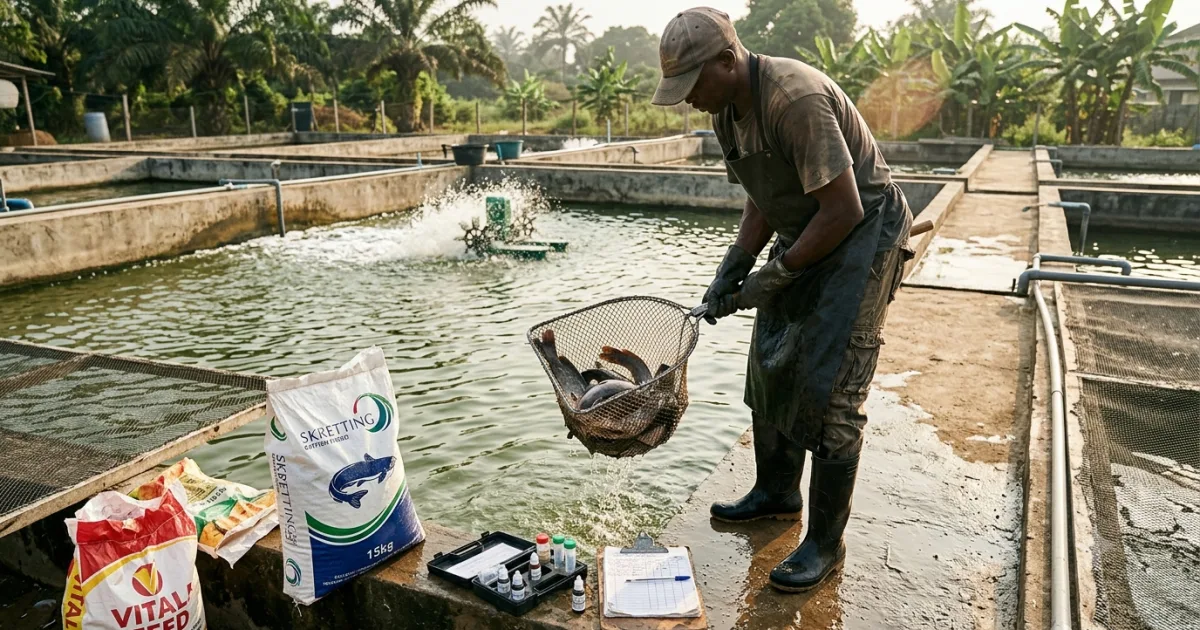
Catfish feed is the single largest cost in any production cycle — accounting for 60 to 70% of total operating cost. Getting feed management right is the most impactful skill a Nigerian catfish farmer can develop. The key metrics: Feed Conversion Ratio (FCR) — how many kilograms of feed are required to produce 1 kilogram of fish weight gain. A well-managed Nigerian catfish pond achieves FCR of 1.5 to 2.0 — meaning 1.5 to 2kg of feed per 1kg of fish produced. A poorly managed pond can see FCR of 3.0 or higher — nearly doubling the effective feed cost per kilogram of fish produced. Feed quality determines FCR — higher protein content (40 to 45% for growing catfish) produces better FCR than cheaper low-protein feeds, even when the price per kilogram is higher. Do the calculation: ₦700/kg feed at FCR 1.6 costs ₦1,120 in feed per kilogram of fish. ₦500/kg feed at FCR 2.5 costs ₦1,250 per kilogram of fish. The cheaper feed is more expensive in practice. Brands widely used by Nigerian catfish farmers: Skretting (Norwegian brand, highest quality), Coppens (Dutch brand), Aller Aqua, and Nigerian-produced brands including Vital Feed and Olam Feed. Floating pellets are strongly preferred over sinking pellets — floating pellets allow you to observe exactly how much fish are eating and remove uneaten feed before it degrades water quality.
Water Quality Management
Poor water quality kills catfish faster than any disease. The three most critical parameters for Nigerian catfish ponds: Dissolved Oxygen (DO) — catfish tolerate lower oxygen than most species but growth rate drops sharply below 3mg/L. Aerate ponds with paddle wheel aerators or air pumps during the peak growth phase, especially in hot weather when oxygen levels naturally drop. Ammonia — the breakdown product of fish waste and uneaten feed. Ammonia above 0.5mg/L stresses fish and increases disease susceptibility. Partial water changes of 20 to 30% weekly dilute ammonia and other waste products. pH — ideal range for catfish is 6.5 to 8.0. New concrete ponds are highly alkaline initially (pH 10+) and must be cured (filled with water and left for 2 to 3 weeks, then drained) before stocking. Test water quality weekly using inexpensive test kits available from aquaculture supply stores in Lagos (Mushin and Mile 12 markets), Ibadan, and Onitsha.
Profitability Calculator: 1,000 Catfish per Cycle
| Item | Cost/Revenue |
| Fingerlings (1,000 × ₦120 each) | ₦120,000 |
| Feed (1,000 fish × 1.5kg growth × 1.8 FCR × ₦750/kg feed) | ₦2,025,000 |
| Medications and probiotics | ₦25,000 |
| Water management and electricity | ₦40,000 |
| Labour (part-time, 6 months) | ₦120,000 |
| Pond maintenance and miscellaneous | ₦30,000 |
| Total Operating Cost (excluding pond construction) | ₦2,360,000 |
| Revenue: 850 fish surviving (15% mortality) × 1.2kg avg × ₦3,200/kg live weight | ₦3,264,000 |
| Gross Profit per Cycle | ₦904,000 |
| Annual Gross Profit (2 cycles/year) | ₦1,808,000 |
Selling Your Catfish: The Four Market Channels
How you sell determines your actual profit margin as much as how you grow. Four channels available to Nigerian catfish farmers in 2026. Live weight direct to consumers: the highest price — ₦3,000 to ₦5,000 per kilogram for live catfish sold directly from the farm, particularly in point-and-kill restaurant markets. Requires buyers who can transport live fish or a farm gate selling operation. Fish market processors: selling to fish market traders who process (smoke or freeze) and redistribute — lower price per kilogram (₦2,500 to ₦3,200 live weight) but faster transaction and less logistics. Restaurants and pepper soup joints: building relationships with the restaurants and points-and-kill bars in your area that consistently need fresh catfish — typically weekly orders at ₦2,800 to ₦3,500 per kilogram. Smokers and processors: catfish smoked for retail and export commands the highest value-added price — smoked catfish sells at ₦8,000 to ₦15,000 per kilogram in Lagos markets and significantly more in the diaspora market. Building a relationship with a reliable fish smoker or establishing your own smoking operation is the highest-margin route for established farms.
Common Diseases and Prevention
The most common catfish diseases in Nigerian aquaculture and their prevention. Bacterial infections (Aeromonas, Pseudomonas): manifested as red sores, fin rot, and ulcers. Prevention: maintain water quality, avoid overcrowding, quarantine new fish. Treatment: antibiotic bath (consult a veterinarian for appropriate products — antibiotic resistance is an increasing concern in Nigerian aquaculture). Parasitic infections (gill flukes, anchor worm): manifest as excessive mucus, scratching, and respiratory distress. Prevention: quarantine all new fish, treat incoming fingerlings prophylactically. Treatment: salt baths (3% saline for 10 to 15 minutes) for external parasites; consult aquaculture supply specialist for heavy infestations. Fungal infections (Saprolegnia): manifested as white cotton-wool growth on skin or eggs. Common in cold-stressed or injured fish. Prevention: maintain water temperature above 24°C; handle fish carefully to avoid skin damage. Treatment: potassium permanganate bath.
Frequently Asked Questions
How much does it cost to start catfish farming in Nigeria?
A 1,000-fish tarpaulin pond setup costs approximately ₦500,000 to ₦800,000 for the first cycle including pond setup, fingerlings, and feed. A 1,000-fish concrete pond operation costs ₦1,200,000 to ₦2,000,000 including construction. Operating costs for subsequent cycles (without construction) run ₦400,000 to ₦600,000 per 1,000 fish per cycle.
How long does catfish take to reach market size in Nigeria?
5 to 6 months from fingerling to market weight of 800g to 1.5kg under good management conditions. Growth rate is heavily influenced by feed quality, stocking density, water temperature, and dissolved oxygen levels.
What is the profit from catfish farming in Nigeria?
A well-managed 1,000-fish cycle generates gross profit of ₦500,000 to ₦1,000,000 per cycle, or ₦1,000,000 to ₦2,000,000 annually for two cycles per year. Actual profit depends significantly on feed costs, mortality rates, and selling price at time of harvest.
Where can I buy catfish fingerlings in Nigeria?
Reputable fingerling suppliers exist in Lagos (Ikorodu, Badagry), Ibadan, Ogun State, Oyo State, and across the Southeast. Buy only from registered, established hatcheries — poor-quality fingerlings from unregistered sources are the most common cause of first-cycle failure for Nigerian catfish farmers. Ask for certification and visit the hatchery before purchasing.
Sources
- FAO FISH4ACP Nigeria — “Making Nigeria’s catfish sector stronger” — fao.org — 2025
- Original business guide — NaijaSabi Business Desk, September 2026
Last updated: 14 September 2026 · NaijaSabi Business Desk. Costs reflect Nigerian market prices as at September 2026 and are subject to change.
Catfish Farming and the Nigerian Diaspora Export Opportunity
One of the most compelling and underexploited opportunities in Nigerian catfish farming is the export market to the Nigerian diaspora — the approximately 17 million Nigerians living abroad, concentrated in the UK, USA, Canada, Italy, and Ireland. Smoked catfish is one of the most consistently demanded Nigerian food products in diaspora markets, where it sells at significant premiums over Nigerian domestic prices. Nigerian grocery stores in London, Houston, Atlanta, Toronto, and Dublin carry smoked catfish and dried fish products imported from Nigeria and West Africa — but supply is often inconsistent and quality varies widely. A Nigerian catfish farmer who establishes consistent, high-quality smoked catfish production and develops relationships with importers in diaspora markets can access a pricing tier that domestic sales cannot reach. The barriers: NAFDAC export certification for processed fish products, packaging that meets import country food safety standards, and a reliable logistics partner for air freight of perishable products. These barriers are not trivial — but they are achievable for an established farmer producing consistent quality, and the margin improvement from export pricing (3 to 5 times domestic smoked catfish prices) makes the investment worthwhile.


0 Comments
No comments yet. Be the first to share your thoughts!