




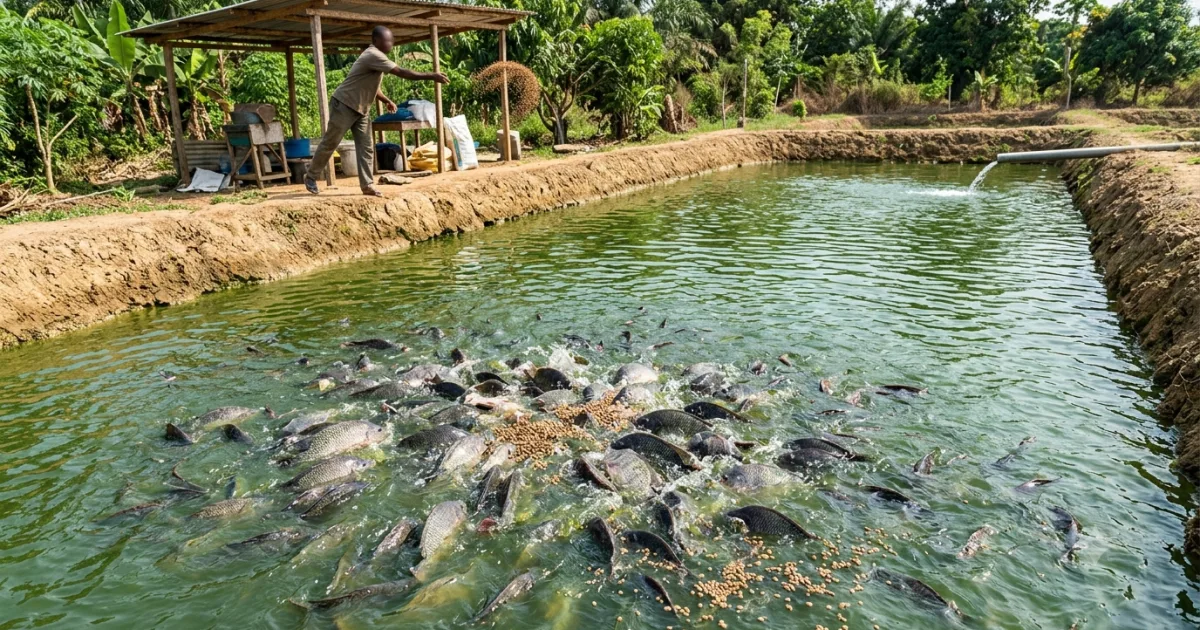
📌 Quick Summary: Tilapia farming in Nigeria requires startup capital of ₦300,000 to ₦1,500,000 depending on pond size and construction method. Tilapia reach market weight of 400 to 600g in 5 to 6 months (or 800g to 1kg in 8 to 9 months for larger market size). A 500-square-metre earthen pond stocked at 3 fish per square metre (1,500 fish) produces approximately 600 to 900kg of fish per cycle. Tilapia sells at ₦2,500 to ₦5,000 per kilogram — lower than catfish but achievable with lower feed cost (tilapia are omnivorous and can utilise pond algae and plankton as a significant part of their diet). This guide covers pond construction, stocking, feeding, water quality management, and where to sell tilapia profitably in Nigeria.
Tilapia farming is often discussed alongside catfish farming in Nigeria but is fundamentally different in production biology, market positioning, and management requirements. Nile tilapia (Oreochromis niloticus) — the species most commonly farmed in Nigeria — is a hardier, more temperature-tolerant, and more disease-resistant fish than catfish, with a more flexible diet that allows significant production cost reduction through algae and plankton feeding in earthen ponds. The market price for tilapia is lower than catfish (₦2,500 to ₦5,000/kg versus ₦3,500 to ₦7,000/kg for catfish), but the lower feed cost and greater disease resistance of tilapia frequently produces a better net margin per kilogram than catfish farming at equivalent production scales. This guide provides a complete foundation for starting a tilapia farming operation in Nigeria.
Tilapia vs Catfish: Key Differences for Nigerian Farmers
| Factor | Tilapia (Nile) | Catfish (Clarias) |
| Market price per kg | ₦2,500 – ₦5,000 | ₦3,500 – ₦7,000 |
| Feed cost | Lower — can utilise algae and plankton; FCR 1.5 to 2.0 | Higher — relies primarily on commercial feed; FCR 1.5 to 2.5 |
| Growth rate to 500g | 5 to 6 months | 4 to 5 months in intensive systems |
| Disease resistance | Higher — tolerates poor water quality better | Moderate — sensitive to dissolved oxygen levels |
| Pond type suitability | Excellent in earthen ponds — utilises natural productivity | Better in concrete or tarpaulin tanks for intensive production |
| Main Nigerian market | Household fresh market, institutional buyers, processors | Premium fresh market, smoked fish, restaurants |
| Monosex requirement | Yes — use all-male fingerlings to prevent population explosion from tilapia’s rapid reproduction | Not applicable |
The Monosex Requirement: Why You Must Use Male-Only Tilapia
Tilapia reproduce prolifically — a female can spawn every 4 to 6 weeks and produce 100 to 300 fry per spawn. In a mixed-sex pond, the fish population explodes with juvenile fish that compete with the target market-size fish for feed and space, dramatically reducing average fish size at harvest and destroying yield economics. The solution: stock all-male (monosex) fingerlings produced through sex reversal — feeding 17-alpha methyltestosterone hormone to fry during the first 21 days of life converts female fry to functional males. Reputable tilapia hatcheries and government fish farms produce all-male fingerlings specifically for commercial farmers. Always buy fingerlings from a certified source that guarantees high male percentage (95 percent+ male). Never stock mixed-sex tilapia fingerlings in a commercial production pond.
Pond Types and Construction
Three pond types commonly used for tilapia farming in Nigeria. Earthen ponds — the most common and lowest-cost option. A 500-square-metre earthen pond (25m × 20m) in a suitable clay-loam soil location costs ₦200,000 to ₦600,000 to excavate and construct with inlet and outlet pipes, embankment compaction, and liming treatment. Earthen ponds support the natural algae and plankton growth that reduces tilapia feed cost significantly. Concrete ponds — more expensive to construct (₦500,000 to ₦2,000,000+ for equivalent size) but more controllable, easier to clean between production cycles, and suitable for higher stocking densities. Better in urban or peri-urban settings where soil quality or land availability prevents earthen pond construction. Tarpaulin tanks (collapsible ponds) — the most flexible and lowest startup cost option for small-scale urban tilapia farming. A 10,000-litre tarpaulin tank costs ₦40,000 to ₦80,000 and can stock 200 to 300 tilapia. Requires aerators (water pump and air stone) as the small water volume does not support the dissolved oxygen levels tilapia need at high stocking density.
Stocking and Feeding
Stocking density for earthen ponds: 2 to 4 fish per square metre (1,000 to 2,000 fish per 500m² pond) for semi-intensive production. Higher densities require supplemental aeration and more intensive feeding management. Fingerling size at stocking: 5 to 10g (approximately 4 to 6 weeks old from hatch). Feeding rate: 3 to 5 percent of estimated total fish biomass per day, divided into 2 to 3 daily feedings. Reduce feeding rate as fish grow larger (mature tilapia closer to 1 to 2 percent of body weight per day). Commercial tilapia feed (35 to 40 percent crude protein for fingerlings, 28 to 32 percent for grow-out) is available from the same suppliers as catfish feed in Nigeria. In earthen ponds with good plankton development, supplemental feeding can be reduced by 30 to 40 percent of what a concrete or tarpaulin pond requires — significantly reducing feed cost per kilogram of fish produced. Fertilising the earthen pond with poultry manure (at 200kg per hectare per month) stimulates plankton growth that provides natural nutrition for the tilapia, further reducing commercial feed dependency.
Water Quality Management
Tilapia are notably tolerant of poor water quality compared to catfish — they survive temperatures from 16 to 40°C, tolerate dissolved oxygen as low as 1 mg/L (though they perform best above 4 mg/L), and withstand moderate ammonia levels. This tolerance makes them significantly more forgiving for farmers without sophisticated water monitoring equipment. Essential water quality practices: maintain water depth of 1 to 1.5m in earthen ponds (deeper water reduces temperature fluctuation); replace 10 to 20 percent of pond water weekly to reduce ammonia accumulation; monitor for algal blooms (excessive green water indicating nitrogen buildup — address by reducing feeding rate and partial water exchange); lime the pond (agricultural lime at 500 to 1,000kg per hectare) before each production cycle to raise pH to 7 to 8 and reduce pathogen load.
Harvest and Market
Tilapia are harvested at 400 to 600g for the standard Nigerian market (5 to 6 months), or grown to 800g to 1kg for premium restaurant and hotel buyers (8 to 9 months). Use seine nets for partial harvesting — regularly removing larger fish while allowing smaller ones to continue growing improves average size and revenue per cycle. The primary Nigerian buyers for farmed tilapia: fresh fish markets (Mile 12 and Oyingbo in Lagos; Wuse Market in Abuja), supermarket fresh fish counters, institutional buyers (schools, hospitals, prisons, factory canteens), and fish processors for smoking. Building institutional supply relationships — where you deliver a fixed weekly quantity at a pre-agreed price — provides the revenue predictability that fresh market sales cannot.
Frequently Asked Questions
Is tilapia or catfish farming more profitable in Nigeria?
Both can be profitable — the answer depends on available infrastructure and market access. Catfish commands higher market prices but requires more intensive management and higher feed cost. Tilapia in earthen ponds has lower feed cost and greater disease resistance, producing competitive margins at a lower per-kilogram selling price. For farmers with access to suitable land for earthen ponds and institutional buyer relationships, tilapia can be more profitable per naira of capital invested.
How long does tilapia take to grow in Nigeria?
5 to 6 months to reach 400 to 600g market weight. 8 to 9 months to reach 800g to 1kg premium market weight. Growth rate depends heavily on stocking density, water temperature, feed quality and quantity, and the proportion of natural pond productivity contributing to nutrition.
Where can I buy tilapia fingerlings in Nigeria?
NIOMR (Nigerian Institute for Oceanography and Marine Research), state government fish farms, and several private hatcheries in southwestern Nigeria (Ogun, Oyo, Lagos States) and the Niger Delta produce and sell all-male Nile tilapia fingerlings. Always request a male percentage certificate from your fingerling supplier and inspect for uniformity of size before accepting delivery. Nigeria’s fish deficit is not a constraint on tilapia farming ambition — it is the structural argument for why a well-run tilapia farm in 2026 will find buyers before it finds production capacity. Every kilogram of farmed tilapia sold in Nigeria is a kilogram that does not need to be imported — and the farmer who produces it captures the economic value that currently flows out of Nigeria to foreign fish exporters. Tilapia farming, done well, is a business that feeds Nigeria and builds Nigerian wealth simultaneously — a combination that makes it one of the most compelling agricultural investment opportunities available to Nigerian entrepreneurs in 2026.
Sources
- NIOMR — tilapia production guidelines — niomr.gov.ng
- Original agricultural guide — NaijaSabi Business Desk, September 2026
Last updated: 24 September 2026 · NaijaSabi Business Desk.
Tilapia Farming and Nigeria’s Fish Deficit
Nigeria consumes approximately 3.3 million metric tonnes of fish annually but domestic production covers only about 1 million metric tonnes — leaving a deficit of over 2 million metric tonnes that is filled by imports at a cost of billions of dollars annually. This deficit is one of the most significant structural opportunities in Nigerian agriculture: the demand for fish exists, is growing, and cannot be met by wild capture fisheries that are already under pressure from overfishing and declining stocks. Aquaculture — particularly catfish and tilapia farming — is the primary pathway to closing this gap. Government policy in 2026 reflects this priority: the Central Bank of Nigeria’s Agribusiness Credit Scheme and several state government agricultural loan programmes specifically target tilapia and catfish farmers with subsidised credit. New tilapia farmers who align their business with these programmes can access credit at 9 to 12 percent annual interest rather than the 25 to 35 percent rates that informal lenders charge — a meaningful cost reduction for a capital-intensive business. The Bank of Agriculture and the Agricultural Credit Guarantee Scheme Fund (ACGSF) are the primary government-backed funding sources worth investigating before committing personal capital to a tilapia farming investment.
Processing Tilapia for Higher Margins
Fresh tilapia commands ₦2,500 to ₦5,000 per kilogram at market. Processed tilapia — smoked, dried, or filleted — commands significantly higher prices and has longer shelf life, opening distribution channels unavailable to fresh fish producers. Smoked tilapia sells at ₦5,000 to ₦9,000 per kilogram — a 50 to 80 percent premium over fresh. Tilapia fillets (boneless, skinless) command ₦6,000 to ₦12,000 per kilogram at supermarkets and hotel restaurants that prefer the convenience of boneless fish over whole fish. A tilapia farm that processes 30 to 40 percent of its harvest as smoked or filleted product — rather than selling everything fresh — significantly improves revenue per kilogram of fish produced. The processing equipment investment is modest: a smoking kiln (₦80,000 to ₦200,000) and a filleting table with sharp knives are the primary capital requirements for value-added tilapia processing. The market for processed tilapia in Nigeria is growing rapidly as urban Nigerians with busy schedules increasingly prefer the convenience of ready-to-cook, bone-free fish protein over the traditional whole fish purchase that requires cleaning, gutting, and often extensive cooking preparation.
Integrated Tilapia-Rice or Tilapia-Vegetable Systems
The most efficient use of tilapia pond infrastructure in Nigeria combines fish production with crop production in the same water system. In tilapia-rice integration, rice is planted on raised platforms or bunds surrounding the tilapia pond — the fish droppings fertilise the water, which irrigates the rice; the rice straw after harvest becomes tilapia feed and additional pond substrate that stimulates plankton growth. In tilapia-vegetable integration, the nutrient-rich pond water is used to irrigate vegetable beds positioned below and around the pond — creating an aquaponics-style system where the fish waste directly fertilises the vegetables without the need for chemical fertiliser application. These integrated systems produce two revenue streams from the same land and water resource, significantly improving the return per square metre of farm land compared to tilapia-only or crop-only production. They are more complex to manage but the efficiency gains are well-documented across Nigerian agricultural research institutions including the National Aquaculture Research and Development Agency (NARDES) at Onisha, Anambra State.




0 Comments
No comments yet. Be the first to share your thoughts!