




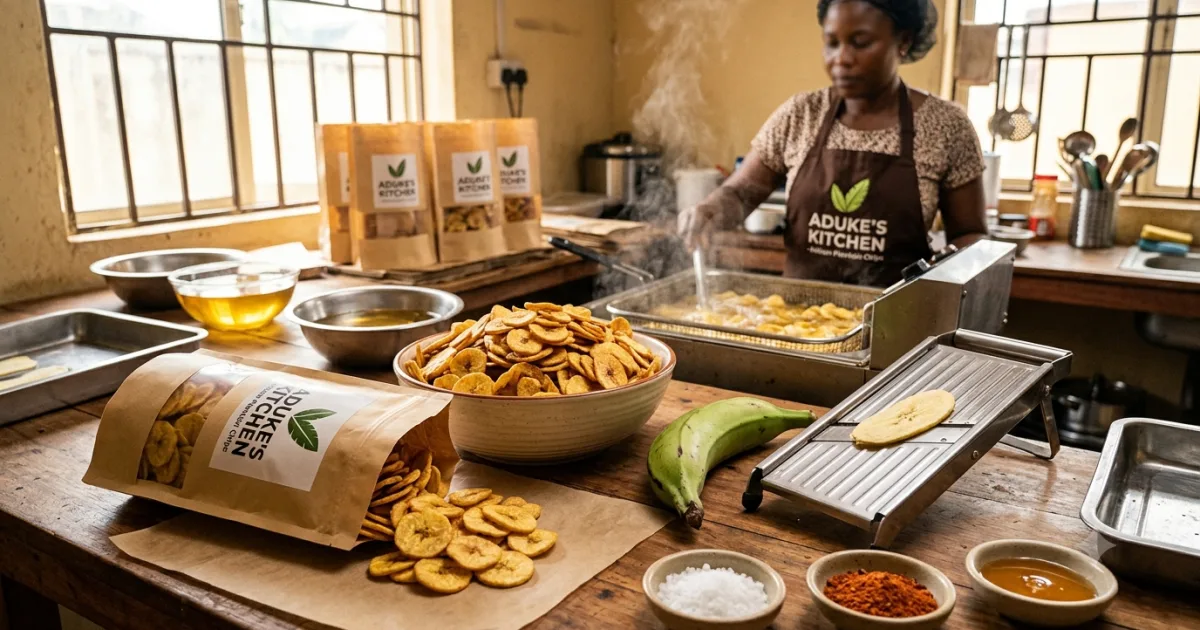
📌 Quick Summary: A plantain chips business in Nigeria starts at just ₦30,000 to ₦80,000 — making it one of Nigeria’s cheapest food businesses to start. The production process: buy unripe plantain (₦150 to ₦300 per finger), slice thinly, season, fry in vegetable oil, package, and sell. A 50-finger batch of unripe plantain (cost ₦8,000 to ₦15,000) produces approximately 4 to 5kg of finished chips that sell for ₦3,000 to ₦6,000 per kilogram — gross revenue of ₦12,000 to ₦30,000 per batch. A plantain chips business producing 3 batches per week earns ₦150,000 to ₦360,000 monthly gross revenue. This guide covers the full recipe, equipment, seasoning variations (salted, spicy, honey, barbecue), packaging for retail and events, NAFDAC registration, and how to build a wholesale distribution network.
Plantain chips is one of Nigeria’s most consistently popular snack foods — eaten at office desks, in market stalls, during road trips, at children’s parties, and at every owambe where the small chops tray makes its obligatory appearance. The snack’s popularity is grounded in something fundamental: fried unripe plantain, sliced thin and seasoned correctly, is simply delicious. It is crunchy, mildly sweet-starchy, versatile in its seasoning options, and satisfying in a way that connects Nigerians to a familiar food experience. The business opportunity exists because most plantain chips available in Nigerian shops are produced by a small number of large brands — and the handmade, fresh, quality-differentiated product that a small-scale producer can make consistently commands premium prices and loyal customers that the large branded options cannot easily match at their scale.
The Plantain Chips Market in Nigeria
Nigeria’s packaged snack market — of which plantain chips is a significant segment — is worth billions of naira annually and continues to grow as urbanisation increases the proportion of Nigerians eating packaged convenience snacks rather than home-cooked foods. The three market tiers a Nigerian plantain chips business can target: the mass market (unpackaged or basic-packaged chips sold at kiosks, market stalls, and roadside — lowest price, highest volume, thinnest margin), the retail market (branded, NAFDAC-registered, attractively packaged chips sold in supermarkets and convenience stores at ₦500 to ₦2,000 per pack), and the premium/artisan market (small-batch, unique seasoning, premium packaging chips sold through Instagram, upmarket gift shops, and corporate hamper companies at ₦1,500 to ₦5,000 per pack). The premium market is the most accessible for a small-scale producer and the most defensible — large brands cannot easily replicate small-batch freshness and unique seasoning at their production scale.
Ingredients and Equipment
| Item | Quantity / Specification | Cost |
| Unripe plantain (green) | 50 fingers per batch | ₦8,000 – ₦15,000 |
| Vegetable oil (for frying) | 5 to 10 litres per batch (reusable for 3 to 5 batches) | ₦7,000 – ₦15,000 initial |
| Salt, seasoning, spices | As required per flavour variant | ₦2,000 – ₦5,000 |
| Manual or electric slicer | Mandoline slicer for uniform thin slices (1 to 2mm) | ₦3,000 – ₦30,000 |
| Deep fryer or large frying pot | Industrial 10 to 15 litre capacity | ₦15,000 – ₦60,000 |
| Basket strainer and cooling racks | For draining and cooling chips before packaging | ₦3,000 – ₦8,000 |
| Packaging machine (impulse sealer) | For sealing polythene or foil bags | ₦8,000 – ₦25,000 |
| Packaging bags (foil or clear polythene, branded) | 100 to 200 per batch | ₦2,000 – ₦5,000 per batch |
| Gas cooker (industrial) | For frying | ₦20,000 – ₦60,000 (if not already owned) |
| Total startup (minimum viable) | ₦40,000 – ₦120,000 |
The Full Plantain Chips Recipe
Step 1: Select and Peel the Plantain
Use fully unripe (hard green) plantain — not yellow, not partially ripe. Ripe or semi-ripe plantain produces soft, sweet chips that do not stay crispy and have a shorter shelf life. Unripe plantain gives the starchy, satisfying crunch that is characteristic of good plantain chips. Peel and immediately place in salted cold water (1 tablespoon salt per litre) to prevent browning. Keep peeled plantain in the salt water until you are ready to slice.
Step 2: Slice Uniformly Thin
Uniform slice thickness is the single most important determinant of even frying. Slices that vary in thickness will have some burnt and some undercooked chips in the same batch. Use a mandoline slicer set to 1.5 to 2mm for the ideal thickness — thin enough to fry quickly and evenly, thick enough to have structure and crunch rather than being paper-thin. Slice on the diagonal (at 45 degrees to the plantain’s length) for the classic elongated oval shape, or straight across for round chips.
Step 3: Season Before Frying
Drain the sliced plantain and pat dry with a clean cloth — excess moisture causes violent splattering when dropped into hot oil. Toss in your seasoning before frying: for salted chips — fine sea salt (1 teaspoon per 20 fingers); for spicy chips — ground cayenne pepper, suya spice, or jollof seasoning blend; for honey chips — drizzle honey and a pinch of sea salt after frying (not before). Season lightly before frying — you can always add more after, but you cannot remove overseasoning from fried chips.
Step 4: Fry at the Correct Temperature
Heat vegetable oil to 170 to 180°C — use a cooking thermometer to verify. Oil that is too cool (below 160°C) produces greasy, soft chips that do not crisp. Oil that is too hot (above 190°C) burns the chips before the interior dries out. Add chips in small batches — never overcrowd the fryer, as too many chips drop the oil temperature significantly and produce uneven frying. Fry for 3 to 5 minutes until golden to deep golden, turning once. The chips will continue to crisp as they cool — do not fry until completely hard, as they will over-crisp on the rack.
Step 5: Drain, Cool, and Package
Remove fried chips to a wire rack or basket lined with paper towels. Allow to cool completely — 20 to 30 minutes — before packaging. Never package warm chips: the residual heat creates condensation inside the sealed bag, causing sogginess and rapid mould growth. Package in foil bags (for premium retail and gift packaging) or clear polythene (for market and kiosk sales). Seal with an impulse sealer. Add a NAFDAC registration number, production date, best-before date (typically 4 to 8 weeks for well-fried, properly sealed chips), ingredients list, and your brand name and contact details.
Seasoning Variations That Sell Well in Nigeria
Five flavour variants proven in the Nigerian market. Classic salted — the most widely consumed; simple, universally liked, and the correct baseline. Spicy suya — toss in yaji/suya spice after frying for a northern Nigerian-inspired heat and peanut note. Jollof seasoning — a proprietary blend that evokes jollof rice flavour — unusual enough to be interesting, familiar enough to be immediately liked. Honey and sea salt — a premium sweet-savoury option targeting the upmarket gift and hamper segment. Lemon pepper — a light citrus-spice blend popular in Lagos’s international-facing food scene. Launch with 2 to 3 variants to manage production complexity, then add more based on customer demand data.
Building Distribution for Your Plantain Chips
The fastest distribution path for a new Nigerian plantain chips business: start with Instagram and WhatsApp direct sales to build initial revenue and customer feedback, then graduate to supplying kiosks and convenience stores in your immediate area (50 to 100 stores each buying 10 to 20 packs weekly is significant volume), then approach supermarkets and gift shops with your NAFDAC-registered, professionally packaged product. Corporate hamper companies — which assemble gift hampers for companies to distribute at Christmas and other occasions — are a high-volume, seasonal but very lucrative channel: a single hamper company order of 500 packs for the December hamper season can generate ₦500,000 to ₦1,500,000 in a single transaction.
Frequently Asked Questions
How much does it cost to start a plantain chips business in Nigeria?
₦30,000 to ₦80,000 for a home-based operation using existing kitchen equipment plus a mandoline slicer, impulse sealer, and initial raw materials. A more equipped operation with an industrial fryer and packaging machine requires ₦100,000 to ₦250,000.
How long do Nigerian plantain chips last?
4 to 8 weeks in properly sealed foil bags stored at room temperature, away from direct sunlight and heat. The key factors are complete cooling before packaging, airtight sealing, and low oil content (well-fried chips with minimal residual oil last longer than under-fried, oily chips).
Do I need NAFDAC registration for plantain chips in Nigeria?
For informal local market and direct sales, NAFDAC registration is often deferred at startup. For supplying supermarkets, shops, corporate orders, or any product with labelling, NAFDAC registration is required. Register through the NAFDAC Small Scale and Cottage Industry food registration pathway. The plantain chips business rewards the entrepreneur who pays attention to detail at every stage — the freshness of the raw plantain, the uniformity of the slice, the temperature of the oil, the completeness of the cool-down before packaging — because it is exactly those details that produce a chip that customers describe to their colleagues the next day. Start small, produce with discipline, listen to your first customers, and the business will tell you exactly how to grow it.
Sources
- Original business guide and recipe — NaijaSabi Business Desk, September 2026
Last updated: 24 September 2026 · NaijaSabi Business Desk.
Plantain Chips as an Export Product
Nigerian plantain chips have genuine export potential — particularly to diaspora Nigerian communities in the UK, USA, Canada, and continental Europe who have strong nostalgic demand for authentic Nigerian snacks but limited access to quality products. A 500g bag of Nigerian plantain chips that sells for ₦2,000 in Lagos retails at £6 to £10 in London African food stores and at $8 to $15 on Nigerian diaspora online shopping platforms. The currency arbitrage is significant: the production cost that generates a 200 percent margin in naira generates a 500 to 800 percent margin in pounds or dollars. The practical requirements for exporting plantain chips from Nigeria: NAFDAC registration (mandatory for any exported food product), food safety certification (HACCP compliance is typically required by UK, EU, and US importers), properly labelled packaging in English with all required information (ingredients, nutrition facts, net weight, best before date, country of origin, NAFDAC number), and relationship with a freight forwarder experienced in Nigerian food export. The UK and USA Nigerian diaspora market for authentic Nigerian snacks is served by a small number of importers who are consistently looking for quality, reliable new suppliers — a Nigerian plantain chips producer who can supply 500 to 1,000 units monthly on a consistent schedule, with consistent quality and food safety certification, will find a receptive audience among these importers.
Operational Tips: Running a Plantain Chips Business Efficiently
Five operational practices that separate profitable Nigerian plantain chips businesses from those that struggle. First: buy plantain in bulk from farmers or wholesalers at Mile 12 Market in Lagos or equivalent produce markets in other cities — bulk buying at ₦100 to ₦150 per finger versus retail market prices of ₦200 to ₦350 per finger makes a significant difference to margin on a product where raw material is the primary cost. Second: standardise your batch size and documentation — the same batch size every time, with recorded weight of raw plantain in, finished chips out, and oil used, gives you the data to price correctly and identify when your production efficiency is declining. Third: change frying oil on a schedule rather than by appearance — used oil darkens naturally but remains usable for 3 to 5 batches if filtered after each use. Beyond 5 batches, the smoke point drops and the chips begin to taste off. Fourth: invest in the right slicer early — a good mandoline slicer is the difference between consistent 1.5mm slices (which fry evenly) and irregular slices (which produce a batch of half-burnt, half-underdone chips). Fifth: get customer feedback on your first 20 to 30 packs sold — the specific flavour feedback, packaging preference, and price acceptance data from your first real customers is more valuable than any market research and costs nothing to collect. Ask every early buyer what they would change and listen carefully to the answers.



0 Comments
No comments yet. Be the first to share your thoughts!