




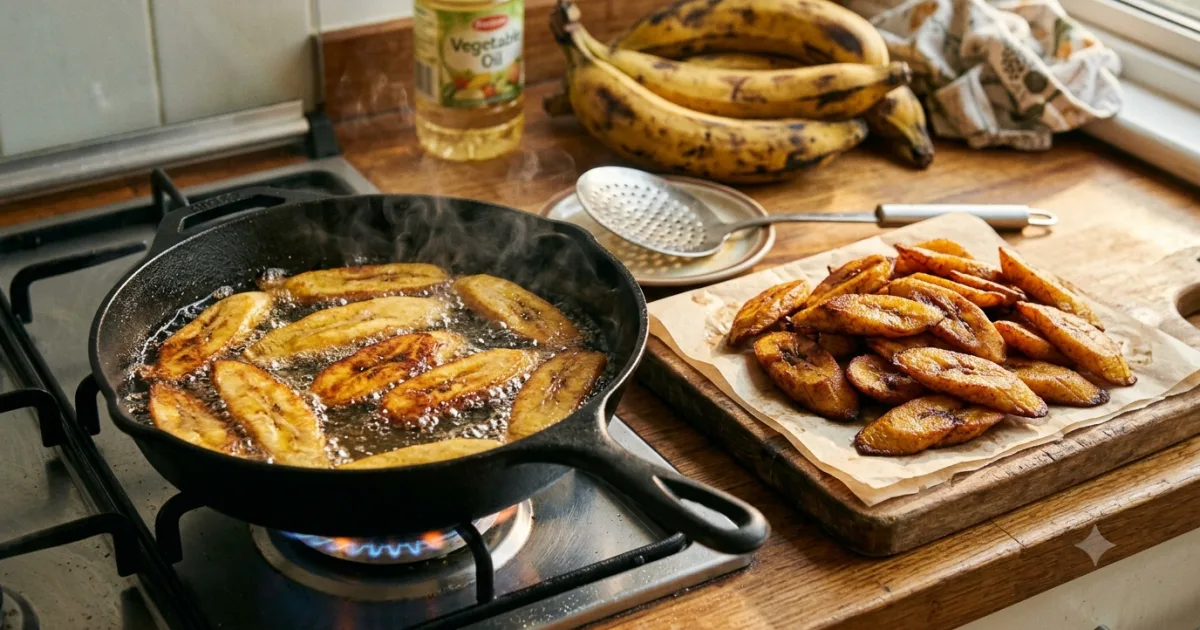
📌 Quick Summary: Nigerian fried plantain (dodo) is made from ripe yellow plantain — peeled, sliced diagonally or into rounds, and deep-fried in vegetable oil at 170–180°C until golden and caramelised. The plantain must be fully ripe — yellow with black spots — for the best result. Under-ripe plantain fries starchy and bland; over-ripe plantain fries too fast and burns. A bunch of 4 to 5 ripe plantains makes approximately 30 to 40 pieces. Fried plantain is served with jollof rice, fried rice, beans, eggs, and virtually every Nigerian main dish. A fried plantain street stall selling 100 pieces daily at ₦100 to ₦150 earns approximately ₦200,000–₦300,000 monthly gross profit. This guide covers the complete recipe, how to pick the right plantain, every cutting style explained, how to avoid soggy dodo, and the business model.
There is no Nigerian food that crosses more boundaries than fried plantain. It appears on the breakfast table with eggs and bread. It shows up at lunch beside jollof rice and fried chicken. It sits on the owambe small chops platter. It is served alone as a snack at midnight. Children eat it. Elders eat it. It is on the menu at roadside bukas and at the most expensive restaurants in Victoria Island. It is a food that requires almost nothing — ripe plantain, oil, heat — and yet is capable of being cooked badly in a surprising number of ways. This guide covers everything you need to fry perfect dodo every single time.
Choosing the Right Plantain: The Most Important Step
The ripeness of your plantain determines everything about the finished dodo. More than oil temperature, more than cutting technique, more than frying time — the ripeness level of the plantain is what separates perfect dodo from disappointing dodo.
| Plantain Stage | Appearance | Flavour When Fried | Texture When Fried | Best For |
| Unripe (green) | Fully green, firm | Starchy, bland, slightly bitter | Stiff, dry, not caramelised | Boiling, chips — NOT for dodo |
| Turning (yellow-green) | Mostly yellow, some green patches | Mildly sweet, still starchy | Firmer than ideal for dodo | Acceptable for dodo if nothing riper available |
| Ripe (yellow with black spots) | Fully yellow, black spots appearing | Sweet, caramelised, rich | Tender inside, slightly crisp outside | PERFECT for dodo — this is what you want |
| Very ripe (mostly black) | Skin mostly or entirely black | Very sweet, almost sugary | Very soft — prone to breaking | Still good for dodo — sweeter and softer; handle carefully |
The ideal dodo plantain has a fully yellow skin with abundant black spots — at least 50 percent of the skin surface should show black. At this stage, the natural starches have converted to sugars, and those sugars caramelise beautifully in hot oil to produce the golden-brown, sweet, slightly sticky exterior that defines perfect dodo. If you buy green plantain, store it at room temperature (not the refrigerator — cold slows ripening) for 3 to 5 days until it reaches the correct stage.
Cutting Styles: Which Shape for Which Occasion
| Cut Style | How to Cut | Best For |
| Diagonal slices | Cut at a 45-degree angle, approximately 1.5cm thick | Party dodo, restaurant serving — the most visually impressive and the standard for events |
| Rounds (straight cross-sections) | Cut straight across the plantain, 1.5cm thick | Everyday home dodo — faster to cut, uniform size |
| Lengthwise (plank cuts) | Cut the peeled plantain in half lengthwise, then each half in half again | Boli-style home frying — longer pieces, good for pairing with groundnut |
| Cubes (diced) | Cut into roughly 2cm cubes | Gizdodo (diced dodo with gizzard) — the Lagos party small chops version |
Ingredients — Serves 6 to 8
| Ingredient | Quantity | Notes |
| Ripe plantain (yellow with black spots) | 4 to 5 fingers of plantain | Each finger yields 6 to 8 slices depending on size |
| Vegetable oil for frying | Enough to fill pan 4 to 5cm deep | Vegetable or groundnut oil. Do not use palm oil — it colours the dodo orange and smokes at lower temperatures. |
| Salt (optional) | A very light pinch | Some Nigerians lightly salt ripe plantain before frying to balance sweetness. Entirely optional — most dodo is fried without salt. |
Step-by-Step Recipe
Step 1: Peel and Cut
To peel a ripe plantain: cut off both ends, then score the skin lengthwise with a knife (one or two cuts along the length of the plantain) and peel the skin away in sections. Ripe plantain peels easily — if it is resisting, it is not yet ripe enough. Cut into your chosen style — diagonal slices for party dodo, rounds for everyday. Aim for uniform thickness (approximately 1.5cm) so all pieces fry in the same time. Uneven thickness produces some pieces burnt and others undercooked in the same batch.
Step 2: Heat the Oil to the Right Temperature
Heat vegetable oil in a wide frying pan over medium heat to 170–180°C. Test without a thermometer: drop a small piece of plantain into the oil. If it sinks to the bottom and rises slowly, the oil is too cool. If it immediately browns within 30 seconds, the oil is too hot. If it rises within a few seconds and begins to gently bubble around the edges, the temperature is correct. Correct oil temperature is the second most important variable in dodo quality — after plantain ripeness. Too cool: the plantain absorbs oil and becomes greasy and soft. Too hot: the outside burns before the inside warms through and caramelises.
Step 3: Fry in Batches
Gently lay the plantain slices into the hot oil in a single layer — do not stack or overlap. Leave space between pieces. Fry for 2 to 3 minutes on the first side without touching — allow the bottom to set and brown before turning. The plantain will release from the pan naturally when it is ready to turn; if it sticks when you try to turn it, it is not yet ready. Turn once with tongs or a slotted spoon. Fry for another 2 to 3 minutes on the second side. The finished dodo should be uniformly golden-brown to deep amber on both sides — not pale (undercooked) and not dark brown-black (burnt). Remove and drain on paper towels.
Step 4: Serve Immediately
Fried plantain is best eaten within 15 to 30 minutes of frying. It loses its crisp exterior quickly as it cools and the residual moisture from the interior softens the surface. For party catering, fry dodo as close to service time as possible rather than hours in advance.
How to Avoid Soggy Dodo: The Most Common Problem
Soggy dodo has one primary cause: oil that is not hot enough when the plantain is added. At correct temperature, the exterior of the plantain sears quickly — creating a slightly firm surface that prevents oil absorption. At too-low temperature, the plantain slowly absorbs oil as it heats, producing a greasy, soft piece rather than a lightly crisp one. Secondary causes of soggy dodo: overcrowding the pan (which drops the oil temperature immediately and causes the same absorption problem as too-cool oil), and not draining properly on paper towels after frying. Always heat the oil fully before adding plantain, fry in small batches, and drain well.
Gizdodo: The Party Small Chops Version
Gizdodo — the beloved Lagos party combination of diced fried plantain and fried chicken gizzard, tossed in a pepper sauce — is one of the most searched Nigerian recipe variations and one of the most requested small chops at premium events. To make gizdodo: cut ripe plantain into 2cm cubes and fry as above. Separately, season and boil chicken gizzards until tender, then fry until slightly crisp. Make a pepper sauce: blend scotch bonnet, red bell pepper, and onion, fry in oil with seasoning until reduced and thickened. Toss the fried plantain cubes and gizzard pieces in the pepper sauce. Serve immediately in small cups or on toothpicks. Gizdodo commands ₦500 to ₦2,000 per portion at premium event catering — significantly higher than plain dodo.
The Fried Plantain Business
Fried plantain is one of Nigeria’s most accessible street food businesses — low capital requirement, universally loved product, and a market that exists at every price point from roadside stalls to premium event catering. A plantain seller working from a small stall or roadside setup buys plantain at ₦200 to ₦500 per finger from wholesale markets, fries and sells each finger as 6 to 8 pieces at ₦100 to ₦200 per piece — generating ₦600 to ₦1,600 revenue per finger of plantain on an ingredient cost of ₦200 to ₦500. At 20 fingers per day (approximately 140 to 160 pieces total), daily gross revenue of ₦14,000 to ₦32,000 on ingredient costs of ₦4,000 to ₦10,000 produces a daily gross profit of ₦10,000 to ₦22,000 — approximately ₦200,000 to ₦440,000 monthly for a 20-working-day month. Location is the defining variable: a stall near a bus stop, school, market, or office with consistent morning and lunchtime foot traffic outperforms a residential area stall by 3 to 5 times on daily volume.
Frequently Asked Questions
How ripe should plantain be for dodo?
Fully yellow with abundant black spots — at least 50 percent of the skin surface showing black. This is the optimal ripeness for sweet, caramelised dodo. Fully black-skinned plantain is still acceptable (sweeter and softer) but handle carefully as it breaks more easily when cutting and frying.
Why is my fried plantain soggy?
The most common cause is oil not hot enough when the plantain is added. Heat the oil to 170–180°C before adding any plantain. A second cause is overcrowding the pan — add pieces in a single layer with space between them. Always drain on paper towels after frying.
Can I fry unripe plantain for dodo?
Unripe (green) plantain can be fried but does not produce dodo — it produces a starchy, bland fried plantain closer to plantain chips. For sweet, caramelised Nigerian dodo, the plantain must be fully ripe. Store green plantain at room temperature for 3 to 5 days to ripen naturally.
What oil is best for frying plantain?
Vegetable oil or groundnut (peanut) oil are both excellent — clean flavour, high smoke point, and they do not discolour the plantain. Do not use palm oil for frying dodo — it colours the plantain orange and has a lower smoke point that makes temperature control harder.
How do I keep fried plantain warm for a party?
Place freshly fried dodo in a low oven (120°C) on a wire rack (not a plate — stacking causes sogginess from trapped steam). This keeps dodo warm and maintains some crispness for up to 30 to 45 minutes. For longer events, fry in batches throughout the service period rather than all at once.
Sources
- Original recipe — NaijaSabi Lifestyle Desk, September 2026
- Nigerian culinary tradition — fried plantain preparation documented across all Nigerian regional cooking practices
Last updated: 13 September 2026 · NaijaSabi Lifestyle Desk.
Boli: The Roasted Plantain Alternative
Boli is roasted plantain — placed directly over an open flame or charcoal grill rather than fried in oil. It is one of Nigeria’s most popular street foods, particularly in Lagos where boli sellers operate along major roads from early morning. Boli uses the same ripe plantain as dodo but produces a distinctly different result: the exterior chars and caramelises from the direct heat, the interior becomes soft and starchy, and the flavour is less sweet and more complex than fried dodo — with a slight smokiness from the charcoal or gas flame. Boli is traditionally served with roasted groundnuts or with fried fish, and the combination is one of the most satisfying and affordable street food meals in Nigeria. For home preparation without a charcoal grill: preheat your oven to maximum temperature and place the whole unpeeled ripe plantain (with the ends trimmed) on the oven rack. Roast for 20 to 25 minutes, turning once halfway, until the skin is fully charred black. The interior will be fully cooked, soft, and caramelised. Peel and eat immediately. A gas cooker open flame — holding the plantain with tongs directly over the burner, turning continuously — produces boli faster (8 to 10 minutes) with more authentic smokiness. Understanding boli alongside dodo positions NaijaSabi’s fried plantain article as the most comprehensive Nigerian plantain guide available — covering both the fried and roasted preparations that together define how Nigerians eat plantain.


0 Comments
No comments yet. Be the first to share your thoughts!