


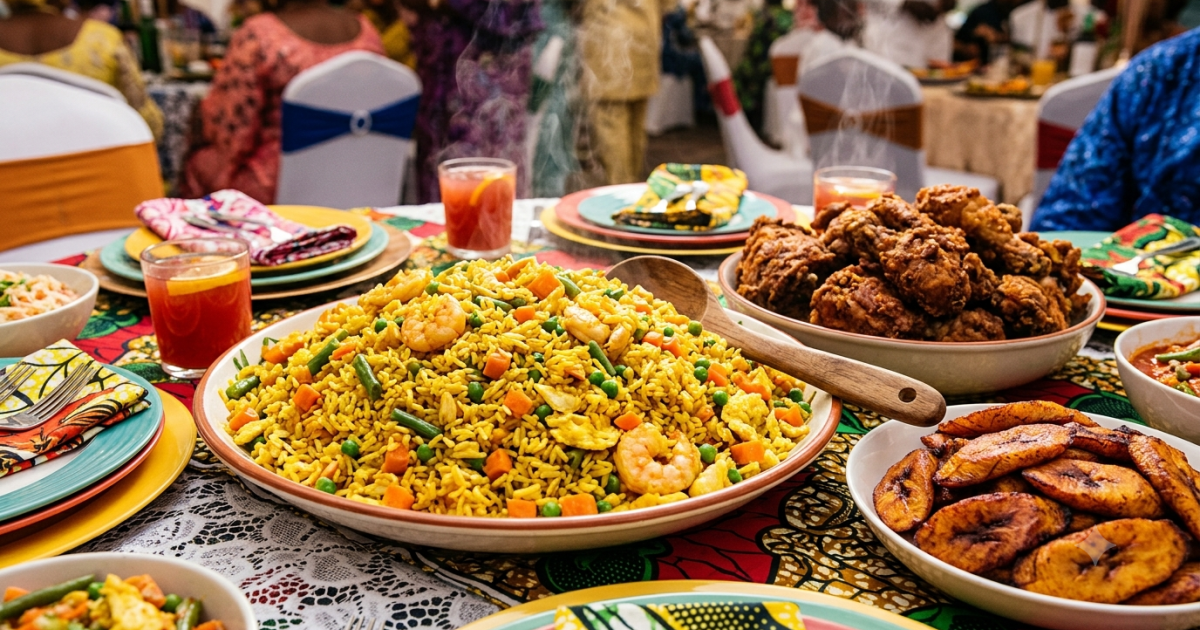
📌 Quick Summary: Nigerian fried rice is made with long-grain parboiled rice, mixed vegetables (carrots, green beans, green peas, sweet corn), liver, prawns, eggs, spring onions, and seasoning — stir-fried in vegetable oil with curry powder and thyme. The signature colour is golden-yellow from curry and the absence of tomato. A batch serving 8 uses 4 cups of rice, 2 cups of mixed vegetables, and cooks in 30 to 40 minutes after the rice is pre-cooked. This guide covers the full recipe, how to get the distinct Nigerian fried rice flavour (not Chinese fried rice), the protein combinations, the stir-fry technique, and scaling for large events.
Nigerian fried rice and jollof rice are the two pillars of every serious Nigerian owambe table. While jollof is cooked in a tomato base and gets its colour from the tomato and palm oil, fried rice takes the opposite route — no tomato, no palm oil, a mix of vegetable oil and butter, and its colour from turmeric or curry powder. The result is a dish that is lighter in colour than jollof, loaded with mixed vegetables and protein additions, and has a distinct flavour profile that is unmistakably Nigerian despite the dish’s clear Chinese and West African cultural crossover origins. Party fried rice — the version cooked for events, loaded with chicken liver, prawns, and a generous vegetable mix — is one of the most celebrated dishes in Nigerian catering.
Nigerian Fried Rice vs Chinese Fried Rice: What Makes Ours Different
Both use pre-cooked rice stir-fried with vegetables, eggs, and protein — but the flavour profiles diverge significantly. Nigerian fried rice uses curry powder and thyme as its primary spices — a combination that gives it a warmly spiced, aromatic quality absent from Chinese fried rice. Nigerian fried rice includes chicken liver as a signature protein component — the liver is diced small, lightly fried, and distributed through the rice, adding a rich, slightly gamey note. Nigerian fried rice uses more vegetables proportionally — the ratio of vegetables to rice is higher than most Chinese versions. And Nigerian fried rice is rarely made with soy sauce — the seasoning comes from seasoning cubes, curry, thyme, and the natural flavours of the proteins rather than from fermented soy.
Ingredients — Serves 8 to 10
| Ingredient | Quantity | Notes |
| Parboiled long-grain rice | 4 cups (800g) | Same rice as jollof — not basmati |
| Chicken or beef stock | Enough to cook the rice | Rice cooked in seasoned stock produces far superior flavour to rice cooked in plain water |
| Carrots | 2 medium, finely diced | 1cm cubes maximum |
| Green beans | 1 cup, chopped | Cut into 1cm pieces |
| Green peas | ½ cup | Frozen is fine and convenient |
| Sweet corn | ½ cup | Frozen or canned, drained |
| Spring onions (green onions) | 4 to 5 stalks | Both white and green parts, finely sliced |
| Eggs | 3 large | Scrambled separately and added at the end |
| Chicken liver | 200g | Cleaned, diced small, and parboiled briefly. The signature Nigerian fried rice protein. |
| Prawns or shrimp (optional) | 150g, cleaned | Adds luxury and is standard for party fried rice |
| Cooked chicken or beef | 200g, shredded or diced | From the stock you used to cook the rice |
| Vegetable oil | 4 tablespoons | |
| Butter | 2 tablespoons | Adds richness — optional but recommended for party fried rice |
| Curry powder | 2 teaspoons | Nigerian yellow curry — gives the characteristic golden colour |
| Dried thyme | 1 teaspoon | |
| Seasoning cubes | 2 to 3 | |
| Salt | To taste | |
| White pepper or black pepper | To taste |
Step-by-Step Recipe
Step 1: Cook the Rice in Stock
Wash the parboiled rice until the water runs clear. Cook in well-seasoned chicken or beef stock — add enough stock to cover the rice by approximately 2 centimetres. Add 1 teaspoon of curry powder and ½ teaspoon of thyme to the cooking stock — this pre-seasons the rice and gives it a golden colour before the stir-fry stage. Cook until the rice is just done — tender but still firm, not mushy. Every grain should be separate. Spread the cooked rice on a wide tray and allow to cool completely. Cold, dry rice stir-fries better than hot, moist rice — hot rice releases steam in the wok or pan and becomes sticky and clumped. Cooking the rice the day before and refrigerating overnight produces the best fried rice results.
Step 2: Prepare the Proteins
Clean the chicken livers: remove any green-tinged bile ducts (they are bitter if left), rinse, and parboil briefly — 5 minutes in seasoned water — to remove excess blood. Drain, dice into small cubes (1cm), and set aside. Season prawns with a pinch of salt, white pepper, and half a teaspoon of curry. Shred or dice any cooked chicken or beef from your stock. Having all proteins prepped and in separate bowls before the stir-fry begins is essential — the actual frying happens quickly and there is no time to prep during cooking.
Step 3: Blanch the Vegetables
Bring a pot of water to a boil. Add the diced carrots and cook for 2 minutes — they should be just beginning to soften but still firm. Add the green beans and cook for 1 more minute. Drain immediately and plunge into cold water to stop cooking and preserve the vibrant colour. Drain again and set aside with the peas and corn (which need no cooking). The blanching step ensures carrots and beans are fully cooked in the final dish without requiring extended stir-frying time that would over-cook the other ingredients.
Step 4: Scramble the Eggs
Beat the eggs with a pinch of salt. Heat a small pan with 1 teaspoon of oil. Add the beaten eggs and scramble until just cooked — still slightly wet, not dry. Remove from heat and set aside. The scrambled eggs will finish cooking when combined with the hot rice. If you prefer egg ribbons visible throughout the rice rather than mixed scramble, pour the beaten egg into a hot pan and allow to set as a thin omelette, then cut into small pieces before adding to the fried rice.
Step 5: The Stir-Fry — Working in Batches
This is the most important technique in Nigerian party fried rice. Use the widest, largest pan or wok available. Heat 2 tablespoons of vegetable oil and 1 tablespoon of butter over high heat until smoking hot. Work in batches — do not add all the rice at once to a domestic pan. Stir-frying rice requires very high heat and wide surface area. If you overcrowd the pan, the temperature drops, the rice steams rather than fries, and you get sticky, clumped fried rice instead of the separated, slightly toasted grains of party fried rice.
Batch 1: Fry the chicken liver in the hot oil for 2 to 3 minutes until browned. Add the prawns and stir-fry for 1 to 2 minutes. Remove and set aside.
Batch 2: Add another tablespoon of oil. Add the white parts of the spring onion and stir-fry for 30 seconds. Add half the rice and stir-fry over high heat for 3 to 4 minutes, tossing constantly. Sprinkle in half the remaining curry powder and thyme. Add half the blanched vegetables, half the corn and peas. Stir-fry for 2 minutes. Add half the scrambled egg. Toss everything together vigorously. Season with crumbled seasoning cube and salt. Transfer to a wide serving dish.
Batch 3: Repeat with remaining rice, vegetables, and eggs. Combine all batches in the serving dish, add the fried liver and prawns, and toss gently. Finish with the green parts of the spring onion and a final pinch of white pepper.
Scaling for Large Events: Party Fried Rice for 50 to 100 People
Party fried rice for large events requires adapting the technique. A domestic wok cannot handle the volumes needed for 50+ people. Professional Nigerian caterers cook large-batch fried rice in wide, flat iron pans over open fire or large commercial burners — the key is maximum heat and maximum surface area. At home, cook the rice in the largest pot available, then stir-fry in multiple batches (never more than 4 cups of rice per batch) and combine in a large container. For the largest events, the most practical approach is to have the rice cooked and the vegetables and proteins prepared the day before, then stir-fry in batches on the morning of the event. A 20-cup batch (enough for approximately 50 people as a side dish) requires at least 5 separate stir-fry batches and a minimum of 2 hours of active cooking time.
Common Mistakes
1. Using Hot, Freshly Cooked Rice
The single most common reason for sticky, clumped fried rice. Always use cold rice — cooked at least 4 hours earlier or refrigerated overnight. Cold rice has dried out enough to stir-fry into separated grains.
2. Overcrowding the Pan
Too much rice in the pan at once causes steaming rather than frying. Four cups of rice maximum per batch in a domestic wok or large pan.
3. Insufficient Heat
Fried rice needs the highest heat your stove can produce. Use maximum flame and allow the oil to reach smoking point before adding the rice.
4. Overcooking the Vegetables
Vegetables in fried rice should be vibrant and slightly crisp — not soft and dull. The blanching step plus the brief stir-fry is all they need. Do not add raw, unblanched carrots directly to the stir-fry — they will not cook evenly.
Frequently Asked Questions
What gives Nigerian fried rice its colour?
Curry powder — specifically Nigerian yellow curry — gives fried rice its characteristic golden-yellow colour. Adding turmeric enhances the colour further. Unlike jollof rice which gets colour from tomato, fried rice gets its colour from spices, which is why it is distinctly lighter and more golden than jollof.
Does Nigerian fried rice have tomato?
No. Nigerian fried rice does not use tomato — this is one of its key distinctions from jollof rice. Tomato would give the rice a red colour and a different flavour profile. Fried rice uses curry, thyme, and white pepper as its spice base.
What protein is in Nigerian fried rice?
Chicken liver is the signature Nigerian fried rice protein — diced small and distributed throughout the rice. Prawns are standard for party versions. Cooked chicken, beef, or fish can be used additionally or as substitutes.
Can I make fried rice without a wok?
Yes — use the widest, flattest pan you own and cook in small batches on maximum heat. A wide frying pan works better than a deep pot for fried rice. The wider the cooking surface and the higher the heat, the better the result.
Sources
- Original recipe — NaijaSabi Lifestyle Desk, September 2026
- Nigerian catering tradition — party fried rice preparation documented across Lagos, Abuja and Port Harcourt catering practice
Last updated: 11 September 2026 · NaijaSabi Lifestyle Desk.
Nigerian Fried Rice vs Jollof Rice: The Party Table Debate
Every Nigerian party table where both jollof rice and fried rice are served hosts an unspoken competition. Jollof rice defenders argue that no other dish carries the same smoky, tomato-rich depth that defines Nigerian party cooking. Fried rice defenders argue that the vegetable complexity, the liver, the prawns, and the distinct curry-spiced flavour profile make fried rice the more technically accomplished dish. Both are right. They are different dishes serving different functions on the party table — jollof provides the emotional anchor, the dish that smells like the party, while fried rice provides the visual statement, the dish that looks like effort was made. The wisest Nigerian caterers serve both. The smartest guests take both. The real answer to the jollof versus fried rice debate is that it is not an either/or question — it is a yes/and question, and the Nigerian party table has always known this.
What Makes Nigerian Fried Rice Better the Second Day
Like most Nigerian rice dishes, fried rice tastes better the day after it is made — a phenomenon that professional caterers take advantage of deliberately. The reason is flavour integration: the curry, thyme, and seasoning compounds in the rice continue to develop and penetrate the grain even after cooking, producing a more deeply flavoured rice on day two than on day one. The vegetables have also softened slightly and their flavour has infused further into the rice. For party catering, making the fried rice the day before (cooking the rice, preparing the vegetables and proteins, and stir-frying the full batch) and then reheating in a wide pan over high heat on the day of the event both improves the flavour and reduces day-of stress. The reheating stir-fry takes only 5 to 10 minutes per batch and restores the separated grain texture if covered carefully during refrigeration.



0 Comments
No comments yet. Be the first to share your thoughts!