


📌 Quick Summary: Agriculture contributes approximately 25% of Nigeria’s GDP and is one of the most reliably profitable sectors available to ordinary Nigerians — but most people assume you need a large farm and millions of naira to participate. You do not. This NaijaSabi guide covers 8 agribusiness ventures a Nigerian can start with ₦50,000–₦500,000 in 2026, with realistic startup costs, income projections, what the market actually pays, and how to access government funding (NIRSAL AGSMEIS at 5% interest, BOI loans, CBN intervention funds) to scale once you have proven your model. Agriculture is not what it was in your grandfather’s time — it is a business, and in Nigeria’s current economy, it is one of the best businesses available.
There is a reason why Nigeria’s wealthiest investors — from Dangote to Renaissance Capital to the Federal Government’s own intervention programmes — are all pointing money at agriculture. Nigeria imports food it could produce domestically. The naira depreciation that has made imported consumer goods unaffordable has made locally grown food more competitive than ever. Food prices in Nigerian markets have risen significantly — which means the margins available to Nigerian food producers have also risen. The farmer who grew tomatoes for ₦5,000 a basket in 2022 sells the same basket for ₦15,000–₦25,000 in 2026. This NaijaSabi guide identifies the 8 agribusiness ventures most accessible to Nigerian entrepreneurs with limited starting capital — and tells you exactly how to start each one.
| Venture | Startup Capital Range | Time to First Income | Space Required |
| Snail farming | ₦50,000 – ₦150,000 | 6–12 months | Small — backyard possible |
| Catfish farming (small scale) | ₦150,000 – ₦500,000 | 4–6 months | Small — pond or tanks |
| Poultry (broilers, small flock) | ₦150,000 – ₦400,000 | 6–8 weeks per cycle | Small — backyard pen |
| Mushroom farming | ₦50,000 – ₦200,000 | 3–6 weeks | Very small — indoor possible |
| Vegetable farming (tomatoes, pepper, ugwu) | ₦50,000 – ₦300,000 | 6–12 weeks | Small plot — rented land possible |
| Grasscutter (cane rat) farming | ₦100,000 – ₦300,000 | 6–8 months | Small — backyard cages |
| Ginger and turmeric processing | ₦50,000 – ₦200,000 | Immediate — buy/process/sell | Very small — processing space |
| Plantain farming | ₦100,000 – ₦500,000 | 12–18 months first harvest | Small plot — rented land |
Why Agribusiness in Nigeria in 2026 — The Honest Case
Before the ventures, the context that makes them worth pursuing right now specifically:
- Naira depreciation has made Nigerian food more competitive. Imported food — rice, wheat, tomato paste, fish — is more expensive than ever. Nigerian-produced equivalents have become more price-competitive. The market for Nigerian-grown food is stronger than it has been in a generation
- Food prices are rising — which means producer margins are rising. A basket of tomatoes, a kilogram of catfish, a crate of eggs — all command significantly higher naira prices in 2026 than 2022. The Nigerian farmer who maintains production costs in naira while selling into this higher-price market is capturing a real margin improvement
- Agriculture contributes ~25% of Nigerian GDP — the sector that employs the most Nigerians and feeds the country is the same sector most underinvested at the small-scale entrepreneur level. The gap between demand and local supply is the opportunity
- Government funding is available specifically for agribusiness. NIRSAL AGSMEIS loans at 5% per annum, BOI agricultural loans, CBN anchor borrowers programme and state-level agricultural funds all offer Nigerian agripreneurs capital at rates no commercial bank will match. These programmes exist specifically because government wants Nigerians to farm — use them
- You do not need to own land to start. Most of the ventures below can be started in a backyard, a rented space or a small rented plot. Land ownership is the traditional barrier to agriculture — it is not the barrier it once was for small-scale agribusiness
1. Snail Farming — The Most Accessible Low-Capital Agribusiness in Nigeria
Snail farming is the most underrated entry point into Nigerian agribusiness for urban and semi-urban entrepreneurs. Here is why it consistently tops expert recommendations for low-capital starters: snails require minimal space (a backyard hutch works), minimal feeding (they thrive on organic waste — banana leaves, pawpaw peels, leftover vegetables), minimal water, and minimal daily attention. The startup cost is genuinely low, and the return per kilogram sold is one of the highest in the meat category.
Market reality: A mature snail (Achatina achatina — the giant African land snail most suited to Nigerian conditions) sells for ₦500–₦1,500 per piece in Lagos, Abuja and Port Harcourt markets in 2026 depending on size. Restaurants, hotels and caterers pay premium prices for consistent large-size supply. A well-managed snail farm with 500 snails can generate ₦250,000–₦500,000+ per harvest cycle (6–12 months) from a backyard setup.
How to start:
- Source your starter snails from a reputable snail farmer or agricultural market — avoid wild-caught snails which often carry parasites and perform poorly in captivity. Starter stock of 50–100 breeder snails costs ₦20,000–₦60,000
- Build or buy snail hutches — wooden or concrete pens with fine-mesh wire tops to prevent escape. A basic hutch for 100 snails can be built for ₦15,000–₦30,000 using locally available materials
- Feed with leafy vegetables, pawpaw, banana, cabbage, cucumber, plantain — all available cheaply at Nigerian markets or as waste from food vendors
- Provide a calcium source — crushed eggshells, limestone or bone meal — for shell development. This is critical for healthy growth
- Maintain humidity — snails need a moist environment. In dry harmattan months, water the pen daily. In rainy season, ensure drainage so snails are not waterlogged
- Harvest at 6–12 months when snails reach market size (100–500g depending on species and care)
Startup cost breakdown: ₦50,000–₦150,000 covering breeder stock, hutch construction, initial feed and basic equipment. NIRSAL and BOI agribusiness loans are accessible for expansion once you have a proven small-scale operation.
2. Catfish Farming — Nigeria’s Most Reliable Protein Agribusiness
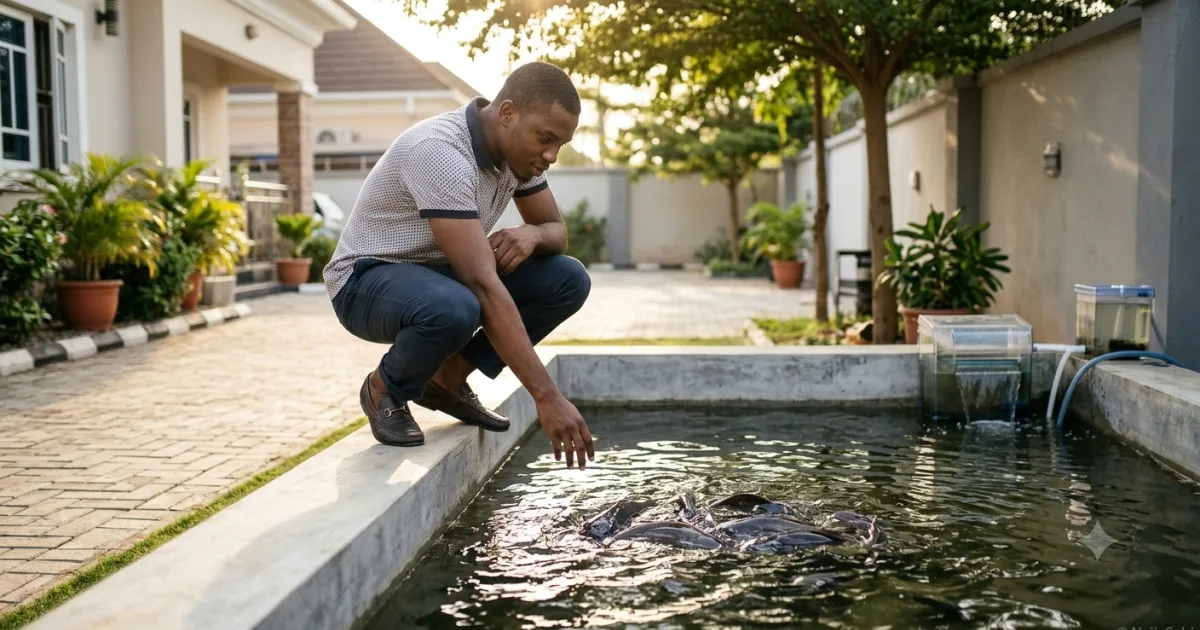
Catfish is the most consumed freshwater fish in Nigeria — and catfish farming remains one of the most reliable income-generating agribusinesses available to Nigerian entrepreneurs. The market is enormous: restaurants, food vendors, hotels, suya spots, eateries and individual households all buy catfish consistently. Unlike crops, catfish has no harvest season — you can sell year-round.
Market reality: Live catfish sells for ₦2,500–₦5,000 per kilogram in Lagos, Abuja and Port Harcourt markets in 2026 depending on size and supply conditions. Smoked catfish commands even higher prices. A 300-fish pond cycling every 4–6 months generates ₦300,000–₦700,000+ in gross revenue per cycle at current market prices for a small-scale operation.
Starting options for low capital:
- Earthen pond: lowest cost — dig a pond on land you own or rent. A basic 10m × 10m earthen pond costs ₦80,000–₦200,000 to construct depending on soil type and location. Can hold 500–1,000 fingerlings
- Plastic or tarpaulin tanks: the lowest-barrier entry for urban entrepreneurs with no land. Large tarpaulin tanks or IBC (intermediate bulk container) plastic tanks can be set up in a compound or yard. A 1,000-litre IBC tank costs ₦30,000–₦60,000 and can raise 50–80 catfish to market size
- Concrete pond: more expensive to construct (₦150,000–₦500,000 per pond) but more durable, easier to manage and acceptable to institutional buyers
Key costs to budget for: fingerlings (₦50–₦150 each depending on size and source), catfish feed (the largest ongoing cost — quality feed costs ₦700–₦1,200 per kg; a 300-fish pond consumes approximately 300–400kg of feed over a 4-month cycle), water management, and harvesting logistics.
The critical success factor: feed quality and feeding discipline. Underfeeding stunts growth. Overfeeding wastes money and pollutes the water. Follow the feeding table from your fingerling supplier or a fish farming extension agent. Poor water quality management kills fish — this is the most common reason Nigerian small-scale fish farms fail.
3. Poultry Farming (Broilers) — Fastest Return Cycle in Agribusiness
Broiler chicken farming offers the fastest return on investment of any agribusiness in Nigeria — a cycle from day-old chick to market-weight bird takes just 6–8 weeks. This rapid cycle makes it ideal for entrepreneurs who need to see returns quickly and reinvest. The Nigerian chicken market is vast — driven by restaurants, pepper soup joints, pepper chicken sellers, fried chicken outlets, hotels and households.
Market reality: A market-weight broiler (1.8–2.5kg) sells for ₦5,500–₦9,000 per bird in Lagos and Abuja in 2026. A small flock of 100 broilers generates ₦550,000–₦900,000 in gross revenue per 6–8 week cycle — against total costs of approximately ₦350,000–₦500,000 for feed, chicks, medication and housing, leaving a gross margin of ₦150,000–₦400,000 per cycle for a well-managed flock.
Startup requirements:
- Poultry pen/brooder — a basic wooden or block structure with mesh sides costs ₦50,000–₦150,000 for a 100-bird pen. Ensure ventilation, protection from rain, predators (rats, dogs, hawks) and clean bedding (wood shavings)
- Day-old chicks — ₦800–₦1,500 per chick from reputable hatcheries. Source from NAFDAC-registered hatcheries to ensure disease-free stock. 100 chicks: ₦80,000–₦150,000
- Feed — the dominant cost. A broiler consumes approximately 4–5kg of feed from day-old to market weight. Quality broiler feed costs ₦700–₦1,100/kg. Budget ₦280,000–₦550,000 in feed for 100 birds
- Medication and vaccination — Newcastle, Gumboro and Marek’s disease vaccines plus broad-spectrum antibiotics and vitamins. Budget ₦20,000–₦40,000 per 100-bird cycle
Critical warning: Bird flu and Newcastle disease outbreaks have devastated Nigerian poultry farms repeatedly. Maintain strict biosecurity — no visitors entering the pen, footbath at entrance, immediate isolation of sick birds, vaccination on schedule. Never cut corners on vaccination to save money — one outbreak can wipe out an entire flock and your investment.
4. Mushroom Farming — The Fastest-Cycle, Indoor-Possible Agribusiness
Mushroom farming is the most overlooked high-margin agribusiness in Nigeria — and one of the few that can be done entirely indoors, in a rented room or even a large wardrobe, without land, without soil, and with a harvest cycle of just 3–6 weeks. The market for fresh mushrooms in Lagos, Abuja and Port Harcourt is strong and undersupplied — most restaurants and hotels source mushrooms from importers at premium prices. A reliable local supplier who delivers fresh mushrooms consistently can command premium contracts.
Market reality: Fresh oyster mushrooms sell for ₦3,000–₦8,000 per kilogram to restaurants and hotels in Lagos in 2026. Dried mushrooms command even higher prices per kilogram and have significantly longer shelf life. A 20-bag mushroom growing setup in a single room can yield 8–15kg of fresh mushrooms per cycle (3–6 weeks) — generating ₦24,000–₦120,000 per cycle from a minimal space.
How to start:
- Substrate (growing medium): mushrooms grow on pasteurised sawdust, rice straw, sugarcane bagasse or a mixture — all agricultural by-products available cheaply across Nigeria. Sawdust from carpentry workshops is often free or very cheap
- Mushroom spawn: purchase oyster mushroom spawn (the mushroom equivalent of seeds) from specialist agricultural suppliers in Lagos, Abuja or online. A bag of spawn costs ₦2,000–₦5,000 and inoculates multiple growing bags
- Growing bags: polypropylene bags filled with pasteurised substrate and inoculated with spawn. Each bag costs approximately ₦500–₦1,500 in materials. 20 bags is a manageable starting scale
- Growing environment: mushrooms need humidity (70–90%), moderate temperature (20–30°C — Nigerian conditions are generally suitable), and indirect light. No soil, no outdoor space required
- Harvest: oyster mushrooms fruit 3–6 weeks after inoculation. Multiple flushes are possible from each bag — 3–4 flushes per bag before substrate is exhausted
5. Vegetable Farming — Tomatoes, Pepper, Ugwu and Leafy Greens
Vegetable farming in Nigeria — particularly tomatoes, red pepper, scotch bonnet (tatashe and rodo), ugwu (fluted pumpkin), waterleaf, scent leaf and cucumber — offers one of the fastest returns of any crop-based agribusiness. Vegetables are consumed daily by virtually every Nigerian household and food vendor. The supply-demand gap is significant — most urban vegetables in Nigeria are sourced from distant farms, creating opportunities for peri-urban producers who can sell fresh locally.
Market reality: A basket of fresh tomatoes sells for ₦15,000–₦35,000 in Lagos markets in 2026 depending on season and supply conditions. A bundle of ugwu sells for ₦300–₦800. Prices spike dramatically during dry season when supply falls — farmers who have irrigation or who time their planting for the dry season earn peak prices.
Starting with limited land:
- Rent a small plot near your location — even 1,000–2,000 square metres (0.1–0.2 hectares) is enough for a productive vegetable operation. Agricultural land rental in peri-urban areas typically costs ₦30,000–₦150,000 per season depending on location
- Raised bed gardening reduces soil preparation costs and improves drainage for backyard and small-plot production
- Focus on fast-cycling, high-value crops — ugwu (harvestable 45–60 days after planting), scent leaf (30 days), waterleaf (4–6 weeks) give the fastest returns. Tomatoes take 90–120 days but command the highest total revenue per cycle
- Invest in a drip irrigation setup (₦30,000–₦80,000 for a small plot) — this enables dry season production when prices are highest and rainfall-dependent competitors cannot farm
6. Grasscutter (Cane Rat) Farming
Grasscutter farming — raising the large African cane rat (Thryonomys swinderianus) — is a niche but genuinely profitable agribusiness for Nigerian entrepreneurs willing to invest time in learning a slightly unusual livestock. Grasscutter meat is highly prized as bushmeat across southern Nigeria, fetching prices significantly above chicken or goat per kilogram. The animal is native to Nigeria, hardy in Nigerian conditions, and feeds primarily on grasses, sugarcane and agricultural by-products that cost very little.
Market reality: A mature grasscutter (2–3kg) sells for ₦8,000–₦20,000 per animal depending on size and location in 2026. Southern Nigerian markets — particularly in Rivers, Delta, Cross River, Ogun and Lagos — pay premium prices. Hotels and restaurant operators pay significantly more for consistent supply. A colony of 5 breeding pairs (10 animals) can grow to 60–100+ animals within 18 months with proper management.
Startup requirements: cages (welded wire mesh on concrete base, approximately ₦5,000–₦15,000 per cage), breeding stock (₦5,000–₦15,000 per animal), feeding (sugarcane stalks, elephant grass, cassava peels — largely free or very cheap). Total startup for a 5-pair colony: ₦100,000–₦250,000.
7. Ginger and Turmeric Processing — Trading, Drying and Packaging
This is the most accessible low-capital agribusiness for urban Nigerians with no land — because it requires no farming at all. Nigeria is one of the world’s largest ginger producers, and both fresh and processed (dried, powdered) ginger and turmeric command strong domestic and export markets. The processing gap — between what farmers grow and what end consumers and exporters buy — is where this business opportunity sits.
The model: Buy fresh ginger and turmeric in bulk from Kaduna, Nasarawa or Benue markets (the major Nigerian ginger-growing states) at farm-gate prices (₦500–₦1,500/kg depending on season), dry and powder it, package attractively and sell to Lagos and Abuja supermarkets, restaurants, food vendors, online buyers and export aggregators at ₦3,000–₦8,000/kg. The processing adds value without requiring land or complex equipment.
What you need to start:
- Capital to purchase raw ginger/turmeric: ₦30,000–₦100,000 for an initial trading batch
- Drying capacity: solar drying on mesh racks (cheap, effective) or an electric food dehydrator (₦15,000–₦40,000 on Jumia)
- Blender or hand grinder for powdering dried product
- Packaging materials — food-grade ziplock bags, labels, NAFDAC registration for commercial scale (NAFDAC registration for small-scale food processors starts from ₦15,000–₦50,000)
- Market linkages — approach supermarkets, online food stores, hotels and export aggregators with samples and pricing
8. Plantain Farming — High Market Demand, Consistent Income
Plantain is one of the most consumed foods in southern and middle-belt Nigeria — eaten boiled, fried (dodo), roasted (bole), processed into chips and flour. Despite this demand, Nigeria imports significant quantities of plantain because domestic production does not meet consumption needs. Plantain farming on even a small plot of land generates consistent income for 5–10 years from a single planting — once established, plantain plants produce suckers that regenerate the plantation continuously without replanting costs.
Market reality: A bunch of ripe plantain sells for ₦2,500–₦8,000 in Lagos and Port Harcourt markets in 2026 depending on size and season. Plantain chips processed from surplus or unripe stock sell for ₦1,500–₦5,000 per kilogram — significantly higher per-kilogram value than raw plantain. A 0.5-hectare plantain plantation (approximately 400–500 plants) generates ₦500,000–₦1,500,000+ per annual harvest cycle at current prices.
Startup: plantain suckers cost ₦200–₦500 each from markets and farms. A 0.5-hectare plot requires 400–500 suckers (₦80,000–₦250,000). Land rental, basic tools, fertiliser and initial maintenance bring total startup to ₦200,000–₦500,000 for a small commercial operation. First harvest comes 12–18 months after planting — this is the longer-term play on this list, but the ongoing returns over 5–10 years without replanting make it one of the most capital-efficient agribusiness investments available to Nigerian entrepreneurs.
How to Fund Your Nigerian Agribusiness — Government Programmes That Actually Work
- NIRSAL AGSMEIS (Agri-Business/Small and Medium Enterprise Investment Scheme): Loans at 5% per annum — the most affordable formal credit available to Nigerian agribusiness entrepreneurs. Administered through NIRSAL Microfinance Bank (nirsal.com). Apply online or at a branch. Requires a business plan, BVN, valid ID and basic financial records. No traditional collateral required for micro loans
- CBN Anchor Borrowers Programme: Specifically for smallholder farmers producing specific crops (rice, wheat, cotton, cassava, maize, etc.). Provides inputs (seedlings, fertiliser, agrochemicals) and financing directly to farmers. Apply through a participating commercial bank or cooperative. Monitor cbn.gov.ng for currently active commodities under the programme
- Bank of Industry (BOI) Agricultural Loans: Single-digit interest loans for Nigerian agribusinesses including livestock, aquaculture and crop farming. Apply at boi.ng or at the nearest BOI office. Requires CAC registration, SMEDAN number and a business plan
- SMEDAN MSME Clinics: Free government events where agricultural entrepreneurs can access free CAC registration, NAFDAC registration, regulatory guidance and grant opportunities. Register at smedan.gov.ng and monitor for MSME Clinic dates in your state
- Presidential Conditional Grant Scheme (₦250,000): Free grants awarded to outstanding MSMEs at MSME Clinics — agribusiness exhibitors are eligible. See NaijaSabi’s full guide to government grants for small businesses in Nigeria
- Tony Elumelu Foundation (TEF): Annual $5,000 grant for African entrepreneurs including Nigerian agribusiness owners. Applications open January 2027. Eligible businesses must be less than 3 years old. Apply at tefelumelu.org
The Golden Rules of Nigerian Agribusiness Success
- Start small and prove the model before scaling. The Nigerian agripreneurs who fail most dramatically are those who borrow large sums to start at maximum scale before understanding the venture. Start with 100 birds instead of 1,000. Start with 50 snails instead of 500. Learn the operation, make your mistakes cheaply, then scale
- Sort your market before you farm. The most common Nigerian agribusiness failure is producing a good product with no clear buyer. Before you plant a single seed or buy a single fingerling, identify 3–5 buyers and confirm they will purchase your product at a price that gives you a profit margin. Restaurants, hotels, market traders, food processors — talk to them first
- Keep detailed records from day one. Your feed costs, mortality rates, medication expenses, harvest yields and sale prices are the data you need to understand whether your operation is actually profitable — and which inputs to cut or optimise. A simple notebook or Google Sheets spreadsheet is sufficient. Without records, you cannot improve
- Join a cooperative or association. Nigerian farmer cooperatives and agribusiness associations provide access to bulk input pricing (significantly cheaper than buying individually), collective marketing, training, and group applications for government funding programmes that are not accessible to individual farmers
- Add value wherever possible. Raw tomatoes sell for one price. Canned tomato paste sells for three times more. Raw catfish sells per kilogram. Smoked catfish sells for a premium. Ginger root has one price. Powdered ginger in branded packaging has five times that price. The processing and packaging step is where the highest margins in Nigerian agribusiness are found — and it does not always require expensive equipment
Frequently Asked Questions — Agribusiness Nigeria 2026
What is the best agribusiness to start in Nigeria with low capital?
The best low-capital agribusiness in Nigeria in 2026 depends on your available space, skills and market access. For urban entrepreneurs with limited space: mushroom farming (₦50,000–₦200,000, indoor, 3–6 week cycle) and ginger/turmeric processing (₦50,000–₦200,000, no land needed) are the most accessible. For entrepreneurs with a backyard or small compound: snail farming (₦50,000–₦150,000) and poultry broilers (₦150,000–₦400,000) offer strong returns. For those with access to a small plot of land: catfish farming and vegetable farming offer the best combination of scale and income. All of these ventures can be started for ₦50,000–₦500,000 and grown using the profits and government funding programmes available to Nigerian agribusiness entrepreneurs.
How can I start agribusiness in Nigeria without land?
Several Nigerian agribusiness ventures require no land ownership and minimal space: mushroom farming (done indoors on substrate bags in any room or space), ginger and turmeric trading and processing (requires only a processing and storage space), snail farming (backyard hutches in a compound), and catfish farming in plastic tanks or IBC containers (can be set up in any compound with water access). For crop-based farming, small plots of agricultural land are available for rent in peri-urban and rural areas of most Nigerian states for ₦30,000–₦150,000 per season — land ownership is not required to start farming commercially in Nigeria.
How do I get funding for agribusiness in Nigeria?
The most accessible funding sources for Nigerian agribusiness entrepreneurs in 2026 are: NIRSAL AGSMEIS loans at 5% per annum (apply at nirsal.com — requires BVN, valid ID and basic business plan, no traditional collateral for micro loans), BOI agricultural loans (apply at boi.ng — requires CAC registration), the CBN Anchor Borrowers Programme for specific crops (apply through a participating commercial bank), and the Presidential Conditional Grant Scheme (₦250,000 free grants at MSME Clinics — register at smedan.gov.ng). The Tony Elumelu Foundation also offers $5,000 non-repayable grants annually — applications open January 2027 at tefelumelu.org. Start with a proven small-scale operation before applying for funding — demonstrated results significantly strengthen your funding application.
Is catfish farming profitable in Nigeria in 2026?
Yes — catfish farming remains one of the most consistently profitable agribusinesses in Nigeria in 2026. Live catfish sells for ₦2,500–₦5,000 per kilogram in Nigerian markets, and demand is strong year-round driven by the enormous Nigerian fish consumption market. A well-managed 300-fish pond cycling every 4–6 months generates ₦300,000–₦700,000+ in gross revenue per cycle at current market prices. The main profitability challenge is feed cost — catfish feed has risen significantly due to naira depreciation on imported inputs. Managing feed conversion ratios carefully (not overfeeding or underfeeding) and sourcing locally-produced feed alternatives are the key levers for Nigerian catfish farmers to protect margins in 2026.
Sources
- BusinessDay Nigeria — Veteran highlights low-capital agribusinesses for Nigerian youths — Sotonye Anga, Universal Quest Nigeria — businessday.ng
- BusinessDay Nigeria — Top 8 most profitable farming businesses in Nigeria 2025 — businessday.ng
- BusinessDay Nigeria — Top 10 high-yield crops to grow for profit in Nigeria — businessday.ng
- AgriculturNigeria.com — How to start farming in Nigeria with little capital — agriculturenigeria.com
- AgriculturNigeria.com — 6 overlooked lucrative agribusiness opportunities in Nigeria — agriculturenigeria.com
- NIRSAL Microfinance Bank — AGSMEIS programme — nirsal.com
Last updated: 19 September 2026 · NaijaSabi Business Desk. Prices, market conditions and government programme details change frequently. Always confirm current market prices in your specific location and verify current programme requirements directly with NIRSAL (nirsal.com), BOI (boi.ng) and SMEDAN (smedan.gov.ng) before making investment decisions.


0 Comments
No comments yet. Be the first to share your thoughts!