




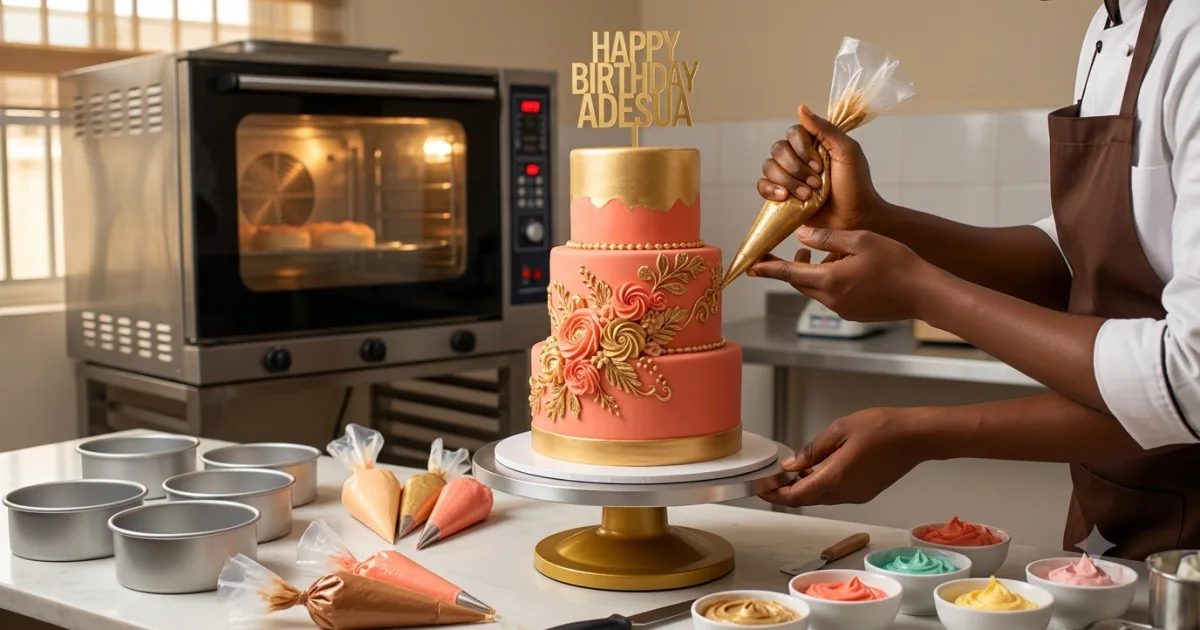
📌 Quick Summary: A small bakery business in Nigeria requires startup capital of ₦500,000 to ₦2,500,000 depending on scale — from a home-based cake business (₦500k) to a small commercial bread bakery (₦2.5M+). The three most profitable Nigerian bakery niches are: artisan bread and pastry (₦3,000–₦8,000 per loaf), custom celebration cakes (₦15,000–₦500,000 per cake), and mass-market bread supply (high volume, lower margin). A home-based cake business taking 3 to 5 orders per week earns approximately ₦200,000 to ₦600,000 monthly. This complete guide covers the three bakery models, equipment lists, startup costs, ingredient sourcing, pricing, how to get first orders, and NAFDAC requirements.
Baking is one of Nigeria’s most consistently expanding food business categories — driven by the growth of the celebration culture that surrounds Nigerian birthdays, weddings, baby showers, gender reveals, and corporate events, all of which now routinely feature custom cakes, cupcakes, and pastries as standard features rather than luxuries. The Nigerian bakery market has two distinct segments that require very different approaches. The artisan and custom segment — custom celebration cakes, cupcakes, artisan bread, pastries — is relationship-driven, skill-intensive, highly differentiated, and commands premium prices. The commercial bread segment — high-volume daily bread production for distribution to supermarkets, kiosks, and households — is capital-intensive, operationally demanding, price-sensitive, and margin-thin. This guide covers both, with specific guidance on which is the right starting point for most Nigerian entrepreneurs.
The Three Nigerian Bakery Business Models
Model 1: Home-Based Custom Cake Business
The most accessible starting point for most Nigerians — baking custom celebration cakes and pastries from home, taking orders through Instagram and WhatsApp. Startup capital: ₦300,000 to ₦700,000 for an oven, mixer, baking tins, decorating tools, and initial ingredient stock. Income potential: ₦150,000 to ₦600,000 monthly for a baker taking 3 to 6 cake orders per week at ₦15,000 to ₦150,000 per cake. This model requires baking skill above all else — the Instagram portfolio of your finished cakes is your primary marketing tool. The advantage of the home-based model is that overhead costs (no rent, no staff, no commercial kitchen fees) keep the break-even point very low, allowing profit from the first few orders.
Model 2: Artisan Bakery (Small Shop or Delivery-Based)
A bakery specialising in artisan bread, croissants, sourdough, pastries, and baked goods for the growing premium urban market in Lagos, Abuja, and Port Harcourt. Startup capital: ₦800,000 to ₦2,500,000 for commercial oven, proofer, dough sheeter, delivery packaging, and shop or kitchen space. Income potential: ₦300,000 to ₦1,500,000 monthly depending on product mix and order volume. This model targets a specific and underserved market — middle and upper-middle class Nigerian households and offices that are willing to pay ₦3,000 to ₦8,000 for an artisan sourdough loaf or ₦600 to ₦1,500 for a quality croissant rather than the cheap sliced bread that dominates the mass market.
Model 3: Commercial Bread Bakery
Mass-production of sliced bread, sweet bread, or agege bread for distribution through retailers, kiosks, and institutional buyers. Startup capital: ₦2,000,000 to ₦10,000,000+ for industrial deck ovens, dough mixers, bread moulds, and initial stock. This model competes on volume and distribution efficiency rather than product uniqueness — margins per loaf are thin (₦50 to ₦200 per loaf) but volumes are high. Commercial bread is a viable business but requires more capital, more staff, and more operational complexity than the first two models. Not recommended as a first bakery business.
Equipment List: Home-Based Cake Business
| Equipment | Cost (2026) | Notes |
| Electric oven (40 to 60 litre capacity) | ₦60,000 – ₦150,000 | A quality oven is the single most important investment. An oven with consistent temperature regulation produces consistent results. Cheaper ovens with uneven heating destroy more cakes and waste more ingredients than a quality oven ever costs extra. |
| Stand mixer (5 litre bowl, 300W+) | ₦45,000 – ₦120,000 | For creaming butter, whipping cream, and mixing batter. A hand mixer (₦8,000 to ₦20,000) works at small scale but limits production capacity. |
| Cake tins (6 to 8 inch round, various sizes) | ₦15,000 – ₦30,000 | Buy 2 to 3 of each size for efficiency |
| Piping bags, nozzle set, spatulas | ₦10,000 – ₦20,000 | Decoration tools |
| Turntable and cake board stock | ₦8,000 – ₦15,000 | |
| Weighing scale (digital, 0.1g precision) | ₦5,000 – ₦12,000 | Precision in baking is not optional — inconsistent measuring produces inconsistent cakes |
| Cake boxes and packaging (first month supply) | ₦8,000 – ₦20,000 | Professional packaging is a significant factor in client perception and word-of-mouth referrals |
| Initial ingredient stock (flour, sugar, butter, eggs, cocoa, vanilla) | ₦30,000 – ₦60,000 | Buy from wholesale market suppliers (Idumota and Balogun in Lagos; Wuse Market in Abuja) for better pricing |
| Total home-based starter | ₦181,000 – ₦427,000 |
Pricing Your Baked Goods
The most common bakery business failure in Nigeria is underpricing — setting prices based on what competitors charge rather than on what the actual production cost demands. The correct pricing formula: (Ingredient cost per unit + Packaging cost + Gas/electricity cost per unit + Your labour cost per hour × hours spent) × 3 to mark up for profit. For a custom celebration cake: a 2-tier 8-inch cake with fondant decoration might use ₦8,000 in ingredients, ₦2,000 in packaging, ₦500 in utilities, and take 4 hours at a labour rate of ₦2,000/hour (₦8,000). Total cost: ₦18,500. Multiply by 2.5 to 3 for profit: minimum selling price ₦46,250 to ₦55,500. A baker selling this cake for ₦20,000 is selling at a loss once labour is properly valued. Know your actual costs before setting prices.
How to Get Your First Bakery Orders in Nigeria
Five strategies that consistently generate first orders for new Nigerian bakers. First: bake 3 to 5 showcase cakes for free — for close friends’ or family members’ upcoming events. Document the process and finished product with professional phone photography, and post on Instagram with clear location tags and contact information. The portfolio is your most valuable marketing asset. Second: join Nigerian bakers’ WhatsApp groups and Instagram communities — existing bakers in your area are often willing to refer overflow orders to trusted newer bakers, and these communities share advice, supplier contacts, and client referral opportunities. Third: approach corporate HR departments for office birthday cake orders — many Nigerian offices now order custom cakes for staff birthdays as part of their employee engagement programmes. A corporate birthday cake account at ₦20,000 to ₦50,000 per order, 4 to 6 times per month, is ₦80,000 to ₦300,000 in recurring monthly revenue from a single corporate client. Fourth: list on Jumia Food, Chowdeck, or Munch as a baked goods vendor — custom cake orders through food delivery apps have grown significantly in Lagos and Abuja. Fifth: collaborate with event planners and wedding coordinators — a relationship with 2 to 3 active event planners generates consistent referrals for wedding cakes, birthday cakes, and corporate event pastries.
NAFDAC Requirements for Bakery Businesses
For small home-based bakers selling to individuals they know directly, informal sales without NAFDAC registration are common and technically below the enforcement threshold. However, for any bakery selling through social media to the general public, supplying restaurants or shops, or marketing at events, NAFDAC registration for food products is required. The relevant NAFDAC pathway is the Small Scale and Cottage Industry registration — designed specifically for small food producers. Requirements include: production facility inspection (even for home kitchens), product sample submission, label review (product name, ingredients list, net weight, production and expiry date, NAFDAC number). The process takes 3 to 6 months and costs approximately ₦50,000 to ₦200,000 depending on product types registered. Begin the registration process early — selling registered products increases customer trust, enables supply to regulated buyers (hospitals, hotels, supermarkets), and protects the business from regulatory action.
Frequently Asked Questions
How much does it cost to start a bakery in Nigeria?
Home-based cake business: ₦200,000 to ₦500,000. Small artisan bakery with shop: ₦800,000 to ₦2,500,000. Commercial bread bakery: ₦2,000,000 to ₦10,000,000+. The home-based model is the recommended starting point for most Nigerians entering the bakery business.
Is a bakery business profitable in Nigeria?
Yes — the custom cake segment is particularly profitable. A skilled baker charging ₦30,000 to ₦150,000 per custom celebration cake and taking 4 to 6 orders per month earns ₦120,000 to ₦900,000 monthly from a home-based operation with minimal overhead. Profitability depends on pricing correctly (not underselling) and maintaining consistent quality.
Do I need a NAFDAC number for my cake business in Nigeria?
For informal direct sales to known customers, NAFDAC registration is not commonly enforced at small scale. For selling to the general public via social media, supplying shops or hotels, or attending commercial events, NAFDAC registration is required. Register through the NAFDAC Small Scale and Cottage Industry pathway. The Nigerian baker who approaches the business with this patient, skills-first mindset — baking to improve, selling when genuinely ready, pricing honestly, and building reputation before scaling — is building something that can sustain them for years, not just months. The ones who rush to market with under-developed skills and underpriced products rarely last a full season.
Ingredient Sourcing: Buying Baking Supplies at the Right Price
The profitability of any Nigerian bakery business depends significantly on ingredient cost management. Flour, butter, sugar, eggs, cocoa powder, and vanilla extract are the core cost items in most Nigerian baked goods, and buying them at retail supermarket prices versus wholesale market prices can represent a 30 to 50 percent cost difference on the same ingredients. The practical sourcing guide for Nigerian bakers: buy flour, sugar, and cocoa in 25kg or 50kg quantities from food ingredient wholesalers in Idumota Market or Trade Fair Complex in Lagos, Wuse Market in Abuja, or Ariaria Market in Aba — prices are significantly lower than supermarket retail for the same product quality. Butter and margarine: buy in 10kg or 20kg catering packs from wholesale baking supply stores (Baker’s Hub, Bakers World, and similar specialty baking supply stores in Lagos and Abuja carry catering packs at significantly better per-kilogram prices than supermarket retail). Eggs: buy in trays (30 eggs per tray) from poultry farmers or egg distributors in your area — the per-egg price at tray level is typically 20 to 30 percent lower than the per-egg supermarket price. Building supplier relationships early — visiting the same wholesalers consistently, paying promptly, and gradually increasing your order quantities — produces better pricing over time and gives you access to advance notice of price increases that allow you to buy ahead before costs rise.
Sources
- NAFDAC — Small Scale food registration requirements — nafdac.gov.ng
- Original business guide — NaijaSabi Business Desk, September 2026
Last updated: 17 September 2026 · NaijaSabi Business Desk. Equipment costs and ingredient prices reflect Lagos/Abuja market rates as at September 2026.
Baking Skills: How to Improve Without Formal Training
The most common question from aspiring Nigerian bakers who want to start a bakery business but do not have formal training is how to acquire the skills needed to produce professional-quality products that clients will pay premium prices for. The honest answer in 2026: YouTube and deliberate practice are the two primary self-teaching tools available, and together they are sufficient to reach a professional standard for most baked goods. Nigerian baking content creators on YouTube — including several with millions of followers who teach specifically to Nigerian equipment, ingredient availability, and oven behaviour — provide step-by-step instruction for virtually every cake, pastry, and bread type. International channels (British Baking School, Joshua Weissman, Preppy Kitchen) provide world-class instruction on technique and decoration. The deliberate practice element: bake the same recipe 5 to 10 times before selling it to a paying client. The 5th attempt at a Victoria sponge will be substantially better than the 1st. The 10th attempt should be consistent enough to sell. Bakers who try to sell their 1st or 2nd attempt at a new recipe damage their reputation with the client and with everyone that client speaks to afterward. Skill compounds with practice — the baker who makes 50 cakes at home before taking their first paid order will always outperform the baker who takes paid orders from day one and learns on the client’s time. For Nigerians who want structured skill development beyond YouTube: the Lagos Baker’s Association, Bake on Online (Nigerian online baking school), and several Instagram-based Nigerian baking mentorship programmes offer structured courses with Nigerian-specific content at price points ranging from free to ₦50,000 per course.


0 Comments
No comments yet. Be the first to share your thoughts!