


📌 Quick Summary: A catering business in Nigeria requires startup capital of ₦150,000 to ₦600,000 for equipment, initial food stock, and branding. Service rates: ₦3,000 to ₦8,000 per head for event catering; ₦15,000 to ₦25,000 per person per week for meal prep subscriptions. A catering business serving one medium wedding (200 guests at ₦5,000 per head) earns ₦1,000,000 gross from a single event. The meal prep subscription model — feeding busy professionals weekly — generates ₦300,000 to ₦700,000 monthly recurring revenue from 20 to 30 subscribers. This guide covers the two primary Nigerian catering models, equipment lists, pricing, how to get first clients, staffing, NAFDAC requirements, and the Instagram marketing strategy that drives most Nigerian catering bookings.
Catering is one of Nigeria’s most financially rewarding food businesses — and one of the most underestimated in terms of how quickly it can generate serious income for someone with genuine cooking skill and the discipline to run it professionally. The Nigerian celebration culture — the owambe, the naming ceremony, the burial feast, the wedding reception, the corporate dinner — produces a consistent, year-round demand for professional catering that significantly exceeds the supply of truly professional caterers in most Nigerian cities. This guide covers exactly how to build a catering business that captures that demand.
The Two Nigerian Catering Business Models
Model 1: Event Catering
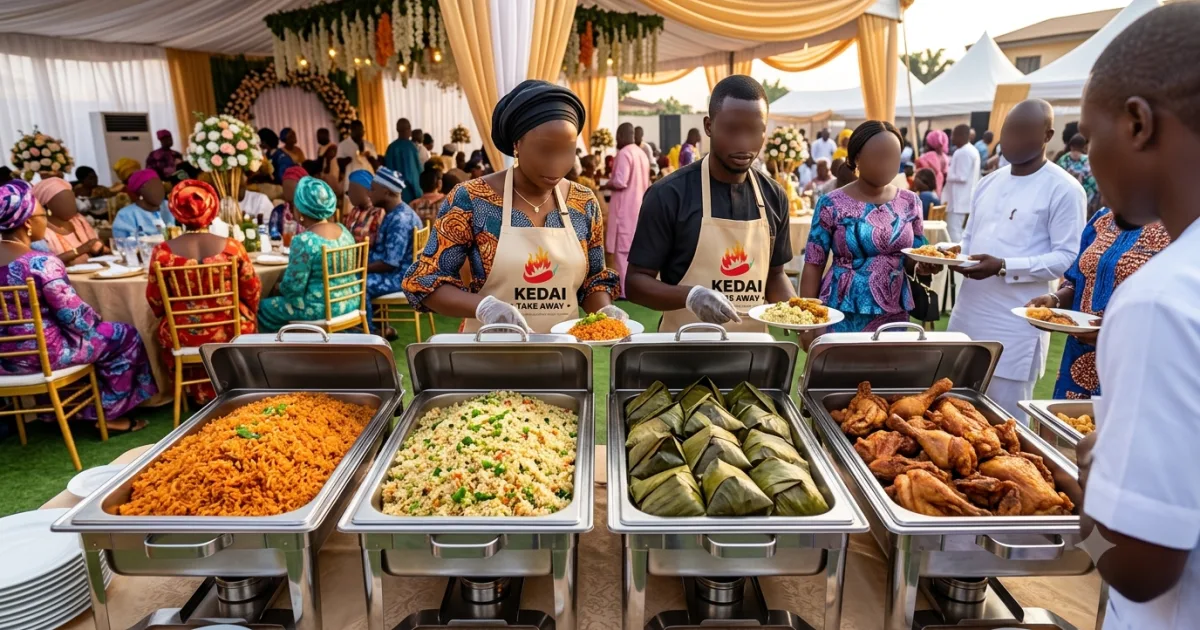
Cooking and serving food at events — weddings, naming ceremonies, birthday parties, corporate functions, burial ceremonies, and owambe parties. This is what most Nigerians picture when they think of a catering business. Revenue comes from one-off event contracts, typically booked 2 to 8 weeks in advance. Income is high per event but variable month to month — peak catering season in Nigeria runs from October through January (wedding and celebration season), while April through June tends to be quieter. A caterer serving 200 guests at ₦5,000 per head earns ₦1,000,000 gross from one event. After food cost (approximately 35 to 40 percent of revenue), equipment and transport, staffing for the day, and packaging, net profit per event is typically ₦300,000 to ₦500,000. Five events per month at this scale generates ₦1,500,000 to ₦2,500,000 monthly net income — but five events per month requires significant operational capacity, staff, and equipment.
Model 2: Meal Prep Subscriptions
The most financially stable and fastest-growing Nigerian catering innovation of 2026 — cooking weekly prepared meals for busy professionals who cannot cook daily but want home-quality food. The model: subscribers pay a fixed weekly or monthly fee for a set number of prepared meals delivered to their home or office. At ₦15,000 to ₦25,000 per person per week for five lunches, a caterer with 20 weekly subscribers generates ₦300,000 to ₦500,000 in recurring weekly revenue — before any event catering is added. The meal prep model has several structural advantages over pure event catering: predictable weekly revenue that does not spike and crash with the celebration season, smaller batch cooking that requires less equipment and fewer staff than large-scale event catering, and a client relationship built on weekly repeat business rather than one-off event transactions. The target client is the Lagos or Abuja professional — earning ₦200,000 to ₦600,000 monthly — who values time above almost everything else and is willing to pay for the convenience of having their working week’s lunch sorted on Sunday delivery. This client acquires through Instagram and WhatsApp, stays for months or years if the food quality is consistent, and refers colleagues and neighbours who have the same problem.
Equipment List and Startup Costs
| Equipment | Cost (2026) | Notes |
| Industrial gas cooker (4 to 6 burners) | ₦80,000 – ₦200,000 | The foundation of any catering operation. A domestic cooker cannot handle catering volumes — industrial burners produce the high heat needed for large-pot cooking and are significantly more durable. |
| Large aluminium pots (various sizes — 50L, 30L, 20L) | ₦40,000 – ₦100,000 | Buy 3 to 5 pots of different sizes — you need to cook multiple dishes simultaneously for events |
| Food warmers / chafing dishes (for event service) | ₦30,000 – ₦80,000 | Essential for event catering — food must be kept hot at service point. Stainless steel chafing dishes with fuel holders are standard. |
| Coolers / insulated containers (for delivery) | ₦20,000 – ₦50,000 | For transporting hot food to event venues and delivering meal prep orders |
| Food containers and packaging (first batch) | ₦15,000 – ₦30,000 | Meal prep containers — clear, microwave-safe, branded if possible. First impressions matter significantly in food delivery. |
| Serving equipment (ladles, spoons, tongs, gloves) | ₦10,000 – ₦25,000 | |
| Generator or inverter (for extended cooking sessions) | ₦80,000 – ₦250,000 | Power outages during cooking are a serious operational risk. A small generator or inverter for the cooker area is a practical necessity. |
| Branded aprons and serving uniforms (6 pieces) | ₦15,000 – ₦30,000 | Professional appearance at events is marketing — clients who see uniformed, professional staff at your events refer you to their next event planner contact |
| Minimum viable event catering startup | ₦290,000 – ₦765,000 |
Pricing Your Catering Services
The correct Nigerian catering pricing formula: Food cost per head × 2.5 to 3 = minimum per-head charge. Food cost for a standard Nigerian wedding menu (jollof rice, fried rice, moimoi, chicken, beef, small chops, drinks) is approximately ₦1,800 to ₦2,500 per head depending on portion sizes and protein quality. At a 2.5 multiplier, the minimum viable per-head charge is ₦4,500 to ₦6,250. Most professional Nigerian caterers charge ₦5,000 to ₦8,000 per head for a full wedding menu — with premium caterers in Lagos and Abuja charging ₦10,000 to ₦20,000 per head for corporate events with full service. The multiplier covers: your labour and the labour of any staff you hire for the event, transport costs, equipment depreciation, packaging, and profit. Charging at food cost only — as many inexperienced caterers do — leaves nothing for labour, equipment maintenance, or business growth. Know your actual costs before quoting any event.
How to Get Your First Catering Clients
Five strategies that consistently generate first catering bookings. First: offer to cater a family or close friend’s event at cost price in exchange for being the sole photographer/videographer of the food presentation. Professional food photos and a video of your service in action are your most powerful marketing assets — they go on Instagram, they go in your WhatsApp status, and they demonstrate real-world catering capacity rather than just home cooking skill. Second: approach event planners and wedding coordinators directly. A relationship with 2 to 3 active event planners in your city generates consistent catering referrals — event planners are asked for caterer recommendations at every event they plan, and a caterer who delivers reliably and professionally is a planner’s most valuable vendor relationship. Third: join Nigerian caterers’ WhatsApp groups and associations — the Nigerian Caterers Association, state-level catering cooperatives, and informal catering WhatsApp communities share overflow bookings among trusted members when a member is overbooked. Fourth: for the meal prep model, post weekly content on Instagram showing your Sunday meal prep process — what you are making that week, the portioning and packaging, the delivery. Consistency over 4 to 8 weeks builds a local following of potential subscribers who see your food every week and eventually message to subscribe. Fifth: approach corporate HR departments for office lunch programmes and staff event catering — a company that books you for its quarterly staff party and its MD’s birthday lunch is a client that generates multiple bookings per year from a single relationship.
Staffing for Events
Catering events requires temporary staff beyond what a solo operator can provide. The standard staffing structure for a 200-guest Nigerian event: 2 to 3 cooks (for the kitchen/cooking station), 4 to 6 servers (for the service line and table service), 1 to 2 coordinators (managing the service flow and communicating with the event planner). Hire trusted people whose food handling hygiene you can vouch for — a food poisoning incident at an event is the most catastrophic reputational event possible in the catering business. Pay fairly — ₦5,000 to ₦15,000 per person per event is standard in Lagos and Abuja depending on role and hours. Build a reliable pool of 6 to 10 people you can call for events, rather than scrambling for new staff every time.
NAFDAC and Food Business Registration
For event catering where food is prepared and served on-site, NAFDAC registration is not typically required — this falls under food service rather than food manufacturing. For meal prep delivery businesses packaging food under a brand name and delivering to consumers, NAFDAC registration is required for the packaged food product. The Small Scale and Cottage Industry registration pathway applies — budget ₦50,000 to ₦150,000 and 3 to 6 months for the process. CAC Business Name registration (₦11,000 to ₦15,000) is recommended regardless of scale — it enables you to open a business bank account, access contracts, and present professionally to corporate clients who require a registered vendor.
Frequently Asked Questions
How much does it cost to start a catering business in Nigeria?
₦150,000 to ₦400,000 for a home-based meal prep operation. ₦300,000 to ₦800,000 for event catering with basic equipment. Larger-scale event catering with full industrial equipment and transport requires ₦1,000,000 to ₦3,000,000.
How much do caterers charge per head in Nigeria?
₦3,000 to ₦5,000 per head for basic event menus. ₦5,000 to ₦8,000 for full wedding menus with multiple proteins and drinks. ₦10,000 to ₦20,000 per head for premium corporate events in Lagos and Abuja.
Do I need NAFDAC registration to start a catering business in Nigeria?
For on-site event catering, NAFDAC registration is not typically required. For packaged, branded meal prep delivery to consumers, NAFDAC registration is required for the food product. CAC Business Name registration is recommended for all catering businesses regardless of model.
What is the most profitable catering business model in Nigeria?
The meal prep subscription model is the most financially stable — generating recurring weekly revenue from a fixed subscriber base rather than the feast-and-famine income pattern of event catering. The highest per-event income comes from large weddings and corporate events at premium per-head rates. Combining both models — weekly meal prep subscribers providing stable income, with event catering providing high-revenue peaks — is the most resilient structure.
Sources
- Original business guide — NaijaSabi Business Desk, September 2026
- Nigerian catering market research — NaijaSabi, September 2026
Last updated: 20 September 2026 · NaijaSabi Business Desk. Service rates reflect Lagos and Abuja market pricing as at September 2026.
Building Your Catering Brand: Instagram and WhatsApp as Your Primary Marketing Channels
The Nigerian catering business lives on Instagram and WhatsApp in 2026 — not in newspapers, not on Google ads, and not in physical flyers. The reason is specific to how Nigerian catering clients make decisions: they book a caterer they have seen cook, whose food they have seen photographed professionally, and whose previous events they have seen documented. They do not book a caterer from a business card. This means that building a social media presence that consistently shows your food in professional conditions is not a nice-to-have for a Nigerian catering business — it is the primary business development activity. Three content types that consistently drive catering bookings on Nigerian Instagram: food photography (styled images of finished dishes — investing ₦10,000 to ₦30,000 in one professional food photography session produces content that books events for months), behind-the-scenes cooking videos (showing the scale of your cooking — the large pots, the professional burners, the volume of food being prepared builds confidence in your capacity to handle large events), and event day documentation (photos and short videos of your team serving at an actual event — uniformed, professional, organised — is the most powerful trust signal available). Post 3 to 5 times per week. Use Lagos, Abuja, or your city as a location tag on every post. Reply to every comment and DM within 2 hours during business hours. The caterers who are fully booked months in advance in Nigerian cities are, almost universally, the ones with the most consistent and professional Instagram presence — not necessarily the ones who cook the best food, though quality is essential to retention once you book a client.
Catering and the Nigerian Owambe Economy
The owambe — the large, music-filled, elaborately catered Nigerian Yoruba party that has become a cultural institution well beyond Yorubaland — is the single largest driver of professional catering demand in Nigeria. The owambe’s defining characteristic is excess: excess of food, excess of music, excess of fabric, excess of celebration. A properly executed owambe feeds guests until they cannot eat more, sends people home with takeaway packs, and has food so abundant that the leftovers become their own conversation. For the caterer, this expectation creates a specific business reality: Nigerian owambe clients are not primarily price-sensitive — they are quality and quantity sensitive. A caterer who consistently delivers the specific taste (smoky jollof from firewood or the specific charred-bottom technique), the appropriate portion sizes (generous), and the right protein distribution (every guest gets substantial chicken, not just one small piece) builds a reputation that carries itself through word of mouth across every owambe network the client belongs to. One excellently executed owambe generates 3 to 5 future bookings from guests who experienced your food and immediately asked the host for your contact. The owambe is the most efficient marketing event in the Nigerian catering industry.


0 Comments
No comments yet. Be the first to share your thoughts!