




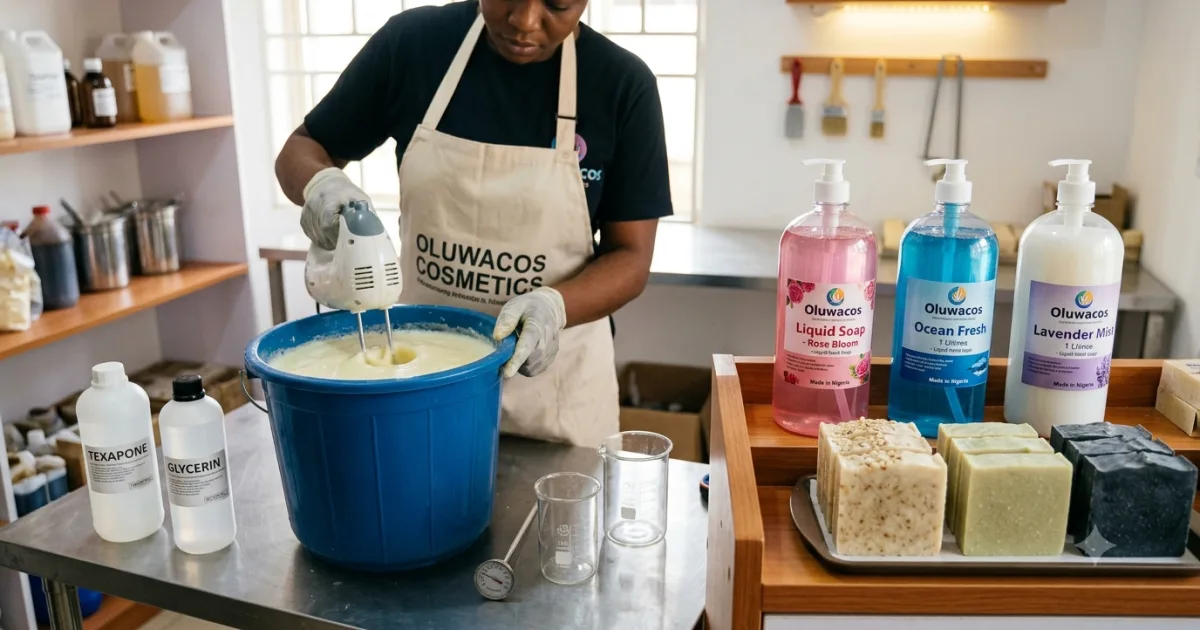
📌 Quick Summary: A soap making business in Nigeria starts at ₦50,000 to ₦200,000 for ingredients, moulds, and packaging. The two most commercially viable products are liquid soap (cheaper to produce, faster to make, higher daily-use demand) and bar soap (higher margin, longer shelf life, more premium positioning). A 20-litre batch of liquid soap costs approximately ₦8,000 to ₦15,000 in ingredients and sells for ₦40,000 to ₦80,000. Selling 10 batches per week generates ₦400,000 to ₦800,000 monthly gross revenue. Key ingredients: caustic soda (NaOH for bar soap, KOH for liquid soap), palm oil or coconut oil, texapone, glycerin. NAFDAC registration is required for commercial sale. This guide covers both liquid and bar soap recipes, equipment, costing, NAFDAC requirements, and how to find soap buyers in Nigeria.
Soap making is one of Nigeria’s most democratically accessible manufacturing businesses — requiring relatively simple chemistry, widely available raw materials, low startup capital, and producing a product that every Nigerian household uses daily and will continue buying regardless of economic conditions. The soap market in Nigeria is large, consistent, and has room for local producers who offer better quality, more natural formulations, or more competitive pricing than the mass-market brands dominating supermarket shelves. This guide covers how to enter that market as a small-scale soap producer.
Liquid Soap vs Bar Soap: Which to Start With
For most Nigerian soap business beginners, liquid soap is the recommended starting point. The reasons: liquid soap requires no curing time (bar soap needs 4 to 6 weeks to cure before it is ready to sell, liquid soap is ready within 24 to 48 hours), the production process is simpler, the equipment requirement is lower, and daily-use demand for liquid soap (for handwashing, dishwashing, and laundry) is extremely high in Nigeria. Bar soap is more premium, commands higher per-unit selling prices, and has a longer shelf life — making it a better product for retail and institutional supply — but its production involves a more complex saponification process and the patience to manage curing time. The ideal soap business trajectory: start with liquid soap to generate immediate cash flow and build customer relationships, then add bar soap as a premium product line once you have an established client base and understand your production costs.
Liquid Soap Ingredients and Recipe (20-Litre Batch)
| Ingredient | Quantity | Purpose | Where to Buy |
| Potassium hydroxide (KOH / caustic potash) | 500g | The alkali that saponifies the oil — creates the soap base. Handle with gloves and eye protection — it is highly caustic. | Chemical supply stores; Balogun Market Lagos; Onitsha Main Market |
| Texapone (sodium lauryl ether sulphate — SLES) | 2 litres | Surfactant — creates lather and cleaning action | Chemical supply stores across Nigeria |
| Coconut oil or palm kernel oil | 500ml | Moisturising base — improves skin feel of finished soap | |
| Glycerin | 200ml | Humectant — draws moisture to skin, improves product quality | |
| CDEA (cocamide diethanolamine) | 200ml | Foam booster and thickener | |
| Sodium chloride (table salt) | 2 to 4 tablespoons | Thickener — adjust quantity to achieve desired consistency | |
| Fragrance oil or essential oil | 50 to 100ml | Scent — your signature fragrance differentiates your product | |
| Colour (cosmetic-grade liquid colour) | A few drops | Visual appeal — match colour to fragrance theme | |
| Preservative (formaldehyde-free — sodium benzoate or phenoxyethanol) | Per supplier instruction | Prevents microbial growth and extends shelf life | |
| Water | 15 litres | Diluent base | |
| Approximate ingredient cost per 20L batch | ₦8,000 – ₦15,000 | ||
Liquid Soap Production Steps
- Dissolve the KOH (caustic potash) in 2 litres of water — add KOH to water, never water to KOH. Stir until dissolved. The solution will heat up significantly — this is normal. Allow to cool to room temperature before proceeding.
- Combine the texapone, CDEA, and glycerin in a large bucket or bowl. Stir gently — do not create excessive foam.
- Add the cooled KOH solution to the texapone mixture slowly, stirring continuously.
- Add the coconut oil or palm kernel oil and continue stirring until fully incorporated.
- Add fragrance oil and colour. Stir until evenly distributed throughout the mixture.
- Add the remaining water (approximately 13 litres) gradually, stirring to combine.
- Add salt solution (dissolve salt in 200ml warm water, then add to the mixture) to thicken. Add gradually, testing consistency — stop when desired thickness is reached.
- Add preservative per the supplier’s recommended rate.
- Allow to rest for 24 hours before bottling. During this resting period, the soap continues to develop and the consistency stabilises.
- Bottle, label, and seal.
Bar Soap Basics: Cold Process Method
Bar soap (cold process) requires: sodium hydroxide (NaOH/caustic soda), a base oil blend (palm oil, coconut oil, castor oil in specific ratios), water, fragrance, and colorant. The NaOH reacts with the oils in a saponification process that generates significant heat — the mixture must be worked at the right temperature (typically 40 to 45 degrees Celsius for both the lye solution and the oil blend). The mixture is poured into moulds, insulated for 24 hours to complete saponification, unmoulded, cut into bars, and cured for 4 to 6 weeks before sale. Do not attempt to rush the cure time — uncured or under-cured bar soap contains residual lye that is harmful to skin. Every batch should be pH-tested before sale (using pH strips — pH 8 to 10 is the acceptable range for finished bar soap).
Costing and Pricing
| 20L batch liquid soap — ingredient cost | ₦8,000 – ₦15,000 |
| Packaging (20 × 1L bottles with labels) | ₦4,000 – ₦8,000 |
| Total cost per 20L batch (packaged) | ₦12,000 – ₦23,000 |
| Selling price per 1L bottle (retail) | ₦2,000 – ₦4,000 |
| Gross revenue per 20L batch (20 × 1L bottles) | ₦40,000 – ₦80,000 |
| Gross profit per batch | ₦17,000 – ₦57,000 |
Where to Sell Soap in Nigeria
Five reliable sales channels for Nigerian soap producers. Supermarkets and shops (consignment or wholesale supply) — approach local supermarkets, convenience stores, and beauty supply shops about stocking your product. Institutional supply — schools, hospitals, hotels, restaurants, and corporate offices all buy cleaning products in bulk and regularly — a single institutional contract can absorb the output of multiple production batches per month. WhatsApp and Instagram direct-to-consumer — natural, artisan, and premium soap products sell very well through social media to the health-conscious urban consumer segment willing to pay above market rate for quality ingredients and attractive packaging. Markets — Balogun, Idumota, and Trade Fair Complex in Lagos; Wuse Market in Abuja — have established soap and cleaning products vendors who buy wholesale from producers. Church and mosque communities — religious community groups often buy cleaning products in bulk for communal facilities and can be approached through their procurement or facilities management contacts.
NAFDAC Registration for Soap
Soap and cosmetics require NAFDAC registration before commercial sale in Nigeria. The cosmetics registration pathway applies to both liquid and bar soap. Requirements include: a formulation list (complete ingredient list with percentages), manufacturing premises inspection, product label review (product name, manufacturer details, net content, ingredients, batch number, manufacturing and expiry date), and product sample submission for testing. Budget ₦50,000 to ₦200,000 and 3 to 6 months for the registration process. Begin the process early — selling unregistered soap commercially exposes the business to NAFDAC enforcement action including product seizure.
Frequently Asked Questions
How much does it cost to start a soap making business in Nigeria?
₦50,000 to ₦150,000 for liquid soap — covering one month of raw materials, basic equipment (buckets, mixing tools, moulds), and initial packaging. Bar soap startup costs are similar for ingredients but add mould costs (₦10,000 to ₦30,000 for basic bar soap moulds).
Where can I learn soap making in Nigeria?
The NYSC SAED programme offers free soap making training at orientation camp. Several Nigerian vocational training organisations (Lagos State Employment Trust Fund training programmes, state ADPs) offer soap making courses. YouTube provides detailed Nigerian soap making tutorials covering both liquid and bar soap. Experienced soap makers in your area often offer paid training workshops for ₦10,000 to ₦30,000 per session.
Is caustic soda dangerous?
Yes — caustic soda (NaOH) and caustic potash (KOH) are highly corrosive and cause serious burns on contact with skin, eyes, or mucous membranes. Always wear rubber gloves, safety goggles, and old clothing when handling lye. Add lye to water (never water to lye). Keep children away from your production area. Store in sealed containers away from moisture. These precautions make soap production safe — the danger comes from casual handling, not from the soap-making process itself when properly managed.
Quality Control: Making Soap That Customers Return For
The Nigerian soap market has two failure modes that destroy small soap businesses before they reach scale. The first is inconsistency — producing a batch of soap that customers love and then never exactly replicating it because the measurements were approximate and the process was not documented. The second is inadequate curing or incorrectly balanced formulations — bar soap with residual lye that irritates skin, liquid soap that separates after a few weeks, or products that smell different from batch to batch because fragrance was added by eye rather than by weight. Both failure modes are solved by the same discipline: write down every ingredient quantity, every step, and every result for every batch. A production log is not bureaucracy — it is the tool that allows you to replicate your best batches and diagnose your failures. Note: the weight of each ingredient (use a digital scale — volume measurements for liquids are acceptable but weight is more accurate for powders), the date of production, the temperature at which you combined the ingredients, the appearance and consistency of the finished product, and the customer feedback on each batch. After 10 to 20 documented batches, patterns emerge clearly: which fragrance oils your customers request most, which formulation produces the best lather in Nigerian water conditions (hard water, which is common in many Nigerian cities, affects soap lather significantly), which batch sizes are most efficient for your production schedule. This documentation transforms soap making from a craft into a reproducible manufacturing process — and reproducible quality is what builds the customer loyalty that sustains a soap business beyond the initial excitement of launch. The soap business rewards patience, precision, and the willingness to learn from every batch — qualities that compound over time into a product quality and business reputation that price-cutting competitors cannot easily replicate.
Building a Soap Brand: From Commodity to Premium Product
The Nigerian soap market has two distinct segments. The commodity segment — bulk liquid soap sold in plain 1-litre bottles at ₦1,000 to ₦1,500 — competes primarily on price and is dominated by established producers who can produce at lower cost per litre because of their scale. The premium artisan segment — branded liquid soap and cold-process bar soap with natural ingredients, attractive packaging, and clear ingredient transparency — competes on quality and brand identity, commands ₦2,500 to ₦6,000 per unit, and is growing rapidly as Nigerian consumers become more ingredient-conscious. A small-scale soap producer attempting to compete in the commodity segment is fighting a cost battle against producers with 10 to 100 times their production volume. The same producer positioning themselves in the premium artisan segment — with a brand name, a signature fragrance, attractive labels that list natural ingredients clearly, and a social media presence that tells the brand story — is competing on identity and quality rather than price, and can charge 3 to 4 times the commodity price to a consumer who actively wants what they are selling. The investment to move from commodity to premium is modest: ₦15,000 to ₦50,000 in branding (logo, label design, business name registration) transforms the same product into a premium one. The Nigerian consumer who will pay ₦4,000 for a branded artisan soap that smells of lavender and lists shea butter and coconut oil as ingredients is not comparing it to ₦1,200 bulk soap — they are comparing it to international skincare brands at ₦8,000 to ₦20,000 per product, and finding your premium artisan soap to be exceptional value. That is the correct competitive frame for a small Nigerian soap producer in 2026.
Sources
- NAFDAC — cosmetics and soap registration requirements — nafdac.gov.ng
- Original business guide — NaijaSabi Business Desk, September 2026
Last updated: 23 September 2026 · NaijaSabi Business Desk.


0 Comments
No comments yet. Be the first to share your thoughts!