




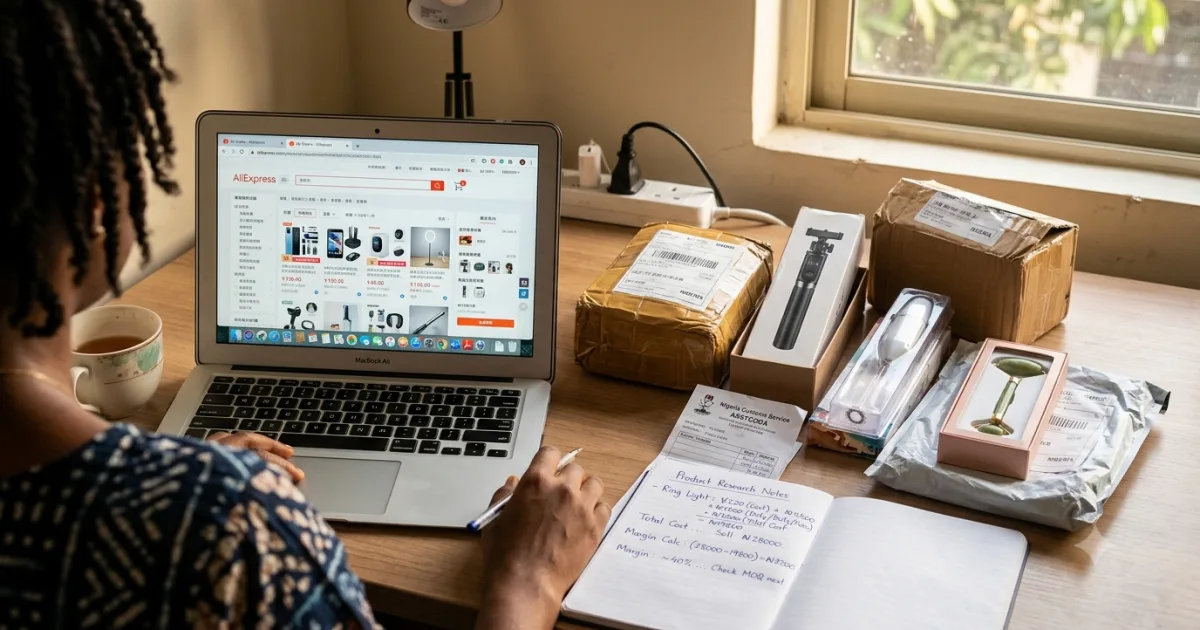
📌 Quick Summary: Mini-importation is the business of buying products in small quantities from Chinese suppliers (Alibaba, 1688, Temu, AliExpress) and reselling them in Nigeria at 200 to 500 percent markup. A product that costs $3 to $8 on 1688 (China’s wholesale platform) sells for ₦8,000 to ₦25,000 in Nigeria. Startup capital: ₦50,000 to ₦300,000 depending on product category. The fastest-selling product categories in 2026: phone accessories, fashion items, kitchen gadgets, hair products, and beauty tools. Sales channels: WhatsApp, Instagram, Jiji, and Jumia. This guide covers how to find winning products, how to order from Chinese suppliers, shipping to Nigeria (air freight vs sea freight), customs clearance, and how to sell profitably.
Mini-importation has transformed the way thousands of Nigerian entrepreneurs enter business — providing a path to profitable trading that requires no manufacturing skill, no large warehouse, and no prior business experience. The model is straightforward: find a product that sells well in Nigeria, source it cheaply from Chinese wholesale platforms, import it, and resell at a significant markup. The difficulty lies not in the concept but in the execution: finding the right products, avoiding the most common sourcing mistakes, navigating Nigerian customs, and building a reliable sales channel. This guide covers all of it.
Why China and Why Now
China is the world’s largest manufacturer of consumer goods, and its domestic wholesale platforms — particularly 1688.com (Alibaba’s domestic wholesale arm) — price products at factory-gate prices that are 60 to 80 percent lower than what the same products cost on international retail platforms like AliExpress or Amazon. A phone holder that costs $12 on Amazon costs $1.50 on 1688. A kitchen gadget that costs ₦15,000 in a Lagos shop costs $3.50 on 1688. These price differentials are the foundation of the mini-importation business. In 2026, the logistics infrastructure connecting Nigerian importers to Chinese suppliers has improved significantly — several Nigerian-focused freight forwarding companies maintain warehouses in Guangzhou, Yiwu, and Shenzhen that consolidate Nigerian orders, handle export documentation, and ship to Lagos and other Nigerian ports and airports at standardised rates. The process that once required a sourcing agent and weeks of uncertainty is now accessible to any Nigerian with a smartphone, an international payment method, and ₦50,000 in working capital.
The Four Chinese Platforms and When to Use Each
| Platform | URL | Best For | Minimum Order | Language |
| 1688.com | 1688.com | Lowest wholesale prices — factory-direct. Best for experienced importers buying in quantity. | Typically 5 to 50 units per item | Chinese — use Google Translate or a sourcing agent |
| AliExpress | aliexpress.com | English platform, buyer protection, 1-unit minimum. Higher prices than 1688 but safer for beginners. | Usually 1 unit | English |
| Alibaba | alibaba.com | Verified suppliers, English platform, larger MOQ. Best for wholesale and private labelling. | Usually 50 to 500 units | English |
| Temu | temu.com | Very cheap retail/small wholesale. No MOQ. Good for testing products before committing to larger orders. | 1 unit | English |
Recommended starting point for Nigerian beginners: AliExpress or Temu for your first 1 to 3 test orders — buy 1 to 5 units, receive them, test quality, and confirm the Nigerian selling price before committing to a larger order on 1688.
Finding Winning Products: The Research Process
Product selection is the most critical decision in mini-importation. The characteristics of a winning product for the Nigerian market: high perceived value relative to low unit cost (a gadget that looks expensive but costs $3 to produce), solves a specific problem Nigerians have or satisfies a strong desire, is not yet widely available in Nigerian shops, is compact and lightweight (reducing shipping cost), and is easy to demonstrate visually on Instagram and TikTok. Five product research methods that work for Nigerian mini-importers. First: browse AliExpress “Best Sellers” and “Choice” product filters in categories relevant to Nigeria — phone accessories, kitchen tools, hair products, baby products, fashion accessories. Items marked “10,000+ sold” are proven global sellers; test whether the Nigerian market has demand through Google Trends Nigeria. Second: look at what Nigerian Instagram shops are currently selling successfully — if a product is generating active engagement and sales on Nigerian Instagram accounts, demand is confirmed. Third: visit Jiji.ng’s most viewed listings — the categories with the most views and active listings tell you where Nigerian consumer demand is concentrated. Fourth: use TikTok Nigeria to find product trends — viral product demonstrations on Nigerian TikTok consistently generate immediate demand that can be capitalised on with 2 to 3 week air freight delivery. Fifth: ask the question “what do Nigerians buy abroad and bring back?” — every category of product that returning travellers regularly bring back from Dubai, London, or the US is a potential import product with proven Nigerian demand.
Top Product Categories for Nigerian Mini-Importers in 2026
| Category | Example Products | Buy Price (1688) | Nigeria Sell Price | Notes |
| Phone accessories | Fast chargers, phone holders, wireless earbuds, power banks | $2 – $8 | ₦5,000 – ₦25,000 | Highest volume category — every Nigerian needs phone accessories |
| Hair products | Wigs, hair extensions, lace frontals, hair growth serums | $5 – $25 | ₦15,000 – ₦80,000 | Very high demand; high margins but higher product complexity |
| Kitchen gadgets | Electric graters, choppers, multi-cookers, air fryers (small) | $4 – $20 | ₦8,000 – ₦50,000 | Strong Instagram content potential; growing middle-class market |
| Fashion accessories | Bags, belts, sunglasses, jewellery, watches | $2 – $10 | ₦5,000 – ₦30,000 | Fast turnover; trendy items move quickly but also go out of style |
| Beauty and skincare tools | Facial steamers, LED therapy masks, hair removal devices | $5 – $15 | ₦12,000 – ₦45,000 | Strong social media marketing potential; Nigeria’s beauty market growing fast |
| Baby products | Baby monitors, feeding sets, carriers, educational toys | $3 – $15 | ₦8,000 – ₦40,000 | Parents are willing to pay premium prices; very large Nigerian market |
| Car accessories | Dash cams, phone mounts, seat organisers, air purifiers | $3 – $12 | ₦6,000 – ₦30,000 | Growing Nigerian car ownership and road commuting culture |
How to Pay Chinese Suppliers from Nigeria
Paying Chinese suppliers from Nigeria is the most common practical barrier new mini-importers face. Nigerian Naira accounts cannot directly pay Chinese suppliers — you need a foreign currency payment method. Three options that work reliably in 2026. First: dollar virtual cards from Grey, Chipper Cash, or Eversend — create a dollar virtual card, fund it from your naira account at the platform’s current exchange rate, and use it to pay on AliExpress, Temu, or Alibaba. Limits apply — most platforms cap single transactions at $500 to $1,000. Second: cryptocurrency (USDT) — many Chinese suppliers and freight forwarders accept USDT payment directly. Buy USDT on Binance Nigeria or Yellow Card with naira, and transfer to the supplier’s wallet address. Confirm acceptance before ordering. Third: use a sourcing agent — a Nigerian-based sourcing agent based in China or with Chinese supplier contacts purchases on your behalf in yuan and bills you in naira. This adds a service fee (typically 5 to 10 percent of order value) but eliminates the payment complexity entirely and often provides better supplier negotiation and quality control.
Shipping to Nigeria: Air Freight vs Sea Freight
| Method | Transit Time | Cost per kg | Best For |
| Air freight (express) | 5 to 15 days | $8 – $15 per kg | High-value, time-sensitive, lightweight products. Phone accessories, beauty products, fashion items. |
| Sea freight (FCL/LCL) | 30 to 45 days | $2 – $4 per kg | Heavy, bulky, lower-value products. Furniture, appliances, large quantities. Minimum 50kg to 100kg for cost efficiency. |
For most Nigerian mini-importers starting out: use air freight. The higher per-kg cost is justified by faster cash flow (product arrives and sells within 2 to 3 weeks of ordering), lower risk of customs complications, and the ability to start with small test orders before committing to sea freight volumes.
Nigerian Customs: What to Expect
All commercial imports into Nigeria are subject to Nigeria Customs Service duties. Key facts for mini-importers: most consumer goods attract import duty of 5 to 20 percent of the customs value (the CIF value — Cost, Insurance, Freight). Most freight forwarders handling Nigerian imports include customs clearance in their service — you pay the all-in landed cost rather than navigating customs yourself. Always work with a reputable freight forwarder who provides a tracking number and clear communication about your shipment status. Undervaluing goods at customs (declaring a $500 shipment as $50) is illegal and results in seizure of goods and potential prosecution. Many freight forwarders experienced with the Nigerian market structure their invoicing to reflect legitimate values — ask explicitly about their customs handling practice before committing to a forwarder.
Selling Your Imported Products in Nigeria
Four sales channels in order of accessibility. WhatsApp Business — the primary channel for most Nigerian mini-importers. A WhatsApp Business profile with your product catalogue, pricing, and an active status showing your inventory converts warm contacts into buyers at zero cost. Instagram — for product categories with strong visual appeal (fashion, beauty, kitchen gadgets), Instagram shopping and targeted ads to Lagos and Abuja users produce consistent leads. Budget ₦3,000 to ₦10,000 per week for targeted Instagram ads initially — measure cost per lead and scale what works. Jiji.ng — Nigeria’s largest online classifieds platform. List products with clear photos, detailed descriptions, and competitive pricing. Jiji generates buyers with purchase intent rather than casual browsers, and it is free to list. Jumia — Nigeria’s largest e-commerce platform. Becoming a Jumia seller requires product registration and compliance with their listing standards, but provides access to Jumia’s millions of active Nigerian buyers. The commission structure (8 to 15 percent of sale price) reduces margin but significantly increases volume potential.
Frequently Asked Questions
How much do I need to start mini-importation in Nigeria?
₦50,000 to ₦100,000 for a first test order on AliExpress or Temu (1 to 5 units per product type), plus shipping cost. A more substantial starting inventory from 1688 with air freight to Nigeria requires ₦150,000 to ₦400,000 depending on product category and quantity.
Is mini-importation still profitable in Nigeria in 2026?
Yes — the naira’s current exchange rate (₦1,580 to ₦1,680 per dollar) makes Chinese goods more expensive in naira terms than they were in 2020, but Nigerian selling prices have also risen correspondingly. The margin structure (200 to 500 percent markup on cost) remains intact for the right products. Product selection and sales channel quality determine profitability more than the exchange rate.
What is the best product to import from China to Nigeria in 2026?
No single “best product” exists — the best product is one with confirmed Nigerian demand, low competition from established local suppliers, and a cost-to-sell-price ratio that produces 200 to 400 percent markup after all costs including shipping, customs, and platform fees. Phone accessories, hair products, and kitchen gadgets consistently meet these criteria in 2026.
Sources
- 1688.com, AliExpress, Alibaba — platform pricing research — September 2026
- Original business guide — NaijaSabi Business Desk, September 2026
Last updated: 23 September 2026 · NaijaSabi Business Desk.
Avoiding the Most Common Mini-Importation Mistakes
Five mistakes that consistently destroy Nigerian mini-importation businesses before they reach profitability. First: ordering large quantities of an untested product. The correct sequence is always: test with 1 to 5 units, confirm Nigerian market demand and selling price, confirm product quality on arrival, then scale to 20 to 50 units. Ordering 100 units of an untested product and discovering that Nigerians do not want it, or that the quality is poor, wastes the entire capital base. Second: ignoring shipping weight and dimensions. A product that costs $3 and weighs 1.5kg costs $12 to $22 to ship by air — meaning the landed cost before profit is $15 to $25 on a $3 product. Always calculate the landed cost (product cost + shipping + customs) before deciding on a selling price. Products with very low value-to-weight ratios are not suited to air freight mini-importation. Third: using unreliable freight forwarders. A lost or indefinitely delayed shipment destroys both capital and customer relationships. Use freight forwarders with verifiable Nigerian customer reviews — ask for references from other Nigerian importers before committing. Fourth: not verifying product quality before listing. Order a sample of every new product before listing it for sale. A product that looks excellent in supplier photos and arrives with poor build quality produces refund requests, negative reviews, and damaged reputation. Fifth: selling only on one channel. WhatsApp-only sellers plateau quickly — the WhatsApp contact list has a finite size. Instagram ads, Jiji listings, and Jumia expand the customer base beyond personal contacts and are essential for scaling beyond the first ₦200,000 monthly revenue.




0 Comments
No comments yet. Be the first to share your thoughts!