




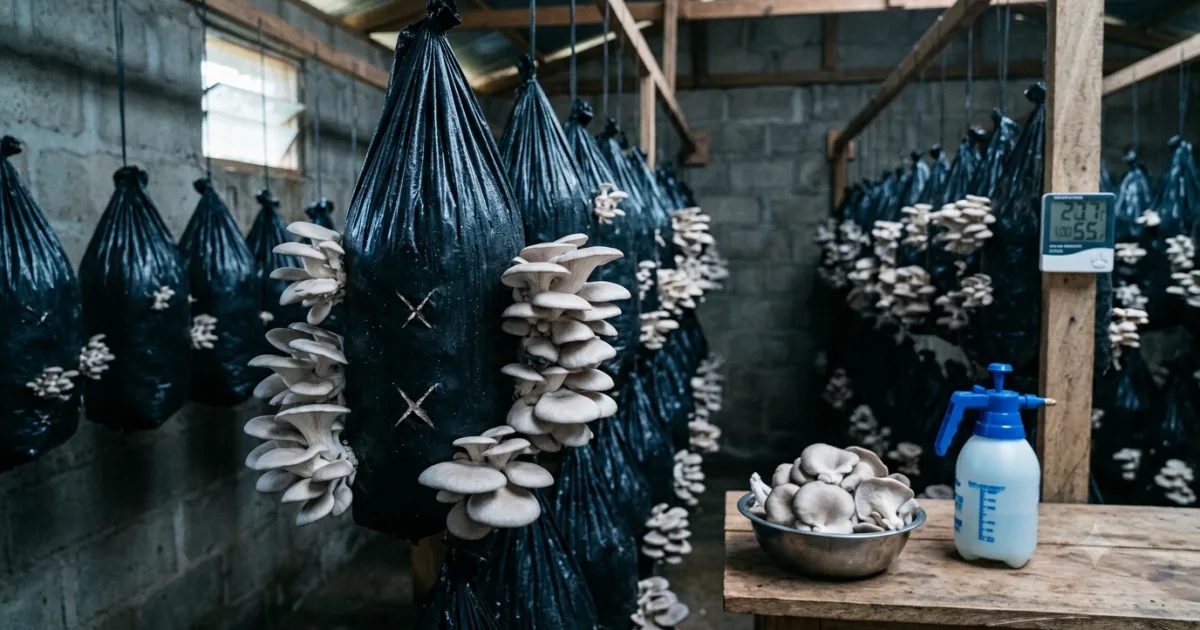
📌 Quick Summary: Oyster mushroom farming is Nigeria’s fastest-growing alternative agriculture business — mushrooms grow from agricultural waste substrate (sawdust, rice straw, corn cobs) and are ready to harvest in just 3 to 4 weeks from spawning. A 100-bag farm setup costs approximately ₦150,000 to ₦300,000 and produces approximately 40 to 60kg of fresh mushrooms per harvest cycle. Oyster mushrooms sell at ₦3,000 to ₦8,000 per kilogram in Nigerian markets, supermarkets, and restaurants. Annual revenue potential from a 100-bag farm: ₦700,000 to ₦2,000,000. This guide covers substrate preparation, spawn sourcing, bag preparation, fruiting conditions, harvesting, pest management, and where to sell mushrooms in Nigeria.
Mushroom farming sits at an unusual intersection in Nigerian agriculture — it requires no farmland, no soil, and no sunlight, yet produces a high-value food crop in weeks rather than months. Oyster mushrooms (Pleurotus ostreatus and related species) are the recommended starting variety for Nigerian beginners: they are the most forgiving to grow, the fastest to produce, the easiest to sell, and the most widely accepted in Nigerian markets and restaurants. The substrate (the growing medium) is agricultural waste — sawdust from timber mills, rice straw, sugarcane bagasse, corn cobs — materials that are available free or at very low cost across Nigeria. The combination of very low input cost, short production cycle, and premium selling price makes oyster mushroom farming one of the highest-return per-square-metre agricultural activities available in Nigeria.
Why Oyster Mushrooms in Nigeria: The Market Case
Nigerian mushroom consumption has increased significantly in the past five years, driven by three converging trends. First: the growing health-conscious consumer segment that is actively seeking high-protein, low-calorie, nutrient-dense foods — mushrooms are approximately 25 to 35 percent protein by dry weight, are rich in B vitamins, selenium, and zinc, and are one of the few non-animal sources of vitamin D. Second: the rapid expansion of Chinese, Asian fusion, and continental restaurants in Lagos, Abuja, and Port Harcourt, where mushrooms are standard menu ingredients but currently sourced inconsistently and expensively from imported dried mushrooms or sporadic local supply. Third: the broader Nigerian curiosity about new food experiences driven by food content on Instagram and TikTok. Fresh oyster mushrooms featured in Nigerian food content regularly go viral — and viral food content drives market demand for the ingredient. Despite this growing demand, fresh oyster mushroom supply in Nigeria remains significantly below demand. Most mushrooms sold in Nigerian supermarkets (Shoprite, Spar, Justrite) are imported or semi-processed. A local mushroom farmer who supplies fresh oyster mushrooms consistently — in hygienic packaging, on a reliable weekly schedule — to 2 to 3 supermarkets and 3 to 5 restaurants fills a gap that currently goes unserved in most Nigerian cities outside Lagos.
Equipment and Materials
| Item | Cost (2026) | Notes |
| Polypropylene bags (18 × 35cm, heat-resistant) | ₦5,000 – ₦10,000 per 100 bags | The growing containers for the substrate |
| Oyster mushroom spawn | ₦3,000 – ₦6,000 per kg | The mushroom “seed.” Buy from reputable spawn producers — contaminated spawn destroys entire batches. Sources: University of Agriculture Abeokuta (FUNAAB), National Horticultural Research Institute (NIHORT), and several Lagos-based spawn producers. |
| Sawdust or rice straw (substrate base) | ₦2,000 – ₦5,000 per 100kg | Sawdust from timber mills (hardwood only — not pine or eucalyptus, which contain antifungal compounds); rice straw from rice processing; corn cobs from maize processing |
| Wheat bran or rice bran (substrate supplement) | ₦3,000 – ₦6,000 per 50kg | Added at 10 to 20% of substrate weight to increase nutrient content and yield |
| Large drum or pot for pasteurisation | ₦15,000 – ₦40,000 | For heat-treating the substrate to kill competing moulds and bacteria before spawning |
| Sprayer (for humidity management) | ₦3,000 – ₦8,000 | Mushrooms need 80 to 90% relative humidity during fruiting — mist the bags twice daily |
| Thermometer and hygrometer | ₦3,000 – ₦8,000 | Monitor temperature (22 to 28°C ideal for oyster mushrooms) and humidity |
| Fruiting room (converted room, shed, or container) | ₦0 – ₦50,000 | Any enclosed space where temperature and humidity can be controlled. A tarpaulin-covered bamboo structure works at low cost. A converted room with shade cloth is ideal. |
| 100-bag starter farm total | ₦80,000 – ₦200,000 |
Substrate Preparation: The Most Critical Step
The substrate is what mushrooms eat — its preparation determines yield, contamination rate, and profitability more than any other factor in mushroom farming. For oyster mushrooms, the standard Nigerian substrate formula: 80 percent sawdust (hardwood) + 15 percent wheat or rice bran + 3 percent lime (calcium carbonate) + 2 percent gypsum. Mix dry ingredients thoroughly. Add water gradually until the mixture reaches field capacity — when you squeeze a handful, a few drops of water appear but the mass does not drip freely. This moisture level (60 to 65 percent water content) is optimal for oyster mushroom growth. Pasteurise the prepared substrate to eliminate competing organisms: pack into a large drum, add water, and heat to 80 to 90°C for 2 to 3 hours. This is hot water pasteurisation — not full sterilisation, but sufficient to reduce contaminant load to manageable levels. After pasteurisation, spread the substrate on a clean surface and allow to cool to room temperature (below 30°C) before spawning — never spawn hot substrate, as heat kills the mushroom mycelium.
Spawning and Bag Preparation
Once the substrate is cool, mix spawn into it at a rate of approximately 5 to 10 percent of substrate weight (500g to 1kg of spawn per 10kg of substrate). Mix thoroughly and evenly. Pack the spawned substrate into the polypropylene bags, filling each bag to approximately two-thirds capacity. Seal the top with a cotton wool plug pushed into the bag’s neck — this allows gas exchange while preventing contamination. Alternatively, use a rubber band closure with a small piece of cotton wadding. Label each bag with the date of spawning for tracking purposes.
Incubation and Fruiting
After packing, the bags enter the incubation stage: store in a dark, clean room at 22 to 28°C for 14 to 21 days. During this period, white fluffy mycelium (the mushroom’s root structure) colonises the substrate — you will see white growth spreading through the bag. When the bag is fully colonised (entirely white throughout), it is ready to initiate fruiting. To trigger fruiting: move the bags to the fruiting room, cut 4 to 6 small slits (2 to 3cm long) around the bag with a clean blade, and increase humidity to 80 to 90 percent by misting the bags and floor twice daily. Lower the temperature slightly if possible — the temperature drop triggers fruiting. Small pins (primordial mushrooms) will appear at the slits within 3 to 7 days. These grow rapidly — oyster mushrooms go from pinning to harvestable size in 5 to 7 days. Harvest when the caps are fully opened but before the edges begin to turn upward — this is the peak quality point. Twist and pull gently rather than cutting, to avoid leaving stem stumps that promote bacterial rot. After the first harvest (first flush), mist the bags and allow to rest for 7 to 10 days before the second flush appears. A well-managed bag produces 2 to 4 flushes before substrate exhaustion.
Yield and Profitability: 100-Bag Farm
| Number of bags | 100 |
| Average yield per bag per flush | 300 to 500g |
| Number of flushes per bag | 2 to 3 |
| Total fresh mushroom yield (100 bags × 3 flushes × 400g average) | 120kg per production cycle |
| Market price per kg (Lagos/Abuja 2026) | ₦4,000 – ₦7,000 |
| Gross revenue per cycle | ₦480,000 – ₦840,000 |
| Production cycle length (spawn to last flush) | 6 to 8 weeks |
| Annual cycles (52 weeks ÷ 7 weeks average) | 7 to 8 cycles per year |
| Substrate and spawn cost per cycle (100 bags) | ₦40,000 – ₦80,000 |
| Annual net revenue potential (100-bag farm) | ₦2,800,000 – ₦6,000,000 |
Where to Sell Mushrooms in Nigeria
Five reliable sales channels for Nigerian mushroom farmers. Supermarkets (Shoprite, Spar, Justrite, FoodCo): supply fresh mushrooms in hygienic sealed packaging — the packaging investment (₦50 to ₦100 per pack) significantly increases the price you can charge versus loose market sales. Restaurants and hotels: Chinese restaurants, continental restaurants, and boutique hotels are the most consistent high-volume buyers. Cold call or visit the kitchen manager directly — a restaurant that uses mushrooms weekly is a recurring revenue relationship worth investing time to build. Nigerian food Instagram and TikTok content creators: several Nigerian food creators with large audiences actively seek interesting ingredients for recipe content — supplying mushrooms to a content creator in exchange for featured content produces marketing exposure worth far more than the mushroom cost. Direct WhatsApp delivery to households: health-conscious urban Nigerians who buy fresh produce directly from farmers are a growing segment — build a WhatsApp list of weekly buyers and deliver freshly harvested mushrooms on a fixed day each week. Dry mushroom processing: excess production that cannot be sold fresh can be dried (using a food dehydrator or sun-drying) and sold as dried mushrooms — which command ₦8,000 to ₦20,000 per kilogram and have a shelf life of 12 to 18 months.
Frequently Asked Questions
How much does it cost to start mushroom farming in Nigeria?
A 100-bag oyster mushroom starter farm costs ₦80,000 to ₦200,000 for substrate materials, spawn, bags, and basic equipment. A converted room or shed is required as the fruiting space — this can be an existing unused space at zero additional cost or a purpose-built structure at ₦50,000 to ₦200,000.
How long does it take to harvest mushrooms in Nigeria?
3 to 4 weeks from spawning to first harvest — 14 to 21 days incubation plus 5 to 7 days from pinning to harvestable mushrooms. This is the fastest production cycle of any commercially farmed food in Nigeria.
Where can I buy mushroom spawn in Nigeria?
FUNAAB (Federal University of Agriculture Abeokuta), NIHORT (National Horticultural Research Institute, Ibadan), and several private spawn producers in Lagos, Abuja, and Enugu produce and sell oyster mushroom spawn. Contact the agricultural extension departments of these institutions directly. Several Lagos-based mushroom farming groups on WhatsApp and Facebook also facilitate spawn access for new farmers.
Sources
- NIHORT — mushroom production guidelines — nihort.gov.ng
- Original agricultural guide — NaijaSabi Business Desk, September 2026
Last updated: 23 September 2026 · NaijaSabi Business Desk.
Contamination: The Biggest Challenge in Nigerian Mushroom Farming
The single most common reason Nigerian mushroom farming operations fail to reach profitability is contamination — competitor moulds (particularly green mould, Trichoderma species) invading the substrate bags and outcompeting the oyster mushroom mycelium. Green mould contamination produces a distinctive bright green patch on the substrate that spreads rapidly and prevents mushroom fruiting in the affected bags. It cannot be treated — contaminated bags must be removed from the fruiting room immediately before the spores spread to adjacent bags. Contamination prevention is entirely about discipline in the substrate preparation and spawning process: thorough pasteurisation, allowing substrate to cool fully before spawning, working with clean hands and tools during spawning, sealing bags properly, and maintaining a clean fruiting room with minimal air movement (open doors and windows introduce wild mould spores). New mushroom farmers who suffer high contamination rates (above 20 percent of bags contaminated) typically have one or more of these process failures: inadequate pasteurisation temperature or time, spawning hot substrate, working in an unclean environment, or using spawn that was itself contaminated at purchase. A contamination rate below 10 percent is achievable with discipline — experienced Nigerian mushroom farmers report rates of 3 to 5 percent. Tracking contamination rate batch by batch and identifying which process change reduces it is the most important quality improvement activity a Nigerian mushroom farmer can undertake.
Mushroom Farming and Nigeria’s Agricultural Future
Beyond its individual business potential, mushroom farming represents something structurally important for Nigerian agriculture: it converts agricultural waste into high-value food at very high efficiency. The sawdust from a timber mill that would otherwise be burned or dumped becomes the substrate for a food crop worth thousands of naira per kilogram. The rice straw that Nigerian rice farmers burn in the field — a practice that contributes to air pollution and soil degradation — becomes mushroom substrate at zero additional cost to the farmer who collects it. Spent mushroom substrate (the used bags after all flushes are exhausted) is an excellent organic compost that improves soil structure and water retention — creating a secondary product from what would otherwise be waste. The circular economy logic of mushroom farming — waste in, premium food out, compost out — is exactly the kind of sustainable agricultural model that Nigerian food systems need as climate variability increases pressure on conventional rain-fed crop production.




0 Comments
No comments yet. Be the first to share your thoughts!