




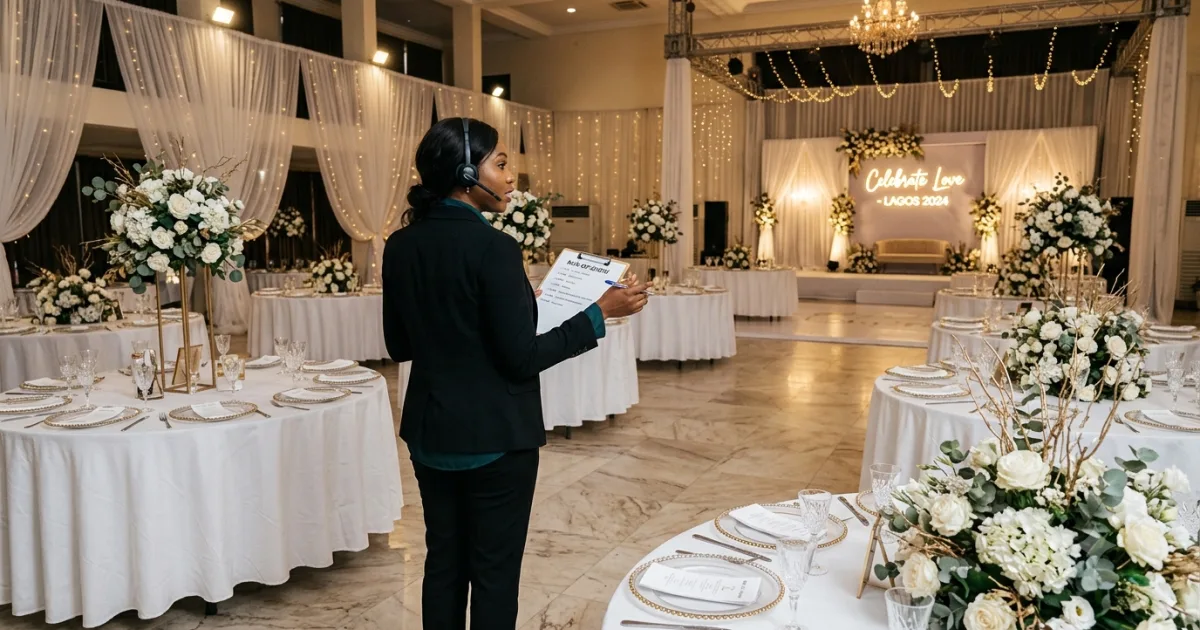
📌 Quick Summary: An event planning business in Nigeria requires startup capital of ₦100,000 to ₦500,000 — mostly for branding, vendor relationship building, and initial equipment. Event planners earn by charging a planning fee (₦100,000 to ₦2,000,000+ per event) or a percentage of total event budget (10 to 20 percent). A Nigerian wedding with a ₦5,000,000 budget generates ₦500,000 to ₦1,000,000 in planning fees. A busy event planner handling 3 to 5 events per month earns ₦500,000 to ₦3,000,000 monthly. The two most profitable Nigerian event niches are weddings and corporate events. This guide covers how to start, how to price, vendor management, the decorator vs planner distinction, how to get first clients, and how to build a portfolio without prior experience.
Event planning is one of Nigeria’s most aspirationally pursued businesses — and for good reason. The Nigerian celebration culture produces a year-round, high-value demand for skilled event professionals who can turn a client’s vision into a flawlessly executed event. The owambe, the traditional wedding, the white wedding, the corporate gala, the product launch, the naming ceremony, the graduation party — each of these is an event that a busy, successful Nigerian family or business is willing to pay a professional to organise rather than manage themselves. The event planner’s value is time, expertise, vendor relationships, and the ability to handle the thousand details of a major event so that the client can be present as a host rather than an operational manager. That value is real and consistently in demand.
Event Planner vs Event Decorator: What Is the Difference?
The most common confusion in the Nigerian event industry is between the event planner and the event decorator. They are related but distinct roles. An event decorator (also called a décor vendor or stylist) handles the visual transformation of a venue — the floral arrangements, the drapery and fabric, the lighting, the backdrops, the table centrepieces, the themed installations. Décor vendors typically arrive at a venue the day before or the morning of an event to set up, and they depart after striking (taking down) the décor. An event planner manages the entire event concept, logistics, and execution — coordinating the caterer, the MC, the photographer, the band or DJ, the décor vendor, the venue, the transport, the accommodation for VIP guests, the printing and stationery, and every other supplier involved. The planner is present from the earliest planning stages (months before the event) through to the day-of execution and post-event wrap-up. Many Nigerian event businesses start as décor vendors and expand into full planning, or start as planners who subcontract décor work. Both are viable, but they require different skills and generate different revenue structures — décor is physical and labour-intensive, while planning is relationship and logistics-intensive.
The Two Most Profitable Nigerian Event Niches
Niche 1: Weddings
Nigerian weddings are the largest, most complex, and highest-budget events in the consumer event market — involving traditional introduction and engagement ceremonies, the white wedding, and often a separate reception, each requiring separate planning, décor, catering, and coordination. Total Nigerian wedding budgets range from ₦2,000,000 for a modest combination to ₦50,000,000+ for premium Lagos and Abuja weddings. Planning fees: ₦150,000 to ₦500,000 for mid-range weddings; ₦500,000 to ₦3,000,000 for premium weddings. Wedding planning generates the highest single-event fees in Nigerian event planning and produces the best referral network — every wedding guest is a future potential client, and a flawlessly executed wedding is seen by 100 to 1,000 people in a single day.
Niche 2: Corporate Events
Product launches, annual general meetings, staff parties, award ceremonies, conferences, and corporate retreats. Corporate clients pay more reliably than individual clients, tend to have larger budgets relative to complexity, and provide recurring business (companies have multiple events per year). Corporate event planning fees: ₦200,000 to ₦2,000,000 per event depending on size and complexity. The corporate niche requires a professional presentation — a registered business, a portfolio of previous corporate events, and the ability to issue invoices and receive payment through proper business channels — but once established, corporate event clients are the most stable source of event planning revenue.
Startup Requirements and Costs
| Item | Cost | Notes |
| CAC Business Name registration | ₦11,000 – ₦15,000 | Essential — corporate clients require a registered vendor |
| Logo and brand identity design | ₦15,000 – ₦50,000 | Professional logo and brand colours for all materials |
| Business cards and stationery | ₦5,000 – ₦15,000 | Physical cards still matter in the Nigerian event industry — you exchange them at every vendor meeting and networking event |
| Portfolio website or Instagram business profile | ₦0 – ₦80,000 | A well-managed Instagram portfolio is sufficient at startup. A website becomes valuable at Phase 2 when targeting corporate clients who verify vendors online. |
| Event planning software subscription (Airtable, Trello, or dedicated event software) | ₦0 – ₦30,000/year | Event timeline, vendor contact management, budget tracking. Free tiers of Airtable and Trello are sufficient at startup. |
| Initial décor items (if offering décor services) | ₦50,000 – ₦300,000 | Backdrop stands, fabric, fairy lights, basic centrepiece items. Build gradually — rent what you do not own in early events. |
| Transport (for vendor meetings and event-day coordination) | Variable | Reliable transport is operationally critical on event day. Budget for Uber/Bolt at minimum; motorcycle ownership becomes practical at higher volume. |
| Minimum viable startup (planning only, no décor) | ₦31,000 – ₦80,000 |
Building Your Vendor Network
The vendor network is an event planner’s most valuable professional asset — more valuable than any equipment, any office, or any individual client relationship. Your vendor network comprises: caterers, photographers, videographers, DJs and live bands, MCs, cake makers, print and stationery suppliers, décor vendors (if you do not offer décor yourself), transport companies, venue operators, and hotel contacts for accommodation. Building this network before your first event is the correct approach — attend industry networking events, reach out to vendors you discover through other events, build genuine relationships before you need to book them under pressure. A vendor who knows you and trusts you gives you better rates, greater scheduling flexibility, and goes the extra mile on event day because the relationship matters to them. A vendor you called the day before the event because you were desperate gives you whatever they have available at whatever price they quote.
How to Get Your First Event Planning Client
Five practical first-client strategies. First: offer to co-plan a family member’s or close friend’s upcoming wedding or major event at no fee, in exchange for full creative control and permission to document everything professionally for your portfolio. One well-documented, beautifully executed event generates the portfolio content that books the next five paying clients. Second: approach venue managers directly — venue managers at hotels, event halls, and dedicated event spaces receive enquiries from clients who need planner recommendations and actively maintain vendor referral lists. Being on a venue’s recommended planner list generates consistent warm referrals. Third: Instagram presence focused on event content — inspiration boards, venue highlights, behind-the-scenes from events you attend or assist with, supplier showcases. Post consistently for 3 to 6 months before expecting significant booking enquiries. Fourth: join Nigerian event planners’ associations and groups — the Association of Nigerian Event Planners (ANEP) and state-level event industry groups provide networking, referrals, and mentorship. Fifth: target the corporate market through LinkedIn — connect with HR managers and executive assistants at Lagos and Abuja companies, position yourself as a corporate events specialist, and pitch your services for the annual staff party, product launch, or awards ceremony.
Frequently Asked Questions
How much do event planners charge in Nigeria?
₦100,000 to ₦500,000 for mid-range weddings and social events. ₦500,000 to ₦3,000,000 for premium weddings and large corporate events. Many planners charge 10 to 20 percent of the total event budget as their planning fee — on a ₦5,000,000 wedding budget, this is ₦500,000 to ₦1,000,000.
Do I need experience to start an event planning business in Nigeria?
Formal qualifications are not required — but practical experience is essential before taking on paid clients. Volunteer or assist at events for free, apprentice under an established planner, or co-plan family events to build genuine operational experience. The event planning industry is entirely reputation-based — one failed event damages a reputation that takes years to rebuild.
What is the difference between an event planner and an event decorator in Nigeria?
An event planner manages the entire event — coordinating all vendors, logistics, timeline, and client communication from concept to execution. An event decorator (décor vendor) handles only the visual setup of the venue — fabrics, florals, lighting, backdrops. Many Nigerian event businesses offer both services; at startup, focusing on one and subcontracting the other is more manageable.
Event Day Management: Executing the Plan Under Pressure
The most technically demanding skill in Nigerian event planning is not the planning — it is the execution on the day of the event, when everything that can go wrong begins to go wrong simultaneously and the planner must resolve each crisis without the client noticing. The venue caterer arriving 45 minutes late. The MC stuck in Lagos traffic with 30 minutes to the reception start time. The decorator missing the deadline on the backdrop setup. The client calling every 10 minutes asking why guests are standing outside. These are not exceptional scenarios — they are the standard operating environment of Nigerian event day execution. The event planner who thrives in this environment has: a detailed run-of-show document shared with every vendor at least 48 hours before the event, with exact timings, arrival windows, and setup sequences; a vendor WhatsApp group active from the morning of the event where every vendor confirms their status hourly; at least one backup for every critical vendor — a second caterer who can supply food if the primary fails, a second photographer, a second MC contact; and a personal buffer of composure, because the client feeds off the planner’s energy — a calm, decisive planner communicates that everything is under control even when it is not, while a visibly panicked planner makes the client panic. The event planner’s value on event day is not their physical presence alone — it is their ability to make decisions quickly, communicate clearly with multiple vendors simultaneously, and present the client with a smoothly running event regardless of what is happening behind the scenes. This skill is learnable but it only develops through experience — start with smaller events, build the experience base, and take on progressively larger events as your event-day competence grows.
Pricing Models: Flat Fee vs Percentage of Budget
Nigerian event planners use two primary pricing models. The flat fee model charges a fixed amount for planning services regardless of the total event budget — for example, ₦300,000 for a mid-range wedding package covering concept development, vendor coordination, timeline management, and full event-day presence. The percentage model charges 10 to 20 percent of the total event budget as the planning fee — on a ₦5,000,000 wedding, this is ₦500,000 to ₦1,000,000. Each model has specific advantages. The flat fee model is simpler to communicate to clients and predictable for the planner’s revenue planning, but can undervalue your services when a client has a very large budget. The percentage model is potentially more lucrative for large-budget events, but requires the planner to actively manage the event budget (since your fee scales with spend, and clients may question whether the planner is recommending more expensive vendors to increase their own fee). Many experienced Nigerian planners use a hybrid — a flat base fee plus a smaller percentage (5 to 10 percent) of total event spend above a certain threshold. Whatever model you use, state it clearly in a written contract before accepting any booking deposit. The planner who masters both the planning phase and the execution phase — who can write an elegant run-of-show and then hold that run-of-show together under the pressure of a 500-person Nigerian owambe — is the planner who gets booked a year in advance and charges fees that reflect that rare combination of skills.
Sources
- Original business guide — NaijaSabi Business Desk, September 2026
Last updated: 22 September 2026 · NaijaSabi Business Desk.

0 Comments
No comments yet. Be the first to share your thoughts!