




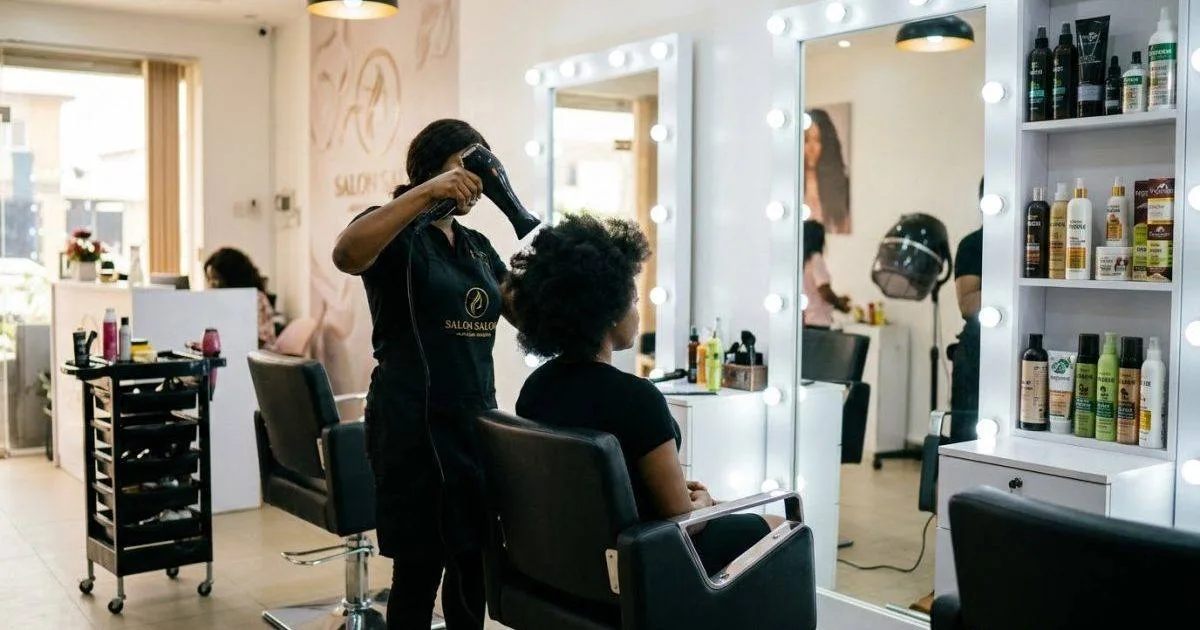
📌 Quick Summary: A hair salon business in Nigeria requires startup capital of ₦200,000 to ₦800,000 for a basic setup (2 to 4 styling chairs, dryer, shampoo bowls, mirrors, styling products) in a rented space. Monthly revenue potential: ₦150,000 to ₦600,000+ depending on location, services, and client volume. Nigerian women spend heavily and consistently on hair — natural hair care, braiding, weaving, relaxer treatment, and lace wig installation are all recurring services. The most profitable Nigerian hair salon model combines a good location near middle-income residential estates, a subscription/loyalty programme to lock in repeat visits, and premium services (lace wig installation, bridal hair packages) alongside everyday services. This guide covers startup requirements, equipment, pricing, location strategy, hiring stylists, and how to build a loyal client base.
The Nigerian hair salon business is as close to recession-proof as any service business gets. Nigerian women — and an increasing number of Nigerian men — spend consistently on hair across all economic conditions. When money is tight, a Nigerian woman may cut back on clothes or dining out, but she will find a way to maintain her hair. This consistent, repeat-purchase demand — most salon clients visit every 2 to 4 weeks — makes hair salon one of the most reliable income-generating businesses in Nigeria. The challenge is not demand: it is consistently delivering quality service in a market where the gap between excellent and mediocre service is wide, and where excellent service creates powerful word-of-mouth that fills appointment books, while poor service generates reputation damage that empties them.
Services to Offer: Nigerian Hair Salon Menu
| Service | Rate Range (Lagos/Abuja 2026) | Frequency |
| Shampoo and blow-dry | ₦3,000 – ₦8,000 | Bi-weekly to monthly |
| Relaxer treatment (including shampoo, treatment, blow-dry, set) | ₦8,000 – ₦20,000 | Every 6 to 8 weeks |
| Braiding (cornrows, box braids, knotless braids) | ₦8,000 – ₦40,000 | Every 4 to 8 weeks |
| Weaving (sew-in, quick weave) | ₦5,000 – ₦25,000 | Every 3 to 6 weeks |
| Natural hair styling (twist-outs, bantu knots, wash-and-go) | ₦5,000 – ₦20,000 | Every 1 to 4 weeks |
| Lace wig installation (frontal, closure, full lace) | ₦15,000 – ₦60,000 | Every 3 to 6 weeks |
| Hair treatment (deep conditioning, protein treatment, steam) | ₦5,000 – ₦15,000 | Monthly to quarterly |
| Bridal hair package (trial + wedding day) | ₦50,000 – ₦200,000 | One-time per client event |
| Men’s hair services (cut + treatment) | ₦3,000 – ₦12,000 | Every 2 to 4 weeks |
Equipment and Startup Costs
| Item | Cost (2026) | Notes |
| Styling chairs (hydraulic, with footrest) | ₦30,000 – ₦80,000 each | Minimum 2 for a starter salon; 4 is the practical working minimum for a busy operation |
| Salon mirrors (large, with mounted lighting) | ₦15,000 – ₦40,000 each | One per styling station |
| Hood hair dryer (standing) | ₦30,000 – ₦80,000 | Essential for relaxer neutralising, deep conditioning, and setting |
| Shampoo bowls and chairs | ₦40,000 – ₦120,000 per unit | Minimum 1; 2 is better for a busy salon |
| Professional hair dryer (handheld) | ₦15,000 – ₦40,000 each | One per styling station |
| Flat irons, curling wands, hot combs | ₦5,000 – ₦25,000 each | Professional grade only — cheap tools damage hair and damage your reputation |
| Steamer | ₦20,000 – ₦60,000 | For deep conditioning treatments — a profitable premium service |
| Reception desk and chairs | ₦20,000 – ₦60,000 | |
| Initial product stock (shampoos, conditioners, styling products) | ₦50,000 – ₦150,000 | Invest in recognisable professional brands — clients notice product quality |
| Generator (for consistent power) | ₦80,000 – ₦250,000 | Power reliability is non-negotiable — a salon without light and power cannot operate |
| First and last rent payment | ₦100,000 – ₦500,000 | Location-dependent — see Location Strategy |
| Minimum viable 2-chair salon (excluding rent) | ₦200,000 – ₦500,000 |
Location Strategy: The Most Important Decision
A hair salon’s revenue is determined more by its location than by any other single factor. The ideal Nigerian hair salon location: a busy road or commercial strip within easy walking distance of a medium-to-high-density residential area (estate, block of flats, or urban neighbourhood with working women as the dominant demographic), with adequate parking, power supply in the immediate area, and no more than 2 to 3 competing salons within 200 metres. Salons located inside middle-income residential estates — Lekki, Ajah, Ikeja GRA in Lagos; Maitama, Wuse II, Gwarinpa in Abuja — typically outperform equally skilled salons in lower-traffic locations because their catchment is wealthier (higher per-service pricing tolerance) and more time-constrained (willing to pay more for speed, convenience, and quality). Avoid: locations where the immediate neighbourhood is predominantly lower-income (the price points will not support your operating costs), locations too far from public transport for clients who do not drive, and locations with very high foot traffic from people who are not your target client (the market area, for example, generates visitors who are not hair salon clients).
Hiring Stylists: The Most Critical Operational Decision
A hair salon is only as good as its stylists. Nigerian hair salon owners consistently identify staff as their biggest operational challenge — finding skilled, reliable, honest stylists who treat clients well is harder than finding clients. The Nigerian hair salon staffing model: stylists typically work on a commission basis (60 to 70 percent of service revenue to the stylist, 30 to 40 percent retained by the salon owner) or on a chair rental basis (the stylist pays a fixed weekly or monthly chair rent and keeps all service revenue). The commission model is better for the salon owner when services are slow — you only pay when revenue is generated. The chair rental model provides more predictable income for the owner in a busy salon. Before hiring any stylist, test their work: have them do a relaxer, a braid style, and a wig installation on practice clients or models — not on paying customers. A stylist who cannot demonstrate the service standard your salon commits to should not be hired regardless of their other qualities. One bad stylist who damages a client’s hair destroys the reputation built by five excellent stylists.
Building a Loyal Client Base
The economics of a hair salon depend on repeat visits. A client who visits every 3 weeks and spends ₦15,000 per visit generates ₦260,000 in annual revenue from a single client relationship. 50 such clients generate ₦13,000,000 annually from repeat visits alone — before new clients are counted. Building this loyal base requires: consistency (the same quality result every visit — clients should know what they will receive), reliability (appointment slots honoured on time — Nigerian salons’ chronic poor timekeeping is a significant client dissatisfaction driver and a genuine competitive advantage for salons that manage appointments properly), the client relationship (knowing clients’ names, their hair history, their preferences, their upcoming occasions) — and a loyalty incentive structure (a discount for referrals, a free treatment after 10 visits, a birthday discount). The Nigerian woman who has found a salon where her hair is done well, on time, by someone who knows her — will not leave for a salon ₦500 cheaper.
Frequently Asked Questions
How much does it cost to start a hair salon in Nigeria?
A minimal 2-chair home-based or small shop salon: ₦200,000 to ₦400,000 (equipment + first products). A proper 4-chair commercial salon: ₦500,000 to ₦1,500,000 including rent deposit, equipment, products, and working capital for the first 2 to 3 months before the business is fully operational.
Is hair salon business profitable in Nigeria?
Very — a well-located salon with 4 chairs, 2 to 3 stylists, and 30 to 50 regular clients generates ₦400,000 to ₦1,000,000 monthly gross revenue. After stylist commissions (30 to 40 percent retention), rent, products, and utilities, a profitable salon earns ₦100,000 to ₦400,000 monthly net for the owner. The most profitable salons combine premium location, reputation for quality, bridal and events business, and product retail alongside services.
Do I need a qualification to open a hair salon in Nigeria?
No formal licensing requirement exists to open a hair salon in Nigeria, though some states require business registration with CAC. Professional training — at a recognised hair school or through apprenticeship under an established stylist — is essential for the quality of service, not for legal compliance. Invest in professional training for yourself and any stylists before serving paying clients.
Product Retail: The High-Margin Revenue Stream Most Salons Ignore
Most Nigerian hair salons focus entirely on service revenue and miss one of the highest-margin opportunities available to them: retail sales of hair products to their own clients. A client who just had a deep conditioning treatment and asks what products the stylist used is a ready buyer — she has already experienced the product, trusts the stylist’s recommendation, and is motivated to maintain the result at home. Professional hair products (moisturisers, edge controls, leave-in conditioners, shampoos, heat protectants) have margins of 30 to 60 percent at retail price — significantly better than service revenue after stylist commissions. Building a small product retail display at your salon’s reception area, stocking 10 to 20 carefully selected products that your stylists genuinely use and recommend, and training stylists to mention products they use during services (without aggressive selling) generates ₦20,000 to ₦100,000 in monthly product sales from an existing client base at near-zero additional marketing cost. The products sell themselves to clients who experienced them during a service — the salon’s role is simply to stock them and make purchase easy.
Social Media for Nigerian Hair Salons: Instagram as Your Portfolio and Booking Channel
Nigerian women discover hair salons primarily through Instagram — a gallery of before-and-after photos, process videos, and finished style results is the most powerful marketing tool available to any Nigerian salon. The Instagram strategy that builds a hair salon client base: post every finished style with the client’s permission (a quick before photo during shampoo and an after photo under good lighting, taken before the client leaves). Tag the style type and location in every post. Post consistently — 3 to 5 times per week at minimum during the building phase. Show a range of services (braids, weaves, natural styles, relaxer sets) to communicate the full range of what the salon does. Post process videos — clients find the “how it was done” content highly engaging and it demonstrates technical skill far more convincingly than finished results alone. The Nigerian hair salon Instagram account that consistently posts high-quality photos and videos of real client results in a specific location, and responds promptly to every DM enquiry, will build a steady stream of appointment requests from women who follow the account and book when they see a style they want to achieve. This is significantly more effective than any other marketing channel available to a Nigerian hair salon at comparable cost — which is essentially zero beyond the smartphone and ring light already used in the salon.
The Bridal Hair Opportunity: Highest Revenue Per Client
Nigerian weddings are among the most elaborate and heavily invested-in celebrations in the world — and Nigerian brides invest significantly in bridal hair. A bridal hair package (hair trial in the weeks before the wedding, traditional wedding day styling, white wedding day styling, sometimes a reception change) generates ₦50,000 to ₦300,000+ in revenue from a single client event. The bridal market has several other attractive characteristics for a hair salon business: it is entirely referral-driven (brides ask other brides who did their hair), it is word-of-mouth-visible (every guest at a Nigerian wedding sees the bride’s hair and remembers who did it if it is exceptional), and it books weeks or months in advance (providing cash flow predictability that walk-in services cannot). Building a bridal hair reputation requires: delivering exceptional quality on every bridal job regardless of package price, photographing every bridal style professionally or collaborating with the wedding photographer for shots that can be used as portfolio material, and actively marketing to wedding planners and coordination services who can refer brides as part of their vendor network. The Nigerian hair salon business rewards the owner who combines genuine service quality with professional business management — and punishes those who treat it as an informal operation that runs itself.
Sources
- Original business guide — NaijaSabi Business Desk, October 2026
Last updated: 2 October 2026 · NaijaSabi Business Desk. Prices and rates as at Lagos and Abuja market, October 2026.


0 Comments
No comments yet. Be the first to share your thoughts!