




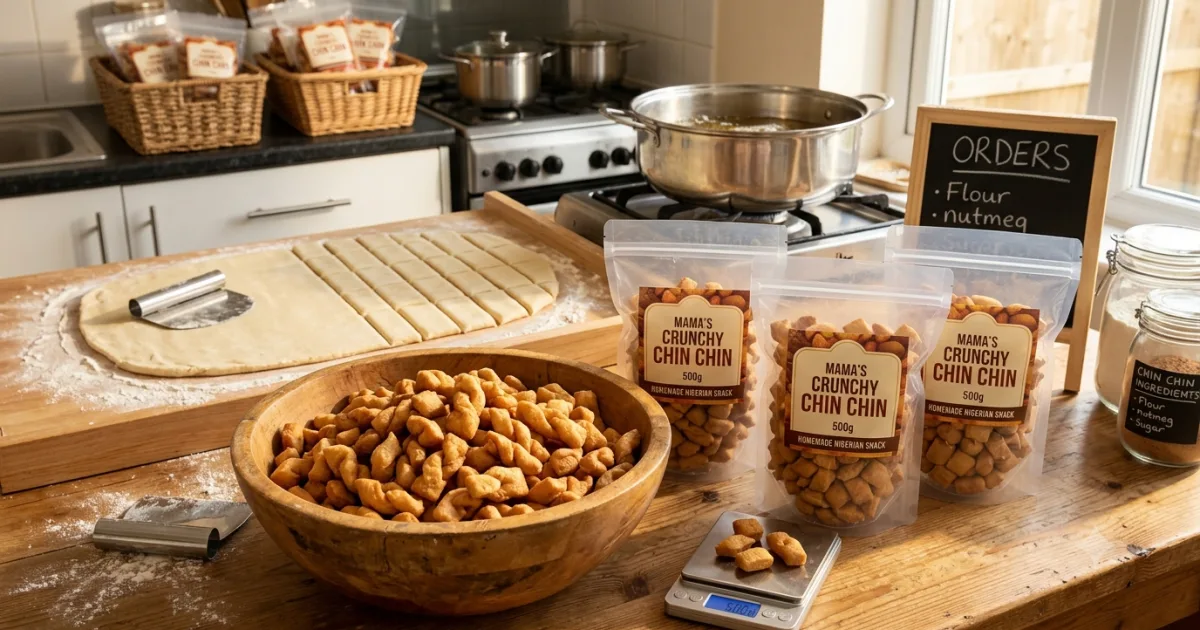
📌 Quick Summary: Nigerian chin chin is a deep-fried crunchy dough snack made from flour, butter, sugar, eggs, milk, and nutmeg — rolled thin and cut into small pieces before frying. A batch using 3 cups of flour makes approximately 500 to 600 pieces and costs ₦2,500–₦4,000 in ingredients. Hard chin chin requires less butter and shorter frying time; soft chin chin uses more butter and eggs. A chin chin business selling 2kg bags at ₦2,500 each and producing 5 bags daily earns approximately ₦187,500 monthly gross profit. This complete guide covers the full recipe, hard vs soft chin chin, the baking soda debate, how to get the perfect crunch, packaging for sale, and how to start a chin chin business from home.
No Nigerian small chops platter is complete without chin chin. The crunchy, golden, lightly sweetened fried dough bites that show up at every birthday party, wedding reception, naming ceremony, and end-of-year gathering in Nigeria have been a staple of the country’s snack culture for generations. They are also one of Nigeria’s most commercially successful home-made food businesses — a product with long shelf life, high demand, relatively low production cost, and a customer base that spans from children to grandparents. Whether you are making chin chin for family enjoyment or building a business, this guide covers everything you need to do it right.
Hard Chin Chin vs Soft Chin Chin: Which Are You Making?
The first decision in chin chin production is style. Nigerian chin chin exists on a spectrum from very hard and crunchy (the type that makes a satisfying cracking sound when bitten) to soft and slightly chewy (the type that melts more easily in the mouth). The difference comes down to fat content and hydration — more butter and more egg produce a softer, more shortbread-like chin chin; less fat and less liquid produce the hard, classic street-stall variety.
| Feature | Hard Chin Chin | Soft Chin Chin |
| Butter/fat | Less — 2–3 tablespoons per 3 cups flour | More — 4–6 tablespoons per 3 cups flour |
| Eggs | 1 egg per 3 cups flour | 2–3 eggs per 3 cups flour |
| Texture | Very crunchy, harder to bite through | Crunchy outside, slightly softer inside |
| Shelf life | Longer — 4 to 6 weeks at room temperature | Slightly shorter — 2 to 4 weeks |
| Best for | Commercial sale, longer storage, packaging | Home consumption, gifts, premium events |
| Rolling difficulty | Easier — stiffer dough | Slightly harder — stickier dough |
Ingredients — Makes 500 to 600 Pieces (Standard Batch)
| Ingredient | Hard Chin Chin | Soft Chin Chin | Notes |
| Plain flour (all-purpose) | 3 cups (375g) | 3 cups (375g) | Plain flour only — not self-raising |
| Butter or margarine | 2 tablespoons (30g) | 4–5 tablespoons (60–75g) | Salted butter for flavour; margarine for budget production |
| Sugar | 3–4 tablespoons | 4–5 tablespoons | Granulated sugar. More sugar = sweeter and faster browning in oil |
| Eggs | 1 large | 2 large | Room temperature eggs incorporate better |
| Milk | ¼ cup (60ml) | 3–4 tablespoons | Full-fat evaporated milk preferred. Peak or Carnation brands work well. |
| Nutmeg (ground) | ¼ teaspoon | ¼ teaspoon | The signature chin chin spice — do not skip |
| Salt | ¼ teaspoon | ¼ teaspoon | Balances sweetness |
| Baking powder (optional) | ½ teaspoon | ½ teaspoon | Some chin chin recipes include it for slight puffiness. Optional — see the baking powder debate below. |
| Vanilla extract (optional) | ½ teaspoon | ½ teaspoon | Adds flavour depth alongside nutmeg |
| Vegetable oil for frying | Enough to fill pan 6–8cm | Same |
The Baking Powder Debate: To Add or Not?
Nigerian chin chin recipes are divided on baking powder. Those who add it argue it produces a slightly puffier, lighter chin chin with a more open crumb — closer to what many commercial producers make. Those who leave it out argue traditional chin chin needs no leavening — the texture should be dense and uniformly crunchy throughout. For hard chin chin sold commercially, baking powder is typically not used — the density is a feature, not a flaw. For soft chin chin and home production, ½ teaspoon of baking powder per 3 cups of flour is widely used and produces acceptable results. This guide treats it as optional — try both and choose based on your preference.
Step-by-Step Recipe
Step 1: Combine Dry Ingredients
In a large bowl, sift the flour. Add sugar, salt, nutmeg, and baking powder (if using). Whisk the dry ingredients together until evenly combined. Sifting the flour is important for chin chin — lumps in unsifted flour create uneven texture in the finished product.
Step 2: Rub In the Butter
Add the cold or room-temperature butter or margarine to the flour mixture. Using your fingertips, rub the butter into the flour — pinching and pressing until the mixture resembles coarse, slightly clumpy breadcrumbs with no visible chunks of butter remaining. This step coats the flour particles with fat, which is what creates the characteristic short, crunchy texture of chin chin. Do not use a food processor for this step — the heat from the machine warms the butter too quickly and produces a different, less crumbly texture.
Step 3: Add Wet Ingredients
Beat together the eggs, milk, and vanilla extract (if using) in a separate small bowl. Make a well in the centre of the flour-butter mixture. Pour in the egg-milk mixture gradually, mixing as you pour. Bring the dough together with your hands until it forms a firm, smooth ball. The dough should not be sticky — if it sticks to your hands, add flour one tablespoon at a time. If it is too dry and crumbly, add milk one teaspoon at a time. The correct chin chin dough is smooth, firm, and slightly stiff — similar to shortcrust pastry dough.
Step 4: Rest the Dough
Wrap the dough in cling film or cover the bowl with a damp cloth. Rest at room temperature for 15 to 30 minutes. This resting period allows the gluten to relax — making the dough easier to roll without springing back. This step is optional but produces better-shaped, more uniform chin chin. Do not refrigerate the dough at this stage — cold dough is harder to roll thin.
Step 5: Roll and Cut
Divide the dough into 3 or 4 portions for easier handling. On a lightly floured surface, roll each portion thin — approximately 3 to 4mm thickness. For hard chin chin: roll as thin as possible (2 to 3mm). Thicker pieces take longer to cook through and may brown outside before cooking inside. Cut the rolled dough into your preferred chin chin shape: strips (cut into 5cm lengths then twist), small squares, or small circles. Uniform sizing is important for commercial chin chin — pieces of different sizes fry at different rates, producing some burnt and some undercooked pieces in the same batch.
Step 6: Fry to Golden Perfection
Heat vegetable oil in a deep pan to 160–170°C — lower than puff puff temperature. Chin chin must fry slowly at lower heat to cook through completely before the outside browns. If the oil is too hot, the outside will colour quickly while the inside remains undercooked — producing chin chin that is brown outside and doughy inside. Test with a small piece: it should sizzle gently and rise to the surface, browning slowly over 4 to 6 minutes. Add chin chin in batches — do not crowd the pan. Stir occasionally to ensure even browning. Remove when uniformly golden-brown and drain on paper towels. The chin chin will continue to crisp up as it cools — it should feel slightly soft when first removed from the oil and harden to its final crunch within 5 minutes of cooling.
Step 7: Cool Completely Before Storing
Spread the fried chin chin on a wide tray and allow to cool completely — at least 30 minutes — before placing in storage bags or containers. Storing warm chin chin traps steam and makes it go soft. Fully cooled chin chin packed in airtight containers at room temperature remains crisp for 4 to 6 weeks for hard chin chin and 2 to 4 weeks for soft chin chin.
The Chin Chin Business: What You Need to Know
Why Chin Chin Is a Strong Business Choice in 2026
Three features make chin chin an unusually strong small food business in Nigeria. First: long shelf life. Unlike puff puff (best within hours) or zobo (5–7 days), properly made and stored chin chin lasts 4 to 6 weeks — eliminating the daily production pressure that roadside fresh-food businesses require. Second: versatile sales channels. Chin chin can be sold at roadside stalls, packaged for supermarkets and provision shops, supplied to caterers for events, sold online and delivered, or shipped to diaspora customers abroad. Third: scalable production. A 3-cup flour batch takes 90 minutes including prep and frying. A 15-cup batch takes approximately 3 to 4 hours and produces enough for multiple sales channels simultaneously.
Startup Capital
| Item | Cost |
| Deep frying pot or electric fryer | ₦8,000 – ₦25,000 |
| Rolling pin and cutting tools | ₦1,500 – ₦3,000 |
| First batch ingredients (3 cups flour) | ₦2,500 – ₦4,000 |
| Packaging (zip-lock bags, labels, 50 units) | ₦2,500 – ₦4,000 |
| Weighing scale (for consistent packaging) | ₦3,000 – ₦6,000 |
| Minimum startup (without fryer) | ₦9,500 – ₦17,000 |
| With electric fryer | ₦17,500 – ₦42,000 |
Profitability
| Metric | Home-based (small) | Growing business |
| Bags produced per day (500g each) | 5 bags | 15 bags |
| Selling price per 500g bag | ₦1,500 | ₦2,000 |
| Daily revenue | ₦7,500 | ₦30,000 |
| Daily ingredient cost | ₦2,000 | ₦6,000 |
| Gas + oil + packaging | ₦500 | ₦1,500 |
| Daily gross profit | ₦5,000 | ₦22,500 |
| Monthly gross profit (25 days) | ₦125,000 | ₦562,500 |
Packaging and Presentation
Chin chin that looks good sells better than chin chin that merely tastes good. Invest in clear zip-lock bags that display the product visibly — buyers want to see the colour and size before purchasing. Label every bag with: your brand name, weight (in grams), ingredients, production date, best-before date (4 weeks from production for hard chin chin), and your contact information for orders. A consistent, professional label — even a simple printed sticker — elevates chin chin from “homemade snack” to “small business product” in the buyer’s perception and justifies a higher price. Chin chin sold in branded packaging commands 30 to 50 percent more per gram than the same product sold unpackaged from a bowl at a roadside stall.
Chin Chin Flavour Variations
Standard chin chin is the foundation — but successful chin chin businesses differentiate through flavour. Coconut chin chin adds 4 tablespoons of desiccated coconut to the dough — a distinctive texture variation popular in Lagos markets. Onion chin chin adds 2 tablespoons of dried onion flakes and a pinch of pepper — a savoury variation that pairs well with drinks. Milk chin chin increases the evaporated milk to ½ cup — richer, creamier flavour at a slight premium. Sesame chin chin adds 3 tablespoons of sesame seeds to the dough before rolling — adds nutrition, texture, and a premium positioning.
Common Mistakes That Ruin Chin Chin
1. Rolling Too Thick
Thick chin chin browns outside before cooking through — producing a dark exterior with a doughy, undercooked interior. Roll to 3mm maximum for hard chin chin, 4mm for soft.
2. Oil Too Hot
Chin chin requires lower frying temperature than puff puff or plantain. 160–170°C is correct. Test with a small piece before adding the full batch.
3. Storing Before Fully Cool
Warm chin chin releases steam in a sealed container — making it soft within hours. Cool completely on an open tray before packaging.
4. Inconsistent Cutting
Pieces of different sizes fry at different rates — some burn while others remain undercooked in the same batch. Use a ruler or consistent cutting technique.
Frequently Asked Questions
Why is my chin chin soft and not crunchy?
Three causes: dough too wet (add flour), oil too hot so outside browned before inside dried out, or stored before fully cooled (steam makes chin chin soft). Ensure dough is firm, oil is at 160–170°C, and chin chin is completely cool before packaging.
How long does chin chin last?
Hard chin chin: 4 to 6 weeks at room temperature in an airtight container. Soft chin chin: 2 to 4 weeks. Keep away from moisture and direct sunlight. Do not refrigerate — cold and humidity soften chin chin.
Do I need NAFDAC to sell chin chin?
For packaged chin chin sold in shops, online, or in significant quantities, NAFDAC registration is required. Register through NAFDAC’s Small Scale and Cottage Industry (SSCI) pathway. For small-scale local sales and events, confirm current requirements with your nearest NAFDAC office.
What flour is best for chin chin?
Plain all-purpose flour — not self-raising, which contains baking powder and produces a different texture. Golden Penny and Dangote flour both work well for chin chin production in Nigeria.
Can I bake chin chin instead of frying?
Yes — baked chin chin is possible at 180°C for 15 to 20 minutes until golden, turning once halfway. The result is slightly different in texture from fried chin chin — less oily and slightly drier — but acceptable and popular with health-conscious buyers who pay a premium for the baked version.
Sources
- Original recipe — NaijaSabi Lifestyle Desk, September 2026
- NAFDAC SSCI registration guidelines — nafdac.gov.ng
Last updated: 8 September 2026 · NaijaSabi Lifestyle Desk. Ingredient costs reflect Lagos market prices as at September 2026.




0 Comments
No comments yet. Be the first to share your thoughts!