

📌 Quick Summary: Starting a YouTube channel in Nigeria in 2026 requires startup capital of ₦50,000 to ₦300,000 for basic recording equipment (smartphone + ring light + microphone). YouTube pays Nigerian creators through the YouTube Partner Programme (YPP) — requiring 1,000 subscribers and 4,000 watch hours (or 1,000 subscribers and 10 million Shorts views) before monetisation. Nigerian YouTubers earn approximately ₦100 to ₦500 per 1,000 views from AdSense (CPM varies significantly by content niche and audience location). Beyond AdSense, the most profitable income streams are brand sponsorships, merchandise, digital products, and affiliate marketing. The most successful Nigerian YouTube niches in 2026: cooking/food, finance and investing, comedy and entertainment, tech reviews, and education/tutorial content. This guide covers channel setup, content strategy, equipment, monetisation pathways, and the fastest path to your first 1,000 subscribers.
YouTube is Nigeria’s most significant untapped creator economy opportunity — and it has been for years. Nigeria has over 80 million active internet users, a growing smartphone penetration rate, and a population that consumes video content voraciously on YouTube, TikTok, and Instagram. Yet despite this enormous audience, the number of Nigerian YouTube channels that have reached 100,000 subscribers or more remains relatively small compared to the size of the potential creator base. This means the Nigerian YouTube space — particularly in specific niches like personal finance, cooking, education, and tech — has genuine first-mover advantages available to consistent, quality creators who commit to the platform in 2026.
The YouTube Opportunity for Nigerians in 2026
Three structural factors make 2026 an excellent time to start a Nigerian YouTube channel. First: YouTube Shorts monetisation. YouTube now pays creators on Shorts (short vertical videos competing with TikTok) — Nigerian creators who build audiences through Shorts (which have much lower production barriers than long-form videos) can now monetise that audience directly through YouTube without needing a separate TikTok or Instagram presence. Second: growing Nigerian YouTube audience. The Nigerian YouTube audience is growing rapidly as smartphone costs fall and data costs moderate — content that was previously too data-intensive for the average Nigerian to watch is now accessible to a larger audience than ever before. Third: advertiser interest in Nigeria. As Nigerian digital advertising spend grows — driven by fintech, telecoms, FMCG brands, and e-commerce — CPMs (cost per thousand ad views) for Nigerian content are rising, making AdSense revenue more significant for Nigerian-audience channels than it was 3 to 5 years ago.
The Most Profitable Nigerian YouTube Niches in 2026
| Niche | Examples | Monetisation Potential | Competition Level |
| Nigerian cooking and food | Recipe tutorials, food business guides, restaurant reviews | High — brand deals with food brands, cooking equipment | Medium — room for specialist creators |
| Personal finance Nigeria | Investing, saving, budgeting for Nigerians, naira tracking | Very High — fintech and financial services sponsorships | Low — significantly underserved |
| Tech reviews Nigeria | Smartphones, laptops, gadgets reviewed at Nigerian price points | High — tech brand partnerships | Medium |
| Education and tutorials | JAMB prep, WAEC study guides, professional skill tutorials | Medium — course and digital product sales | Low to Medium |
| Business and entrepreneurship | How to start Nigerian businesses, SME growth | High — brand deals, consulting offers, course sales | Low |
| Lifestyle and vlogs | Nigerian daily life, city guides, cost of living | Medium — brand deals, tourism partnerships | High |
| Comedy and skits | Short comedy sketches, observational humour about Nigerian life | Medium — entertainment brands, events | Very High |
| Diaspora content | Life abroad for Nigerians, japa guides, comparison content | High — remittance platforms, travel brands | Low to Medium |
Equipment: What You Actually Need to Start
| Equipment | Budget Option | Cost | Mid-Range Option | Cost |
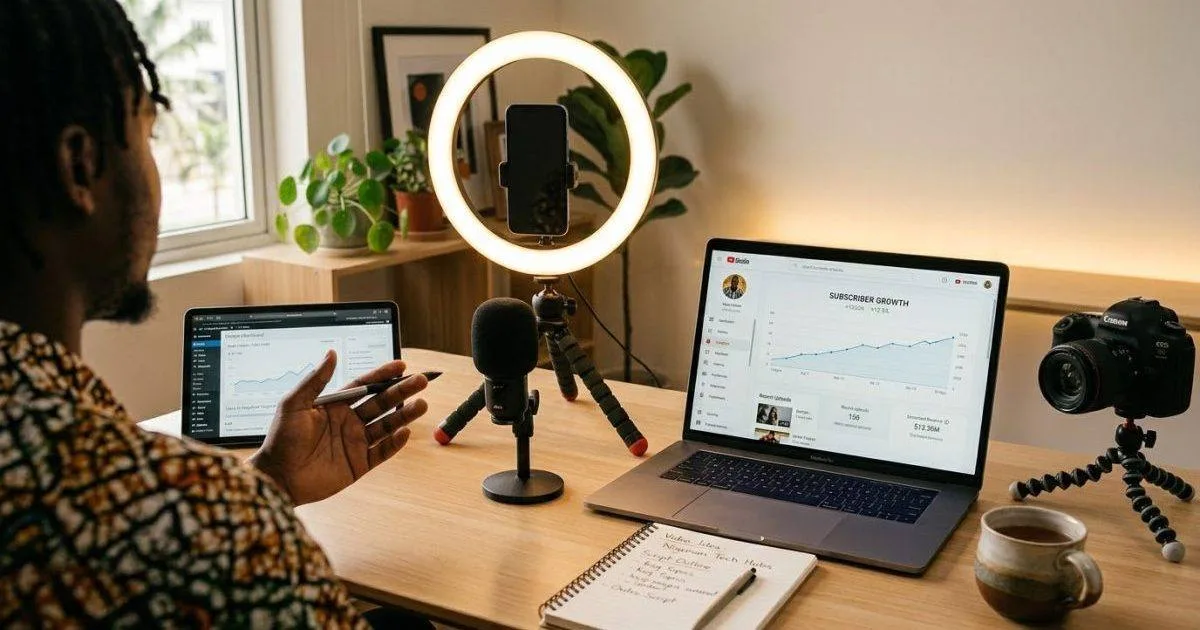
| Camera | iPhone 13 or Samsung S22 (smartphone camera — 4K capable) | Already owned by many | Sony ZV-E10 (mirrorless vlogging camera) | ₦300,000 – ₦500,000 |
| Microphone | Boya BY-M1 lavalier mic (clips to clothing) | ₦8,000 – ₦15,000 | Rode VideoMicro or Blue Yeti USB | ₦30,000 – ₦80,000 |
| Lighting | Ring light (40cm diameter) | ₦8,000 – ₦20,000 | Softbox kit (2-light setup) | ₦30,000 – ₦80,000 |
| Tripod / phone stand | Flexible gorilla pod or standard smartphone tripod | ₦3,000 – ₦10,000 | Full-size camera tripod | ₦10,000 – ₦40,000 |
| Editing software | CapCut (free, mobile) | Free | DaVinci Resolve (free, desktop) or Adobe Premiere | Free to ₦15,000/month |
| Laptop (for editing) | Any laptop with 8GB RAM minimum | Already owned or ₦150,000+ | 16GB RAM laptop for faster editing | ₦300,000 – ₦600,000 |
| Minimum viable starter setup | ₦19,000 – ₦45,000 (if you have a smartphone) | ₦370,000 – ₦800,000 |
Critical advice: Start with what you have. The barrier to starting a YouTube channel in 2026 is content quality and consistency, not equipment. A well-lit, clearly audible video on a modern smartphone will outperform a poorly conceived video on a professional camera every time. Do not use equipment as an excuse to delay starting.
Getting to 1,000 Subscribers: The Real Path
The YouTube Partner Programme requires 1,000 subscribers and 4,000 watch hours (or 10 million Shorts views) for monetisation. Most Nigerian new YouTubers take 6 to 18 months to reach these thresholds with consistent effort. The fastest proven path to 1,000 subscribers for Nigerian channels. Post 2 to 3 videos per week consistently for the first 3 months — this is the behaviour that separates channels that grow from those that plateau. Quality over production value — a genuinely useful 8-minute tutorial beats a beautifully shot but vague 20-minute video every time. Titles and thumbnails are more important than video content at the discovery stage — 70 percent of views on most YouTube channels come from the title and thumbnail combination getting clicked in search or suggested videos. Nigerian YouTubers who study which titles drive clicks in their niche and design thumbnails with clear, high-contrast faces and text consistently outgrow channels with better content but weaker titles. Search-optimised content — creating videos that directly answer Nigerian YouTube search queries (“how to cook ofada rice Nigeria”, “how to check JAMB result 2026”, “best phone under 200k Nigeria”) builds a reliable view base from YouTube search rather than depending on the algorithm for distribution. Shorts acceleration — publishing a new Short (60-second vertical video) every day in addition to longer videos dramatically accelerates subscriber growth in 2026 because YouTube actively promotes Shorts to new audiences.
YouTube Monetisation Beyond AdSense
AdSense revenue from YouTube is frequently disappointing for Nigerian channels in the early stages — Nigerian CPMs (cost per thousand ad views) of ₦100 to ₦500 mean a channel getting 100,000 views per month earns ₦10,000 to ₦50,000 from AdSense alone. The channels that earn serious income from YouTube use AdSense as one income stream among several. Brand sponsorships: Nigerian and international brands pay Nigerian YouTubers ₦50,000 to ₦500,000+ per sponsored video once a channel reaches 10,000 to 50,000 subscribers in a relevant niche. A fintech company sponsoring a personal finance channel, a Nigerian food brand sponsoring a cooking channel — these deals generate more income per video than months of AdSense. Digital products: creating and selling eBooks, online courses, templates, or digital guides related to the channel’s content. A Nigerian business channel creator selling a ₦5,000 to ₦15,000 course on starting a specific business to 200 buyers per month generates ₦1,000,000 to ₦3,000,000 monthly from a single product. Affiliate marketing: recommending products with affiliate links (Jumia affiliate, Amazon Associates, fintech referral programmes) and earning commission on purchases made through your links. Merchandise: branded products sold to a loyal audience. Consulting and coaching: becoming known as an expert in your niche through YouTube builds a consulting reputation that generates client enquiries at premium rates.
Frequently Asked Questions
How much does YouTube pay in Nigeria per 1,000 views?
AdSense revenue varies significantly by niche, audience location, and time of year. Nigerian-audience channels typically earn ₦100 to ₦500 per 1,000 views. Channels with significant international audiences or in high-CPM niches (finance, tech, business) earn significantly more. AdSense is typically the smallest YouTube income stream for established creators — brand deals and digital products generate far more per viewer.
How many subscribers do I need to make money on YouTube in Nigeria?
YouTube Partner Programme requires 1,000 subscribers and 4,000 watch hours (or 10 million Shorts views) to enable AdSense monetisation. Brand deal income typically starts at 5,000 to 10,000 subscribers for niche channels. Significant YouTube income (₦200,000+ monthly) typically requires 50,000+ subscribers or a combination of a smaller audience with strong digital product or consulting income.
What is the best niche for a Nigerian YouTube channel in 2026?
Personal finance, business and entrepreneurship, and food/cooking offer the best combination of high advertiser CPM, brand deal potential, and underserved Nigerian audience. Choose a niche you can create content in consistently for 2 to 3 years — the creators who win on YouTube are those who outlast the competition through consistent output, not those who choose the “hottest” niche.
Nigerian YouTube Success Stories: What They Did Right
Several Nigerian YouTube channels have built audiences of 100,000 to over 1 million subscribers in the past five years — and the pattern behind their success is consistent enough to be instructive for new creators. They picked a specific niche and stayed in it — not “general Nigerian content” but “Nigerian personal finance” or “Nigerian comedy about Lagos life” or “Nigerian food and recipes.” Specificity builds a loyal, returning audience because subscribers know exactly what to expect from the channel. They published consistently, especially in the first 12 months — most Nigerian YouTubers who built significant channels published at least once per week without break for the first year, which builds the back-catalogue depth that YouTube’s algorithm uses to recommend the channel to new viewers. They invested in audio quality early — many Nigerian YouTube viewers will tolerate lower video quality, but poor audio (road noise, hollow echoing, low-volume recording) causes immediate drop-off. A ₦8,000 to ₦15,000 lapel microphone investment that dramatically improves audio quality has the highest return of any equipment purchase a Nigerian YouTuber can make. They engaged with their audience actively — replying to every comment in the first six months, asking questions at the end of videos that encouraged responses, and letting viewer feedback shape content decisions. The channels that grow on YouTube in 2026 are not the most technically polished — they are the most consistently useful, the most specifically relevant to a defined Nigerian audience, and the most genuinely committed to the long game of building trust through regular valuable content over months and years.
YouTube vs TikTok for Nigerian Creators in 2026
Nigerian creators frequently debate whether to focus on YouTube or TikTok as their primary platform. The honest comparison: TikTok builds audiences faster — viral potential on TikTok can produce 100,000 views on a first video for a new account with no subscribers, which is essentially impossible on YouTube. But TikTok audience monetisation in Nigeria is less developed — TikTok’s Creator Fund pays very low rates per view and brand deal access requires a significantly larger following than YouTube. YouTube builds slower but monetises better and more durably — a YouTube video about “how to check WAEC result” continues to generate views and AdSense income every year that WAEC results are released, potentially for a decade or more. TikTok videos have a much shorter shelf life. The recommended approach for Nigerian creators starting in 2026: use TikTok Shorts and YouTube Shorts to build an audience quickly (repurposing the same short-form content to both platforms costs almost no additional effort), then drive that audience to your YouTube channel for longer-form content where the monetisation is more developed and the content has longer lasting value. The Nigerian YouTube creator who understands this — who commits to a specific niche, publishes consistently for 18 months, optimises every title and thumbnail, and builds multiple income streams beyond AdSense — is building a media asset that generates income while they sleep, teaches their audience something genuinely valuable, and compounds in value every month that passes.
Protecting Your YouTube Income: Diversification Is Not Optional
Every Nigerian YouTuber who has built an audience on a single platform should understand one risk above all others: YouTube can demonetise your channel, remove a video, or change its algorithm in ways that destroy your AdSense income overnight and without warning. This is not a hypothetical — it has happened to creators with millions of subscribers, and it can happen to channels of any size. The protection is diversification: building income streams that do not depend exclusively on YouTube’s goodwill. An email list that you own and can contact regardless of what any platform decides. Digital products (courses, templates, ebooks) that you sell directly, not through YouTube. Brand sponsorships negotiated independently, not through YouTube’s built-in sponsorship marketplace. A presence on at least one other platform (podcast, blog, Instagram) so that if one channel is affected, your audience relationship continues somewhere else. The Nigerian YouTubers who have built genuinely sustainable businesses treat YouTube as a distribution channel for their expertise, not as the business itself. The business is the audience relationship and the value they provide — YouTube is just currently the best available channel for reaching that audience at scale.
Sources
- YouTube Help — Partner Programme requirements — support.google.com/youtube
- Original guide — NaijaSabi Business Desk, September 2026
Last updated: 25 September 2026 · NaijaSabi Business Desk.



0 Comments
No comments yet. Be the first to share your thoughts!