




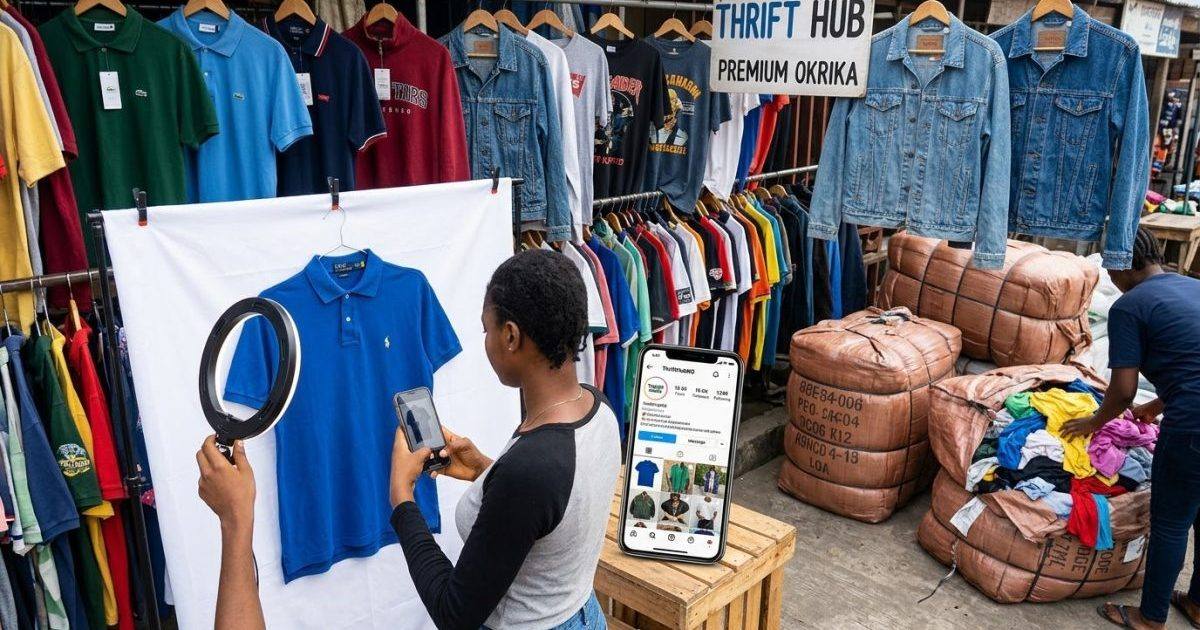
📌 Quick Summary: An okrika (thrift/second-hand clothing) business in Nigeria requires startup capital of ₦100,000 to ₦500,000 for initial bale purchases. Okrika bales (compressed bundles of second-hand clothing imported from the UK, USA, and Canada) sell at ₦80,000 to ₦300,000 per bale depending on category and grade, and contain 200 to 500 garments. Individual garments from a bale sell at ₦500 to ₦15,000 each depending on brand, condition, and category. A well-sorted, well-displayed okrika business generates ₦200,000 to ₦1,500,000 monthly gross revenue. Sales channels: market stalls, Instagram, WhatsApp, and Jiji.ng. This guide covers bale sourcing, grading, pricing, display, Instagram selling strategy, and the specific okrika niches that generate the highest margins.
The okrika business — selling second-hand clothing imported from Western countries — is one of Nigeria’s most established and culturally embedded trading businesses. The name “okrika” comes from Okrika, a town in Rivers State that was historically a major landing point for imported second-hand goods arriving by sea. The business has evolved significantly: from purely informal market-based trading to a sophisticated resale ecosystem that includes Instagram boutiques selling curated vintage designer pieces at prices that rival new retail, and WhatsApp-based sellers who build loyal customer communities of thousands of followers. In 2026, okrika sits at an interesting intersection — it has always been a practical, affordable clothing option for budget-conscious Nigerians, but it has also been elevated by the global vintage clothing trend, the growth of Nigerian fashion consciousness on social media, and a growing awareness among Nigerian consumers of sustainability in fashion. The okrika business today spans the street-market trader selling ₦500 trousers in Mile 12 and the Instagram vintage curator selling a Ralph Lauren polo for ₦8,000 to someone in Ikoyi — and both ends of this spectrum represent viable, profitable business models.
How the Okrika Supply Chain Works
Second-hand clothing arrives in Nigeria as compressed bales imported primarily from the United Kingdom, United States, Canada, and South Korea. The supply chain: charities and clothing collection companies in these countries collect donated garments, sort and grade them (some go to domestic charity shops, lower-quality garments are baled for export), and sell the bales to export companies who compress them into standardised bale sizes and ship to importing countries. Nigerian importers receive the bales at Lagos ports (Apapa and Tin Can Island), pay customs duties, and distribute to wholesale markets (Katangua Market in Lagos is the primary Nigerian okrika wholesale market — the largest second-hand clothing market in West Africa). Retailers then buy bales at Katangua or from wholesale distributors, sort the contents, price individual items, and sell to end consumers. The bale is the basic purchasing unit — you buy a compressed bundle and do not know exactly what is inside until you open it (this uncertainty is part of both the risk and the excitement of the business). Bale grades and categories determine what type of clothing you receive and the expected quality distribution within the bale.
Bale Types, Grades and Prices
| Bale Category | Contents | Price Range (2026) | Typical Margin |
| Grade A (Cream / First Grade) | High-quality, mostly branded (Ralph Lauren, Tommy Hilfiger, Zara, M&S), minimal wear, many with tags. The premium category. | ₦200,000 – ₦400,000+ | 300 to 600% on premium pieces |
| Grade B (Standard) | Mixed brands and quality — the most common category. Most pieces are good condition; some are well-worn. The workhorse of most okrika businesses. | ₦80,000 – ₦180,000 | 150 to 300% |
| Grade C (Value / Mixed) | Lower average quality — more worn pieces, fewer brands. Best for high-volume, low-price market stall selling. | ₦40,000 – ₦80,000 | 100 to 200% |
| Children’s clothing bales | Children’s wear — very high demand in Nigeria’s family market | ₦60,000 – ₦150,000 | 200 to 400% |
| Shoes bales | Second-hand shoes — mixed brands and conditions | ₦100,000 – ₦250,000 | 100 to 300% |
| Bags and accessories | Second-hand bags, belts, accessories | ₦80,000 – ₦200,000 | 200 to 500% |
Where to Source Bales in Nigeria
Katangua Market (Lagos): Nigeria’s largest and most established okrika wholesale market, located in Badagry Express area of Lagos. The primary sourcing point for most Lagos-based okrika retailers. Hundreds of bale distributors sell across all categories and grades. Visit early in the week (Monday to Wednesday) for the freshest stock. Owode-Ede Market (Osun State): a major okrika wholesale market in southwestern Nigeria, particularly strong for children’s clothing and women’s wear. Ladipo Market and Trade Fair Centre (Lagos): additional wholesale markets with okrika distributors. Direct from importers: as your business grows, buying directly from importers at port-stage prices reduces cost versus buying at Katangua — but requires more capital (minimum bale purchases of 5 to 10 bales), transport logistics, and the customs expertise that established importers already have. Online sourcing: several WhatsApp groups and Telegram channels connect okrika retailers directly with importers and Katangua-based distributors for remote bale purchasing and delivery.
Sorting and Pricing: The Skill That Determines Profitability
The margin in okrika is made in the sorting and pricing, not in the buying. When a bale is opened, the contents must be sorted by category, gender, size, brand, and condition. Branded items (Nike, Adidas, Ralph Lauren, Gucci, Louis Vuitton — yes, authentic designer pieces appear in okrika bales) must be separated from non-branded items and priced individually according to their desirability. The sorting skill: identifying what Nigerian customers will pay premium prices for — brand names they recognise, Western fashion trends that have filtered to Nigeria through Instagram, pieces in excellent condition that look essentially new, and unusual or distinctive items that stand out from standard high-street fare. Pricing strategy for maximum revenue: branded/designer pieces at maximum market value (₦5,000 to ₦25,000 or more for recognisable luxury items), good condition non-branded pieces at ₦1,000 to ₦3,000, worn but wearable pieces at ₦500 to ₦1,000. The fastest way to lose money in okrika is to price everything equally — a flat ₦1,000 per piece price wastes the premium on the Ralph Lauren polo that would sell for ₦7,000 and prices the worn basic t-shirts too high.
Instagram Okrika: The Highest-Margin Channel
Instagram has transformed the okrika business by creating a direct connection between sellers and fashion-conscious Nigerian buyers who are willing to pay significantly more for curated, well-photographed, authentically branded second-hand pieces than they would pay at a market stall. The Instagram okrika model: source Grade A bales with a concentration of designer and branded pieces, photograph each piece with a ring light against a clean background (hangers or flat lay), post with the brand name, size, condition description, and price, and build a following of Nigerian fashion buyers who trust your curation and pricing. Successful Nigerian okrika Instagram accounts have 5,000 to 100,000+ followers and generate ₦300,000 to ₦2,000,000 monthly from DM-based sales. The keys to Instagram okrika success: consistent posting (3 to 5 items per day keeps the account active and the algorithm showing it to new followers), clear photography (ring light, plain background, both front and back of each garment), honest condition descriptions (overselling condition destroys buyer trust and generates returns), and fast response to DMs (buyers who are not responded to within 30 minutes often buy from someone else).
Frequently Asked Questions
How much does it cost to start an okrika business in Nigeria?
₦100,000 to ₦300,000 for a first bale purchase (1 to 2 Grade B bales) plus display equipment (hangers, a rack or table) if selling from a stall. An Instagram-only okrika business (no physical stall) can start with ₦80,000 to ₦150,000 for a single bale, a ring light (₦8,000 to ₦20,000), and a smartphone camera.
Where is the best place to sell okrika in Nigeria?
Market stalls in high-foot-traffic locations (Tejuosho, Yaba, Oshodi in Lagos; Wuse Market in Abuja; Onitsha Main Market) for high-volume sales at lower per-item margins. Instagram for premium branded pieces at high margins but lower volume. WhatsApp for a loyal repeat-buyer community. Jiji.ng for individual high-value pieces (designer items) where a full description and photos can justify premium pricing to buyers searching specifically for them.
Is okrika business still profitable in Nigeria in 2026?
Yes — consistently. The combination of high demand (Nigerians are price-conscious and fashion-conscious simultaneously — okrika satisfies both), reliable supply (international donation flows are consistent), and the social media channel that has created a new premium market segment for curated vintage pieces makes okrika one of Nigeria’s most resilient trading businesses. The market is competitive at the low-price, high-volume end; the Instagram-based curated vintage segment remains less crowded and more profitable per unit sold.
The Okrika Niche Opportunity: Vintage and Designer Resale
Within the broader okrika market, a specific niche has emerged that commands dramatically higher margins and attracts a different, more affluent customer segment: curated vintage and designer resale. The Nigerian consumer who shops this niche is typically urban, social-media-active, fashion-conscious, and willing to pay ₦8,000 for an authentic Ralph Lauren polo, ₦15,000 for a genuine Coach bag, or ₦25,000 for a Burberry scarf — because they understand the original retail value and recognise that okrika is the most accessible way to own quality items at realistic prices. The vintage niche specifically — clothing from the 1980s and 1990s in distinctive silhouettes, bold patterns, or collectible brand heritage — has developed its own community of Nigerian buyers who follow specific Instagram accounts dedicated to vintage pieces and will pay premiums for the right item. Succeeding in this niche requires different sourcing than standard okrika. Grade A bales with the highest concentration of branded pieces. An eye for what the vintage-conscious Nigerian buyer wants — not just brand names but specific eras, specific items (vintage Levi 501s, original Champion sweatshirts, 90s Tommy Hilfiger), specific conditions (the charm of vintage is partly in the wear, but not the damage). The ability to photograph and describe each piece in a way that communicates its value story. The patience to price accurately and hold items at their correct price rather than reducing everything quickly for fast turnover. This niche is more work per item than standard okrika resale — but the margins and the customer quality justify that investment for the entrepreneur who enjoys fashion and wants to build a premium brand rather than a high-volume market operation.
Okrika Trends in Nigeria 2026: Sustainability and the Japa Generation
Two converging trends are reshaping the Nigerian okrika market in 2026 in ways that create new opportunities. The sustainability movement — the growing global and Nigerian awareness that fast fashion is environmentally destructive, and that buying second-hand is both more responsible and increasingly fashionable — has begun to reach Nigeria’s urban middle class. Nigerian Instagram creators and fashion influencers who showcase sustainable fashion choices are normalising okrika shopping for consumers who previously viewed it as a budget necessity rather than a lifestyle choice. This repositioning from “necessity” to “choice” significantly expands the potential customer base and supports premium pricing for well-curated, authentically sustainable product. The japa generation — the large cohort of Nigerians who have emigrated to the UK, USA, Canada, and Europe in the past five years, and their networks in Nigeria who consume UK/US fashion media — has created a culturally interesting feedback loop in the okrika market. These Nigerians are the same demographic that donated much of the clothing now arriving in okrika bales, and they are also heavy consumers of Nigerian Instagram okrika accounts, buying pieces and having them shipped back to Nigeria for family or as an investment in familiar items at lower prices. Understanding these trends helps an okrika business position itself correctly for where the market is going: toward curation, authenticity, and the story behind each piece, rather than toward pure volume and price competition.
Record-Keeping: The Discipline That Separates Profitable Okrika Businesses
Most Nigerian okrika traders operate without systematic record-keeping — they buy a bale, sell pieces, and estimate profit from the cash left over. This approach makes it impossible to know which bale categories produce the best margins, which price points sell fastest, what the real cost per unsold piece is, or how seasonal demand affects their business. The okrika sellers who consistently scale their businesses and build genuine financial stability are those who track every bale purchase (date, category, grade, cost), every piece sold (description, price received), and every unsold piece remaining as inventory. From these records, clear insights emerge: Grade A bales produce higher per-piece revenue but slower turnover; Grade B bales produce faster turnover with slightly lower per-piece margin; children’s clothing moves fastest in September before the school year. These patterns inform better buying decisions, smarter pricing, and more accurate cash flow management. A simple spreadsheet on Google Sheets, updated daily, capturing bale purchases and daily sales totals, transforms an informal trading operation into a trackable business. The okrika entrepreneur who builds this discipline early — before the business is large enough that informal tracking obviously fails — is building the foundation for sustainable growth rather than the feast-and-famine cycle that characterises most informal Nigerian trading operations without financial discipline.
Sources
- Original business guide — NaijaSabi Business Desk, October 2026
Last updated: 1 October 2026 · NaijaSabi Business Desk.


0 Comments
No comments yet. Be the first to share your thoughts!